What's the difference?
Ah, yes, the Lexus GS. Toyota's luxury off-shoot had high hopes for the new big boy when I first saw it a few years ago. Not thousands-of-sales high hopes, but the company thought a rear-wheel drive luxury sedan stacked with gear you didn't even know you wanted would be a dead-set winner.
And to be fair, they were right. I ran a GS as a long-termer and it was impeccably-mannered. In hybrid form. It wasn't sparkling, but my goodness, it used barely any fuel; especially impressive given its size.
As the sun is surely setting on the GS, it's time to have a look and see if it's a match for the BMW 5 Series or the Mercedes E.
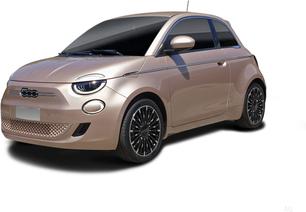
You wouldn’t know it to look at it, but this is a brand-new — as in really and truly all-new — Fiat 500.
That has got to be a big deal for fans of Fiat’s pint-sized city car, with a genuinely all-new 500 about rare as spotting Halley’s Comet soaring over Turin. The last time was way back in 2007, by the way, and that car will remain on sale alongside this new one for the foreseeable.
But that’s not the only surprise. This 500 is also entirely electric, properly modern inside, and it has actual technology in its cabin and on its safety list.
Fiat reckons this is a big reset for the 500. And that there will never be another all-new petrol model again.
So, how does this new 500e stack up against the recent flood of small EVs, predominantly from China?
Let’s go find out.
Weirdly, given all the good things I've had to say about the GS F Sport, it doesn't quite hang together. It's missing that certain something the Europeans have in their chassis, particularly the BMW 5 Series, and with ageing interior tech, it's struggling to keep up.
It's a car built for specific tastes, and they're more California than Straya. And that's perfectly okay, but unfortunately, that doesn't translate to a stampede of buyers. Having said that, none of its German rivals (or its beleaguered Japanese counterpart, Infiniti) could claim wild sales success either.
The GS is a terrific car, underrated but also just not quite there for my taste. The GS F, though, that's another thing altogether.
A fun, funky EV which will no doubt appeal to lovers of Italian style, but also one which struggles a little on the range and price front.
Still, there’s no doubt that electrification has improved the Fiat 500 formula.
The GS is ageing well, but it's still a bit heavy-handed around the headlights and a little on the slabby side along the flanks. It doesn't look poised for action, even with the F Sport additions, but nor does it look frumpy, mostly due to the whopping blacked-out spindle grille, a Lexus signature.
The rear end is good looking but a bit bluff, again neither surprising or delighting.
Little has changed inside, but it's still a very nice cabin, and always will be apart from a couple of clangers (the gear shifter looks super-cheap).
What's more, it's welcoming, lots of very nice materials, comfortable, seats - it's exactly what it needs to be. Whatever you might think of the looks, one thing is absolutely certain - if anyone builds cars better than Lexus, it's a very, very short list.
It looks, well, it looks like a Fiat 500.
It’s actually bigger in every dimension than an ICE cinquecento, but it doesn’t really look like it, which is a good thing.
The 17-inch wheels look great, and big against the very small Fiat, and I like the hidden doorhandles, which make the already smooth-looking 500’s flanks look a little smoother still. But I can take or leave the little DRLs up front that are meant to act as little illuminated eyebrows for the headlights, which come over a bit too cutesy.
But I think the highest compliment I can pay it is that it looks like a regular Fiat 500 — one of the most successful reincarnations of a timeless design ever — and not some modern, eco-friendly version that would have killed the look.
In the cabin, however, it’s definitely a more modern affair, with the big screen, the horizontal push-button gear selector, and the nifty push-button door openers.
Still, it’s all pretty familiar Fiat 500, only a little nicer, even if some of the plastics are far too hard and scratchy for a vehicle this expensive.
There are five colours available: Ice white, Onyx black, Rose gold, Ocean green and Celestial blue.
Being a big car, there's plenty of room inside. Four passengers will be very comfortable although rear legroom was a bit on the skinny side given the car's size.
The cabin contains a good-sized console bin, four cupholders and each door pocket into which you could conceivably slot a bottle.
The 520-litre boot is a useful shape, with a sensible load height and a space-saver spare under the floor. The 5 Series and E Class both best the Lexus by 10 litres, so the GS isn't far off the norm.
The 500e is 29mm taller, 61mm longer and 56mm wider than the current ICE Fiat 500 (now 1529mm, 3631mm and 1683mm respectively), and it rides on a longer wheelbase, too .
That means more front-seat room and head room, but there’s still not oodles of space in the four-seat cabin, and especially in the back, where things are pretty tight.
I’m 175cm tall, and my head touches the ceiling in the back, and if I had another full-size human in the back with me, I’d want it to be someone I know well, because we’d be well and truly aquatinted by the time we got to our destination.
The front seats are more accomodating, but there is a strange tightness to the pedal area for the driver. It’s so tight, in fact, that when you rest your left foot, you have to be careful not to accidentally clip the brake pedal when driving.
The boot is a small 185 litres, too. But you’re not buying this for practicality perks, are you?
We had the pleasure of the GS 350 F Sport for the week, which is well over $10,000 cheaper than the Luxury and is therefore the 'default. If you're not sure what F Sport means, it's Lexus' answer to an M Sport or AMG pack, without all the high-powered engine shenanigans to go with it. If that's what you're after, the V8-powered Lexus GS F is definitely for you.
Starting at $95,300, the F Sport has a spectacular standard features list - 17-speaker stereo, 19-inch alloys, variable-geared four-wheel steer (!), adaptive suspension, dual-zone climate control (with moisturising function), hectares of leather trim, head-up display, electrically-operated heated and ventilated front seats, rear sunshade, F Sport instrument screen, auto LED headlights, keyless entry and start, sat nav, front and rear parking sensors with around-view cameras and a space-saver spare.
The media system is run from Lexus' 12.3-inch screen embedded in the dashboard and controlled from an infuriating console-mounted mouse-clicker with a couple of shortcut buttons. It really is spectacularly irritating and made worse by the rotary dial stationed next to it that acts as the drive mode selector. Why not use that instead?
As ever, the system is mildly baffling to use and hard to look at, but the sound is absolutely lovely from the Mark Levinson-branded speakers. Lexus is persisting with a DVD player but it also has DAB+.
The 500e is not cheap by modern small EV standards — we’re looking at you, China — but it does arrive in one well-equipped trim level, called La Prima, with paint the only available option.
It's also, quite shockingly for anyone who has driven an ICE Fiat 500 lately, stacked with some truly high-tech kit.
There’s heated seats for the first time ever, for example, and there’s 10.25-inch central screen with Apple CarPlay and Android Auto, and wireless charging.
There’s a digital driver display, too, plus there’s faux-leather on the seats and dash, a panoramic glass sunroof and fancy push-button front doors (though with a mechanical back-up lever hidden in the door pockets should something go pear shaped).
Outside, you’ll find 17-inch alloys, as well as LED lightning all around, including the DRLs, and there’s keyless entry and push-button start, too.
But, and it’s a significant but, the 500e lists at $52,500 before on-roads , which — when you consider its size, battery and range — really edges it into the premium EV space.
A similar-sized EV from China can be had for under $40k, which means you are going to have to really love the 500e to drop that extra $15k or so.
Lexus fits a 3.5-litre (2GR-FKS) naturally-aspirated V6, delivering 232kW/380Nm to help shift the 1745kg GS. Power goes to the rear wheels via an eight-speed automatic. Lexus claims the sprint from 0-100km/h is completed in just six seconds.
A single front-mounted electric motor delivers the power here, with 87kW and 220Nm on offer. Enough, Fiat says, to knock off 100km/h in 9.0 seconds. But it does feel quicker than that in real life, thanks to the way electric vehicles deliver their power.
There’s the usual EV single-speed gearbox, too, with power sent to the front wheels.
A real world 13.7L/100km is a solid miss of the claimed 9.3L/100km, which itself is hardly earth-shattering. It's a big heavy car and that's the penalty. It drinks fuel fast, so the 66-litre fuel tank does drain quickly and it's worth knowing you have to fill it with the 95 RON or better.
The Fiat 500e’s 42kWh battery provides a smallish 311km driving range on paper, but when we got in it was more like 290km at 96per cent charged. A city car, then, rather than a long-distance hauler.
When it does come time to charge, you’re set up for 85kW DC fast charging which should take you from zero to 80 percent in 35 minutes.
There are things you expect in a Lexus. Quietness. Composure. Smoothness. The GS delivers all three of those things effortlessly. But it has a few extra things in its bag that I can't say I was expecting.
For a start, the 3.5-litre V6 moves the car without any carry-on and in doing so, I was constantly amazed at how quickly the speed in the head-up display reached the posted limit. It just doesn't feel or sound like a six second car, but there you are. The transmission is virtually faultless, the engine sound distant and refined, the power impressive.
It's a heavy car, no question, but two things work to make it feel much lighter. First - and it doesn't matter which mode you choose - the adaptive suspension somehow knocks about 200kg out of how heavy the car feels. The brakes, while a little soft on pedal feel when you first step on them, are very effective and again help to make the car feel lighter than it is.
The four driving modes are quite distinct. As usual, Eco makes everything soft and doughy or as I prefer to say, unpleasant. Normal is great for every day, with just the right throttle response and steering weight.
Moving to sport ups the aggro slightly while Sport+, while never harsh, firms everything up to the point where it starts to feel like a different car. Sport+ makes the car feel race-car pointy, the suspension holds the body in check and the power seems readily available without jerky progression
The all-wheel steer is a big part of the change in feel. It's is especially sharp in Sport+ mode. The steering's gearing changes up quite a bit, meaning a lot less steering lock required for your favourite hairpin bend. Of course, at real speed it all calms down because neither you nor Lexus are fond of sneezy lane-changes or Armco-swiping. At first I thought it just made the big car feel a bit too nervous but as I got used to it (and was able to dial it down by switching back into a less racy mode) I found it fun but a little bit out of character with the car itself.
And just because it's the F Sport, that doesn't mean it can't do all the things you'd expect from a Lexus. You can still waft, you can still creep up on people and it's really very comfortable when you're cruising or stuck in traffic.
This is the probably the best-driving example of the Fiat 500 I’ve ever climbed into. Sure, it’s not quite as engaging as self-shifting a perky little manual, but it’s smoother, easier and more comfortable, and a whole lot better than ICE vehicles fitted with Fiat's odd dual-logic automatic gearbox.
The EV transition genuinely suits the little Fiat, admittedly sapping a little character, but also thoroughly modernising the drive experience, with smooth, constant acceleration, sharp-enough steering and a ride that’s mostly settled, only really becoming crashy over the bigger road imperfections.
The small dimensions here also help the EV reincarnation. Yes, it’s heavier than you might expect, weighing in at 1290kg (tare), with the batteries adding several hundred kilograms to the equation, but the 500e still doesn’t feel overly heavy, with the little Fiat remaining pretty light on its feet.
There are three drive modes on board, including the catchy Sherpa mode (because it will help get you where you’re going), which, when you’re running low on battery, kills the climate control and anything else it needs to preserve range and get you home.
But you can’t shake the feeling that the 500e is a little expensive for such a specialist tool. It’s unashamedly a city car, but one that will cost you more than $50k, and which doesn’t feel quite premium enough in the cabin to justify that asking price.
The GS scores 10 airbags, ABS, stability and traction controls, blind spot monitoring, rear cross traffic alert, forward AEB, active cruise, auto high beams and lane departure warning with lane keep assist.
The GS doesn't have an ANCAP or Euro NCAP rating while the USA's IIHS (Insurance Institute for Highway Safety) rating is good for each key crash-worthiness measure. The IIHS suite of tests is quite rigorous but differ from our ANCAP/Euro NCAP standards.
There’s a heap of active safety stuff on board (again, unusual for a 500), with active cruise control, traffic sign recognition, front, rear and side parking sensors, blind-spot monitoring, AEB with pedestrian and cyclist detection, and more.
Still, the 500e only secured a four-star ANCAP safety rating, scoring just below the five-star cut off in Adult Occupant Protection, Child Occupant Protection and Safety Assist, with a lack of a centre airbag not helping.
There's one area where Lexus smashes the Germans and that's after-sales. While the warranty is hardly ground-breaking at four years/100,000km and service intervals are reasonable at 12 months/15,000km, it's how it all comes together.
For the duration of the warranty, when the car needs a service, Lexus will either come and get it then return it to you, or give you a loan car. Anecdotal evidence suggests this continues long after the warranty runs out. Like, 10 years after the warranty runs out.
This is a small thing, but if there's one thing I hate about car ownership, it's the servicing experience. If I was a betting man, I'd dare you to find someone who genuinely has a problem with Lexus after-sales care.
On top of that, you get a generous roadside assist package for four years.
The fly in Fiat’s ointment is its ownership proposition, with a three-year, 150,000km warranty now way below par in Australia these days, even if the battery is covered for the standard eight years.
Servicing is every 12 months or 15,000kms, and will cost $250 a pop for the first eight years, which is commendably cheap.