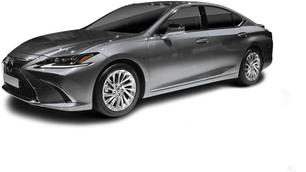
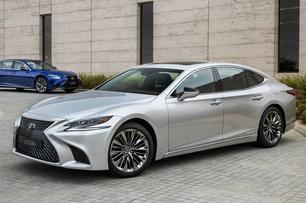
What's the difference?
What’s the closest thing we have to a modern-day Holden Statesman/Caprice?
If, like General Motors, you obliterate Australia’s Own from existence altogether, you’re left with time-honoured rivals also made in this country, like the Ford Fairlane, Chrysler by Chrysler and Toyota’s Crown and Avalon.
But they’re also all in history’s dustbin (well, the American ones, anyway), leaving the humble Camry as the sole living nameplate with any connection to Australian manufacturing.
And since the Lexus ES is a close relative, we’re going to take a fresh look at the latest version, with a view of it as a bit of a survivor of a bygone era – where aspirational vehicles were created from normal family sedans.
Just like the Fairlane, Crown and of course, the Caprice.
Launched in mid 2018 but facelifted in 2021, we test the ultimate version of the seventh-generation ES, the 300h Sports Luxury – or SL, if we’re to make yet another tenuous connection to long-gone Holdens.
Let’s go!
Lexus is returning to its roots and playing to traditional strengths with the 2021 LS update, as the Japanese luxury brand braces itself for the imminent release of an all-new Mercedes-Benz S-Class.
On sale now from $195,953 before on-road costs, the facelift ushers in a raft of comfort, refinement, driveability and technological upgrades, striving to deliver the quietest and most luxurious experience in the upper luxury sedan segment.
The blink-and-you'll-miss-it makeover runs to redesigned headlights, wheels, bumpers and tail-light lenses, as well as the inevitable multimedia screen update, improved seating revised trim and better safety.
Along with an all-in equipment list and unparalleled levels of ownership benefits, the goal is to emulate the dramatic differences that existed between the LS and its mostly German competition more than 30 years ago, which helped make Lexus a disruptor, decades before the term was even coined.
The MY21 range will continue offering two grades – the racier F Sport and opulent Sports Luxury – in either V6 twin-turbo petrol LS 500 or V6 petrol-electric hybrid LS 500h powertrain choices, as per the XF50-generation's Australian debut back in late 2017.
The question is: has Lexus gone far enough with its limousine flagship?
There’s no denying the Sport Luxury is imposing, spacious, plush, chock-full of kit, efficient, speedy and pleasingly relaxing up to a point.
But its interior is also dated and true ride comfort can be elusive beyond smooth roads for this top-of-the-line version to make the grade as a proper luxury sedan. Â
The ES 300h feels more like an aspirational Toyota than a Lexus for the (wealthier) masses, especially after recent triumphs like the latest NX and RX SUVs. The Camry DNA is difficult to disguise, as the amused strangers who sat in our test car uninvited thinking it was their Camry highlights.
Sure, the hybrid is no Chevy V8, but in many other ways, the Sport Luxury seems like the modern successor to the Holden Caprice experience.
One might be surprised to learn that, without having driven the latest S-Class, rival large luxury sedans have struggled to juggle comfort and refinement with agility and speed. Even in this modern age of adaptive dampers and air suspension. The Germans, in particular, seem to struggle at times.
The latest Lexus LS, however, walks the line with impressive confidence and poise, prioritising the former yet without dropping the ball with the latter. Just keep in mind that the 500h Sports Luxury manages the balance best.
The bar may just about be raised with the bestselling Stuttgart's arrival from March, but even then, with its extensive and complete specification, outstanding hybrid efficiency/performance combination and remarkable build quality and presentation, Japan's master luxury sedan deserves to find more buyers in this country.
Well done, Lexus.