What's the difference?
Looking for a small SUV that’s not tiny? The Kia Seltos could be that SUV, and it’s been updated for 2023.
This review covers the entire Seltos range and reviews this small SUV based on its safety, practicality, price and features, plus ownership costs, its fuel economy and what it’s like to drive.
So, if you’re thinking about a Honda HR-V, a Toyota Corolla Cross or something even as large as a Hyundai Tucson or Kia Sportage then you need to be thinking about a Kia Seltos, too.
Meet the MG QS, the latest SUV from the Chinese giant, and one that the brand promises is a “true” seven-seater – not a five-seater with two dinky little seats in the boot, but a full-size SUV that can carry seven adult-sized humans.
And that promise puts it on a collision course with family favourites like the Toyota Kluger or the Kia Sorento.
So, how does this big MG measure up?
Read on.
Kia’s updated Seltos is more expensive than the previous version but it's better as well.
The entry grade no longer has hubcaps and gets alloy wheels, all grades have directional air vents in the second row, the jerky dual-clutch auto is gone and an excellent regular eight-speed auto has arrived, plus there’s more safety tech and modern displays screens.
What hasn’t changed is the Seltos’s size. It’s a big, small SUV, that’s easy to park in tight spaces but roomy inside even for tall, awkward humans like me.
The sweet spot in the range is the Sport+ with the 1.6-litre engine, if only it had the LED headlights that only come on the GT-Line.
Note: CarsGuide attended this event as a guest of the manufacturer, with meals provided.
What it lacks in driving panache it does make up for in terms of space and equipments, and there really is room for seven decent-sized humans on board. Combine that with a decade of warranty coverage, and the MG QS will no doubt be appearing on family shortlists.
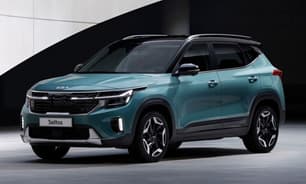
This updated Seltos has had a few styling tweaks, too. The grille is taller and there’s a new headlight design which on the GT-Line is stunning with its LED running lights.
The rear of the Seltos has been restyled as well, with a new tail-light design and again on the GT-Line there’s an LED strip which runs between them.
The Seltos is pretty big for a small SUV. At 4.4m long it’s bigger than a Hyundai Kona and a Honda HR-V and about the same size as a Nissan Qashqai and Corolla Cross.
What’s good about that is you’re getting more space inside with a package that’s still smallish on the outside.
If you think the Seltos’ look is familiar, then I agree. The Honda HR-V and Haval Jolion have very similar tail-light designs and the profile follows many of the same styling cues of the Toyota Corolla Cross.
To my eyes, though, I think the Seltos is the more refined looking of its peers with a more modern and interesting interior.
Speaking of which, keep in mind that the top-of-the-range GT-Line’s cabin is far more fancy than the interior of the entry grade S. The GT-line’s large double digital displays are impressive and the buttons around the shifter for seat heating and ventilation are replaced with blank plastic panels in the S.
Hard plastic armrests were another of my gripes about the previous entry grade Seltos, too.
Still all cabins have a premium look even if the feel isn’t luxurious throughout on all grades.
You’re not going to miss the MG on the road, are you? For one, it looks pretty big, and pretty athletic, plus it’s got that bold front-end and grille design that, if I’m honest, I can’t tell if I like, or if it’s over the top.
Elsewhere, though, it’s more traditional SUV styling, though there is some nice and gentle detailing in the body that makes it look less big, broad, and boring, and the slightly nose-forward design gives the QS something of an athletic stance.
Inside, it’s really quite nice. The twin screens look fantastic – and the subtle curve linking the two looks properly elegant – and there’s some lovely detailing in the through the dash panels, too, which also helps to break up the fact that there is simply a lot of dash here.
As always, I love the row of switches below the screen that act as shortcuts to the functions you need, when you need them, without having to rely on the screen all the time.
But I'd encourage you to have a good squeeze of all the materials used. Some look like stitched leather, but are actually harder plastics in disguise.
Some small SUVs are seriously small, which might be fine for some, but if you’re hoping to also have enough space for passengers in the back seats, and a boot which can carry plenty of luggage then the Seltos is a good choice.
Even at 191cm tall I had more than enough room to sit behind my driving position with good headroom back there, too.
Cabin storage is also good with door pockets front and rear, and a deep centre console box. As for cupholders there are two up front on all grades, while the Sport+ and GT-Line get two more in the second row fold-down armrest.
Boot capacity depends on if you’ve requested a full-sized spare wheel or the space-saver spare. With the space-saver you’ll have more room at 469 litres, while the full-sized wheel under the boot floor will leave you with 433 litres. That’s still decent for the class.
The new Seltos has directional air vents for back seat passengers which is a win (motoring journalists had been complaining about the lack of them for years) and there are also two USB ports (Type-C) for the second row along with another two for those in the front, plus a 12V outlet.
The MG QS is a smidge under five-metres long, just over 1.9m wide and just under 1.8.m high, which puts it right in the seven-seat SUV ballpark.
That pays dividends in the backseat. I’m 175cm tall, and I had heaps of room to spread out, and I don’t only have my own air vents, but I have my own temperature controls, too.
It’s a big and airy space, and I’d have no problem spending some serious time here on a longer road trip.
But the big question is, what do those dimensions mean for third-row riders, and does it live up to its promise of being a true seven-seater?
Well, yes and no. The fact that the middle row is on rails helps massively, because you can slide it forwards to maximise leg room for backseat riders, and the one-touch entry (which folds the middle row up and forwards) makes actually climbing back there pretty simple, too.
But... it's still a space in which I wouldn't want to spend too much time. Its big enough for shorter trips, but it's still best for the smaller kids in the family.
Now, as is often the case with three-row cars, how much boot space you get very much depends on how many people you have onboard. With all three rows in place, you get a miserly 203L, fold the third row and you get 517L, drop both rows and you get 1052L.
The price of the Kia Seltos has increased by about $2000 across the range, but you are getting more in the way of features. Let me take you through the model line-up.
There are four grades: the entry grade S, then the Sport, Sport+ and GT-Line. Those are all available with the 2.0-litre petrol engine and front-wheel drive.
The Sport+ and GT-Line can also be had with a more powerful engine which is a 1.6-litre turbo-petrol with all-wheel drive.
So, the list prices for the 2.0-litre engine start at $29,500 for the S, then step up to $32,700 for the Sport, $35,800 for the Sport+, and $41,500 for the GT-Line.
The 1.6-litre turbo engine is a more expensive proposition and in the Sport+ you’ll pay $39,300, and to pair it with the GT-Line grade you’ll need to hand over $44,900, before on-road costs.
Kia was also doing drive-away pricing at the launch of the new Seltos. So check with your dealership to ensure that the offer is still available.
Coming standard on the S grade for the first time are alloy wheels, they’re small at 16-inches but better than hubcaps, and there’s also roof rails.
Inside, there are cloth seats, an 8.0-inch media display, digital driver’s display, air-conditioning, wireless Apple CarPlay and wireless Android Auto.
The Sport grade adds 17-inch alloy wheels, auto headlights, a 10.25-inch media screen and matching 10.25-inch driver display, digital radio, sat nav, climate control, plus Apple CarPlay and Android Auto.
The Sport+ has all the Sport’s features but brings a proximity key with push-button start, privacy glass, power driver’s seat, synthetic leather upholstery and extra safety tech which we’ll get to soon.
The top-of-the-range GT-Line has all the Sport+ features but adds a power front passenger seat, heated and ventilated front seats, sunroof and a power tailgate.
The GT-Line also comes with the option of two-tone body paint - that is a black roof with 'Clear White' or 'Pluton Blue' body colours. Be advised that this combination is not available with the sun roof.
The value is good, but I don’t agree with Kia’s decision to keep the LED headlights for the GT-Line only and leaving all other grades stuck with dim Halogen headlights.
Being able to seem clearly on dark Australian country roads at night shouldn’t be a luxury. Toyota offers LED headlights across the Corolla Cross range from the entry grade up.
You get introductory national drive-away pricing for the two-grade MG QS range, with the Excite yours for $46,990, and the Essence we’re testing sets you back $50,990 on the road.
In typical MG fashion, neither model is wanting for much in the spec department, but our Essence gets the lot and the kitchen sink.
Outside, there are 21-inch alloys, LED lighting with fog lights, a powered tailgate and a powered sunroof. Inside, there are leather seats which are heated and ventilated up front, tri-zone climate control and ambient interior lighting.
Tech is handled by twin 12.3-inch screens with wireless Apple CarPlay and Android Auto. There’s wireless charging, too, and a 12-speaker Bose stereo.
The top-spec model also gets all-wheel drive, adaptive suspension and six drive modes — Normal, Snow, Off-Road, Sport, Custom and Eco.
There are five exterior colours available on the QS, including Oxford White, Black Pearl, Camden Grey, Regency Green and Cashmere Silver.
The Seltos range has two engines to choose from: a 2.0-litre four-cylinder petrol engine making 110kW/180Nm and a 1.6-litre turbo-petrol engine producing even more grunt at 146kW/265Nm.
The 2.0-litre engine comes with a CVT which is a type of automatic transmission and the 1.6-litre engine has an eight-speed auto.
CVT stands for Continuously Variable Transmission and some people (me included) find the droning they cause the engine to make to be annoying. They also come with a feeling of less acceleration.
The good news is the eight-speed auto that comes with the 1.6-litre is a great transmission with smooth shifts and a sporty nature that matches the punchy engine.
This eight-speed auto is welcome because it also replaces the jerky dual-clutch transmission that had been paired with the 1.6-litre engine in the previous Seltos.
All-wheel drive is only available with the 1.6-litre engine while front-wheel drive comes solely with the 2.0-litre.
So, if you’re after great acceleration and better traction then the 1.6-litre is the way to go. If you’re not after a sporty driving experience then the 2.0-litre engine will suit you, and it costs less.
Under this hood is a 2.0-litre turbocharged petrol four-cylinder engine, which produces 153kW and 360Nm. In this all-wheel-drive Essence, that power is channelled through a nine-speed automatic and sent to all four wheels.
I don’t have a zero to 100km/h time for this two-tonne-plus beast, but suffice it to say it won’t knock your hat off. I’m guesstimating just under 10 seconds.
The smaller engine actually uses more fuel, but not a great deal more. Kia says the 1.6-litre engine with all-wheel drive uses 7.4L/100km after a combination of open and urban roads. The 2.0-litre engine according to Kia will use half a litre less at 6.9L/100km.
Both engines only need 'standard' 91 RON petrol, too - that’s the cheap one.
Where is the hybrid variant? Good question. The answer is, there isn’t one. And neither is one coming, I’ve asked. That’s disappointing considering the Corolla Cross comes with a hybrid version of each grade in its line-up.
It’s for this reason the Seltos range scores a lower mark for fuel efficiency.
Now MG reckons you will see 8.8L/100km on the combined cycle, which would give you a theoretical driving range of around 738km from its 65-litre fuel tank. For the record, we saw more like 11 litres.
That tank, by the way, demands 95RON fuel, so you won’t be troubling the cheapest pump at your local service station.
The Kia Seltos has two personalities. The laid back Seltos with a 2.0-litre engine and the enthusiastic sporty Seltos with the 1.6-litre engine.
Regardless of which Seltos you pick, the ride is comfortable, the handling is good, and the steering is excellent.
Kia says it's worked to make the Seltos’s cabin more insulated from road noise, but having driven it on country roads for hours I think it could do with more sound dampening.
If you’re considering the Sport+ grade and are not sure if the $3500 premium for the 1.6-litre engine is worth it, my answer would be absolutely, if you can afford it.
That 1.6-litre turbo petrol is a great engine and the new eight-speed transmission is excellent. Even as a daily driver I think anybody would enjoy driving this version of the Seltos more, and for those who like sporty driving then it’s definitely the powerplant for you.
It all comes down to what you're looking for in your large SUV. Is it a vehicle that – against all odds – manages to somehow stir your emotions from behind the wheel, whether you're flying solo or you're riding with seven on board? Well, the MG QS won't do that.
But if you're looking for something big, comfortable, nicely trimmed and with just about every feature you can think of, then the MG QS ticks those boxes and then some.
But let's start with the not so good. The steering in the MG QS is super, super light, leaving it feeling largely disconnected from what's happening beneath the tyres, and giving the drive experience a weird and artificial vibe.
Now, it must be said that some drivers like that. A big car with light steering makes manoeuvrability easy in car parks and the like. But I don't. It makes me feel uninvolved in the drive experience.
The QS is equipped with Sport mode that does add heft to the steering, but which also appears to make the gearbox way to eager to shift down and hold a lower gear, adding a harshness to the drive.
It's also not a big engine, and this is a big car, and so there's a bit of delay when you first plant your foot as the engine figures out its next move, and you're always aware of the engine working fairly hard to get the QS moving along – though MG has done a good job of deadening much of that sound before it enters the cabin.
But if that's the not-so-good, there are still plenty of ticks in the MG's plus column. It's a largely smooth-riding, sweet-shifting proposition, the QS, and the space in all three rows is impressive, especially when the sliding second row is utilised to maximise the space where you need it.
The Seltos has the maximum five-star ANCAP safety rating but that’s from 2019. Still, the advanced safety tech is excellent. All grades come with AEB, blind spot warning, lane keeping assistance and rear cross-traffic alert.
All grades also come with the rear occupant alert, which is great for sleep-deprived parents, and there’s also the safe exit feature which will let you and the kids know if a car or cyclist is approaching before you open the door and ruin everybody’s day.
The Sport+ and GT-Line both come with AEB that works at intersections.
It’s good to see front and rear parking sensors standard across the range.
The MG QS hasn’t yet been crash-tested by ANCAP, but all the expected safety kit is on board, including seven airbags, AEB, rear cross-traffic alert, adaptive cruise control, blind-spot monitoring, lane-keep assist and lane departure warning.
But be warned, it can bing and bong and random intervals. If it thinks you’re speeding, or that you’re not paying attention, and it is very, very annoying. Learn how to switch off the speed limit recognition and driver attention alert, and fast.
The Seltos is covered by Kia’s seven-year, unlimited-kilometre warranty.
Servicing differs between the two engines.
A Seltos with a 1.6-litre engine needs to be serviced every 12 months or 10,000km and over seven years the average service cost comes to $497 per year.
A Seltos with the 2.0-litre engine needs to be serviced every 12 months or 15,000km and over seven years the average service costs comes to $434 per year.
Capped price servicing is good, but the prices can get higher than $600 for some visits.
It’s a tale of goods and bads in the QS ownership world. The good is a near market-leading 10-year/250,000km warranty (so long as you regularly visit an authorised service centre), and solid service intervals of 12 months or 15,000km, whichever comes first.
The bad is eye-watering service costs – including a whopping $2920 dollar service at the six-year/90,000km mark.
All up, seven years/105,00km of servicing will cost you $6336 in the 2WD, or $6962 in our AWD – the latter averaging out at close to $1000 per year.