What's the difference?
It's rare to see a Kia Rondo on the road. Spotting one is like when you get a commemorative 50-cent coin in your change, only not as exciting. Yup of the 219,270 cars sold so far this year 59 of them were Rondos. But the more I've driven the base-spec Rondo S - the more I think 219,211 people may have missed out on something quite good.
So what is a Rondo? Is it a van? Is it a hatch? Is it a wagon? Well, Kia calls it a people mover, but while the top-spec Rondo Si has seven seats, the five-seater Rondo S which arrived late in 2016 only has seating for five. Is that enough people to count as a people mover?
As for rivals to the Rondo S, well there's the Citroen C4 Picasso, the Mercedes-Benz B-Class and the BMW 2 Series… aaaaaaand that's about it.
So what is it about the Rondo S that makes me think that many of the 220,000 people may have the wrong choice and bought a SUV when what they really needed was a Rondo, but just never knew it? Oh and what is it about the Rondo that dogs really like? And what's bigger about the five-seater Rondo S than the seven-seater Rondo Si?
Looking for a small SUV that’s not tiny? The Kia Seltos could be that SUV, and it’s been updated for 2023.
This review covers the entire Seltos range and reviews this small SUV based on its safety, practicality, price and features, plus ownership costs, its fuel economy and what it’s like to drive.
So, if you’re thinking about a Honda HR-V, a Toyota Corolla Cross or something even as large as a Hyundai Tucson or Kia Sportage then you need to be thinking about a Kia Seltos, too.
If you're thinking of getting an SUV because you like to sit a little higher up and want a car with plenty of room and a big boot, but don't head off-road ever, then you may be better off in a Rondo S which drives more like a car and has much of the benefits of an SUV.
Kia’s updated Seltos is more expensive than the previous version but it's better as well.
The entry grade no longer has hubcaps and gets alloy wheels, all grades have directional air vents in the second row, the jerky dual-clutch auto is gone and an excellent regular eight-speed auto has arrived, plus there’s more safety tech and modern displays screens.
What hasn’t changed is the Seltos’s size. It’s a big, small SUV, that’s easy to park in tight spaces but roomy inside even for tall, awkward humans like me.
The sweet spot in the range is the Sport+ with the 1.6-litre engine, if only it had the LED headlights that only come on the GT-Line.
Note: CarsGuide attended this event as a guest of the manufacturer, with meals provided.
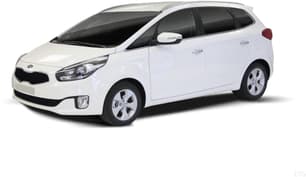
The Rondo has a mini-people mover shape with a horizontal and high roof, an upright back and a heavily raked windscreen and pointy nose. The headlights look too big for its face but that's kind of cute in a manga-cartoon way.
Take a look at the dimensions for the Rondo S - it's bigger than you might think. At 4525mm end to end it's 45mm longer than a Kia Sportage mid-sized SUV, and 35mm shorter in height at 1610mm tall. It's 35mm narrower than the Sportage, too, at 1805mm across.
Clearance is about the same as a regular car at 151mm but the driving position is higher – though not as high as the Sportage's.
Inside the dashboard and steering wheel are low, the windscreen is enormous and those A-pillars either side of it are long.
On the outside you can tell a Rondo S from the top spec Rondo Si by the wheels – the S has plastic hubcaps and the Si has alloys. You can spot a Rondo S from the inside by the tiny media screen and the chunky plastic steering wheel – the Si gets a bigger screen and sleeker looking wheel.
The cabin is stylish with the brushed aluminium look trim and dark materials. The CarsGuide photographer told me he liked its '80s retro look – thing is I'm pretty sure the designers weren't trying to go for an ironic retro feel.
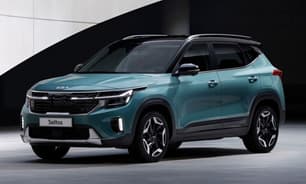
This updated Seltos has had a few styling tweaks, too. The grille is taller and there’s a new headlight design which on the GT-Line is stunning with its LED running lights.
The rear of the Seltos has been restyled as well, with a new tail-light design and again on the GT-Line there’s an LED strip which runs between them.
The Seltos is pretty big for a small SUV. At 4.4m long it’s bigger than a Hyundai Kona and a Honda HR-V and about the same size as a Nissan Qashqai and Corolla Cross.
What’s good about that is you’re getting more space inside with a package that’s still smallish on the outside.
If you think the Seltos’ look is familiar, then I agree. The Honda HR-V and Haval Jolion have very similar tail-light designs and the profile follows many of the same styling cues of the Toyota Corolla Cross.
To my eyes, though, I think the Seltos is the more refined looking of its peers with a more modern and interesting interior.
Speaking of which, keep in mind that the top-of-the-range GT-Line’s cabin is far more fancy than the interior of the entry grade S. The GT-line’s large double digital displays are impressive and the buttons around the shifter for seat heating and ventilation are replaced with blank plastic panels in the S.
Hard plastic armrests were another of my gripes about the previous entry grade Seltos, too.
Still all cabins have a premium look even if the feel isn’t luxurious throughout on all grades.
The Rondo has enormous rear doors that are light and easy to swing open and when they do you have a wide and tall entrance which makes getting in and out easy. That's good news if you're not as agile or young as you used to be or if you're a parent putting kids into car seats. I find I almost double over when putting my toddler into his car seat in small cars, but the Rondo's seat height is elevated enough that there's less of a bend needed. The step to get in is low, too.
The second row is made up for three individual seats rather than a single bench seat. The legroom in all of them is excellent and even at 191cm tall I can sit behind my driving position with two finger-gap between my knees and the seatback.
Headroom is outstanding and even with my big hair I still have about 20cm of clearance.
The Rondo was already so impressively practical and roomy that it could have been terrible to drive and it still would be worth buying.
The cargo volume of the Rondo S is 536 litres, and that's 44 litres more than the boot space in the seven-seater Rondo Si which loses luggage capacity because of the foldable third row seats and 130 litres more than the Sportage's boot.
Under the boot floor is like a giant bento box of storage compartments with three equal-sized large rectangular areas big enough for handbags, shoes and laptops, a smaller shoe boxed-sized area and a tiny hidey hole big enough for my phone. Also in the boot on the right-hand side wheel are elasticised straps for – picnic blankets or whatever else you don't want flapping about in there.
There's shoe-boxed sized storage under the floor in the second row, on both sides, too.
The centre seat in the back folds flat and being hard-backed can act as a table, it also has three cup holders moulded into it. There's another two cup holders up front and giant bottle holders in all doors.
The Rondo is just as practical as many SUVs if not more so.
And here's a random Rondo fact for you – the Rondo is pretty popular with dog owners because the height of the roof means their hounds can stand up and turn around. Yup dogs love the Rondo.
Some small SUVs are seriously small, which might be fine for some, but if you’re hoping to also have enough space for passengers in the back seats, and a boot which can carry plenty of luggage then the Seltos is a good choice.
Even at 191cm tall I had more than enough room to sit behind my driving position with good headroom back there, too.
Cabin storage is also good with door pockets front and rear, and a deep centre console box. As for cupholders there are two up front on all grades, while the Sport+ and GT-Line get two more in the second row fold-down armrest.
Boot capacity depends on if you’ve requested a full-sized spare wheel or the space-saver spare. With the space-saver you’ll have more room at 469 litres, while the full-sized wheel under the boot floor will leave you with 433 litres. That’s still decent for the class.
The new Seltos has directional air vents for back seat passengers which is a win (motoring journalists had been complaining about the lack of them for years) and there are also two USB ports (Type-C) for the second row along with another two for those in the front, plus a 12V outlet.
The Rondo S lists for $26,990. The $40,990 Citroen C4 Picasso is the closest in price to the Rondo S, while the Mercedes-Benz B180 is $42,400 and BMW 2 Series Active Tourer starts at $49,100.
It has to be said, the Rondo S isn't a prestigious as those rivals and the standard features aren't as extravagant. Still the basics are covered with a 4.3-inch touch screen with reversing camera, rear parking sensors, six-speaker stereo, Bluetooth connectivity, CD player, cloth seats, auto headlights, tinted glass, cruise control, and air conditioning with vents in the second row.
That screen is pretty small – like business card small, and that means the image for the reversing camera is a bit hard to make out at times.
The Rondo S is still good value though at this price.
The price of the Kia Seltos has increased by about $2000 across the range, but you are getting more in the way of features. Let me take you through the model line-up.
There are four grades: the entry grade S, then the Sport, Sport+ and GT-Line. Those are all available with the 2.0-litre petrol engine and front-wheel drive.
The Sport+ and GT-Line can also be had with a more powerful engine which is a 1.6-litre turbo-petrol with all-wheel drive.
So, the list prices for the 2.0-litre engine start at $29,500 for the S, then step up to $32,700 for the Sport, $35,800 for the Sport+, and $41,500 for the GT-Line.
The 1.6-litre turbo engine is a more expensive proposition and in the Sport+ you’ll pay $39,300, and to pair it with the GT-Line grade you’ll need to hand over $44,900, before on-road costs.
Kia was also doing drive-away pricing at the launch of the new Seltos. So check with your dealership to ensure that the offer is still available.
Coming standard on the S grade for the first time are alloy wheels, they’re small at 16-inches but better than hubcaps, and there’s also roof rails.
Inside, there are cloth seats, an 8.0-inch media display, digital driver’s display, air-conditioning, wireless Apple CarPlay and wireless Android Auto.
The Sport grade adds 17-inch alloy wheels, auto headlights, a 10.25-inch media screen and matching 10.25-inch driver display, digital radio, sat nav, climate control, plus Apple CarPlay and Android Auto.
The Sport+ has all the Sport’s features but brings a proximity key with push-button start, privacy glass, power driver’s seat, synthetic leather upholstery and extra safety tech which we’ll get to soon.
The top-of-the-range GT-Line has all the Sport+ features but adds a power front passenger seat, heated and ventilated front seats, sunroof and a power tailgate.
The GT-Line also comes with the option of two-tone body paint - that is a black roof with 'Clear White' or 'Pluton Blue' body colours. Be advised that this combination is not available with the sun roof.
The value is good, but I don’t agree with Kia’s decision to keep the LED headlights for the GT-Line only and leaving all other grades stuck with dim Halogen headlights.
Being able to seem clearly on dark Australian country roads at night shouldn’t be a luxury. Toyota offers LED headlights across the Corolla Cross range from the entry grade up.
There's one engine in in the Rondo range – it's a 122kW/213Nm 2.0-litre four-cylinder petrol and it comes with a six-speed automatic transmission. A manual gearbox isn't available.
You may hear the engine called a GDI, don't let then name throw you – it's not a diesel. The acronym stands for Gasoline Direct Injection.
The Seltos range has two engines to choose from: a 2.0-litre four-cylinder petrol engine making 110kW/180Nm and a 1.6-litre turbo-petrol engine producing even more grunt at 146kW/265Nm.
The 2.0-litre engine comes with a CVT which is a type of automatic transmission and the 1.6-litre engine has an eight-speed auto.
CVT stands for Continuously Variable Transmission and some people (me included) find the droning they cause the engine to make to be annoying. They also come with a feeling of less acceleration.
The good news is the eight-speed auto that comes with the 1.6-litre is a great transmission with smooth shifts and a sporty nature that matches the punchy engine.
This eight-speed auto is welcome because it also replaces the jerky dual-clutch transmission that had been paired with the 1.6-litre engine in the previous Seltos.
All-wheel drive is only available with the 1.6-litre engine while front-wheel drive comes solely with the 2.0-litre.
So, if you’re after great acceleration and better traction then the 1.6-litre is the way to go. If you’re not after a sporty driving experience then the 2.0-litre engine will suit you, and it costs less.
Kia says the Rondo's average combined fuel consumption is 7.9L/100km or 10.8L/100km if you're keeping it urban. Our test vehicle was thirstier and was driving at a rate of 10.1L/100km according to the trip computer over a week of highway and urban use, while our city commuting saw usage jump to 17.4L/100km.
The smaller engine actually uses more fuel, but not a great deal more. Kia says the 1.6-litre engine with all-wheel drive uses 7.4L/100km after a combination of open and urban roads. The 2.0-litre engine according to Kia will use half a litre less at 6.9L/100km.
Both engines only need 'standard' 91 RON petrol, too - that’s the cheap one.
Where is the hybrid variant? Good question. The answer is, there isn’t one. And neither is one coming, I’ve asked. That’s disappointing considering the Corolla Cross comes with a hybrid version of each grade in its line-up.
It’s for this reason the Seltos range scores a lower mark for fuel efficiency.
You know what? The Rondo was already so impressively practical and roomy that it could have been terrible to drive and it still would be worth buying, but its on-road performance was pretty impressive.
Look, the brakes can be a bit bitey, acceleration on take-off is sharp and then the engine seems to run out of oomph and just get noisier at higher speeds, but those are my only real complaints, because the ride is composed and comfortable, the steering feels smooth and light, while the handling is impressive. I took the Rondo through the same test loop as all my test cars and it performed better than many in this price range.
Being lower to the ground gives the Rondo better dynamics than many SUVs, too. Corners that cause a good degree of body roll and tyre chirp in a Sportage or RAV4 saw the Rondo coast through perfectly stable and unfussed.
The A-pillars do obstruct visibility and at one set of traffic lights, the only way I knew I had a green arrow was because the bloke behind me was leaning on his horn. But there are small port-hole windows integrated into the A-pillars that help with visibility.
The Kia Seltos has two personalities. The laid back Seltos with a 2.0-litre engine and the enthusiastic sporty Seltos with the 1.6-litre engine.
Regardless of which Seltos you pick, the ride is comfortable, the handling is good, and the steering is excellent.
Kia says it's worked to make the Seltos’s cabin more insulated from road noise, but having driven it on country roads for hours I think it could do with more sound dampening.
If you’re considering the Sport+ grade and are not sure if the $3500 premium for the 1.6-litre engine is worth it, my answer would be absolutely, if you can afford it.
That 1.6-litre turbo petrol is a great engine and the new eight-speed transmission is excellent. Even as a daily driver I think anybody would enjoy driving this version of the Seltos more, and for those who like sporty driving then it’s definitely the powerplant for you.
The Rondo has the maximum five-star ANCAP rating. There's nothing in the way of advanced safety equipment – that means no AEB, blindspot or rear cross traffic warning. But there is the expected traction and stability control, plus ABS.
In the second row you'll find three top tether anchor points and two ISOFIX points for child seats.
The Seltos has the maximum five-star ANCAP safety rating but that’s from 2019. Still, the advanced safety tech is excellent. All grades come with AEB, blind spot warning, lane keeping assistance and rear cross-traffic alert.
All grades also come with the rear occupant alert, which is great for sleep-deprived parents, and there’s also the safe exit feature which will let you and the kids know if a car or cyclist is approaching before you open the door and ruin everybody’s day.
The Sport+ and GT-Line both come with AEB that works at intersections.
It’s good to see front and rear parking sensors standard across the range.
The Rondo is covered by Kia's seven year/unlimited kilometre warranty. There's capped price servicing for seven years, too. Servicing is recommended every 12 months or 15,000km and is capped at $299 for the first service, $375 for the second, $361 for the third, $398 for the fourth, $336 for the fifth, $470 for the sixth and $357 for the seventh.
The Seltos is covered by Kia’s seven-year, unlimited-kilometre warranty.
Servicing differs between the two engines.
A Seltos with a 1.6-litre engine needs to be serviced every 12 months or 10,000km and over seven years the average service cost comes to $497 per year.
A Seltos with the 2.0-litre engine needs to be serviced every 12 months or 15,000km and over seven years the average service costs comes to $434 per year.
Capped price servicing is good, but the prices can get higher than $600 for some visits.