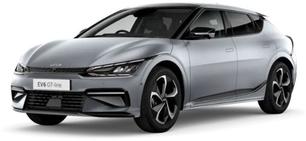
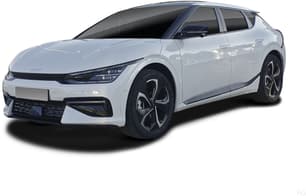
What's the difference?
Kia’s EV6, launched in 2021, was an early signal from Kia that its talk of rearranging car-buyers’ perceptions was more than an idle boast.
Sure, the South Korean brand had gone from budget also-ran a couple of decades ago to a brand that represents reliability and quality in a very short space of time.
But a brand that was technically innovative and EV-savvy? Or capable of family cars with supercar performance? Let’s wait and see, we all said.
And now the latest member of the all-electric EV6 family has arrived, and with it Kia’s big chance to prove its point, as well as convince us that its flagship products are worthy of a six-figure price-tag.
With shattering straight-line performance and all the hallmarks of a thoroughly modern take on the electric vehicle concept (including all-wheel-drive and electronic control of everything from the suspension to the rear differential) the EV6 GT makes the technical statement it needs to.
But does it have the quality, the specification and the overall appeal to justify a price-tag that was unimaginable in a South Korean car until very, very recently?
The fact is that technical merit is not enough – never has been – when it comes to making a macro price-point shift in the minds of consumers.
Any model seeking to reset the value proposition of an entire brand needs to be more than the sum of its parts. But does the EV6 GT achieve that rare distinction? That’s what we’re here to find out.
If the Kia Stinger looks wistfully to the past like some alternate-universe Holden Commodore SS, then surely the forward-looking Kia EV6 electric vehicle is simply another side of the same coin?
After all, both are five-door, five-seater, rear-drive-based family cars with a strong focus on sports sedan performance and style.
Indeed, both leverage Hyundai technologies, though not so you’d know it at a glance, as the Genesis-based Stinger and Ioniq 5-derived EV6 are clearly completely Kia in their look and feel.
But where the Stinger 200S starts from $51,250 (all prices are before on-road costs unless otherwise stated), the EV6 Air from $67,990 picks up from where the $64,960 Stinger V6 GT flagship ends, taking in the $74,990 GT-Line and then topping out to the $82,990 GT-Line AWD.
Kia arrived long ago. Now it’s pulling ahead. Ahead of the Stinger. Ahead of most rivals. Ahead of the EV curve. We drive the GT-Line AWD to find out how and why.
A hundred thousand dollars used to be big money. And for a family SUV, it still is. But don’t make the mistake of confusing the Kia badge with pedestrian motoring. The EV6 GT is proof that Kia can make high performance cars that work, and make the most of modern EV tech in the process.
We’re a bit disappointed in the real-world range of the car, and there’s no doubt the vast majority of drivers neither need nor want a car as focussed as this one. But as an example of how a modern, digital electric car can feel more like an old-school analogue performance car, the GT is Exhibit A. And for those of us for whom it’s about the journey, not the destination, this is indeed good news as EVs continue to take over the world.
Note: CarsGuide attended this event as a guest of the manufacturer, with meals provided.
Make no mistake. Thanks to Kia and Hyundai, the electric car has come of age in Australia.
Yes, the EV6 is expensive, but it is a world-class technical achievement that attempts to reduce the many compromises of EV ownership better than most luxury brands can. And it does this with an attitude that is Kia’s own. Even compared to the brilliant and beautiful Ioniq 5.
If you want to go electric and can afford/find one, then go for it. The EV6 is the cheapest of the best EVs available right now. As it’s no sports sedan, we’d gladly trade some of the AWD’s twin-motor muscle for the extra distance (and savings) going RWD brings, but whichever you decide, this is the Kia to make you focus on the future and forget about the past.
In more ways than one then, a Stinger GT the EV6 GT-Line AWD resolutely is not.