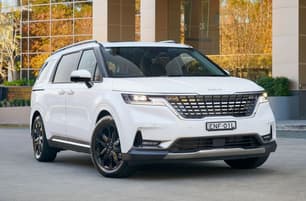
What's the difference?
This is actually the Carnival that Kia always wanted.
See, the last Carnival, the one this replaces, was Covid compromised, missing out on key technologies, as well as skipping an in-depth ride and handling localisation program, due to part supply issues and a freeze on international travel.
This one, though, addresses all of that, which is why you get a new cabin experience, new tech, and a complete overhaul of the steering and handling.
It is, however, significantly more expensive, right across the range.
So, is the Carnival still worth it? Let’s find out.
Just as the world appears to be having an each way bet when it comes to global electrification, so, too, has Ford Australia hedged its bets in the world of last-mile delivery vehicles. While some carmakers run away from EVs altogether, and others choose between fully electric and hybrid drivelines, the latest Transit Custom vans to join the conventional diesel-powered vans in Ford’s local showrooms feature a choice of either hybrid or pure EV operation.
The first is the E-Transit Custom, a battery-electric play on the popular Transit Custom theme. The second is a plug-in hybrid van dubbed, logically enough, Transit Custom PHEV. And the choices don’t stop there. Both of the electrified vans are available in entry-level Trend form or the ritzier Sport trim specification. There’s even a choice of wheelbases: Long-wheelbase for the Trend and a short-wheelbase layout for Sport variants.
Clearly, Ford Oz has big plans for the future of the Transit van, a concept that still – in Australia, anyway – lives in the shadow of the all-conquering dual-cab ute phenomenon. But the bigger, high-roofed Transit is already available here in EV form, so the launch of the smaller Transit Custom line-up in electrified form was always going to happen.
And while the world in general continues to vacillate over the pros and cons of an electrified future, it’s fair to say that the fleet managers and tradies of this world are a bit more pragmatic. If the EV and PHEV purchase-price-versus-running-costs sums add up, that’s kind of all that matters.
So, how does the electric Transit Custom line-up fare in the maths test? And what about actually using the electric Transit Custom in the real world of eight-hour shifts, delivery docks, fork lifts and commercial charging stations?
Ok, here's the rub. Everything you just read could well be pointless. You like the Carnival. In fact, it sometimes makes up close to 90 per cent of the sales in its segment, and outsells all of its competitors combined.
So whether I like it or not, I suspect you'll be buying one anyway.
But I can say this - the new Carnival improves the formula right across the board. Well, everything except for price.
Does the world need a pair of electrified Transit Custom vans? It’s not as simple a question when it comes to commercial vehicles like these, because there’s a fair chance the last-mile delivery sector is going to absolutely love the EV variant of the Ford van. Charged overnight at a depot, the EV Custom has the potential to massively reduce running costs for large and small fleets, as well as reduce downtime in terms of maintenance. It could be a big win.
But for our money, the PHEV Transit Custom is the one that offers the most promise. The usual EV compromises and range anxiety are shown the door and the plug-in driveline not only trumps the traditional turbo-diesel for running costs, refinement and actual performance, it also promises day-to-day efficiency that even the otherwise handy Ford diesel just can’t match. Win, win, we believe it’s called.
The question now is what Ford does with this driveline. Surely, as an option for the Tourneo people-mover (itself Transit Custom based, so all the hard work is done) the PHEV driveline seems like a foregone conclusion. And that’s the Transit van we’d most like to see, to be honest.
So, take these vehicles as a taste of what might be to come. The first shot in a market segment that stands to gain more than most from electrification.
Note: CarsGuide attended this event as a guest of the manufacturer, with accommodation and meals provided.
Surely the greatest trick the Carnival pulls off, and it does so convincingly, is that it manages to make something so quintessentially uncool, the people-mover, and make it look good. Somehow sporty, even.
I like the Carnival's big, bold and blacked-out front end of the GT-Line, and with its two-tone 19-inch alloys, wide stance and low ride height, it looks almost like some mad attempt at a JDM tune car, rather than a sensible people mover.
Elsewhere, the boxy profile, the sharp body creases and the third-row compartment that kind of juts over the rear tyres like a house that's been extended all somehow work, and give the Carnival far more street cred than you might expect.
Inside, we spent time only in the flagship GT-Line and its GT-Line Lite sibling, and both present as calming, comfortable spaces, and Kia's minimalist approach to combining the climate and audio controls into a single strip (it's functionality can be changed by pushing a button) helps keep the cabin fuss free.
The tech in the top-spec models feels modern and on-point, too, and the materials are all nice under the touch. Be warned though, the cabin plastics get progressively worse the further back you sit, and the third row is cocooned by hard and scratchy plastics.
Functionality trumps all else in commercial vehicles, but even so, the Transit Custom is a pretty cool looking thing, particularly in Sport trim with its stripes and alloy wheels. It’s easy to see how the van might appeal to private buyers as well, both as family transport with optional rear seats and windows or decked out as a camper. Keeping the roofline below 2.1 metres also means the Custom will work in an underground car-park environment.
Inside, it’s all about function and while there are plenty of hard plastics in evidence, the sheer attention to detail regarding storage and convenience features is what you’ll remember. Maximising interior space is part of that and the Transit Custom cleverly uses front airbags mounted in the roof lining, clearing up dash-top space that has subsequently been used to locate a second glovebox.
The Carnival measures 5115mm in length, 1995mm in width and 1775mm in height, and it rides on a sizeable 3092mm wheelbase.
And those mini-van dimensions have a predictably positive impact on luggage space, with room growing from 627 litres with all seating rows in place, to a massive 2827 litres with the third row stowed.
The key practicality perk here, though, is space, and lots of it. At 175cm, there was ample room for me in the middle row, and you can configure the cabin to your liking, too. You can slide the row on rails, for example, to prioritise leg room where you need it, and the middle seat folds down to reveal cupholders in a kind of hard plastic travel tray.
But even in the third row I could easily get comfortable, though head room begins to get a little tighter. There are cupholders and USB connection points, too, and I can honestly say you could send full-size humans back there and not feel overly guilty about it.
The Carnival will tow 2000kgs braked, too.
Here’s the meat and potatoes of a vehicle like the Transit Custom. If it can’t cut it as a workhorse, then there’s not much point in having it take up showroom space, and Ford knows that. But Ford also has loads of experience in making one and two-box vans work for their living. The fact is, these vehicles have been best-sellers in Europe for decades, so there’s plenty of back-catalogue to draw from.
Knowing that some drivers will spend a full shift in the cabin of the Transit Custom, Ford has gone to a lot of trouble finding little nooks and cubbies for things like clipboards, pens and phones to live. There’s also a fold-down centre seat that forms a small desk, two gloveboxes, and no less than four cupholders across the cabin. A large storage area lives under the flip-up passengers’ seat.
There’s a single USB-A charging port in the cabin and no less than five USB-C ports, as well as a 12-volt socket in the dashboard. Bottles can be stored in either door pocket and the front cabin steps are illuminated. A flat-bottomed steering wheel makes sliding across the cabin easier.
In the cargo bay, the walls feature protective panels and there’s a hose-out plastic mat on the floor. You’ll also find LED cargo lights, eight tie-down points in the long-wheelbase Trend and two fewer in the shorter Sport. Integrated roof racks are standard and while only one sliding side door is standard, there’s the option of a second one on the other side. The standard rear doors are the barn-door type, but open wide and back on to the vehicle’s sides to allow for fork-lift loading. A tailgate version of the rear door is optional.
There’s a load-through hatch giving a total length of 3.45m in the long-wheelbase version and, depending on what variant you choose, the payload is anything up to 1339kg. Cleverly, the top-hinged hatch cover for the load-through is held up by a magnet when in use so it doesn’t rattle against the load over bumps.
Towing capacity for either electrified Transit Custom is down from the turbo-diesel's 2800kg to 2300kg.
Keeping passengers safe in a nose-to-tail crash is a metal bulkhead with a window, but the window can be deleted as part of a security pack on the long-wheelbase variant, at which point the interior rear-view mirror becomes a camera screen. That mirror also incorporates a forward-looking dash cam.
It won’t matter to everybody, but it’s worth mentioning that the PHEV Transit has a space-saver spare wheel, while the EV variety has no spare at all.
All Fords are now connected via modem, allowing managers back at head office to receive alerts for low fuel or tyre pressure and even track their vehicles when they’re on the move. For fleet managers, this will doubtless be welcomed. For the drivers, perhaps not so much.
Bad news first. The price is higher this time around, right across the five-trim line-up, with the prices up between around $2600 and $5300, depending on which trim level you’re shopping for.
Prices start at $50,150 for the entry-level S petrol, and climb to $72,910 for the top-spec GT-Line diesel. There’s also a GT-Line Hybrid, which tops the group at $76,210, but it’s not here yet, so we’ll cross that electrified bridge when we get to it and stick with the ICE range for now.
The range opens with the S ($50,150 petrol, $52,380 diesel), which scores 17-inch alloys, LED headlights and DRLs, heated mirrors, cloth seats, an electronic parking brake, and a smart key with push-button start, which is new for this update.
On the tech front, there is a new integrated 4.0-inch driver display, and a new 12.3-inch central screen with Apple CarPlay and Android Auto, linking with an eight-speaker sound system, now with a surround-sound function.
Stepping up to the Sport ($56,050 petrol, $58,280 diesel) adds 18-inch alloys, rear LED combination lamps, a leather steering wheel and shifter, and dual-zone climate up front with single-zone temperature control in the second row. New for this update is a wireless charging pad and artificial leather seats.
Next is the Sport+ ($62,380 petrol, $64,610 diesel), which gets a whole host of new safety equipment, which we will come back to in a moment, along with a powered tailgate, automatic sliding doors and auto windows, and heated seats in the first and second rows. It also ups the tech, with twin 12.3-inch screens taking care of multimedia and driving info duties.
Then comes the GT-Line Lite ($66,350 petrol, $68,580 diesel), which is fitted with bigger 19-inch alloy wheels, scores LED interior lighting, gets a dual-pane auto sunroof and some chrome embellishments on the exterior. The trade-off, though is that the powered windows are now for the driver only, as is the powered front seat.
Finally, there’s the flagship GT-Line ($70,680 petrol, $72,910 diesel), which nabs dual-projection headlights, a heated steering wheel, a 12-speaker BOSE sound system, ventilated seats up front, a big head-up display and a digital rear-view mirror, along with a slightly better interior treatment and the return of the auto window and powered seat to the passenger side of the car.
Let’s start at the start. The E-Transit Custom Trend is the pure EV entry-level version. With battery-only operation, it’s the more radical of the two drivelines. The next step up in the EV line-up is the E-Transit Custom Sport with the same driveline and a few standard equipment additions.
The same goes for the PHEV Transit; the Trend kicks things off and the Sport adds the same trinkets.
The biggest difference, of course, is in terms of the wheelbase. The Trend grade (in either EV or PHEV) uses the long-wheelbase version of the Transit platform, while the Sport trim level is based on the short-wheelbase Transit.
All versions get a central 13-inch infotainment screen, LED lighting, full Android Auto and Apple CarPlay, wireless connectivity, embedded sat-nav, a 12-inch dashboard screen, keyless entry and start, and wireless phone charging.
Beyond that (and, again, the differences in trim remain identical across EV and PHEV variants) you get 16-inch steel wheels for the Trend and 17-inch alloys for the Sport, and the Sport comes with a body-kit including a rear spoiler and a set of racy looking exterior stripes. Inside the Sport also gets striped seat trim (still fabric and not leather) dual-zone climate control (single-zone for the Trend) and a 10-way powered driver’s seat (manual in the Trend).
The biggest interior difference is in the seating layout. The basic set-up is a three-position front seat, while the more utilitarian Trend, oddly, is the one with the option of individual buckets and an arm-rest for both occupants.
Prices start at $67,590 before on-road costs for the PHEV Trend (LWB), while the PHEV Sport (SWB) lands at $69,990. The parity is maintained in the EV version with the Trend starting at $77,590 and the EV Sport at $79,990. Those EV prices are a bit more than some of the competition (LDV eDeliver 7 and Peugeot Partner) but are line-ball with the Volkswagen ID. Buzz Cargo. The PHEV Transit Custom variant at ten grand less seems pretty competitive, then.
There are two ICE options on the table here. The first is what I reckon is the lesser of the two, a 3.5-litre petrol V6, producing a rev-happy 216kW and 355Nm.
The better option, I think, is the 2.2-litre, four-cylinder diesel, which makes 148kW and 440Nm, and just suits the nature of the car a little better.
Both pair with an eight-speed automatic, and send their power to the front tyres.
Although they might both subscribe to the concept of electrification, under the skin the Transit PHEV and EV are quite different animals. That’s starts with the fundamentals, with the front-engined PHEV Transit Custom using front-wheel drive, and the pure EV variant placing the single electric motor between the rear wheels for a compact rear-drive layout. As per usual practice, the EV’s batteries are positioned under the floor.
That single electric motor, when fed by the standard 64kWh battery, gives the EV Transit Custom a sensible power output of 160kW and a meaningful 415Nm of torque. Thanks to the way an electric motor makes its power (and torque, more importantly) there’s no need for a conventional gearbox, so a single-speed transmission is all that’s required.
The PHEV, meanwhile, uses the combination of a 2.5-litre petrol engine, teamed with a single electric motor. Interestingly, the electric motor is more powerful than the non-turbocharged petrol engine, but when both are delivering, there’s a total of 171kW of power and 400Nm of torque. A continuously variable transmission (CVT) is fitted for maximum efficiency.
Four-wheel disc brakes are fitted on all electrified Transit Customs in deference to their greater kerb weight (just shy of 2200kg for the LWB). Independent rear suspension is also a feature on all Transit Custom variants, and has been engineered to be compatible with the one-tonne payload standard.
Ford has also fitted the PHEV Transit Custom with selectable drive modes, four in the Trend (Tow, Normal, Eco and Slippery) and five in the Sport with the addition of a, you guessed it, Sport mode. The PHEV builds on that with modes to force electric operation, store the battery power for later or use a combination of both at the car’s discretion.
The petrol engine will sip a claimed 9.6 litres per hundred kilometres on the combined cycle, and produce 220g per kilometre of C02. The diesel lowers both those numbers, to 6.5 litres and 170 grams.
Both models are fitted with a 72-litre fuel tank, which means you’ll be sailing well north of $100 to fill one up.
Typically, for a hybrid vehicle, Ford quotes a staggering combined fuel economy figure for the Transit PHEV. In this case, that’s a marvellous, yet often unattainable 1.7 litres per 100km with tailpipe CO2 emissions of just 38 grams per kilometre.
No, you probably won’t achieve this in the real world, and our testing suggests closer to 4.2 litres per 100km in urban running which is where the PHEV shines most brightly thanks to the opportunity to harvest energy in stop-start traffic.
And even though that’s a long way from 1.7 litres per 100km, it’s still a pretty impressive number for a big, heavy vehicle with garden-shed aerodynamics. Combined with the Transit’s 63-litre fuel tank, there’s a real chance of stretching fill-ups beyond the 1000km mark.
The plug-in element provides for an electric range of 54km which is off the pace for most PHEVs and means any delivery driver in a Transit Custom PHEV will be making use of the petrol engine pretty much daily.
Unlike the Transit Custom EV with its 64kWh battery, the PHEV’s smaller 11.8kW battery doesn’t allow for commercial fast chargers. Instead, you can take the battery from fully discharged to 100 per cent capacity in seven hours on a household 10-amp socket, or in four hours, 15 minutes on a 15-amp outlet, which equates to a maximum AC charge rate of 3.5kW.
The Transit Custom in EV form, meanwhile, can be charged from zero to 100 per cent capacity in 6.7 hours on an 11kW outlet, but can also make use of fast DC charging. At that point, it’ll charge from 15 to 80 per cent in 32 minutes at its maximum charge rate of 125kW.
Ford claims a range of 301km for the Transit EV Trend and 307km for the slightly lighter Sport. Both those figures are likely to be a little optimistic in the real world, but we reckon, based on our on-test power usage figure of 17kW per 100km, they might be a lot closer to the mark than many other makes claim. So, that should, theoretically, work for most delivery vans in major cities where daily distances are generally below 200km.
Forgive the horrific paraphrasing, but it seems rumours of the death of diesel have been greatly exaggerated, at least when it comes to the Kia Carnival.
Get this – diesel sales make up some 90 per cent of the Carnival's total haul, with petrol providing a pittance towards the sales total, presumably being picked up by fleet buyers.
And to be honest, that means nine out of 10 people are making the right choice here. Yes, the petrol makes more power, but it's the torque on offer from the diesel that makes pushing the Carnival around feel far more effortless.
The petrol engine can definitely get you moving, but it feels a bit too rev-happy and thrashy when you really put your foot down, and its significantly thirstier to boot.
The diesel isn't perfect – the thrum of the engine is a constant companion whenever you put your foot down, and there's actually too much torque on offer at times, like if you're accelerating up hill from a standstill on a damp road, and so the front tyres can scrabble and scramble for grip.
But it otherwise so perfectly suits the nature of the Carnival that it is definitely the best and most satisfying choice.
Another big change for this update is the fact that Kia's complete ride and handling program has been rolled out here. Kia says local work done on the outgoing car, the one this replaces, was curtailed by Covid and bushfires, and so ended up being done by correspondence.
This one, though, has had the whole enchilada thrown at it, and it shows. They've succeeded in making a bigger car feel smaller around you. It's not a sports car by any measure, but nor does it ever feel too big and unwieldily.
Part of that is down to the steering, which is direct and confidence inspiring, but mostly I suspect it's because of the ride, which is firmer than you might expect in a family hauler, but also offers a connection to that road below that makes you feel in control.
Whether a firm-ish ride is a perk or negative is up to you, but it definitely works for me.
We’ve said it plenty of times before, but delivery vans really have come a long way. What were once bucking, sliding, pitching, screeching monsters are now almost as comfortable as a car and vastly more stable and predictable to drive even at freeway speeds.
The EV variant almost sounds and feels like a modern Melbourne tram in the way it accelerates with authority but also in near silence with only the suspension and a bit of tyre slap over sharp edges to spoil the serenity. Even then, the noises barely intrude. Tyre noise is the worst of it.
Performance is strong and effortless and this is a parcel van that accelerates like a decent car right up until about 100km/h when things start to tail off a little. The overall driving position is a bit sit-up-and-beg, but that’s actually comfy over longer distances and the seats themselves are good with plenty of padding, but not too much bolster that you need to climb over it to enter or leave the cabin.
The column-mounted gear selector is smart, but does mean the indicator stalk moves to the `wrong’ side, and confusing them can leave you in Neutral. And even though it’s a clearer, sharper result than many cars offer, the camera-screen interior rear-view mirror (if you choose the solid cargo-barrier version) is never as good as a conventional mirror. For some reason, the camera screen lacks the depth of field of a mirror and is more difficult to focus on. Those who wear reading glasses might struggle with it.
On the plus side, the EV variant’s one-pedal-driving setting is brilliantly set up and allows for bringing the Transit Custom to a complete stop without touching the brake pedal. Also better than average is the calibration for the driver aids including the lane-keeping assistance which is there to help, but never call the shots.
The PHEV version is, logically, more of the same, although the ride quality seems a little better with an extra layer of plush particularly on smaller, sharper bumps. The slightly lower kerb mass that allows for the one-tonne payload without the same spring firmness is probably the reason.
What the front-drive PHEV can’t achieve, however, is the EV’s level of power-down and grip. Floor the throttle and the PHEV will easily make its front tyres chirp and introduce a small amount of tugging at the wheel. Over bumps with lots of throttle, the PHEV will also momentarily lose traction, but meantime, it’s just as quick as the EV version, even if the CVT is evident in the way the engine revs up and the rest of the van eventually catches up with it.
Part of the change package for this updated Carnival is in its safety kit, some of which simply wasn’t available when Kia launched its predecessor.
Which is why every model now gets a centre side airbag, 'Forward Collision Assist AEB', 'Rear Occupant Alert', 'Trailer Stability Assist' and front parking sensors, joining the rear ones that were already there.
Sport+ Models and up now add a 'Blind Spot View Monitor' and rain-sensing wipers, as well as rear AEB through the 'Parking Collision Avoidance' function.
I have to say, though, when your entry-level car is $50k-plus, there’s no real excuse for limiting the best safety kit to the upper-spec models.
Also standard are lane keep assist, with 'Lane Follow Assist', multi-collision braking, a speed-limit warning (which you will turn off) and a reversing camera.
The Carnival range carries a five-star ANCAP safety rating, which it earned in 2021.
All four versions of the electrified Transit Custom feature the same safety gear, reflecting the increasing importance of OH&S concerns regardless of the vehicle’s purchase price. On that basis, you’ll get six airbags including side and side-curtain bags. There are also a pair of front airbags regardless of whether you have the standard cabin (three-seater) or optional two-seater layout.
Driver assistance packages include stability control with traffic sign recognition, adaptive cruise control, blind-spot monitoring, rear cross-traffic monitoring, exit warning, forward collision warning, lane keeping assistance, parking sensors front and rear and a 180-degree rear camera system. There’s also autonomous emergency braking that incorporates pedestrian recognition.
It’s also good to see a standard tyre pressure monitoring system, too.
The Transit Custom has been rated by ANCAP according to its light-commercial vehicle Medallion system which assesses active safety systems rather than actual crash data. In this case, the vehicle achieved the highest, Platinum, rating with a 96 per cent score.