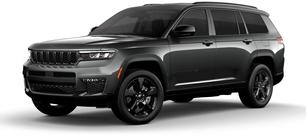
What's the difference?
The Jeep Grand Cherokee has always been big. But if you want to carry more than five people, not big enough. Which is where the all-new, fifth-generation model comes in.
It’s the Grand Cherokee L. Jeep’s first-ever seven-seat version of its flagship SUV.
It’s set to compete with top-spec versions of mainstream models like the Hyundai Palisade and Toyota LandCruiser Prado, as well as premium full-size family trucksters like the Land Rover Discovery and Volvo XC90.
Jeep invited us to the Grand Cherokee L’s Australian launch to get a first taste of how it measures up to local conditions.
In the realm of family friendly mid-size SUVs, few names have the same reputation as Mitsubishi’s Outlander.
While this new one looks almost identical to the previous version, it’s hiding some serious, Australian-flavoured changes under the skin.
But in a segment now full of not only upgraded mainstream rivals, but also new cut-price alternatives from China, does such a modest upgrade to the Outlander do enough to deserve your consideration in such a crowded market?
We went to its Australian launch to find out.
Jeep’s aim with this car is to lift the Grand Cherkee to a more premium level, and that’s about brand equity and badge credibility as much as it is the vehicle itself.
The seven-seat L has stepped up in price, but also in practicality, refinement and equipment, while maintaining serious off-road ability.
Does it have what it takes to tempt people away from, say, the German Big Three? That’s a tough ask, but this Jeep certainly has more of what it takes to make that a real possibility.
For mine, the entry-level Night Eagle is the pick. Well equipped, heaps of safety and plenty of off-highway prowess.
Note: CarsGuide attended this event as a guest of the manufacturer, with travel, accommodation and meals provided.
Mitsubishi has leaned into its strengths with this Outlander update, spending its money in subtle areas to upgrade what was already a widely appealing mid-size SUV.
The local tuning has made a notable difference to the refinement and comfort of this version, while subtle updates to the software and interior trim help to refine things even further.
If you’ve had an Outlander before, you’ll love this one, although it doesn’t help the brand to challenge new players on the value front. This leaves you with the decision of whether to pick a brand with the reputation and network of Mitsubishi, or roll the dice on a far more affordable new player.
For what it’s worth, it’s genuinely tough to pick a sweet spot here. I think the best picks are at either end of the spectrum, with the ES being outstanding value, and the Exceed being particularly plush.
Note: CarsGuide attended this event as a guest of the manufacturer, with travel, accommodation and meals provided.
A decade. That’s how long the previous Grand Cherokee was on sale in Australia, Which is ages, but also testament to the quality of that fourth-generation car’s design.
And there are echoes of it in this new model’s exterior. The overall proportions are similar, although the track is increased by 36mm, and the overriding impression is that key elements have been made slimmer and wider for a more contemporary look.
For example, the headlights, LED on all models, are shorter, but longer, while the signature seven-bar Jeep grille has been truncated a little and stands more upright.
Character lines along the side of the car are softer, and the rear follows the same slimline philosophy. But it’s inside where the biggest steps have been taken.
The dash layout and hardware have been transported from the relative Dark Ages to a clean and simple approach dominated by this broad centre console, topped by a sleek media screen.
The screen measures 8.4 inches in the entry-level Night Eagle, stepping up to 10.25 inches in the upper grades.
The latest, configurable, digital instrument cluster enhances the low-key tech vibe, and there’s a sensible mix of on-screen controls and physical dials and buttons. That said, there are a lot of buttons across the lower part of the centre stack and steering wheel.
The rest of the interior is a blend of simple lines and a subtle colour palette, including piano black highlights. It feels more mature and premium than the car it replaces.
Blink and you’ll miss the changes. Actually, squint and you still might miss them. Aside from the eye-catching new 20-inch wheels on the Exceed and Exceed tourer grades and the new ‘Moonstone Grey’ paint colour, it’s hard to tell the new Outlander apart from its predecessor.
Look closer and there’s new lower garnish designs front and rear, a tweaked grille and a smoked appearance for the rear tail-light clusters.
It’s very subtle stuff, but Mitsubishi has chosen to spend its time and money on upgrades on unseen areas.
For example, the bonnet is now steel rather than aluminium, which helps with noise insulation (and also has the side-effect of removing the high-speed ‘fluttering’ effect the aluminium bonnet had on the previous version), there’s additional sound insulation throughout the car, and cladding in the transmission tunnel to make the cabin a quieter place.
Back on the topic of appearance, though, the dash and console has also been tweaked a little. For example, the new screen looks a bit more contemporary, with a much smaller bezel and more attractive software. The console has been rearranged to move the bottle holders to one side of the electronic gear shifter, which makes for a larger centre console.
High-grade leather seat trims also now have alternate patterns, but the range follows the same trims, from cloth on the ES and LS, while the Aspire gets a microsuede and synthetic leather blend, while the Exceed and Exceed Tourer get the ‘high-grade semi-aniline’ leather trim.
When it comes to practicality, thoughtful, family-friendly touches include large door apertures, with the doors themselves opening right out to 64 degrees, as well a second row seat able to move fore and aft to balance passenger and/or cargo space.
Up front there are big bins in the doors with space for large bottles, a pair of decent size cupholders in the centre console, a two-tiered storage box between the seats that doubles as an armrest, and a covered wireless charging bay in front of the gearshift.
For connectivity and power there are two USB-A and two USB-C ports, as well as an ‘aux in’ socket, and a 12-volt outlet.
Jump into the second row, and sitting behind the driver’s seat set for my 183cm position, I enjoyed heaps of headroom and hectares of legroom, remembering it’s possible to slide the middle seat forward to give third row passenger more room, or increase load space.
Again, there are generous pockets in the doors with space for large bottles, map pockets on the front seatbacks, a fold-down centre armrest containing two cupholders, and rear seaters have their own ventilation control.
The dual USB-A and USB-C ports are repeated in the back, and there’s a 230-volt AC socket for three-pin plugs.
Access to the third row is helped by a roll and fold function in the second row, and once back there space is generous and the amenities are civilised.
I could sit bolt upright without any head clearance issues, and legroom is good. There are bottle holders on each side, adjustable ventilation in the C-pillars, small storage pockets, and yet more USB outlets.
And how’s this for a parent’s dream? ‘Fam Cam’ (optional on the Limited and standard on the Summit Reserve) is an adjustable rear seat monitoring camera able to switch between all second and third row positions. No more craning around and taking your eyes off the road to check what’s going on back there.
Even with all seven seats upright, boot space is 487 litres. Fold the 50/50 split third row and that grows to 1328L, and with the second (40/20/40 split) and third rows down you’ve got 2395L, enough room to start a boutique furniture moving business.
The loading height is user friendly, there are multiple tie-down hooks and a 12V outlet, there’s no lip to get over the top of, and a power tailgate, standard on all grades and hands-free on the Summit Reserve, is always welcome.
The Grand Cherokee L is rated to tow a braked trailer up to 2.8 tonnes, although that’s reduced to 2.3 tonnes in the Summit Reserve, partly due to the standard air suspension. And off-roaders rejoice, the spare is a full-size (18-inch) steel rim.
The previous Outlander was already known for having a spacious and versatile cabin, and this continues for the new car with a few small tweaks.
The width and satisfying seat positioning continue, and seats in all grades are generous and comfortable, but particularly the leather seats on the Exceed and Exceed Tourer grade we tested.
Adjustability is good in all positions, and the digital instrument cluster has an attractive dual-dial layout and functional display options. While not the best in class, it’s far better than many rivals.
The touchscreen’s new software is meant to be faster, but I found it a bit laggy still, although the integration of Google’s API into the navigation suite is an excellent tweak, making it relevant and useful for much longer.
The tweaks to the centre console make the area more space efficient and useful, but the new cupholders seem strangely shallow, potentially causing large bottles to tip. The tweaked centre console box is nice and large, and the wireless charger is nice and accessible, although its surface is not quite rubbery enough to stop your phone from leaving the charging area in the corners.
The back seat is noticeably stadium – you sit a fair bit higher than in the first row, which eats into headroom in cars equipped with a sunroof for adults. However, width is good, as is the seat comfort.
The rear doors open nice and wide, which should make fitting a child seat easy enough, and the floor is surprisingly flat, too, which makes the middle position more useful.
The third row, which I sampled in an Aspire grade, is both hard to get into and tight once you’re in there. The second row can slide forward on a rail, offering just enough room for me, at 182cm tall, to fit back there, with my knees hard up against the seat in front, and my head nearly touching the roof.
It is for this reason Mitsubishi calls seven-seat versions ‘5+2’. Good for kids, maybe, but not adults for any extended period of time.
The boot is enormous with two rows in use (485 litres in five-seat versions, or 478 litres in seven-seaters), and for this update, the space now has a wider aperture that should make loading objects easier. Space with seven seats up is 163L. Five-seaters get a full-size spare under the floor, while seven-seaters get a space saver.
Braked towing capacity is a middling 1600kg for petrol-powered variants. The brand says not many Outlander buyers are focused on towing as a key capability for the mid-sizer.
This three-row L, scheduled to go on sale mid-year, is the first of several versions of the Grand Cherokee set to arrive in 2022.
Our very own Chesto has driven the five-seat version in the US, specifically the plug-in hybrid 4xe, another first for the model, set to hit showrooms in the second half of the year.
But for now, the seven-seat L is the focus, offered in three grades starting at just over $80K, before on-road costs, and topping out at roughly $115,000.
This is part of Jeep’s stated aim to move upmarket, and aside from the safety and drivetrain tech covered a little later, the entry-level Night Eagle at $82,250, before on-road costs, features suede and leather-appointed seat trim, eight-way electrically-adjustable and heated front seats, a heated steering wheel, sat nav, an 8.4-inch multimedia screen, a 10.25-inch instrument display, six-speaker audio (with Apple CarPlay and Android Auto connectivity), three-zone climate control, a rear-view camera, keyless entry and start, adaptive cruise control, auto LED lights, 20-inch alloys, a power tailgate, and more.
Step up to the Limited ($87,950) and the media screen increases to 10.1-inch, the seat trim is even plusher ‘Capri’ leather, there’s a multi-memory seat function for the driver, the front seats are ventilated and the second row is heated, pull-up shades are added to the rear side windows, the audio system has three extra speakers with a 506W amp (and active noise control), plus there’s ambient interior lighting, and auto high beam.
Opt for the top-shelf Summit Reserve ($115,450) and the rims are even bigger at 21 inches, the front seats are 12-way electrically-adjustable, open pore wood trim is added to the dash, doors, and steering wheel, the climate control is four-zone, the front seats feature a configurable massage function, the stereo is pumped up to a 19-speaker, 960-watt package, there’s a dual-pane sunroof above your head, and the ‘Palermo’ leather seat trim is quilted. There’s more, from Berber floor mats to a hands-free tailgate, but you get the idea.
Overall, despite a solid asking price, generous standard equipment helps substantiate a category competitive value package.
Let’s get the bad news out of the way first: prices are up across the whole Outlander range.
The increases are modest, contained to between two to three thousand dollars across this mid-size SUV’s sprawling eight-variant range.
It sounds like an overwhelming number of versions but the Outlander is split across five grades in front- or all-wheel drive, with either five or seven seats.
Check out our pricing table below for the detailed prices before on-road costs:
Traditional rivals in the 5+2 mid-size SUV category include this model's platform-mate Nissan X-Trail (from $38,025 - $59,265) and the Honda CR-V ($41,900 - $59,900), with the Hyundai Santa Fe ($53,000 - $72,500) and Kia Sorento ($50,880 - $84,660) being a price-bracket above.
The biggest issue is the Outlander is facing increased competition from models like Chery’s Tiggo 7 (as a five-seater), which can be had for as low as $29,990 drive-away! Even the most expensive version of the Tiggo 8 (seven-seater) in plug-in hybrid form costs the same as a mid-grade Outlander, at $49,990 (d/a).
Options like this put the choice back in your hands. You can choose a brand with the heritage and support network of Mitsubishi, or you can go with the value of a new player yet to put those runs on the board.
Although it has an almost identical visage to the previous car, there are some major upgrades hidden below the metal. Sure, there’s a tweaked equipment list, but importantly, there’s a completely revised ride and handling tune, which was developed by Mitsubishi right here in Australia using local expertise.
It’s a similar program to the successful ones undertaken by Kia and Hyundai in recent years to improve the handling of their cars, and Mitsubishi in Japan was impressed enough with the depth of the changes that most of them have been adopted to the global tune for the car.
On the topic of standard equipment, LED interior lights and the 12.3-inch digital dash have been made standard across the range, there is now seat ventilation to join the seat heating for the front two positions in the top Exceed and Exceed Tourer grades, while the upper mid-spec Aspire grade scores front seat heating and a heated steering wheel.
The 12.3-inch multimedia screen has also been upgraded, featuring a smaller bezel and more processing power for a faster response rate, as well as a tweaked software suite with a new layout. This screen also hosts wireless Apple CarPlay and Android Auto across the range.
In addition, there’s also the introduction of the Mitsubishi Connect phone app, which features a range of safety and security features, as well as the ability to remotely control things like the ignition, climate system, navigation and locking system.
Across the range the audio system has also been upgraded to an eight-speaker Yamaha-developed system, with the top-spec Exceed Tourer grade scoring a 12-speaker Yamaha system with up to 1650W of power.
The interior now uses higher-quality materials, according to the brand, with extended upholstery across the range. The top-spec Exceed Tourer also scores a new brown interior colour.
A 360-degree parking camera is now standard across the range, and the safety suite also includes the driver monitoring system and traffic sign recognition system as also used in the Triton.
The plug-in hybrid version, which is what the Outlander is arguably most famous for, is not yet available, but Mitsubishi tells us it will arrive in a few months time, at very least before the end of 2025, and it, too, will carry an Australian-developed ride and handling tune.
All versions of the Grand Cherokee L are powered by a 3.6-litre naturally-aspirated V6 petrol engine producing 210kW at 6400rpm, and 344Nm at 4000rpm, driving all four wheels through an eight-speed auto transmission and a transfer case - single speed on the first two models and two-speed on the Summit Reserve flagship.
The evergreen Pentastar V6 is a naturally-aspirated, all-alloy, quad-cam design featuring dual variable valve timing and sequential-injection.
If you want more grunt? Yes, there’s a 5.7-litre Hemi V8 available in this new Grand Cherokee. But it’s in the States, not here. There’s no diesel option, either. But as mentioned earlier, a plug-in hybrid, the 4xe (four-by-e) is coming later in 2022.
The petrol-powered Outlander soldiers on with a drab non-turbo, non-hybrid 2.5-litre four-cylinder engine, mated to a continuously variable automatic transmission.
The brand calls this combination “proven” and it’s hard to argue given it hasn’t cropped up with any major reliability issues in the pre-facelift car.
Still, it produces a middling 135kW/244Nm, not as punchy as many turbo options, and nowhere near as efficient as hybrid alternatives.
Those seeking a more powerful fuel-sipping option may want to wait for the PHEV version arriving later this year.
Jeep’s official fuel economy figure for the Grand Cherokee L on the combined cycle is 10.6L/100km, the 3.6-litre V6 emitting 243g/100km of CO2 in the process.
Given the specific on and off-road combination of the launch drive we’ll wait until we can evaluate the car over a longer period to quote an ‘on test’ number.
Worth noting stop-start is standard, and in the name of weight saving, the car’s bonnet and tailgate are aluminium. Still weighs around 2.2 tonnes, though.
The tank holds 104 litres, which using the quoted consumption number, translates to a range of around 980km.
As a result of its relatively old-school sounding powertrain, fuel consumption isn’t at the forefront of the petrol-powered Outlander, with official consumption ranging between 7.5L/100km for the lightest five-seat ES 2WD version, to 8.1L/100km in the heaviest, top-spec Exceed Tourer AWD.
C02 emissions are also on the high side, which the brand will no doubt be off-setting with the new PHEV version which will offer even more emissions-free driving range than before.
One benefit of this long-serving engine, though, is it can be fed entry-level 91RON unleaded, better for the back pocket. The petrol-powered Outlander has a 55-litre fuel tank.
In driving the new Grand Cherokee the first thing you recognise is the Pentastar V6’s characteristic induction sound. That’s not to say it’s overly loud, just familiar.
But in terms of what it delivers, nearly 90 percent of the engine's peak torque is available from 1800 to 6400 rpm, so you’ve got that mid-range pulling power which is as nice on the highway as it is around town, but also good for people that are into towing.
The eight-speed auto is nice and smooth, as well, and even though it’s a conventional torque-converter unit, manual shifts through the steering wheel paddles are quick.
Suspension is multi-link front and rear, with the top-spec Summit Reserve picking up air suspension and active damping. Major components are alloy to reduce unsprung weight but you can certainly feel the scale of this car.
It’s 5.2 metres long and weighs roughly 2.2 tonnes, so you’re guiding this sizeable machine along the road. It’s not an involving drive, we’re not in sports car territory here. But it feels stable and predictable in cornering, and body control is well buttoned-down.
The electrically-assisted steering’s weight is nice from parking speeds right up to freeway velocity, but road feel through the wheel is relatively modest.
In terms of the seating position, you do feel as though you’re sitting up and on, rather than down and in the front seats. But when it comes to support, after hours behind the wheel, including off road, the front chairs remained comfortable.
This is a big vehicle, that will often have a boat, van, or something else substantial hitched to the back of it, and the brakes are suitably specified.
Big discs are ventilated all around, clamped by two piston calipers at the front and singles at the rear, and on the off-road section of the launch drive we were by necessity leaning on the brakes for long periods of time.
You could occasionally smell that they were working hard, but the pedal remained firm all day, without a hint of fade.
Speaking of off-highway performance, as part of its development program Jeep tested this new Grand Cherokee in remote parts of Australia, with more than 60,000 km under the wheels of various prototypes. Likely a big help in setting up the local spec.
And that spec is, four-wheel drive in all models, as well as a single-speed transfer case in the Night Eagle and Limited, with the latter also featuring the ‘Selec-Terrain’ traction management system, controlling torque split (up to 100 per cent of drive to either axle), as well as the brake calibration, steering, suspension, throttle, transmission, transfer case, traction control, stability control, and ABS settings.
The Summit Reserve boasts a two-speed transfer case, with low-range reduction, as well as traction management and air suspension with electronic adaptive damping.
The air suspension incorporates five height settings - Normal, Off-road 1 (40mm lift), Off-road 2 (60mm lift), Park (46mm lower), and when in sport, Aero (21mm lower).
In typical Jeep fashion we attacked challenging fire and forestry trails on the launch drive and a couple of things emerged.
First, on street-focused tyres this car does incredibly well off-highway. And second, the ‘Quadra-Trac II’ 4x4 system with low-range capability in the Summit Reserve, combined with the crawl control function, makes a significant difference. You find yourself feeling that bit more composed and confident tackling very rough sections.
Also in the Summit Reserve, a low-set, forward facing camera allows you to see what’s actually happening at the front wheel via the central media screen, and in the Off-road 2 setting the car feels like it’s up on stilts and able to tackle anything in its way.
And for those that really want to get amongst it, the body clearance data is below.
The Australian team had a significant amount of input on the driving dynamics of this new Outlander, but does it make a big difference behind the wheel?
We were granted the chance to drive the old one alongside the new version to find out, and the changes are significant.
Overall, the character of the car hasn’t been fundamentally altered. This is still a somewhat plush and soft-around-the-edges family SUV, but redeveloped new suspension parts and even very minor, nerdy modifications like the thickness of sway bars have added up to a much more pleasant vehicle to spend an extended amount of time in.
The first thing you’ll notice is the retuned steering. Mitsubishi’s engineers tell us the tweaked feedback was all down to the software in the rack, and it’s a big difference, upping the firmness of the steering at low speeds, keeping the vehicle on track with more confidence while heading straight, and also removing a slight twitchiness with sudden adjustments.
Next is the cabin ambiance. The new Outlander is a relatively quiet place to be thanks to the extra insulation throughout. It combines with the new steering to give the car much more of a sense of heft than before. The engine is reduced to a distant thrum, and the road is damped away for the most part. Mitsubishi says the 20-inch wheels are a particular hit with buyers, which to me is a shame because I’m willing to bet it’s particularly comfy on the lower-grade tyres.
Elsewhere, the Outlander has a softer initial response to bumps thanks to retuned shocks, and the reduced width of the front sway bar makes for less ‘head toss’ for front seat occupants.
Does it make a significant difference? Yes. The new Outlander is all-round better balanced and better suited to our road conditions. It might not have the sophistication of more expensive options, and it still might be a tad off what the also balanced-and-comfortable RAV4 offers, although it will be interesting to get one back to see how it compares to rivals in a like-for-like test.
Just expect a much more comfort-oriented option than some rivals. These changes don’t make the Outlander as fun to drive as a Mazda CX-5 or a Skoda Kodiaq. For example, while the 2.5-litre engine and CVT combo provides a surprisingly urgent initial response, it's a dull, rubbery power application from there on.
The Grand Cherokee L is yet to be assessed by ANCAP, but Jeep has upped its active safety game with standard crash-avoidance tech including, AEB with cyclist and pedestrian detection, lane keep assist, ‘Intersection Collision Assist’, adaptive cruise, as well blind-spot monitoring, rear cross-traffic alert, traffic sign recognition, tyre pressure monitoring, and ‘Drowsy Driver Detection.’
The Summit Reserve adds Level 2 driving assistance features, a 360-degree camera view, self-parking assist (parallel and perpendicular), and more.
If an impact is unavoidable, there are eight airbags on-board - dual front, front side, front knee, and full-length side-curtain.
There are three child seat top tethers across the second row, with ISOFIX anchors on all three positions. And there are top tethers on both third row seats.
The Outlander has a robust array of active safety kit, with all the key gear like autonomous emergency braking, lane support, blind-spot monitoring and rear cross-traffic alert available across the range. Traffic sign recognition and driver attention monitoring is now available from the new Triton, however it is also worth noting some relatively minor items are only available on higher grades.
The ES and LS grades miss out on adaptive high beams, traffic jam assist and steering assist (although they maintain lane departure warning and lane-keep assist).
Mitsubishi is hoping the updated Outlander will qualify for a continued five-star ANCAP safety rating held by the pre-facelift model.
During our drive we also found the lane-keep and driver attention software (which was much-derided at the launch of the Triton) was reasonably well behaved, with the brand saying it had had significant software tweaks over time to make it less invasive. We’ll need to save our final verdict on this system for when we spend an extended time behind the wheel.
Jeep covers the Grand Cherokee with a five-year/100,000km warranty, which is behind the five-year unlimited kays cover which is pretty much standard in the mainstream market now.
But you do receive 12 months complimentary roadside assistance, which is renewed for another year every time you service your vehicle at an authorised Jeep dealer.
Service is recommended every 12 months or 12,000km, and capped price servicing is available for $399 annually for the first five years. Not bad for a car of this scale and complexity.
Mitsubishi continues to offer its near-industry-leading 10-year/200,000km warranty, conditional on the car being serviced at a Mitsubishi dealer. Otherwise, it reverts to a five-year/100,000km promise.
The 10 years of warranty is joined by 10 years of capped-price servicing required at 12 month or 15,000km intervals.
Prices are tame, varying between $320 and $680 per visit, for a total yearly average of $434. It’s not the cheapest yearly average out there, but most brands also don’t have capped price servicing extended this far, so it seems like a good deal regardless.