What's the difference?
If you believe there should be a ute version of everything, Jeep has long been there for you with a tray-backed Gladiator version of its iconic Wrangler off-roader.
But the Gladiator has hardly attracted the same love as its mainstream ute rivals, preferring a more lifestyle-oriented vibe, which it leans into extra hard for this 2026 update.
While it might look pretty much identical from the outside, Jeep has made some pretty significant changes underneath to make it a better overall offering, with a nice reduction in price, too.
So is it now worth your consideration? Read on to find out.
The Chevrolet Silverado enjoys enduring popularity in Australia’s unique new vehicle market for locally remanufactured right-hand drive versions of full-size US pick-up trucks.
Armed with unique V8 power, the range offered by General Motors Speciality Vehicles (GMSV) comprises the entry-level 1500 LTZ Premium and top-shelf 1500 ZR2, while the colossal 2500 HD offers the ultimate in heavy towing capabilities.
Their combined sales represent a leading market share of more than 40 per cent, in a specialised segment where purchase prices extend well into six figures.
The latest MY26 Silverado range is backed by a new five-year/unlimited km warranty paired with five years of roadside assist, which provides greater peace-of-mind for buyers than the previous three-year/100,000km and three years' roadside assist. The ZR2 also gets upgraded driver assistance plus additional exterior colours.
We recently spent a week aboard one of the latest 1500s to find out why the Silverado is such a popular choice for Aussie buyers and if it’s well suited to tradie duties.
The Gladiator is far from the most practical, versatile, or sensible dual-cab on the market. Not going to lie, though. This is the most fun I’ve had in a ute in a long time.
With its unique V8 soundtrack, all-terrain capabilities and sumptuous comfort, the ZR2 is a quintessential American muscle truck that's as capable of carting crews and accessing rugged worksites during the week as it is towing boats, horse-floats and caravans or getting muddy on weekends. For either work or play, there's a lot to like here.
Despite a legion of trendy retro-styled off-road pretenders, from the Ineos Grenadier to the GWM Tank 300, there’s nothing quite like the original Jeep style which the Gladiator shares with its Wrangler sibling. Unless you’re Mahindra which has technically been producing Willys Jeep successors for longer, but that’s another story for another time).
The new Rubicon looks a bit more swish in 2026, with the body coloured wheel arches and a tweaked grille which is now wider and shorter. The two-tone roof which was previously optional is now standard.
It looks rugged, tough, and undeniably classic, with the mud terrain tyres sealing the deal.
Of course, you can’t forget the many so-called ‘Easter eggs’ Jeep hides about the place. In the case of the Gladiator, these include a silhouette of a Willys Jeep climbing up the driver’s side windscreen, a gorilla imprint on the opposite side signifying the windscreen is now constructed from the same stuff designed to make your phone scratch-free. The tray features imprints of dirtbike tyres where you might want to strap two in and even the recirculate button on the climate unit is in the shape of a Wrangler. Nice touch.
On the inside generally, it feels like a purpose-built vehicle in much the same way as an old Defender. It leaves you with a sense of how genuine it all is, with loads of physical switchgear and an overall shape meant to replicate the no-nonsense appeal of Jeeps dating back to the Willys.
The Silverado’s extensive remanufacturing to RHD, performed on a purpose-built production line in Melbourne, meets OEM standards of fit and finish.
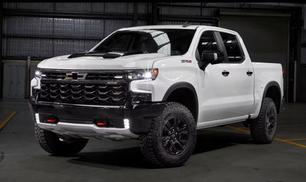
As the off-road focused 1500 model, the ZR2 has hardware and detailing consistent with its rugged bush-bashing persona, highlighted by aggressively treaded mud-terrain tyres and unique raised suspension with high performance dampers.
Other ZR2 features include a raised bonnet with ZR2 applique, ‘off-road cut’ front bumper, bash plates, black grille with ‘Flow Tie’ (flow-through) bow-tie motif, ‘Performance Red’ chassis-mounted front recovery hooks, concealed dual-outlet exhaust, black fender flares/door handles/bumpers/window surrounds and chrome ZR2 badges.
It has a tough and purposeful look with bluff-fronted styling and an imposing stance.
An expansive length of almost 6.0 metres (5931mm) and a 14.4-metre turning circle highlight formidable (and at times impractical) dimensions for urban life.
The cabin is spacious and airy with a tasteful blend of contrasting tones and textures combined with many soft-touch surfaces, yellow stitching along seams and splashes of chrome and satin chrome creating a plush look and feel.
However, also like an old Defender, the Gladiator’s interior is full of compromises to maintain its iconic design.
The seating position is awkwardly high, which is fine when off-roading, but can be limiting when you’re just driving around a city, and the footwell is half taken up by a transmission tunnel so there’s nowhere to rest your foot.
The door cards are pretty basic because the doors are removable (although Jeep stresses this is only legal on private property), but elsewhere there’s much-appreciated levels of functionality in an era of touch-based controls.
The centre control panel, for example, features physical dials for high-use functions and toggles or buttons for everything else. It’s mercifully easy to use and old-school motorists will also love the physical shifters for gear selection and the transfer case alongside. And an analogue handbrake is an increasingly rare sight.
There are even buttons we didn’t ask for, like the four pre-wired auxiliary switches, and while the dash trades away a fully digital panel for a digital supervision screen with analogue dials either side, it suits the character of the car.
It’s not the most comfortable space to be in, however. Not only is the seat base super high off the ground, but despite the Gladiator’s imposing dimensions the front seat somehow feels narrow.
Storage is okay, but not on the same level as many rival utes. The basic doors score nettings on each side, with two deep and useful bottle holders in the centre console. The armrest box is two-tiered which is handy, and there’s a small glove box. Outside of this, there’s not a lot of storage up front.
The rear seat is decent when it comes to space for the ute segment, although it is also very high off the ground and hard to clamber into thanks to the way the rear door is shaped. Once you’re in there, be sure not to smack your head on the frame, which seems like it could be an easy thing to do.
Again, nets feature in the doors, with two more nets on the backs of the front seats, which also feature luggage hooks. There are dual adjustable air vents back there and two bottle holders moulded out of the centre console. They're nicely-sized, but will eat into the legroom of any adult you want to put in the centre rear position, making it extra cramped if you have three across.
The back seat features some things I’ve never seen before, though. There’s a huge storage area underneath the seats with its own lid, and some limited storage space behind the seat backs which features a removable Bluetooth speaker which also automatically re-charges when it’s docked back there. Cool.
The rear window features an opening port, which is also rare, while all the main storage compartments are lockable for when you want to leave the car with the roof and/or doors off.
Capacities and payloads have never been a strong point for the Gladiator. The tray measures 1531mm long, 1443mm wide and 1137mm between the arches, making it unable to fit a standard-sized Australian pallet. The payload is also limited at just 693kg, far short of the close-to-one-tonne many work-focused dual-cabs can hit.
However the tray isn’t for show only, featuring an array of useful tie-down points and a built-in rail system to help secure all sorts of objects. There are even steps built into the rear bumper design for easier access and a full-size spare wheel underneath.
The braked trailer towing capacity is limited to just 2721kg which is also short of the industry benchmark 3500kg, all of which may limit its use as a work vehicle, or even its appeal as a touring vehicle. I could see how these capacities are easily exceeded with a rooftop tent, recovery gear, a fridge, supplies and at least one passenger.
The ZR2’s hefty 2587kg kerb weight and 3300kg GVM results in a 713kg payload, which is modest given a seated crew of five big tradies could use up about two-thirds of that payload capacity before loading any of their gear.
It can also legally tow up to 3500kg of braked trailer on a 50mm ball and up to 4200kg on a 70mm ball. The latter figure is 300kg less than the LTZ due to the specialised off-road suspension.
However, given the ZR2’s 6851kg GCM rating (or how much it can legally carry and tow at the same time), you would be left with a mere 64kg of vehicle payload if you wanted to tow the maximum 4200kg.
That’s barely enough for a driver - and a light one at that. Fact is, few if any owners in real-world use would need to tow 4200kg, but it’s important to be across these legal limits if you’re planning to.
The load tub is protected internally by a spray-on liner and offers almost 1.8 cubic metres of load volume. Its load floor is 1776mm long, 1813mm wide and sits 569mm deep, with 1286mm between the rear-wheel housings. More than wide enough for hauling Aussie or Euro pallets.
There are also 12 load-anchorage points, power assistance for lowering the tailgate and a tub camera to keep an eye on loads when driving. The rear bumper provides surefooted tub access using either the centre step or concave side-steps.
All occupants enjoy luxurious space, particularly rear passengers thanks to easy entry created by the wide-opening doors, a flat floor with no transmission hump for the centre passenger to straddle and palatial head and legroom even for tall people. Combined with ample shoulder room, a full crew can travel in enviable comfort.
Cabin storage for the driver and front passenger includes two bottle holders and a bin in each door. There’s also a large glove box and the centre console has an open tray and two USB ports up front, two bottle holders in the centre and a big box at the back topped by a padded lid that provides comfy elbow support.
Rear passengers get a bottle holder and bin in each door, plus more USB ports and two more pairs of bottle holders in the rear of the centre console and in the bench seat’s fold-down centre armrest.
There’s also storage pockets on both front seat backrests and handy compartments for small items are cleverly concealed within the rear seat’s upper-backrest cushions. Its 60/40-split base cushions can also swing up and be stored vertically if more internal load space is required, or to access ample under-seat storage.
For this update, the Gladiator has been trimmed down to just one variant, the fully-loaded, top-spec Rubicon.
While the lesser Night Eagle grade has been discontinued, the good news is the Rubicon is now more affordable, starting at $82,990, before on-road costs. Although this still pitches it against only the most expensive mainstream dual cabs.
At this price, for example, you could pick a Ford Ranger in luxury Platinum or sporty Wildtrak form, or even as a plug-in hybrid. However, this car’s classic vibe and purpose-built feel, with a big six-cylinder petrol engine, is more reminiscent of the Ineos Grenadier Quartermaster, which wears a price tag well in excess of $100,000.
While it might be a pricey ute, the Gladiator Rubicon comes with all the gear plus extra stuff for this update, including new 17-inch two-tone wheel designs clad in pricey BF Goodrich mud terrain tyres, Nappa leather seats and a more powerful standard alternator with pre-wired auxiliary switches.
There are also body-coloured fender flares replacing the previous black plastic ones, 12-way power adjust and heating for the front seats, extended soft-touch materials throughout the cabin, a much larger and better-specified 12.3-inch multimedia touchscreen (with built-in nav) as well as wireless Apple CarPlay and Android Auto connectivity. In addition, the LED headlights have picked up an auto high-beam function and the spray-in bedliner for the tray is now standard.
Standard overlanding kit includes the brand’s signature 'Roc-Trac' on-demand 4x4 system, which includes front and rear differential locks, an electronic sway bar disconnect (pretty rare), manually selectable low-range gearing (with a 4:1 ratio), as well as additional underbody protection and rock-slider side steps.
Not enough? This is the only ute on sale in Australia where you can remove the roof and pop the windscreen flat for a full-on Barbie (or maybe Ken) Power Wheels vibe.
Our 1500 ZR2 test vehicle, like its LTZ Premium sibling, comes standard with GM’s thumping 6.2-litre petrol V8 paired with a 10-speed automatic and multi-mode 4WD transmission for a list price of $144,900.
Our example is also fitted with several items from the GMSV genuine accessory range including the tri-fold tonneau cover, side rocker protectors (aka rock rails) and matching removable side-steps. It’s also finished in 'Riptide Blue Metallic', which like the accessories is available at extra cost.
The ZR2’s standard equipment includes 18-inch gloss black alloy wheels with chunky 275/75 R18 Goodyear Wrangler Mud-Terrain tyres and a full-size alloy spare, LED headlights/DRLs/tail-lights, load tub camera, spray-on tub-liner with ZR2 logo, power tailgate, 4500kg towing kit including towbar, 12-pin harness and electric trailer-brake controller, 360-degree camera with up to 14 views and lots more (see Design).
Climb aboard the sumptuous interior with its keyless opening/start and you’re treated to a heated leather-wrapped steering wheel with power tilt/reach adjustment and multiple remote controls, leather-appointed and heated/cooled driver and front passenger seats with 10-way power adjustment and memory settings, heated rear seats, power sliding rear window, dual-zone climate control, front and rear USB ports and lots more.
The high-feature dash includes a colour 12.3-inch configurable driver’s instrument display and 13.4-inch multimedia touchscreen that controls, among other things, the Bose premium sound and wireless Apple CarPlay/Android Auto connectivity. The driver also has a choice of adaptive and non-adaptive cruise control plus there's a head-up display, switchable rear-view mirror camera function, tyre pressure monitoring and lots more, including the recent addition of standard front parking sensors on the ZR2.
Owners who need to tow will appreciate the reversing camera with hitch guidance and view, in-vehicle trailering app with different trailer profiles, trailer theft alert, automated trailer lighting test and a GCM alert.
There’s a relatively massive 3.6-litre non-turbo, non-hybrid ‘Pentastar’ petrol V6 engine under the bonnet, producing 209kW/347Nm.
Sounds old-school because it is, and it remains the only option for this machine in Australia despite emissions regulations closing in and a 2.0-litre four-cylinder turbocharged engine available in the current Wrangler and overseas versions of the Gladiator.
The V6 is mated to a predictable ZF-sourced eight-speed (torque converter) automatic transmission and drives either the rear- or all four wheels depending on the mode selected.
Like the LTZ, the ZR2 is powered by a 6.2-litre petrol V8 producing 313kW of power at 5600rpm and 624Nm of torque at 4100rpm. It features cylinder deactivation to optimise fuel economy when full power isn't required.
This is paired with a refined 10-speed torque converter automatic, armed with an auxiliary external oil cooler ideal for heavy towing duties and off-road slogging. It also offers sequential manual shifting using steering wheel-mounted paddles and there are numerous selectable drive modes.
Its dual-range transfer case with push-button control offers the choice of '2WD High', '4WD High', '4WD Low' and '4WD Auto', with the latter being a full-time torque-on-demand system. It’s also equipped with driver-selectable front and rear locking differentials for optimum traction in the rough stuff.
As you might imagine, the large naturally aspirated petrol engine combines with the over 2.0-tonne Gladiator to make for a relatively steep fuel bill.
Consumption is a hardly-impressive 12.4L/100km on the official combined (urban/extra-urban) cycle, with our car consuming even more - 12.9L/100km - on our three day test covering nearly 500km and with no shortage of freeway time either.
Brim the 83-litre tank and theoretical range is around 670km, dropping to just over 640km using our on-test figure.
GMSV claims official combined cycle (urban/extra-urban) fuel consumption of 12.7L/100km and the dash display was showing 15.3 when we stopped to refuel at the completion of our 397km test, which included our usual mix of suburban, city and highway driving of which about half was hauling a variety of payloads.
This compares to our own figure, calculated from fuel bowser and tripmeter readings, which was higher again at 16.8L/100km. That exceeds the usual 2.0-3.0L/100km discrepancy between official and real-world consumption but is still acceptable for a 2.5-tonne pick-up powered by a big petrol V8 in urban use.
So, based on our real-world consumption figure, you could expect a driving range of around 540km from its relatively small 91-litre tank.
The Gladiator is interesting to drive for many reasons. Mainly, because as a purpose-built off-roader it's a little compromised when it comes to on-road manners.
For example, the high seating position and tapered bonnet shape might be great for visibility off-road, but the boxy design of the chunky A-pillars (designed to keep the car in one piece when the doors roof and windscreen are removed) make it a little difficult to see properly around corners at T-junctions or roundabouts in the confines of a city.
Even proximity of my head to the roof presented a problem when trying to see whether traffic was coming at an intersection with the vehicle angled downhill.
The next alarming trait is how vague the steering is while on the tarmac. It’s an unfortunate characteristic of the Gladiator’s rugged live front axle, making this ute a bit of a handful to steer at low speeds. And it tracks all over the place on the freeway, requiring constant vigilance and steering input from the driver at higher speeds.
It’s also noisy, despite this 2026 version featuring extended sound deadening in the cabin. It needed it. The knobbly mud terrain tyres make their presence felt through a resonant droning entering the cabin at all speeds.
Then, at freeway pace, the wind noise from the Gladiator’s blocky shape picks up. You can feel the sound waves leaking in through the removable doors and plasticky removable roof. There are even silly things like being able to feel reverberations of the sound system through the accelerator pedal.
So, I should hate the Gladiator, right?
Wrong.
This thing is ridiculous amounts of old-fashioned fun. The V6 engine is keen to rev and the transmission lets you ride the gears out, creating a throaty roar and lurching acceleration reminiscent of old Commodores.
While the mud terrain rubber is noisy and offers questionable levels of grip on tarmac or in the wet, the thick sidewall combines with coil springs and chunky Tenneco shock absorbers all-around to make for a pretty decent ride for a ladder-frame vehicle.
In addition, we took the Gladiator for a quick off-highway jaunt as its design intends and it performed as-expected. It has great approach and departure angles, with good visibility for peering over moguls and into ruts or dips.
The mechanical hardware feels up to the task, and while it might slip once or twice as the less sophisticated traction systems (compared to, say, a modern Defender) find their bearings, the Gladiator ate up the moderately challenging trails we found for it.
The chunky tyres come into their own, with the sidewall offering confidence, and the car clambers about with relative ease. Obviously, the enormous 3488mm wheelbase and resulting 18.4-degree breakover angle are the Gladiator’s Achilles heel, making me think twice about cresting certain hills or objects, and making this ute particularly prone to cringe-inducing underbody scraping.
Still, despite its comparatively unsophisticated approach and lack of environmental responsibility the Gladiator is a huge amount of fun to drive.
The ZR2’s raised off-road suspension requires more of a climb aboard than the LTZ, but the low-slung removable side-steps fitted to our test vehicle certainly make boarding easier and are an accessory worth considering if most of your driving is on-road.
There are large handles on the truck’s A- and B-pillars to assist entry to the cabin where the driver is treated to multiple power adjustments of seat and steering wheel plus a large left footrest, which together provide a very comfortable driving position.
The ride and handling are outstanding, as the ZR2’s suspension combined with the additional cushioning of its baggy all-terrain tyres is commendably supple over bumps, yet it's surprisingly responsive to steering input without the ponderous feeling expected in a vehicle of this size and weight.
This response is optimised when the ‘Sport’ mode is selected as it sharpens steering, brake pedal feel and suspension tuning for a more engaging drive. It also activates the louder and freer-flowing exhaust setting and modifies the auto’s shift calibration, which allows the V8 to shine with a guttural roar under full throttle that is not only an aural delight but can quickly reach triple-digit speeds with remarkable ease.
By contrast, it can also deliver relaxed and fuel-efficient highway travel thanks to the V8’s auto cylinder deactivation and less than 1500rpm being required to maintain a leisurely 110km/h. Engine, tyre and wind noise are negligible at these speeds.
To test its payload rating we forklifted 475kg into the load tub which combined with our crew of two equalled a total payload of 655kg that was within 60kg of its legal limit.
The rear leaf-springs only compressed abut 35mm under this loading, which left more than enough bump-stop clearance to ensure there was no bottoming out on our test route. The ZR2 performed so effortlessly with this payload it was easy to forget we even had one.
Our only criticism of the driving experience was the tri-fold tonneau cover. When hauling loads, this accessory is designed to fold forward into a flat bundle that leans against the rear of the cabin with two adjustable struts to brace it in place (see photo).
This worked fine during suburban driving up to 80km/h but was not suited to higher speeds, as the increased air pressure made it flex enough to block the rear-view mirror's camera view. So, an alternative tonneau design would be preferable for those needing to do lots of highway travel with uncovered loads.
The previous Gladiator was awarded just a three- out of five-star ANCAP safety rating in 2019, although this updated version gets a few notable upgrades including side curtain airbags, seat reminder alerts and auto high beams.
On the modern active safety equipment front, the new Gladiator scores auto emergency braking, blind spot monitoring with rear cross-traffic alert, adaptive cruise control, roll mitigation as well as front and rear parking sensors and a halfway decent reversing camera.
Not present is lane departure warning or lane keep assist, and given how long the Gladiator is, it would be nice to have a front parking camera, too.
It’s disappointing to see the Gladiator miss key kit like lane keep assist, but unlike a lot of modern vehicles, the Gladiator isn’t annoying to drive and I didn’t find myself needing to turn any equipment off to make it work off-road, either.
There are currently no ANCAP star ratings for full-size US pick-ups. However, Australia’s vehicle safety authority has acknowledged the growing popularity of these vehicles with its inaugural ‘Large Utilities ADAS Safety Comparison’ to provide local consumers with comparisons of Advanced Driver Assistance Systems (aka crash-avoidance technologies).
The Silverado 1500 range (February 2025-build onwards) earned the minimum bronze grading, with its score of 27 per cent being the lowest of all vehicles tested. By comparison, Ford’s F-150 earned the highest score with 81 per cent and premium platinum status.
Even so, the ZR2 has an extensive active safety menu including forward collision alert with low-speed AEB, lane-keeping, blind-spot monitoring (which expands to include trailers), rear cross-traffic alert, front/rear parking sensors, plus a 360-degree camera view (with up to 14 views) and more.
It also has six airbags including side-curtain protection for all outboard seating positions, plus ISOFIX child-seat anchorages on the two outer rear seating positions and three top-tethers.
It’s no secret ownership has long been an awkward topic for Jeep, with models like the Grand Cherokee previously causing all kinds of dramas for owners. A quick scan of forums suggests the Wrangler and Gladiator are less prone to issues compared to their more mainstream siblings in the Jeep line-up. So, food for thought.
Regardless, the Gladiator is offered with a five-year warranty which is distance-limited to just 100,000km, which is well off the pace, although a five-year capped price servicing pack is priced at a reasonable $399 per annual or 12,000km workshop visit.
The brand also offers lifetime roadside assist so long as you continue to service your Jeep in its authorised dealer network.
Now comes standard with a class benchmark five years/unlimited km manufacturer warranty, plus five years of roadside assist.
Scheduled servicing is every 12 months/12,000km whichever occurs first, but there's no capped-price servicing. Expect a three year service bill of around $2000, which isn't outrageous for a vehicle of this type.
GMSV has an Australian network of 50-plus dealers across most states and territories and all dealerships can provide vehicle servicing.