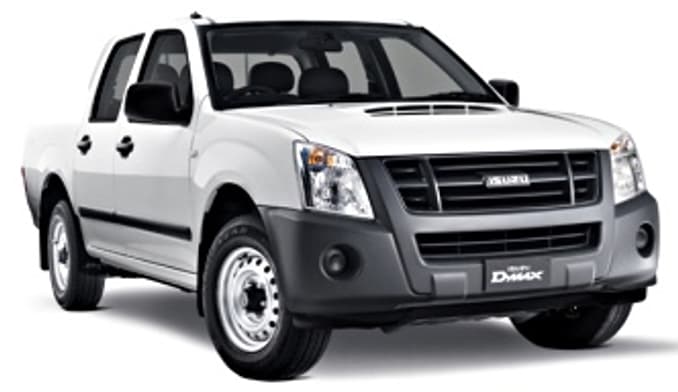
The 2009 Isuzu D-Max range of configurations is currently priced from $10,999.
Our most recent review of the 2009 Isuzu D-Max resulted in a score of 7 out of 10 for that particular example.
Carsguide Contributing Journalist Graham Smith had this to say at the time: SMITHY SAYSMight lack the bling of some others, but no-fuss workhorse gets the job done.
You can read the full review here.
This is what Graham Smith liked most about this particular version of the Isuzu D-Max: Designed to handle the tough going, Gutsy turbo-diesel
The 2009 Isuzu D-Max carries a braked towing capacity of up to 2500 Kg, but check to ensure this applies to the configuration you're considering.
The Isuzu D-Max is also known as Chevrolet Colorado, Chevrolet D-Max, Chevrolet LUV D-Max, Holden Colorado, Holden Rodeo, Isuzu KB, Isuzu LB, Isuzu Rodeo, Chevrolet T Series, GMC Canyon in markets outside Australia.
The Isuzu D-Max 2009 prices range from $7,260 for the basic trim level Dual Cab LS Artic Pearl LE (4x2) to $19,690 for the top of the range Dual Cab Ls-U (4X4).
What you’re experiencing is the front and rear axles fighting each other. Us old-timers call it axle wind-up and, as the name suggests, it’s what happens when the various wheels need to turn at different speeds, but can’t.
When you’re in 4H, you’re effectively driving the front and rear axles at precisely the same speed. Logic says this shouldn’t matter, but, depending on what lumps and bumps they’re covering at the time, there are times when the front and rear wheels need to travel at slightly different speeds. Throw in full steering lock, and you’ve just made things very difficult for the driveline with all sorts of competing forces being fed around the various tyres, axles and driveshafts.
This is far from limited to the Isuzu, and many four-wheel-drives without a centre differential (such as your D-Max) when driven at full lock in 4H will exhibit the same shunting and apparent loss of power. The power loss, meanwhile, is simply those front and rear tyres fighting each other; nothing to do with the engine at all.
When you shift back to two-wheel-drive (2H) the front and rear axles are suddenly free to turn at different speeds, and the sensation goes away. This whole situation is why you can’t use 4H on dry bitumen in a four-wheel-drive vehicle without a centre differential. Meantime, there’s no fix for it other than learning when and when not to engage 4H.
Show more
Any time you have a grinding noise from the driveline of a car, it’s time to have it checked out. That’s because continuing to drive it in that condition might cause more damage than was already there. Grinding sounds from the area of the transmission can indicate worn bearings in the gearbox which, if caught early enough can sometimes be replaced without resorting to a complete transmission replacement. Even so, it will be a big job as the gearbox will need to be removed and pulled apart.
You may also find while you’re inside the transmission that there’s other wear that needs to be addressed, at which point the decision becomes whether to repair or replace. You can buy a reconditioned transmission from a specialist shop, or a second-hand one from what was once called a wrecking yard. If you do the latter, make sure the used gearbox has been tested and comes with some sort of warranty. The cost of a replacement could be anywhere from $1000 to $10,000 depending on what you buy and where you buy it from.
Show more
Any time a diesel engine produces black smoke, it’s doing so because too much fuel is entering the engine. The danger then is that the engine will start to run hot and that can cause all sorts of meltdowns. But combined with a knocking noise, black smoke can also signal serious internal engine damage.
The best advice is to not drive it any farther and get a diesel specialist to look at it. Diesel engines often make a knocking noise as a normal part of their operation, but if this noise has changed, then something’s wrong.
Show more