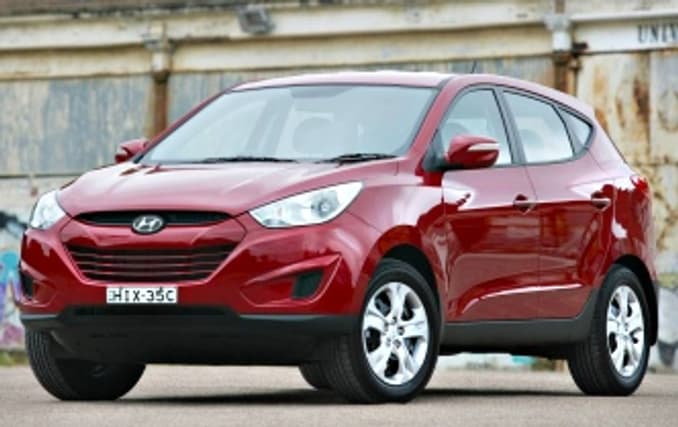
The 2011 Hyundai IX35 range of configurations is currently priced from $3,999.
Carsguide Contributing Journalist David Morley had this to say at the time: Had the Hyundai ix35 been a ground-breaking car in terms of its packaging or how it drove, maybe you could forgive the potential mechanical issues. As it stands, however, the lack of dynamic prowess combined with the chance of mechanical mayhem down the road means there are simply better choices out there.
You can read the full review here.
This is what David Morley liked most about this particular version of the Hyundai IX35: Lots of specification choices, Cheap to buy now, Turbo-diesel offers strong performance
The 2011 Hyundai IX35 carries a braked towing capacity of up to 1600 Kg, but check to ensure this applies to the configuration you're considering.
This is an increasingly common question as car makers take the decision to delete the conventional transmission dipstick from their cars. It’s probably down to the fact that modern transmissions claim to be sealed for life (many mechanics disagree with this) but the move probably also has something to do with preventing owner tinkering as well as the cost saving in not including a dipstick.
But for car owners like yourself who like to keep an eye on what’s happening under the bonnet, the way to check the transmission fluid all takes place underneath the car. Once you have access to the car’s nether regions, you’ll find an inspection plug on the transmission. If you remove this plug, you should find the level of the transmission just touching the lip of the plug-hole. If any drains out, the transmission is too full. If the level is too low (below the lip) you can add flid through this inspection hole.
The catch is that sometimes (follow the instructions in the owner’s manual for the detailed method) you need to have the car running and the transmission at normal operating temperature. Obviously, there are safety implications involved here, especially if you don’t have access to a workshop with a hoist.
With all that said, some Hyundais are, in fact, fitted with a conventional dipstick, making this check much easier. Again, your owner’s manual should reveal all.
Show more
When a bunch of electrical functions all go out at once (or within a short space of time of each other) suspicions are always drawn to the car’s body computer. This computer controls all the functions you mentioned as well as dozens of others from the heating and cooling, central locking, lights, wipers, dashboard and much, much more. When the computer starts to die (as most computers eventually do) these functions will start dropping one by one and sometimes in simultaneous batches of failures. Eventually, pretty much nothing will work and the car will not even respond to the key’s inputs.
An auto electrician is the best place to take the car, and as well as the computer, they will also check the car’s battery and charging system and the quality (or otherwise) of the car’s earthing points. Bad earths can cause similar problems to this, but the body computer remains a likely culprit.
Show more
With that list of problems, I’d be looking at having the body computer checked, at either a Hyundai dealership or a known automotive electronics specialist. Modern cars have computers to control not just the engine and driveline’s behaviour, but also the functions you’ve mentioned.
Central locking and sunroof problems are classic examples of a body computer that is not playing the game. You might find a specialist can reboot the computer to fix these flaws, but you may also be looking at a complete computer replacement.
But before you do any of that, try this little hack: Lock the vehicle and when you press the button to unlock it, hold the unlock button down for at least 30 seconds. Believe it or not, this can sometimes re-set the body computer and will fix all your problems. It’s a bit of a long-shot, but definitely worth a try.
Show more
The Hyundai IX35 2011 prices range from $4,510 for the basic trim level SUV Elite (Awd) to $8,690 for the top of the range SUV Active (Fwd).
| Hyundai IX35 Model | Body Type | Specs | Price from | Price to |
|---|---|---|---|---|
|
Active (Fwd)
|
Body Type: SUV | Specs: 2.0L ULP 6 SP AUTO | Price From: $4,950 |
Price To:
$8,690
|
|
Elite (Awd)
|
Body Type: SUV | Specs: 2.0L Diesel 6 SP AUTO | Price From: $4,510 |
Price To:
$7,150
|
|
Highlander (Awd)
|
Body Type: SUV | Specs: 2.4L ULP 6 SP AUTO | Price From: $5,500 |
Price To:
$8,360
|
| Hyundai IX35 Model | Body Type | Height x Width x Length | Ground Clearance |
|---|---|---|---|
|
Active (Fwd)
|
Body Type: SUV | Height x Width x Length: 1655x1820x4410 mm |
Ground Clearance:
170 mm
|
|
Elite (Awd)
|
Body Type: SUV | Height x Width x Length: 1655x1820x4410 mm |
Ground Clearance:
170 mm
|
|
Highlander (Awd)
|
Body Type: SUV | Height x Width x Length: 1655x1820x4410 mm |
Ground Clearance:
170 mm
|
| Hyundai IX35 Model | Body Type | Specs | Braked Capacity |
|---|---|---|---|
|
Elite (Awd)
|
Body Type: SUV | Specs: 2.0L Diesel 6 SP AUTO |
Braked Capacity:
1600kg
|
|
Highlander (Awd)
|
Body Type: SUV | Specs: 2.0L Diesel 6 SP AUTO |
Braked Capacity:
1600kg
|
|
Active (Fwd)
|
Body Type: SUV | Specs: 2.0L ULP 6 SP AUTO |
Braked Capacity:
1600kg
|
| Hyundai IX35 Model | Body Type | Specs | Fuel Consumption |
|---|---|---|---|
|
Active (Fwd)
|
Body Type: SUV | Specs: 2.0L ULP 5 SP MAN |
Fuel Consumption:
8.5L/100km
|
|
Elite (Awd)
|
Body Type: SUV | Specs: 2.4L ULP 6 SP AUTO |
Fuel Consumption:
9.2L/100km
|
|
Elite (Awd)
|
Body Type: SUV | Specs: 2.0L Diesel 6 SP AUTO |
Fuel Consumption:
7.5L/100km
|
| Hyundai IX35 Model | Body Type | Front Tyre Size | Front Rim | Rear Rim |
|---|---|---|---|---|
|
Elite (Awd)
|
Body Type: SUV | Front Tyre Size: 225x60 R17 | Front Rim: 6.5x17 in |
Rear Rim:
6.5x17 in
|
|
Highlander (Awd)
|
Body Type: SUV | Front Tyre Size: 225x55 R18 | Front Rim: 6.5x18 in |
Rear Rim:
6.5x18 in
|
|
Active (Fwd)
|
Body Type: SUV | Front Tyre Size: 225x60 R17 | Front Rim: 6.5x17 in |
Rear Rim:
6.5x17 in
|