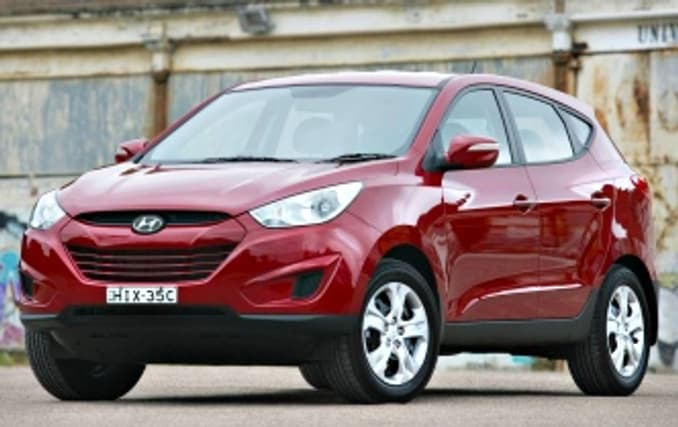
The 2012 Hyundai IX35 range of configurations is currently priced from $3,977.
Our most recent review of the 2012 Hyundai IX35 resulted in a score of 7 out of 10 for that particular example.
Carsguide Contributing Journalist Ewan Kennedy had this to say at the time: Look to spending from $9000 to $14,000 for a 2010 Hyundai ix35 Active FWD;$12,000 to $18,000 for a 2011 Highlander AWD or a 2013 Elite FWD;$14,000 to $20,000 for a 2011 Highlander AWD or a 2012 Elite AWD;$17,000 to $23,000 for a 2013 Elite AWD;$19,000 to $27,000 for a 2013 Highlander AWD;$20,000 to $29,000 2015 Elite AWD;and $24,000 to $33,000 for 2015 Highlander AWD.
You can read the full review here.
This is what Ewan Kennedy liked most about this particular version of the Hyundai IX35: Good build quality, Good amount of space for passengers and luggage, No real complaints about spare parts pricing and availability
The 2012 Hyundai IX35 carries a braked towing capacity of up to 1600 Kg, but check to ensure this applies to the configuration you're considering.
A poor earth is often the cause of this sort of misbehaviour and it’s a good place to start looking. Check the earthing points in the engine bay and around the area where the tail-lights are earthed in the cargo area.
You might need to lift some carpet or trim pieces, but when you find the earth points, make sure they’re tight and clean and not covered in corrosion. Don’t forget to check the tightness and cleanliness of the battery terminals, too.
Beyond that, these symptoms point to a problem with the car’s body computer which controls all these functions and many more.
When this computer starts to die, all sorts of weird and random flaws can occur. But try this first: Disconnect the battery of the car and let it sit overnight. Reconnect it next morning and keep a close eye on what happens. Sometimes this simple trick will reboot the body computer and normal service will be resumed. Best of all it’s free.
Show more
When an engine blows thick white (or bluish-white) smoke, it’s often a sign of internal engine wear. Some Hyundai engines have had problems with major engine components developing premature wear and causing similar problems to the ones you’ve experienced. But some Hyundai engines of this era also suffered problems with the EGR valve (exhaust gas regulation, part of the emissions control system) and that could lead to similar problems.
The best advice is to have the vehicle inspected for internal wear or any other problems that could be causing the smoking under load situation. This is pretty back to basics stuff and would include a compression test and leak-down test and should be well within the capabilities of any decent workshop. From there, you can make a more informed decision on whether to spend the money to have the car fixed, or cut your losses and move on.
It's also worth mentioning that Hyundai has been very pro-active in helping out owners who have experienced premature engine-wear problems, but the age of your car plays against this. It would be worth contacting Hyundai’s customer service division, however.
Show more
If you’re lucky, the problem might be as simple as a blown fuse that controls these circuits. So that’s where to start checking. The instrument panel lights and rear fog lights in the Hyundai are on separate circuits, so you’ll need to locate both fuses. Start with the internal fuse box located low down on the dashboard near the steering column. The inside of the cover will have a map of which fuse does what, but don’t forget there’s also a second fuse box under the bonnet.
If the problem is not a blown fuse, or the fuse blows again once you’ve changed it, you’ll probably need to services of an auto electrician to figure out where the power is going and what’s the cause. A poor earth somewhere on the car or a short circuit are two likely culprits.
Show more
The Hyundai IX35 2012 prices range from $5,500 for the basic trim level SUV Elite (Awd) to $10,010 for the top of the range SUV Elite.
| Hyundai IX35 Model | Body Type | Specs | Fuel Consumption |
|---|---|---|---|
|
Active (Fwd)
|
Body Type: SUV | Specs: 2.0L ULP 5 SP MAN |
Fuel Consumption:
8.5L/100km
|
|
Elite (Awd)
|
Body Type: SUV | Specs: 2.4L ULP 6 SP AUTO |
Fuel Consumption:
9.2L/100km
|
|
Elite (Awd)
|
Body Type: SUV | Specs: 2.0L Diesel 6 SP AUTO |
Fuel Consumption:
7.5L/100km
|