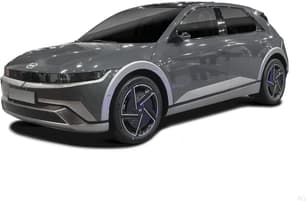
What's the difference?
This new Hyundai Ioniq 6 N asks one important question for the brand - how far can Hyundai go?
Not in the sense of driving range, but rather how far can the brand go in terms of both performance and price. The Ioniq 6 N pushes the limit on both, offering supercar levels of power and performance and at a price that continues to take the brand into unchartered territory.
This is the follow-up to the groundbreaking Ioniq 5 N, the all-electric performance SUV that launched in 2024. But, as you’d expect, in the intervening time Hyundai has been able to make improvements to push the Ioniq 6 N to new levels.
The Ioniq 5 N dramatically raised the bar for Hyundai, offering up to 478kW of power and 770Nm of torque, way beyond the 242kW/348Nm offered by the brand’s i30 N hot hatch. This was Hyundai’s ‘Godzilla moment’, when the Skyline GT-R changed the image of Nissan forever.
Now the Ioniq 6 N looks to push things even further. And it does so as the sole Ioniq 6 model grade in 2026, with the rest of the range currently unavailable in Australia, as the local operation waits for the facelifted model to arrive sometime in the future.
Toyota finds itself in a very unusual position - playing catch-up.
Usually the Japanese brand dominates any market segment it is in - or at least has one of the more popular offerings. But when it comes to mid-size electric SUVs, Toyota finds its bZ4X trailing well behind several rivals including the BYD Sealion 7, Geely EX5, Kia EV5, Tesla Model Y and Zeekr 7X.
There’s a very clear reason for this, too. Toyota was late to the party. The brand has taken a very slow approach to the electric vehicle (EV) market, launching its first battery-powered model, the bZ4X SUV, in early 2024.
Up until the start of 2026 and a price drop that coincided with surging petrol prices and a spike in EV demand, the bZ4X was something of a bit-player in the EV market. But with sales up more than 300 per cent in 2026 the time seems perfect to expand, with the bZ4X Touring reaching dealerships.
So is this the right SUV at the right time? Or is it too little too late?
In the Ioniq 6 N Hyundai has built an incredibly quick and high-capable performance car. But that doesn’t mean it’s flawless and an obvious recommendation over its rivals.
Its looks remain divisive, and while obviously each individual will need to judge the design of the Ioniq 6 N themselves, objectively speaking there is a lot to like about this latest addition to Hyundai’s N stable.
Yes, it’s very fast, but with all the N modes switched off it’s also a very quiet and relaxed sedan with a premium look and feel. So it will play the dual role of track terror and everyday family transport well.
But it needs to be for the price, which is really testing the limits of Hyundai’s brand appeal. It obviously won’t be a best seller, but with the less-polarising Ioniq 5 N only selling approximately 300 cars since its launch, this could be a very niche proposition, reserved only for those who crave its special kind of electric performance.
Note: CarsGuide attended this event as a guest of the manufacturer, with accommodation and meals provided.
Is the bZ4X Touring the right Toyota for this moment in time or too little too late for the brand to play catch-up to its EV rivals?
The good news for Toyota is that it isn’t too late, at all. The Touring expands the appeal of the bZ4X, metaphorically and literally, and certainly the sales trajectory in 2026 suggests buyers are warming to Toyota’s electric future.
However, it remains a more expensive proposition for its size and the Touring doesn’t really make it stand out amongst the crowd that includes the popular BYD Sealion 7 and Tesla Model Y. It’s unfamiliar territory for Toyota, but it didn’t become the automotive juggernaut it is by giving up, so there is every reason to think the bZ4X duo will chip away at the EV sales leaders.
Note: CarsGuide attended this event as a guest of the manufacturer, with travel, accommodation and meals provided.