What's the difference?
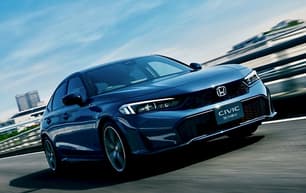
I’m just going to cut to the chase here. This Honda Civic hybrid is a good car. A great one, even.
But for some reason, nobody is really buying it. And it’s not just because it’s not an SUV – it has been outsold in its segment this year by the the BMW 1 Series, the Mercedes A-Class, the MG4 EV, and the VW Golf. Premium and non-premium alike, they’ve all got the little Honda licked.
So, what’s going on? A CarsGuide investigation is required. Stick around and we’ll try to figure this out together.
By God, but hasn't Lexus come an awfully long way from what was undeniably a drab and dull past? The Japanese premium brand now routinely pumps out cars that are not just fun to drive, but are even *gasp* fun to look at, too.
And should you trace the genesis of all this new-found excitement, you'll find it was the Lexus RC that started it all. That car, unveiled at the Tokyo Auto Show in 2013, was an early sign that Lexus was going to start pushing the envelope with its passenger cars.
The two-door, four-seat RC has just been updated for 2018, with added technology, safety kit and even a particularly un-Lexus launch-control system in the most powerful models.
High time we took a closer look then, no?
Talk about your new-car unsung heroes – I can't believe Honda's not selling more of these. So, if you can get over the price, and you worry it might be too small for you, I encourage you to check the Civic out. The back seat and boot are both bigger than you might expect, and the drive experience leaves most SUVs in the rear view mirror.
Still a rock-solid option in the (admittedly not massive) premium-coupe space, the Lexus RC looks and feels like a quality product. The 2018 update has addressed any safety shortcomings, even if the interior technology still feels a touch behind the times.
But an out-and-out performance car this ain't. Even in cars fitted with the big V8 engine, the RC behaves more like an effortless grand tourer than it does a performance coupe. But if we're being really honest with each other, that only serves to make it much easier to live with.
Beauty. Eye. Beholder. All that. But I reckon this Civic looks fantastic. Low-slung and sporty. The perfect antidote to all those bland, beige SUVs currently doing the rounds.
New as part of the most recent refresh is the front-end treatment, a new front bumper, more body-coloured flourishes and new designs for the 18-inch alloys.
I think it looks sleek, premium and purposeful, and not at all boring.
Inside, though, it’s a little less adventurous, though I do adore some of the little design touches, like the perforated metal effect that spans the dash.
The central screen is pretty small by modern standards, and you don't want to push too hard on some of the touch points, like the gloss-black highlights on the doors, which feel flimsy, flexible and pretty cheap.
Now, the screen. Does UX design count in the overall design section? Let's say that it does. I haven’t really experienced less intuitive and user friendly cabin tech lately.
For example, I couldn't figure out (though I must admit I didn't resort to owner's manual) how to get Apple CarPlay to load automatically, if you can.
Instead I had to select my phone, cycle through several screens of approval, and then select my phone again, every single time I got in the car. I had a similar issue using Google maps, which simply wouldn't connect at all for me.
Good tech is easy and intuitive. This wasn't.
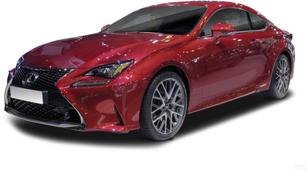
Yes, yes - eye of the beholder and all that business. But for mine, the RC looks terrific. We cycled through two models, the RC350 and the performance-focused F Sport, and both cut a fine and athletic figure on the road.
Front on, the pincered grille dominates the view, sweeping back into bonnet, and stretching to the lowest corners of the front end, while a flared-lip body kit runs the length of the body. Special mention also goes to the cat-claw swipes that live behind the rear wheels.
The regular RC models make do with twin exhaust tips, while the F Sport range scores quad pipes, separated by a slinky rear diffuser, and the rear spoiler is an integrated lip that forms part of the boot. Cooler still, the Carbon Edition adds lightweight elements, like a carbon-fibre roof panel and an active rear wing - with about 6.6kg shaved off the kerb weight.
Climb inside, and you'll find a quality - if slightly dated interior - with soft leather seats, carbon-effect trim elements and a new, 10.3-inch screen in the centre of the dash.
As you can see from our interior photos, though, some elements do now feel a little behind the times. The door panels feel harder than I'd like, almost as if a thin-piece of leather has been stretched over hard plastic, and the control unit in the middle of the cabin is awash with hard black plastic, and the knobs mounted on it feel a touch cheap and non-premium, too.
The Honda Civic measures 4569mm in length, 1802mm in width and 1415mm in height, and as you've no doubt already noticed, it's not an SUV, rather a liftback-style sedan.
But if you feel like you need an SUV to move a family, I beg to differ. While the middle seat in the second row is too tight for adults (owing largely to the intrusive raised tunnel that runs through the middle of the cabin), the two window seats can absolutely fit adult humans. I'm 175cm, and had absolutely no issue sitting behind my own driving position.
But the biggest surprise is the boot, which opens to reveal a flat and wide storage space that can swallow 409 litres (VDA) of luggage. In real terms, that's more than enough for our pram and the assorted knick-knacks that go with it on a baby day out.
Unfortunately, though, there’s no spare. Instead you’ll find yourself wrestling with a hateful repair kit should you get a puncture, and you don't want to wait for roadside assist.
There's also twin USB ports in the back, as well as air vents, along with twin cupholders in the pulldown divider.
Now look, if you see a future filled with trips to Bunnings or ferrying the troops to soccer training, the RC is not for you. It's a two-door, four-seat coupe - and those two rear seats couldn't be less helpful for adult-sized humans if they'd been painted on.
Its dimensions measure 4695mm in length, 1840mm in width and 1395mm in height, but most of that space is focused on the front-seat riders, where your surrounds feel sporty-snug, but not claustrophobic.
Up front, that cursed mousepad control system is still in full flight, but the screen it controls is now bigger. There are two cupholders to be shared between front-seat folks, as well as the usual compliment of USB and 'aux' connections. And even a CD player, for that matter.
Climb into the back, which is no easy task in and of itself, and you'll find the space cramped for anyone but kids. But while it's tiny, it's clever. Deep cut-outs in the rear of the front seats mean more room for your legs. Headroom, however, is a problem, and my (I'm 176cm) head was touching the roof.
There are two cupholders, at least, but - surprisingly - little in the way of entertainment connections. You will find an ISOFIX attachment point in both of the rear seats.
The boot opens to reveal a fixed 423 litres of space, which is handy enough for weekends away. Predictably, though, extra practical accessories are fairly limited - you can forget optional roof racks.
Ah, so we may have hit the first Honda hurdle. Ours is the entry-level e:HEV L, and it’s a cool $49,900, drive-away. The top-spec LX is $55,900, on the road.
To put that into perspective, Toyota's two Corolla sedan hybrid grades are about $36K and $39K, drive-away, at the moment. The admittedly non-hybrid Golf starts at $39,990, on the road.
The German premium brands are still more expensive, but I think that might be at least part of the Honda’s problem. It now occupies a space between mainstream and premium, which might also be something of a no-man’s land.
Still, the entry-level L is decently equipped, with 18-inch alloy wheels wrapped in quality Michelin Pilot Sport rubber, all-LED lighting all around and key-less entry.
Inside, there’s synthetic leather and fabric seats, dual-zone climate, a 9.0-inch central touchscreen with Apple CarPlay and Android Auto, but also with Google built-in that provides mapping and updates and a 12-speaker Bose stereo.
Both Civic variants also arrive with a three-year subscription to 'Honda Connect', which gives you remote access to your car to lock or unlock it, pre-heat or cool the cabin, or set a geofence alert if your teenagers are borrowing it, that sort of stuff.
But… there are no full-leather seats, there's no sunroof, no wireless charging and you have to open the boot yourself.
The lack of all that doesn’t feel overly premium.
As it is with most of the Lexus range, the RC model comparison is pretty straightforward. You need to pick your engine (300 or 350) and then choose your trim level (how much you want to pay), be it Luxury, F Sport or Sports Luxury. Only the RC F model line differs, because here you can choose from the base RC F trim, or the more expensive RC F Carbon.
Engine and kit aside, the RC family is the same basic set-up; four seats, two doors and coupe styling. The rest, then, depends on your intended price range.
Entry-level Luxury cars - $65,400 for the 300, $68,400 for the 350 - arrive with 18-inch alloy wheels, LED headlights and fog lights, leather trim, standard navigation, heated and ventilated front seats, dual-zone climate and keyless entry with push-button start.
Step up to the F Sport Trim - $74,700 for the 300, $77,700 for the 350 - and you'll get bigger 19-inch alloys, a better Mark Levinson stereo and rain-sensing wipers.
Finally, the Sports Luxury models - $84,900 for the 300, $87,900 for the 350 - get better seats, some fancier cabin furniture and a moonroof. All the RC models get a new 10.3-inch screen (but no Apple Car Play/Android Auto).
Step up to the the V8-powered RC F models - $138,100 for the base model, $152,300 for the RC F Carbon - and you'll add adaptive variable suspension and an improved safety package that we'll come back to under the Safety sub-heading. The Carbon variant - predictably - gets a carbon-fibre roof panel, active rear wing and some carbon-fibre interior trim elements.
On the colour palette, the regular RC range is available in 'Sonic Quartz' (white), 'Mercury Grey', 'Premium Silver', 'Sonic Titanium' (another silver), 'Onyx' (black), 'Graphite Black' and 'Infrared' (red). The performance-flavoured RC F cars nab some extra choices, including 'Cobalt Mica' (blue), 'Lava Mica' (orange) and the brand's new hero colour, 'Zinnia Yellow'.
A moonroof (or sunroof) is standard fit on the RC F models, as well as the Sports Luxury trim, while it's a cost option on the cheaper cars. Speaking of which, you'll find all sorts of goodies in the accessories catalogue, including unique floor mats.
Each price listed is the RRP, of course, so you'll be paying more in on-road expenses. But you knew that already, right?
The Civic range is an all-hybrid affair, which in this case is what Honda calls its 'two-motor hybrid', which pairs a 2.0-litre petrol engine with two electric motors, one being an electric generator, and the other being the actual propulsion motor which sends power to the wheels. Expect a total 135kW and 315Nm, which is sent to the front wheels via a CVT auto.
The more you spend, the more you get. Spring for the 300, and you'll find a 2.0-litre turbo engine nestled under the bonnet, good for 180kW at 5800rpm and 350Nm at 1650rpm. It pairs with an eight-speed automatic, and shuffles power to the rear wheels.
Step up to the 350-badged cars and your engine specs improve accordingly. You'll now find a 3.5-litre V6 motor providing the horsepower, good for 232kW at 6400rpm and 380Nm at 4800rpm. The gearbox (eight-speed auto) remains the same, and the power is still sent to the rear axle.
The pick of the power bunch, though, is the 5.0-litre V8 engine nestled in the RC F cars. It'll fire 351kW at 7100rpm and 530Nm at 4800rpm toward the rear wheels - more than enough to shift the 1820kg (tare) weight. It's paired with an eight-speed automatic, or what the Lexus spec sheet refers to as a "Sports Automatic".
There is no AWD or manual transmission option anywhere in the range, and for specific oil type etc, consult your owner's manual.
Honda says you can expect 4.2L/100km on the combined (urban/extra-urban) cycle, but we found the fuel use was a still impressive 5.5L or so, admittedly mostly in the city.
The 40-litre tank drinks 91 RON 'standard' fuel, meaning its cheapish to fill up, and — using Honda’s numbers at least — should deliver a 950km driving range.
Yesterday, 91 RON was about $1.80 per litre meaning you can theoretically get from Melbourne to Sydney for around $75.
Let's start from the top, shall we? There is a price to pay for power, and the V8-powered Lexus arrives with its claimed 10.9L/100km on the combined cycle. That's quite a lot, and it's a number that will surely only worsen if you drive the RC F the way that you really should drive it.
Things improve with the 3.5-litre capacity engine, recording 9.1L/100km on the same cycle, while the 2.0-litre engine will return 7.3L/100km.
There is no diesel engine anywhere in the range, and the fuel-tank capacity across the board is 66 litres, with 95RON fuel required.
First things first – I really, really like the way this Honda drives. There's a finesse, a confidence, in the drive experience that's sometimes missing from the new brands when they first arrive in Australia.
In short, it feels like it was engineered by people who really know what they're doing. That's the easiest way to describe it.
If you're used to driving older-fashioned hybrid systems you might be used to a bit of shuddering harshness when the engine kicks in, but that's simply not the case here.
Instead, the transition is seamless, with the Honda Civic making the choice for you and largely leaving you out of the process entirely.
Where the powertrain does let itself be more known is under heavier acceleration, with engine thrum seriously invading the cabin, without much in the way of flat-footed performance to accompany it.
But the magic of the Civic drive experience is in its balance. It's not a performance car, but there's real driver engagement to be found in the way it rides and handles. Equally, though, it's never uncomfortable, striking the balance between road-holding confidence and comfort really well.
Happy in the city, happy on a twisting road - this is not one of those smaller cars that leaves the drive experience as a secondary factor. It feels like it really has the driver at heart.
Having now spent a fair chunk of time behind the wheel of the V6 and V8-powered cars, we're ready to make a pretty bold claim: the six-cylinder engine is - and there's no other way to put it - simply more fun.
Shocking, I know, but there it is. There's effortless power on offer in the RC F models, of course, but it's the way that power is delivered that makes it feel like more of a loping grand tourer than a fire-breathing performance coupe.
For one, both the power and exhaust notes arrive in stages. So if you're gentle with the throttle - like you almost always are in the CBD or suburbs - it wafts around in near silence, the engine feeling anaesthetised, and like it's only using a tiny proportion of its available oomph.
The V6 engine just feels sportier. It's still not super emotional, but I think it reacts to inputs quicker.
Leave your foot buried, however, and the character transforms, the exhaust booming into life and that big V8 finally unlocking its prodigious power. With the adaptive dampers (no air suspension) set to the sportiest setting, it sits flat in corners, with nary a roll through the body. And while there isn't an intimate connection with the road below, nor masses of feedback through the steering, it does acquit itself well on the bends.
But... the V6 engine just feels sportier. It's still not super emotional, but I think it reacts to inputs quicker, and comes alive a little lower in the rev range than the big V8. It doesn't really matter if you're in Normal, Sport or Sport+, it just feels more vibrant. Hell, you can even get the traction light flashing if you're particularly silly with the accelerator.
And as such, it's our pick of the bunch. Sure, it can't match the outright performance of the V8, nor the speed of its 0-100km/h acceleration time, but it puts a bigger smile on your face in normal, day-to-day driving. And let's face it, that'll be 90 per cent of the time you spend behind the wheel.
The big safety news surrounding the Civic is that its eight airbags are joined by 'Honda Sensing', which packages up every safety system you can possibly imagine — forward collision warning, lane keeping, adaptive cruise, AEB – and delivers them as standard across the range.
But the bigger news is that, refreshingly, none of it is overly intrusive. Even the speed limit warning, which – as in most cars – always gets the speed wrong, just flashes gently on the driver display, rather than binging and bonging through the cabin.
The Civic Hybrid scored a full five-star ANCAP safety rating, with the score based on crash testing in Europe through Euro NCAP.
Standard safety across the RC includes dual front and front-side airbags, as well as front airbags for the second row. You'll also find a knee airbag for both driver and front-seat passenger. Forward-collision warning with AEB (and pedestrian protection) is standard fit, too, and so are front and rear parking sensors and a parking camera.
F Sport and Sports Luxury-badged cars add blind-spot monitoring and rear cross-traffic alert, along with lane-departure warning and lane-keep assist. The RC F and RC F Carbon both get radar cruise control and an active lane-departure system included in the standard offering.
The Lexus RC range is yet to be crash-tested by ANCAP, and so is yet to receive an Australian safety rating.
The Honda is covered by a five-year/unlimited-kilometre warranty, and servicing is every 12 months or 10,000km.
There is a capped-price servicing program, called 'Low Price Servicing', which means your first five services are $199, but don't cover things like brake pads and tyres.
The RC range is covered by a four-year/100,000km warranty, with service intervals pegged at 12 months/15000km. There is no capped-price servicing program on offer, but Lexus will guarantee you a loan car every time your vehicle is in the shop, and will even come to your house or workplace to collect - and drop-off - your car.
For any owner-reported reliability problems, keep and eye on our Lexus ownership page.