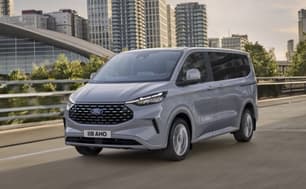
What's the difference?
Brand Finance self-effacingly describes itself as "the world's leading independent branded business valuation and strategy consultancy". And adds that it regularly picks apart the current and future value of more than 3500 brands across multiple market sectors around the world.
These London-based boffins reckon Delta trumps American Airlines, Real Madrid has knocked off Manchester United, and Haval is a more powerful SUV brand than Land Rover or Jeep. So, no surprise Haval promotes the research on its Australian website.
Just to split hairs, Land Rover leaps to the top of the rankings when it comes to overall value, but in terms of an upward trajectory and potential for future growth, Brand Finance says Haval is the one.
The irony is you probably wouldn't know a Haval if it ran into you, which obviously isn't good in any sense, but a factor of the Chinese Great Wall subsidiary's relatively brief time, and so far, limited sales in the Australian market.
One of three models released in late 2015 to launch the Haval brand locally, the H2 is a small, five-seat SUV competing against a hot bed of more than 20 established players including the segment-leading Mitsubishi ASX, ever-popular Mazda CX-3, and recently arrived Hyundai Kona.
So, is Haval's potential reflected in its current product offering? We spent a week living with the sharply priced H2 City to find out.
This idea hasn’t always worked out too well. Take a parcel-van (in this case the Ford Transit Custom) strip out the rubber matting and cargo barrier and bolt six or seven seats into what was the load area. Sure, the original vehicle to use this concept, the Volkswagen Kombi way back in the 1950s, got away with it, possibly because there wasn’t anything better around.
Ford has plenty of history with this notion, too. The first Transit of 1965 was also available as a mini-bus, but worked okay because the Transit itself was such a car-like departure from the commercial-vehicle norm.
Things didn’t go so well for Ford in the early 1980s, however, when the Econovan-badged parcel van it shared with Mazda (the E2200) was fitted with eight seats, given some fuzzy velour trim and dubbed the Spectron. And it was dreadful. In fact, so bad, that it made the contemporaneous Mitsubishi Nimbus and the even more forgettable Nissan Prairie seem like vastly superior alternatives to the job of moving people. Only because they were.
Early versions of the Spectron retained the Econovan’s crude suspension, wheezy (and fragile) little engines and even the tiny dual rear wheels that entirely deprived the vehicle of any traction. In fact, dreadful doesn’t even cover it.
So you can see why Ford might be a bit antsy about me referring to the new Tourneo (a badge that has been around in Europe for decades) as a Transit Custom with extra seats and windows. Yet that kind of sums it up (up to a point, anyway). Luckily, the Transit Custom itself is a pretty sorted thing these days, so maybe Ford has nothing to worry about. Maybe…
How you define value will determine whether the Haval H2 City is the right small SUV for you. In terms of metal for money it delivers heaps of space, a reasonable standard features list and adequate safety. But it's let down by mediocre performance, sub-par dynamics and a surprising thirst for (premium) unleaded. Brand Finance may rank Haval high on the power index, but the product needs to climb a few rungs higher before that potential's realised.
There’s absolutely no doubt that the van-based people-mover has some distinct advantages over a three-row SUV. The rear seat is bigger, access to it is far better and there’s more luggage space even when all eight seats are occupied. But the Tourneo goes a step or two further with the sliding, swivelling seats that make it one of the most practical and flexible interiors on the market.
True, the driving experience is a bit alien at first, but it’s a case of different, rather than worse. Meantime, the ride is excellent and the performance and economy from the turbo-diesel driveline are both absolutely spot on for this vehicle’s intended purpose.
And perhaps that’s the metaphor for the whole thing: By not trying to be something it’s not, and concentrating on what it needs to do, the Tourneo emerges as a bit of a quiet achiever.
As we said earlier, this type of vehicle concept is never a sure-fire proposition. Parcel vans converted to passenger duties haven’t always worked out. This time, though, it’s different.