What's the difference?
If you're in the market for a premium-style four-wheel drive wagon with eight seats and a petrol V8 engine and you live in Australia, your choices have been rather limited. You'd be looking at something like the Nissan Patrol or the Land Rover Defender 130.
Well, that has now changed as General Motors Specialty Vehicles (GMSV) is importing the GMC Yukon Denali to Australia. This top-of-the-range Yukon arrives here as a left-hand drive vehicle and is converted to right-hand drive at a facility in Victoria to suit our market.
The Denali has a price tag just under $175,000, though, and that makes it a lot more expensive than most vehicles that could be considered rivals in the Aussie market. Is it worth it?
Read on.
You might not think right now is the best time to buy a Holden, what with the announcement from General Motors about closing down its Aussie operations at the end of 2020.
That’s understandable but side-stepping around the Equinox could see you miss out on what is a practical, comfortable and safe mid-sized SUV.
You can also bet on some heavily discounted deals on the final Holdens which could see you pick up a huge bargain if you buy an Equinox.
I’ve tested the top-of-the-range Equinox LTZ-V in this review and along with taking you though its features and what the SUV is like to drive, I’ll cover what type of support you can expect to have after Holden closes down. The company has promised to take care of its customers with parts and services for at least the next decade.
Explore the 2020 Equinox LTZ-V in 3D below
https://my.matterport.com/show/?m=RnCngGtbQHx
The 2025 GMC Yukon Denali is a big, comfortable, eight-seat 4WD with few rivals in the Aussie market. However, while it may occupy its own niche, it doesn't offer enough in terms of premium look and feel and towing capacity over what could be considered its rivals – and it all comes back to that price tag.
While it lacks a competitive warranty and its price puts it way out of reach of a lot of 4WD buyers, if you are in the market for a big premium-style wagon with a V8 and eight seats – and the Nissan Patrol and Land Rover Defender 130 aren’t your cup of tea – then the Yukon Denali just might be the right choice for you.
But when all is said and done, for the price of the Denali, you could buy two Nissan Patrols – maybe not brand-new ones – and a camper trailer and a couple of cartons of beer.
Overlook the Holden Equinox LTZ-V and you could miss out on a practical, spacious and value-for-money mid-sized SUV. Concerned about Holden’s exit from Australia and how this affects servicing and parts? Well Holden has assured us that it will provide servicing support for 10 years following its closure at the end of 2020. If anything, you could be picking up a bargain and one of the last cars to wear a Holden badge.
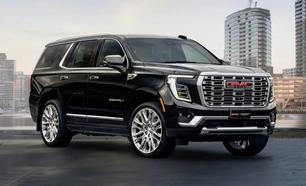
The 2025 GMC Yukon Denali is 5337mm long (with a 3071mm wheelbase), 2378mm wide, 1943mm high and has a kerb weight of 2813kg.
Suffice it to say, it’s big.
The signature Denali grille – with LED headlights and chrome accents – is the size of a house and it’s eye-catching.
In terms of design, the rest of the Denali is standard SUV, but it's so massive it can't help but have plenty of presence on the road.
This 4WD has 24-inch rims, which are not suited to off-roading at all, but I’ll get to that later.
The Denali’s dual exhaust system, with polished stainless-steel tips, adds to the street-cool aesthetic.
The rest of the Denali exterior works – but it’s an in-your-face kind of success.
Inside, the space is cavernous and with leather upholstery, wood-look trim and soft-touch surfaces you’d expect it to feel like a plush, well-appointed cabin. But it doesn’t quite hit the mark.
Sure, all three rows of seats offer enough in terms of comfort and amenities but, for a $175,000 vehicle, the cabin lacks a distinctive premium feel, as you'd assume it should in a vehicle at this price point. That's a bit of a disappointment.
Big cheesy grin grille? Check. Flowing curves? Check. Sharp creases? Check. Irregular shapes? Check.
The Equinox is a bit of a mishmash of design elements which doesn't win this reviewer over.
The sloping, broad grille bears more than a passing resemblance to the Cadillac family face, and hints at the Equinox’s American origins. In the United States the SUV wears a Chevrolet badge, although ours is built in Mexico.
The shape of the rear-side window is also a little jarring to me. If you want to see something you’ll never be able to unsee, take a look at my video above where I turn this mid-sized SUV into a small sedan. That sounds ridiculous but, trust me, watch it and be amazed.
How big is the Equinox? Just when you thought the design of the Equinox couldn’t get any more peculiar it does. The Equinox is longer than most of its rivals at 4652mm end-to-end but about the same width at 1843mm across (2105mm to the ends of the wing mirrors).
Telling the LTZ and the LTZ-V apart is tricky, but you can spot the top-grade Equinox by its sunroof and a metallic window garnish around the widows of the rear doors.
Inside is a premium and modern cabin. There’s a high quality feel here from the materials used on the dash, seats and doors, to the display screen which sits at an angle that’s perfect for my reach, although others in the CarsGuide office aren’t quite as enamored with it.
Many cars are dressed up at the front of the cabin, but lack the same treatment in the rear, and the Equinox is a case in point, with hard plastics used around the window sills and the back of the console.
The Denali has retractable sidesteps, which is a big help to hobbits, such as me, and it also has big grab handles, again a welcome addition for the purposes of easier ingress for those on the wrong side of tall.
Once you climb inside, it’s easy to appreciate the fact that this wagon’s interior is vast, functional and comfortable, with plenty of storage spaces for everything – glove box, centre console, sunglasses case, door pockets etc – and plenty of charge points for your array of smart devices, even a wireless charge pad.
It’s a well-designed cabin but, as mentioned earlier, the Denali lacks the prestige fit and finish and even build quality usually showcased in something at this price-point.
Instead, there are expanses of hard plastic throughout, storage receptacles with flimsy lids, and lacklustre fit and finish here and there.
The vertically-oriented 16.8-inch touchscreen multimedia system is simple enough to use, even when the road gets bumpy, although it sometimes took a few stabs of my finger to get the system to register a command.
Climate control switches and the like are located under the screen.
The three rows of seats offer more than adequate levels of comfort – the front seats are heated and ventilated and the second row’s outboard seats are heated – and each row also has the appropriate amount of amenity to suit its occupants, including cupholders, USB-C sockets, map pockets and the like.
The second-row seats even have 12.6-inch HD colour touchscreens – one on the back of each front-row headrest – with which to enjoy… whatever. Those units also have wireless headphones so everyone else in the vehicle doesn’t have to listen to… whatever.
Those in the third row get air vents, a USB-C plug and two cupholders on both sides.
Rear cargo volume with all seats up is 722 litres. With the second row folded that number expands to 2056 litres, and with only the front seats left standing you have a 'yuge' 3480 litres to play with.
The boot area has tie-down points, a shallow section of underfloor storage and plenty of packing potential. The tailgate door is power-assisted with remote open and close.
As I mentioned, the Denali’s interior is very functional and very comfortable and that includes the second and third row, which offer plenty of space.
Overall, my thoughts on the Denali’s cabin interior boil down to “massive”, “comfortable” and “feels cheap”.
The Equinox’s greatest strength is its spaciousness and much of that comes down to its wheelbase.
See, the longer a car’s wheelbase the more room there is for the passengers inside. The Equinox’s wheelbase is longer than most of its rivals (25mm longer than a CX-5’s) and that goes some way to explaining how, at 191cm tall, I can sit behind my driving position with plenty of knee room.
The longer wheelbase also means the rear wheelarches don’t cut far into the back doors, which allows for a wider aperture and easier access.
So, if you have young kids like me, they’ll find it easy to climb in, but if they’re really little the large opening will make it easy for you to put them into their car seats.
Headroom, even with the LTZ-V’s sunroof, is good in the back seats, too.
Cabin storage is excellent: the centre console bin is enormous, the door pockets are large; there are four cupholders (two in the back and two up front),
Even with all this extra room, however, the Equinox is only a five-seater SUV. Still, that leaves you with a large boot with cargo capacity of 846L when the rear row is up and 1798L with the second-row seats folded.
The Equinox has power outlets galore: three 12-volt sockets, a 230-volt power point; five USB ports (including one type C); and a wireless charging bay. That’s more outlets than any mid-sized SUV I’ve tested.
A flat floor in the second row, large windows and comfortable seats complete a well-appointed and practical cabin.
Really, the only reasons the Equinox doesn't score 10-out-of-10 here is the lack of a third-row seat, and sunshades or privacy glass for the rear windows.
The 2025 GMC Yukon Denali is a top-shelf, eight-seat, 4WD V8-powered wagon with a price-tag of $174,990, before on-road costs.
The standard equipment list is a comprehensive and its more notable features include a 16.8-inch touchscreen multimedia system (with wireless Apple CarPlay and Android Auto - but no sat-nav), a 14-speaker Bose sound system, power-adjustable heated and ventilated leather-accented seats, a head-up display, 12.6-inch rear HD touchscreens for the second-row passengers, a panoramic sunroof and an auto-sense power rear door.
It also has a 360-degree high-definition camera system (with up to 11 camera views), power-retractable sidesteps, 24-inch machined and painted 'pearl nickel' alloy wheels (on Bridgestone all-season tyres), all-around adaptive air suspension and a maximum braked towing capacity of 3628kg (when it has a 70mm ball and weight-distribution hitch).
Exterior paint choices include 'Onyx Black', 'Summit White', 'Titanium Rush Metallic', 'Volcanic Red Tintcoat' (on the test vehicle and costs $2000), 'Downpour Metallic', 'White Frost Tricoat' and 'Sterling Metallic'.
The Holden Equinox LTZ-V is the fanciest version you can buy with its list price of $46,290. That may sound expensive, but the standard features list is massive.
There’s an 8.0-inch screen with Apple CarPlay and Android Auto, sat nav, heated leather seats, dual-zone climate control, a Bose sound system with digital radio and also wireless charging.
Then there are the roof rails, the front fog lights and LED headlights, heated wing mirrors, and 19-inch alloy wheels.
But you get all that on the grade below it, too - the LTZ for $44,290. So, adding the V to LTZ along with an extra $2K adds the panoramic sunroof, ventilated seats up front, and a heated steering wheel. Still great value, but not as good as the LTZ.
Also, as Holden gets closer to the 2021 finish line you can expect the prices of it cars and SUVs to be heavily discounted - after all, everything must go
If you’re considering an Equinox, you could do a model comparison with the Mazda CX-5 or Honda CR-V. The Equinox is a five-seater, mid-sized SUV, so, if you’re looking for seven seats but roughly the same size and price there’s the Hyundai Santa Fe.
The GMC Yukon Denali has a naturally-aspirated 6.2-litre V8 petrol engine – producing 313kW and 624Nm – and that’s matched to a 10-speed automatic transmission.
This is an impressive set-up – the Denali is punchy off the mark, smooth and refined at highway speeds and overall it offers a composed and comfortable driving experience.
The Denali has a full-time 4WD system, selectable driving modes include 'Normal', 'Sport', 'Off-road' and 'Tow' and an electronic limited-slip differential is standard.
The Equinox LTZ-V has the most powerful engine in the Equinox line-up – a 188kW/353Nm 2.0-litre four-cylinder turbo-petrol engine.
The only other grade in the line-up to have this engine is LTZ, although it doesn’t have the LTZ-V’s all-wheel drive system.
It’s a powerful engine, especially considering that it’s just a four cylinder. Only a bit more than a decade ago V8s were making less power.
The nine-speed automatic transmission shifts slowly, but I found it to be a smooth unit at all speeds.
Obviously, with such a big vehicle – almost three tons – driven by such a big V8 engine, fuel consumption is a concern. The 2025 GMC Yukon Denali has a listed fuel consumption figure of 12.8L/100km (on a combined, urban/extra-urban cycle).
I recorded 16.2L/100km on this test. I did a lot of high- and low-range 4WDing and this wagon was never working hard.
The Denali has a 91L fuel tank so, going by my on-test fuel-consumption figure, you could reasonably expect a driving range of about 560km from a full tank.
Holden says the Equinox LTZ-V all-wheel drive with the 2.0-litre turbo-petrol four-cylinder and nine-speed auto transmission will use 8.4L/100km over a combination of open and urban roads.
My fuel test covered 131.6km, with 65km of that being city and suburban roads, while 66.6km were on the motorway almost entirely at 110km/h.
At the end of that I brimmed the tank with 19.13L of 95 RON premium unleaded which works out to be 14.5L/100km.
The trip computer disagreed and reported 13.3L/100km. Either way that’s a thirsty mid-sized SUV and it hadn’t even been carrying a full load of people or cargo.
The Denali is imported to Australia as a left-hand drive vehicle and then Walkinshaw's subsidiary company Premoso remanufactures the US 4WD wagons to right-hand drive at their facility in Clayton, Victoria.
And that mob has done a commendable job.
Firstly, the Denali is very impressive on general driving duties – settled and composed, that V8 just rumbles along. It’s pretty close to flawless on the open road - smooth and refined.
But off-road is a different story – especially in low-speed technical low-range 4WDing – and a lot of that has to do with the Denali’s sheer bulk and its 24-inch wheels.
The big pizza plate rims and paper-thin Bridgestone all-season tyres (285/40) aren't suited to four-wheel driving as they don’t offer the grip of a decent all-terrain and you can’t drop air pressures because there isn’t enough tyre there. Worth noting the spare is a Maxxis Bravo HT-750 (265/70R17).
In its favour, though, the Denali has a range of drive modes – one of which is Off-road and that seems well calibrated for a variety of 4WD situations – as well as high- and low-range gearing and an electronic limited slip diff.
Steering has a nice balance to it at low speeds, throttle response is quite impressive and controlled. And you can call on that 624Nm from the big 6.2-litre V8 pretty much as you see fit, and it delivers it smoothly and in a controlled fashion.
This top-shelf variant has air suspension – that does some levelling out of even major imperfections in the road or track surface – and it does have a special damper system also working away to even out ride and handling.
In terms of off-road measurements, the Denali offers approach, departure and rampover angles of 24.8 degrees, 20.5 degrees and 22.5 degrees, respectively.
Ground clearance is listed as 205mm, wading depth is not quoted, but likely a guesstimated 700-800mm, and turning circle is 12.4m.
And again, this is a big vehicle – 2813kg – so it requires more consideration, more patience, more skill and probably more experience than perhaps some smaller four-wheel drives do.
The Denali's payload is listed as 634kg, which is not a lot for a massive vehicle like this. Its towing capacities are 750kg (unbraked) and 3500kg braked.
If you do, however, put a 70mm tow ball and a weight-distribution hitch on the Denali, you can tow as much as 3628kg legally (braked).
That's not a lot more than something like the Nissan Patrol, which is 3500kg, or the equivalent 4WD wagon or ute available in Australia already. So the extra towing capacity in the Denali is not that big of a selling point. GVM is 3447kg and GCM is 6577kg.
Ultimately, even though the Denali has sound four-wheel drive mechanicals and reasonable off-road traction control, it's hampered by its gargantuan dimensions and let down by its 24-inch wheels and paper-thin tyres.
If you got rid of the standard wheel-and-tyre combination and replaced it with a set of decent, aggressive all-terrain tyres on 17 inch or 18 inch, or even (if you had to) 20 inch wheels, those changes would go a long way to making this over-sized 4WD capable in some off-road scenarios.
In its current state, however, the Denali is a tow vehicle playing at 4WDing rather than the other way around.
The Equinox’s handling isn’t superb and the ride could be more comfortable, but this is an SUV with far more good points than bad.
Such as impressive power from that four cylinder engine, and an all-wheel drive system which provides excellent traction, to the good visibility, and a stack of safety features.
But while I can excuse the average dynamics, the 12.7m turning circle proved annoying in car parks. Not knowing you can make U-turns in the space provided is an anxiety you should only experience when driving a bus.
Five-point turns aside, the LTZ-V is easy to drive, with accurate steering providing good road feel.
The GMC Yukon Denali does not have an ANCAP safety rating because it has not been tested.
Standard safety features include six airbags (including full-length curtain airbags for all three rows) and a full suite of driver-assist tech includes AEB (with pedestrian detection), adaptive cruise control, blind-spot monitoring, lane-keep assist, rear cross-traffic alert, front and rear parking sensors, tyre-pressure monitoring, a surround-view camera, trailer sway control, trailer hitch guidance with hitch view and more.
The Holden Equinox was given the maximum five-star ANCAP rating when it was tested in 2017.
Coming standard is advanced safety technology such as AEB with pedestrian detection, blind spot warning, rear cross traffic alert, lane keeping assistance and adaptive cruise control.
For child seats there are two ISOFIX mounts and three top-tether points. There’s also a rear-seat alert to remind you there are children sitting in the back, when you park and switch off the vehicle. Don’t scoff… it’s happened to parents before.
Front and rear parking sensors are standard, but in the media menu you can swap the ‘beeps’ for ‘buzzes’ that vibrate the seat to let you know when you’re getting close to objects.
The driver’s seat that is, if everybody’s seat buzzed that’d be weird. Actually, who am I kidding – it’s weird that even the driver’s seat buzzes.
The rear-view camera is good, and the LTZ-V comes with a 360-degree view, as well – great for when kids are running around the car.
A space saver spare wheel sits under the boot floor.
The 2025 GMC Yukon Denali has a three-year/100,000km warranty – which is on the wrong side of ordinary in this day and age.
Roadside assistance is available for three years but check with your dealership for more details on that.
Servicing is scheduled for every 12 months or 12,000km. The first three workshop visits come in at $398.33, $420.33 and $506.48, including GST. Not outrageous for such a hefty beast.
The Holden Equinox is covered by a five-year, unlimited kilometre warranty. At the time this review was published Holden was offering seven years’ free scheduled servicing.
But normally, the Equinox is covered by a capped price servicing program which recommends servicing annually or every 12,000km and costs $259 for the first visit, $339 for the second, $259 for the third, $339 for the fourth and $349 for the fifth.
So, how will servicing work after Holden closes down? In Holden’s February 17, 2020, announcement that the company will cease trading by 2021 it said that it would support Australian and New Zealand customers in honouring all existing warranties and guarantees, while providing servicing and spare parts for at least 10 years. The current seven-year free servicing offer will also be honoured.