What's the difference?
The flagship GAC M8 PHEV Luxury we’re reviewing lives in a strange corner of the family car market. It’s a people mover, but it’s priced like a luxury SUV, designed like a VIP shuttle and powered by a plug-in hybrid system that suggests someone, somewhere, had very specific plans.
It finds itself up against the fully-electric LDV Mifa 9 and Zeekr 009, while also circling the upper end of the Kia Carnival range. The latter of which has proven itself to be the default choice for families.
Which begs the question - who is the GAC M8 actually pitched towards? Families with older teens or ageing grandparents feel like a more natural fit than those deep in the child-seat phase, largely because the M8 prioritises space, comfort and efficiency over the usual kid-wrangling conveniences.
At the same time, its chauffeur-like identity hints at a broader, more commercial audience and one more focused on quiet efficiency and passenger comfort. What can be agreed is the real point of difference here isn’t packaging or versatility, it’s the M8’s plug-in hybrid powertrain, and the way it reshapes where a people mover like this sits within the broader electrified landscape.
Does that approach make sense once you live with it? Let's find out.
Maserati's Quattroporte is part of a dying breed. A decade or so ago, the European manufacturers took a huge amount of pride in their range-topping big luxury sedans, cars you can either drive or be driven in, bristling with the latest technology.
In 2015, all we hear about are the range-topping SUVs from those makers, with cars like the S-Class and 7 Series fading slowly into irrelevance.
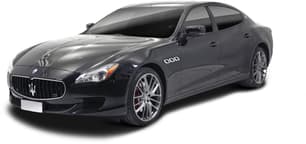
While by no means low-tech, the Maserati Quattroporte takes the high style route, focussing on a luxurious interior with that handmade feel.
The GAC M8 PHEV Luxury is a people mover that carves out a very specific niche, largely thanks to its plug-in hybrid powertrain and ambitious price point. It’s undeniably well specified and genuinely luxurious inside, but it never quite escapes its chauffeur-like identity as it's a vehicle built around passenger comfort rather than driver engagement.
Being a new brand in our market limits ownership appeal, at least for now. Where the M8 really impresses, though, is efficiency, and that alone may be enough to justify its unusual positioning.
Beauty is way more than skin-deep in the Quattroporte and while the 330 doesn't have the punch of the S, it's hardly that much slower. Maserati reasons you will want to spend the $25,000 saved on options, concentrating on the Italian craftsmanship rather than the outright performance available in the V8 or the efficiency of the less aurally attractive diesel.
As with any car of this type, you've got to want one in the first place, but for a big, beautiful sedan, there's nothing as good looking this side of an Aston Rapide. The Quattroporte 330 does nothing to dim the allure of Modena's big mover and, if you're that way inclined, nobody on the outside will ever know.
The GAC M8’s design is… well, it’s out there. This isn’t a people mover that fades politely into the background. There are clear parallels with the Lexus LM, right down to the towering grille (complete with a vague hint of spindle shaping), which may well be the tallest grille I’ve encountered!
It’s a big unit, too, measuring 5212mm long, 1893mm wide and 1823mm high. The overall shape is sharply squared-off and prioritises presence over dynamism. It also comes standard with a full suite of LED exterior lighting.
The cabin claws back some design cred, though, as it’s downright plush with its semi-aniline two-tone leather upholstery - finished in a lush burgundy/black duo in our test vehicle. Accent panels vary between a diamond-design for the dashboard and doors, to suede soft-touchpoints and rose-gold inserts liberally scattered across the cabin.
The only accent that doesn’t land is the large swathes of piano black on the centre console as it’s hard to keep clean.
There are some nice little surprises, too, like the fidget spinner-style crystal gear lever, which is surprisingly fun to fiddle with at traffic stops and two sunroofs with the rear fixed panel illuminating with internal ambient light.
Some of the finishes aren’t the best as there are joinery and door handles that don’t line up properly, which is surprisingly more annoying than you’d think once you notice it. But overall, the cabin feels well-considered and luxurious, even if the execution isn't always flawless.
Long, flowing lines mark out the Maserati as something quite different to its German, British and Japanese competition. This Quattroporte has increased in every dimension but the lines cover its size beautifully.
Big wheels, long wheelbase, low ride but it still looks like a sedan rather than pretending to be a coupe.
The elegance of the lines is complemented by a distinct lack of bling – there's little in the way of chrome work or shouty details. There's plenty satin finishes available and the beautiful paint, while available in pretty much any colour you like, is best kept to a restrained, deep hue. Or silver.
The cabin will doubtless age well. Classic shapes house a fairly conventional but hugely comfortable cabin. The front seats have heaps of adjustment and are large but supportive. Naturally, the leather is soft and supple.
The central screen isn't the dominant feature, like a 50-inch LCD screen in a small living room while buttons are kept to a minimum.
The rear seat is sensationally comfortable, with hectares of available space and a seat comfortable for either lounging or working.
There are two grades available for the GAC M8, and for this review we’re in the flagship Luxury, priced from $83,590, before on-road costs. It’s an awkward vehicle to compare because, right now, it’s the only people mover on sale with a plug-in hybrid powertrain.
Its closest like-for-like rivals in terms of size, specification and middle-row captain’s chairs are the all-electric LDV Mifa 9 Luxe and Zeekr 009 (FWD), priced from $129,000 and $115,900, before on-road costs, respectively. Compared to them, the M8 presents strong value. The equation looks less convincing when it’s parked alongside the flagship Kia Carnival Hybrid, which starts from $76,630 MSRP, though the intended markets between the two are notably different.
GAC hasn’t held back on features in the Luxury grade. The front and middle-row captain’s chairs are power-adjustable and offer heating and ventilation, with the middle seats also gaining full recline, extendable footrests and a massage function. Curiously, the driver misses out on massage, though.
Other highlights include a front sunroof with manual blind, a second fixed glass roof, semi-aniline leather upholstery for the first two rows with leather in the third, and a heated steering wheel. Practical conveniences are well covered too, with powered sliding rear doors, a hands-free powered tailgate, acoustic Michelin 18-inch tyres (designed to reduce road noise), a 360-degree camera system, manual rear sunblinds, three-zone climate control and one-touch ‘reset’ buttons for the middle-row seats.
Technology feels thoughtfully specified rather than excessive. There’s a 12.3-inch digital instrument cluster, wireless Apple CarPlay and Android Auto, Bluetooth connectivity and an eight-speaker Yamaha sound system. Charging and power options include six USB-A ports, one USB-C port, a 12-volt socket and a 220-volt AC outlet. The 10.1-inch multimedia touchscreen looks larger than it is thanks to its housing, though it ultimately sits on the smaller side for a vehicle pitching itself at the luxury end of the market.
The current Quattroporte has been with us now for a couple of years in diesel and petrol turbocharged V6s and turbo V8 forms.
The 330BHP uses the same, Ferrari-built V6 but detuned to 'just' 330 bhp. The price has been detuned too, dropping $25,000 from the V6 S's entry price to kick off at $210,000.
Maserati 330bhp benefits from an overall specification improvement across the range, landing in your garage with a ten-speaker stereo with USB and Bluetooth, power everything, dual-zone climate control, keyless entry and start, front and rear parking sensors with reversing camera, cruise control, sat-nav, auto headlights and wipers, double glazed windows and an interior covered in leather and wood.
Later in the year, your Quattroporte will be available with a new silk trim from Zegna
Only very occasionally does it become clear that Maserati is part of the Fiat Group and that moment comes when you use the 7.0-inch central screen in the dash.
eight-speed ZF automatic transmission
The software is based on the group's UConnect and it isn't great. It's not bad, but it feels its age (however, it's much better than the system on the Gran Turismo), needing a lot more work or a quick surrender to Apple's CarPlay or Android Auto.
Once you work your way through the weird menus, it's fine to use and is miles ahead of the not-much-cheaper Lexus LS unit which is almost unusable.
Sound from the ten speaker stereo is crystal clear and the phone performance is also very good.
Both M8 grades share the same plug-in hybrid powertrain, pairing a 2.0L, four-cylinder, turbo-petrol engine with a single electric motor. Combined, they produce up to 274kW of power and 630Nm of torque which is impressive on paper, though it only manages 0‑100km/h in 8.8 seconds. Once the battery is depleted, outputs drop to a more modest 140kW/320Nm. Power is sent to the front wheels through a two-speed automatic transmission, and the M8 is not rated for towing.
To get the best performance from this type of set-up will require diligent recharging.
Like the S, the 330bhp is powered by Maserati's twin turbo 3.0 litre V6, made with more than a dash of Ferrari involvement. As the name suggests, it produces 243kW and a chunky 500Nm. With just under two tonnes to shift, the ubiquitous eight-speed ZF automatic transmission whisks the Quattroporte 100km/h in 5.6 seconds, only half a second down on the 301kW V6 S.
Maserati claims 9.1L/100km on the combined cycle (with the help of stop-start), which seems reasonable given our figure of 10.8L/100km, which we got a with a mix of city and highway running as well as a very enthusiastic blast through some secret back roads.
Around town, the M8 delivers plenty of power and is whisper-quiet when running in electric mode. Once the battery depletes or you switch over to the petrol engine, that sense of instant oomph fades. Overtaking on hills is achievable, but even with an empty car it can feel a little underwhelming.
Steering is light, but the car feels solidly planted in most situations. Handling isn’t as dynamic as a Kia Carnival and the M8 can feel a touch ungainly through bends, though it’s more than manageable for everyday driving.
Ride comfort is high, especially for passengers, due to forgiving suspension and a cabin that doesn't let a whole lot of road or wind noise in. The M8 is a comfortable cruiser.
Visibility is surprisingly good for a 5.2m-long vehicle with minimal blind spots from the driver’s seat. The bonnet and dash, however, stretch further than they appear, which can make judging the nose a little tricky at first.
Ground clearance is only 143mm, so it’s easy to scrape the nose over speed bumps or when parking. The 360-degree camera system is decent, but manoeuvring into tight spaces still requires some care as it fills out a space. You also have to leave about a metre of clearance behind you if you want to open the tailgate.
Just a few hundred metres behind the wheel is all it will take to convince you the Maserati belongs in the same class as the competition. It's incredibly quiet – courtesy of the acoustic double glazing – and all occupants benefit from supreme comfort.
While the 330 is 58kW down on the full fat V6, you won't really miss them. There's a fat torque curve, with all 500Nm available from 1750 to 5000rpm, meaning easy progress for the 5.2 metre sedan.
The Quattroporte has two sport buttons to choose from – one looks after the drivetrain and exhaust valving while the second stiffens up the Skyhook suspension.
With the first sport button pressed, you get a more lively throttle, sharper shifts and a glorious noise from the exhausts, although they are a long way from your ears.
It's still a fast car, with strong acceleration from standstill and in the gears, the power as linear as you like with no real turbo lag and a most un-turbo noise to go with the performance.
The only dynamic problem is the electric steering – it seems to get confused between your inputs and feedback from the road, the tyres feeling like they're 'nibbling' an uneven surface, tweaking the wheel in your hands.
The assistance is a little spotty, too, unexpectedly changing weight. It's just a bit weird. In normal driving, you'll never notice it.
The M8 hasn’t been tested with ANCAP yet and is unrated but it has a good suite of safety equipment including seven airbags with the curtain airbags covering all three rows but unique for the class is another airbag across the rear windscreen. However, it misses out on a front centre airbag., which is a strange omission now.
Standard equipment includes big-ticket systems like blind-spot monitoring, autonomous emergency braking, forward collision warning, lane keeping aid, lane departure warning, traffic sign recognition, rear cross-traffic alert and a clear 360-degree view camera system with front and rear parking sensors.
There is a sound alert and driver seat vibration that activates for some systems which I found to be a good addition. There’s also four ISOFIX child seat mounts (two in each rear row) and a total of five top-tether anchor points. While the M8 has adaptive cruise control, it’s not well-calibrated and creates a middling on-road experience.
Six airbags, ABS, stability and traction controls, brake assist, blind spot monitoring and rear cross traffic alert.
There is no ANCAP or EuroNCAP safety rating for the Quattroporte.