What's the difference?
Ford has introduced what is being touted as an adventure-type van to its Transit Custom line-up and it’s called the Trail.
The Trail is based on the long-wheelbase Transit Custom Trend and it’s equipped with a suspension lift, on-demand all-wheel drive, 'Trail' drive mode, LED headlights and daytime running lights, a variant-specific grille, black wheel arch moulding and side strip, yellow exterior decals and 16-inch matt black twin-spoke alloy wheels.
With all that in mind, maybe a van is your next adventure vehicle?
Read on.
Is there a class of vehicle more overlooked in Australia than the humble light van?
While the pragmatic and often hatchback-based small van is dwarfed in size and sales by the popular ute as the commercial vehicle of choice here, the case is completely reversed in Europe, where light commercial vans dominate city streets, favoured for their compact nature and relative fuel efficiency.
What is it about Australia which makes the ute more successful? Is it just our history of locally producing them? Do you really even need one, or are the Europeans on to something?
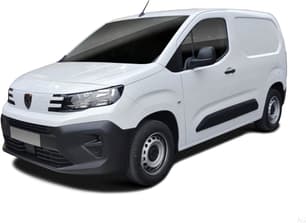
I spent a week reacquainting myself with the freshly facelifted 2025 Peugeot Partner to find out.
The Ford Transit Custom Trail has plenty of appeal as a work van or a camper fit-out candidate. It’s a well-packaged, comfortable and contemporary van that’s nice to drive and as a bonus, with all-wheel drive it’s given the scope of capability to be able to tackle mild off-roading situations with confidence.
It’s built for work and play and though it’s limited to two-up for travels, the Trail offers so much potential as a camper conversion for adventure seekers its few niggles are easily forgotten when you’re busy making memories.
It might not be the most modern looking or feeling small van, but amongst its competitors, the Partner stands out for its relative value and load-lugging capabilities.
It’s somewhat fun to drive but now feels a bit plain on the inside, and could benefit from a few extra options and features to make it more comfortable and maybe even a little more customisable.
Still, I think the Peugeot Partner will fit the needs of many primarily city-based small businesses or tradies who want to work out of a compact and easy-to-drive van instead of an unwieldy and often overkill dual-cab ute.
It looks like a van but with some striking yet low-key flourishes that all kind of work as a whole. Those include a Trail grille and the matt black alloy wheels. The yellow sticker-pack is a neat touch.
The Trail has more presence than a regular Trend with its 30mm-taller raised suspension and overall adventure-ready look with strong front end and chunky wheel arches.
The striking but low-key theme continues inside with a neatly laid-out yet spartan cabin. The two synthetic leather seats are topped with Trail embossing and lined with yellow stitching.
The cabin is separated from the rear cargo area by a bulkhead, which incorporates a small wired window.
The Partner’s recent update brings with it a new, more contemporary face, with the ‘claw’ style light fittings clasping a body-coloured panel in place of the usual grille fitting. It also updates all the badgework to match the French brand’s passenger car range.
Thanks to these upgrades, as well as the fetching colour and Premium body-matching highlights, it looks pretty schmick at a distance, but up close you can start to tell the Partner’s relative age.
It simply doesn’t look as contemporary or coherent in its design as the much newer ground-up fifth-generation Caddy or third-generation Renault Kangoo with which it competes.
A big part of this is due to the Partner being based on a much older platform which is shared across a lot of Stellantis brands. It started life as the third-generation Citroen Berlingo in 2018, and needs to warp its look overseas to fit the Fiat Doblo, Toyota Proace and Vauxhall Combo (although the Partner is the only version sold in Australia).
As a result, up close you can see its somewhat pieced together brand identity bits and boxy, upright bodywork.
There are some odd touches, like the plastic bumper at the front not matching the gloss black highlights or body coloured bumper at the rear, and the contemporary badgework finished in a matt grey adds yet another texture and colour to the mix.
The theme continues inside, with a huge plastic dash piece jutting into the cabin space. Here, the bits from Peugeot’s passenger car range have been integrated, including the cool 'squircle' steering wheel, digital dash elements and the multimedia screen.
In the centre, the electric shifter part from cars like the current 2008 small SUV has been embedded in the sea of plastic.
It technically matches the brand identity, but it doesn't stop the Partner’s interior from feeling a bit cobbled together, rather than the more unified corporate identity which is so well executed in the VW Caddy, which is almost hard to tell apart from a Golf.
The software is another area the Partner could use some work. It’s fairly simple and straightforward to use, but the layout isn’t very customizable, both for the multimedia suite and digital dash.
Again, the Caddy runs rings around Peugeot in this department, with its more impressively-featured and nicer-looking software it shares with other VW Group passenger cars.
There are also little areas which feel like they’re behind the pace for a top-spec variant. The steering wheel is hard plastic without even the option for a softer wrap, for example, and the Caddy offers an alternate optional synthetic leather seat trim for an operator willing to dish out a little extra cash.
It’s a van so there are two distinct sections to the Trail, the cabin and the load space.
Firstly, the cabin. More a work-friendly than family-friendly interior, this Trail is a two-seater with plenty of durable plastic everywhere – ready for work and life – as well as charging (with USB-A and -C ports) and storage (including a van-favourite dash-top slot for logbooks etc, outboard moulded cupholders and a nifty pop-out cupholder), all amenities enough to cope with most daily van-related duties.
The seats are comfortable, supportive and have a fold-down lock-in-place armrest.
Now for the load space. There are no seats back there and as such it has plenty of potential as a work van or touring vehicle.
Access to the rear load space is via a barn door at the back and this Trail has a sliding door on both sides.
The cargo area is substantial – 3002mm long (to the bulkhead; 3450mm long if load-through hatch is used), 1392mm wide (between wheel arches) and 1425mm high (floor to roof). Easily big enough for work equipment or recreational gear. It can cope with four Euro pallets (each measuring 1200mm x 800mm) and it has a listed maximum load volume (with the bulkhead) of 6.8 cubic metres.
Load height through the rear barn doors is 531-585mm, depending on how much weight is already onboard.
The load space has the aforementioned metal bulkhead (with window and load-through hatch), load area protection kit (full height walls and moulded floor), LED lights and eight tie-down loops.
Otherwise, this is a load area ripe for customisation. Maybe a plethora of shelves for a tradie, or some bedding and extra storage for an adventurous person or couple.
So design-wise the Partner might barely hit the brief when it comes to matching it up with Peugeot passenger car design, but one area where it manages to shine is in-cabin storage.
There’s lots on offer, massive bottle holders and pockets in the doors, storage areas galore in the big plastic dash, with trays in the centre and passenger side, as well as behind the multimedia screen and under the shifter.
There are a set of non-variable bottle holders cut out of the top of the dash, as well as hidden storage compartments under both front passenger seats.
I should mention at this point the Partner has a three-across front bench, although actually putting three people in there will be quite the squeeze, especially given the centre of the dash juts quite far into the cabin area, leaving the centre occupant with nowhere to put their knees.
Maybe it will suit a child in a pinch if you plan to have this as a small business vehicle which may need to be dual-purpose from time to time.
There’s also a fold-down rotating table thing in the backrest of the centre position, designed to be used with a laptop. Another feature of the Partner’s dash is physical toggles and buttons for the climate controls, which are increasingly rare in favour of touch-based menus.
In terms of load area dimensions, the Partner LWB offers 3.9 cubic metres (excluding the bulkhead) and dimensions come in at 2167mm long, 1527mm wide (1229 between the arches) and 1243mm tall. This should accommodate two Euro-sized palettes.
Loading and securing should also be relatively breezy thanks to sliding doors on both sides, a barn door rear which hinges out of the way for forklift loading, and no less than 10 tie down rings.
It also scores decent LED lighting in the roof, so you can see what you’re doing in a poorly lit warehouse, or when using the load area at night.
As for capacities, the Partner LWB has a payload of 898kg. It claims a 950kg braked towing capacity (not much more than the unbraked of 740kg) although in reality 740 seems to be closer to the limit thanks to the 74kg towball download rating.
How does this compare to the Caddy? I was surprised to find the Caddy 5 in equivalent LWB form has a smaller load area (3.7 cubic metres) and a significantly lower payload of 695kg.
However, it can tow slightly more (up to a claimed 1500kg - however has a 75kg max towball download). Additionally, the Partner isn’t able to be fitted with a tailgate to replace the barn doors (an option which some buyers may prefer on the Caddy).
A full size spare wheel is present on all variants to keep you on the road.
The 2025.75Y Ford Transit Custom Trail has a MSRP of $61,990 (excluding on-road costs).
Standard features onboard include a 13-inch multimedia touchscreen (with wireless Apple CarPlay and Android Auto), a 12-inch digital instrument display and synthetic leather upholstery with Trail logos on the seats.
Other gear includes an eight-way manually adjustable driver’s seat, keyless entry and start, front and rear parking sensors, climate-control air and automatic LED headlights.
It also has all-wheel drive, LED headlights and daytime running lights, a variant-specific grille, black wheel arch moulding and side strip, yellow exterior decals and 16-inch matt black Trail twin-spoke alloy wheels.
The standard no-cost exterior paint is 'Frozen White'. Anything else – 'Agate Black Metallic', 'Grey Matter', 'Magnetic' or 'Moondust Silver' – will cost you $700.
Given the uniquely European nature of a van like this, it makes sense the remaining options offered to us are only from French and German makers.
In fact, this Peugeot Partner is one of just three left for you to choose from. Starting from $39,990, before on-roads (for a Pro SWB), the Partner goes into battle against its Gallic nemesis, the Renault Kangoo, and the defending small van champion in the form of VW’s popular fifth-generation Caddy.
Unlike its rivals, though, the Partner range is automatic only and exclusively powered by a three-cylinder, turbo-petrol engine (if you exclude the electric ePartner).
This immediately gives it a leg up, as in its most affordable form, it already undercuts the base manual Caddy (TSI220 SWB - $40,990) and most affordable automatic Kangoo (SWB auto - $41,990) although the Renault holds onto the most affordable price-tag in the segment if you’re happy shifting yourself, at $38,990 for its SWB manual.
The specific version we’re looking at for this review is the Premium LWB, which wears a price-tag of $45,990 and adds an additional 350mm to its length over the SWB.
Standard kit on Premium versions includes items otherwise missing on the Pro, like 16-inch alloy wheels instead of steel wheels, LED headlights instead of halogen, push-start ignition instead of turn-key, dual-zone climate instead of single-zone as well as body-coloured highlights, rails and door handles in place of plain plastic fittings.
Standard items across the range include a 10-inch central touchscreen with wireless Apple CarPlay and Android Auto, a digital instrument cluster, cloth seat trim, a 180-degree reversing camera, a digital rear vision mirror to make up for the standard windowless barn doors, a glaze-finish bulkhead to separate the cabin and load area, as well as an array of active safety items we’ll explore later.
The fetching blue scheme our car was painted in comes at an additional $690, and from there you can modify further with an array of factory options.
Key among them are a choice of windows for each sliding door ($486 each) or the barn door ($503), a metal cargo barrier to protect the bulkhead ($1146), an LED cargo light kit ($350), roof racks ($536) or a more comprehensive roof kit ($2610).
Additionally, long-wheelbase versions can be equipped with a cargo bay floor kit ($894), wall protection kit ($960) or the rubber floor mat which our van had ($600).
A complete towing set-up will set you back $1045 for the towbar and $510 for the wiring harness.
From a base of nearly $50K then, you can easily add a few thousand to the price once you start ticking boxes, but it is important to note not every commercial van, even ones a size up, offer this level of factory customisation.
This gives the Partner deeper (and warranty-covered) customisation for various trade purposes straight from the factory.
For what it’s worth, I matched our test car in the configurator and ended up with a final price of $52,429 with drive-away pricing set to Sydney.
Out of curiosity, I also priced up a VW Caddy Cargo LWB petrol auto with as close as I could get to the same equipment as this Partner Premium, and was surprised to find I had to tick a lot more option boxes to get LED headlights, alloy wheels (although the Caddy alloys are larger at 17-inches), premium paint, colour matching body panels, keyless entry with push-start and a rubber floor mat.
The total price for the spec-matching Caddy came in at $57,952 drive-away in Sydney.
The Ford Transit Custom Trail has a 2.0-litre four-cylinder turbo-diesel engine producing 125kW at 3500rpm and 390Nm at 1750-2500rpm.
The Trail has a clever eight-speed automatic transmission and an on-demand all-wheel drive system.
It all works rather well, but it’s a van afterall and as such it is less dynamic and more dependably driveable than perhaps a cross-shopped SUV wagon. However, as an AWD van the Trail can be trusted to keep its grip on wet bitumen, soggy grass and loosely-gravelled tracks and that’s a strong part of its appeal over a 2WD van.
There is just one combustion engine option in the Partner range, a three-cylinder 1.2-litre turbocharged petrol unit producing 96kW/230Nm which drives the front wheels via an eight-speed automatic transmission.
The only alternative to this is the E-Partner which sports a 100kW/260Nm electric motor instead.
The three-cylinder petrol is a perky unit sourced from Peugeot’s passenger car line-up, although the Partner range doesn’t quite offer the VW Caddy’s breadth of options; the choice of a 1.5-litre four-cylinder petrol or a 2.0-litre diesel in two states of tune.
The Ford Transit Custom Trail has an official combined cycle (urban/extra-urban) fuel consumption figure of 8.5L/100km. On this test I recorded 8.8L/100km.
The Trail has a 70-litre fuel tank so going by my on-test fuel figure you could reasonably expect a driving range of about 795km from a full tank of diesel. However, as with any vehicle, once you’ve loaded the Trail with real-world burdens (e.g kids, dogs, camping gear, etc) you’ll soon see that fuel consumption increase.
One of the key downsides of the Peugeot’s Euro-compliant turbo-petrol engine is it requires mid-shelf 95RON fuel, which could be a blow to those who want to drill down on running costs.
Claimed fuel consumption on the official combined (urban/extra-urban) cycle is decent, at 6.3L/100km. Ours spent the week mainly urban commuting and landed closer to the official urban number of 7.3L/100km with a total of 7.2L/100km over a few hundred kilometres.
The 60-litre fuel tank should allow for roughly 950km of driving range at the official consumption. More like 830km using our test figure.
It’s easy to get in and out of the Trail’s driver seat with a wide-opening door and a big step to help you inside.
The seats are comfortable and it’s simple enough to dial-in your driving position via the tilt-and-reach adjustable steering wheel and manually-adjustable seat.
Word of warning: the auto transmission is operated via a stalk mounted on the right-hand side of the steering wheel column, which takes some getting used to.
Once underway, the Trail is punchy enough around town and in the suburbs with its 2.0L 'EcoBlue' turbo-diesel engine offering a more-than-adequate amount of power and torque (125kW and 390Nm) and its clever auto helping out with nifty moves through traffic (for a van, anyway).
Visibility is impressive from the cabin and you’re afforded a convenient vantage point with the Trail standing a bit taller than its regular Transit Custom stablemates as it’s on lifted suspension, but feeling composed on most surfaces.
The Trail has a listed kerb weight of 2046kg and a turning circle of 12.1m, pretty standard for a long wheelbase van, so this is not an insubstantial vehicle and it’s a bit tricky to 'flip a u-ee' if the situation demands it.
It has six drive modes – 'Normal', 'Eco', 'Slippery', 'Tow/Haul', 'Sport', 'Trail' – which each adjust engine torque, throttle response and traction control, among other things, to suit the road surface and conditions.
But we’re all here to see how it goes off-road, aren’t we?
Well, obviously this is no rock-crawling machine and it’s not intended to be. It’s best thought of as having an all-wheel drive system that gives this van mild off-road capabilities, as in it can tackle wet bitumen, soggy grass, lightly corrugated bush tracks and very shallow mud puddles with more confidence than the Transit Custom Trend it's based on.
In a nutshell, the AWD Trail will be able to handle most low-level traction-compromised scenarios. But it does not have enough ground clearance, wheel articulation, grip or underbody protection to tackle any terrain beyond modest off-roading.
Speaking of grip, the Trail as standard rides on Bridgestone Duravis R660 (215/65 R16) rubber, a van/light truck commercial tyre and they are not so well suited to dirt tracks and the like. Grippier all-terrain tyres would help this van perform slightly better off-road than on its showroom rubber.
In its favour, the Trail has a front skid plate and underbody protection in case it cops some knock from the ground during its adventures.
Not in its favour, however, especially as a potential touring vehicle, is the fact it has a space-saver spare wheel and tyre.
If you’re thinking of using your Trail as a tourer, it’s worth knowing payload is listed as 1179kg, maximum braked trailer towing capacity is 2500kg, Gross Vehicle Mass (GVM) is 3225kg and GCM is 5725kg.
One thing which I always like about these little European vans for trades is they’re usually very humane and easy to drive compared to a dual-cab or a van in a larger market segment.
They tend to offer closer to the feel of a passenger car, with some of the little luxuries which are missing in big hollow diesel units like some form of refinement and less noise.
The Partner is no different, and shone in some ways I did not expect.
The brand has done a good job of making it feel like a Peugeot passenger car from a touch-point perspective with the dash elements and the small chuckable steering wheel.
It also has a swift steering ratio, making even this LWB version feel nimble and agile for darting around corners and down tight laneways just as I’m sure its French creators envisaged.
The peppy three-cylinder engine helps the hatch-like feel. It offers a punchy turbo surge and a satisfyingly gruff soundtrack, which makes this little commercial offering quite fun to drive.
The ride is also remarkably smooth for a commercial vehicle, even completely unladen. Car-like suspension handles the bumps and potholes of the city environment well, which could make this a good choice for delivery drivers who will spend a lot of time in urban environments, and maybe are less concerned about getting so close to the GCM rating.
However, it’s not quite as polished as the Caddy, which won me over big time when the fifth generation version arrived in 2022.
The Peugeot can suffer from significant bouts of turbo lag, and its eight-speed transmission can be occasionally jerky from a stand-still, making for the odd awkward moment at T-junctions and roundabouts where this van takes a second to get going again.
Additionally, some of the fun, refined feeling wears away over time as you constantly come into contact with the hard plastic trims of the interior, and the scratchy urethane steering wheel.
This can get a bit jarring over a full day of driving. It’s for this reason VW puts a leather-bound steering wheel in even basic versions of the Caddy these days.
The software also leaves a lot to be desired, with minimal customisation and laggy interfaces.
Sure, the reality is you’ll spend most of your time working with Apple CarPlay or Android Auto which worked perfectly in my time with the car, but it would be nice to have more customisation for the dash and a few nicer menus for the multimedia screen.
All in all, then, it’s a nice little van to drive, and is excellent at urban duties, but it has a slightly industrial character which will eventually catch up with you after a long day behind the wheel.
The Caddy is better in pretty much every way behind the wheel, but then it also costs over $5000 more in equivalent spec and can't carry as much stuff.
Ford’s five-year/unlimited kilometre warranty applies to the Trail.
Servicing is set down for every 12 months or 30,000km and capped-price servicing is offered. Four scheduled services will set you back $2000 (including a brake fluid change at year three) which isn't over the top for a vehicle of this type.
Ford Australia has about 195 independent Ford dealers in Australia, with many located in metropolitan or suburban areas.
The Partner is covered by a par-for-the-course five year and 200,000km warranty which applies to the rest of its light commercial range, paired with five years of roadside assistance.
The Partner requires servicing once every 12 months or 15,000km.
When it comes to pricing, you can package the car up with either a two- or four-year service plan (priced at $400 or $1000, respectively) which Peugeot claims can save you up to $437 compared to a-la-carte servicing.