What's the difference?
Ford's small hatch, the Focus, is criminally under-bought in Australia. The latest model is one of the best hatchbacks on the road and when you chuck in the decent price, impressive equipment and absurdly powerful engine for its size, it's a winner.
But you lot? You don't buy it in nearly the kinds of numbers it deserves. Partly because there isn't a bait-and-upsell boggo model to lure you in, partly because it's got a badge that is not exciting Australians any more and partly because it's not a compact SUV.
Or is(n't) it? Because alongside the ST-Line warm hatch is the identically priced and therefore technically a co-entry level model; the Focus Active. Slightly higher, with plastic cladding, drive modes and a conspicuous L on the transmission shifter, it's a little bit SUV, right?
Life comes at you fast, especially in the automotive industry, where model lifecycles are becoming shorter as each new generation comes and goes.
Take the BMW 4 Series for instance. It’s been a segment stalwart since 2013, but the current model’s time in the sun is finally coming to an end a little later this year.
And that got us thinking whether or not the old saying rings true in this context. So, we put the flagship 440i coupe to test to find out if the older you get, the wiser you are.
Ten years ago, the idea that the higher-riding version of a hatchback would be a good city car would have been laughable. The Focus Active is pitched as a kind of SUV with its different low-grip driving modes, which you'll never touch if you stick to the city.
The Ford Focus is genuinely a brilliant car, no matter where you take it. The Active takes a terrific chassis, tweaks it for comfort but, ironically, doesn't lose much of the speed.
Is now the right time to buy a 4 Series coupe? With the next-generation model a matter of months away, probably not.
That said, those buyers who decide to park a new ‘old’ 4 Series coupe in their driveway will be very pleased with their purchase.
At the end of the day, the current-generation model is still a cracking sports-luxury coupe, and more so when in 440i form. It’s just that good.
For a fairly conservative hatchback, the Focus came under fire for what some termed its derivative styling. I quite like it, and not just because the styling work was led by an Australian. The front end is very much family Ford, as long as it's the European arm of the family, fitting in with its smaller sibling, the Fiesta. The Active scores the usual black cladding, higher ride height and smaller diameter wheels, in exchange for more compliant, higher-profile tyres. All of that takes nothing away from a design that I think looks pretty good.
The cabin is well put together, with just that oddly angled touchscreen causing me a bit of a twitch. The design is a fairly steady Ford interior with a lot of switchgear shared with the Fiesta, but it's all quite nice. The materials feel mostly pleasant and the hardwearing fabric on the seats feels right for this kind of car.
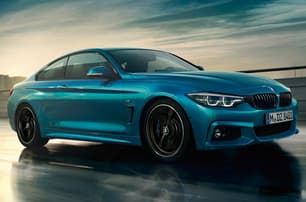
The first-generation 4 Series coupe has aged relatively well, despite sharing most of its design cues with the superseded sixth-generation 3 Series sedan.
Compared to current BMW models, the 4 Series coupe’s signature kidney grille is small, flanked by angry-looking adaptive headlights with hexagonal daytime running lights, all of which are of the LED variety.
The 440i’s standard M Sport body kit adds to the aggressive styling with chunky front bumper with three large air intakes, the outer two of which also contain the LED fog lights.
Around the side, a strong shoulder line stretches from the front wheel arches to beyond their rear counterparts, while BMW’s Air Curtains split the difference between it and the sporty skirts.
The rear end is the 440i’s simplest angle, although its bumper is spruced up with a dark-grey insert and dual exhaust tailpipes. Predictably, L-shaped LED tail-lights punctuate the styling at the rear.
Inside, the 4 Series coupe is holding up well, but it's still clearly a generation behind most other new BMW models.
That said, it’s a throwback we quite like, particularly iDrive6, which is still arguably BMW’s best multimedia system to date. Powering a floating 8.8-inch touchscreen in this instance, it’s just so intuitive, partly thanks to its rotary controller.
An 8.8-inch digital instrument cluster is a late-life addition for the 440i, and while it looks great with its drive mode-specific views, it lacks the breadth of functionality of Audi’s set-up.
The 4 Series coupe’s cabin is otherwise pretty basic despite its apparent emphasis on sportiness, although the selection of luxurious materials used throughout is top-notch.
The entire dashboard, chunky M Sport steering wheel and old-school handbrake lever are trimmed in high-quality leather, while lower-quality Dakota leather covers the sports seats, armrests and door inserts.
Soft-touch plastic is used for the door shoulders and bins, even in the second row, while hard plastic is limited to the centre console, and gloss-black trim is used on the centre stack’s audio and dual-zone climate control surrounds.
The Focus is quite roomy compared to other cars in its class. The rear seat has good leg and headroom, with the feeling of space accentuated by large windows. Annoyingly, though, all that work put into making the rear a nice place to be is ruined by a lack of amenities like cupholders, USB ports or an armrest.
Front-seat passengers fare better with two cupholders, a roomy space at the base of the console for a phone and a wireless-charging pad. The front seats are very comfortable, too.
The boot starts at a fairly average 375 litres - clearly sacrificed for rear-seat space - and maxes out at 1320 litres with the seats down. While you have to lift things over the loading lip and down into the boot, it's one of the more sensibly shaped load areas, with straight up and down sides. Ironically, the smaller Puma has a noticeably larger boot.
Measuring 4640mm long, 1825mm wide and 1377mm tall, the 440i coupe is a true mid-sizer, and that means it’s surprisingly practical – for the most part.
Cargo capacity is more than solid, at 445L, but stow the 60/40 split-fold rear bench via a pair of manual latches located in the boot and more storage space is quickly liberated.
To make matters even better, the boot has two bag hooks and four tie-down points, making securing a load a cinch. That said, the high load lip means bulkier items can require a little more effort to accommodate.
Up front, the door bins are large enough for a regular bottle each, while a pair of cupholders separate the gear selector from a seriously shallow storage tray.
The central storage bin is on the shallow side, too, albeit not to the same degree as the dedicated storage tray. That said, much of its space can be taken up by the optional wireless smartphone charger ($200), which was fitted to our test car.
The glovebox tries its best to make up for the lack of genuine in-cabin storage options by being quite large, while storage nets are attached to the backs of the front seats.
Rear occupants can also make use of a large storage tray that resides where a middle seat would otherwise go. They also have access to a fold-down central armrest that incorporates two more cupholders.
Speaking of armrests, the rear side ones are incredibly narrow, leaving tired elbows in a bit of a pickle.
It’s not all bad news in the second row, though, as legroom and toe-room behind our 184cm driving position are very generous, with the former offering several inches of wriggle room.
We’d go as far as to say the rear quarters are comfortable, but that would require ignoring the fact that headroom is seriously compromised with the optional power-operated sunroof ($3000) fitted, with our head pressed firmly against the 440i coupe’s Anthracite roofliner.
Either way, child seats can be fitted in the second row, with ISOFIX anchorage points available for the outer seats. Speaking of which, it’s worth noting ingress and egress to the rear bench isn’t too bad, with the front seats folding forward via manual latches.
Connectivity-wise, two USB-A ports are found in the first row, split between the centre stack and the central storage bin, while three 12V power outlets are spread across the front and rear of the centre console, and the boot.
The Focus Active wears a $30,990 sticker but the several people I know who bought one haven't paid that much, so Ford dealers are obviously keen to do deals. Even at that price, it's got a fair bit of stuff. The Active has 17-inch wheels, a six-speaker stereo, dual-zone climate control, reversing camera, keyless entry and start, front and rear parking sensors, cruise control, auto LED headlights, LED fog lights, sat nav, auto wipers, wireless hotspot, powered and heated folding door mirrors, wireless phone charging, a big safety package and a space-saver spare.
Ford's SYNC3 comes up on the 8.0-inch screen perched on the dashboard, which weirdly feels like it's facing away from you slightly. It has wired Apple CarPlay and Android Auto, sat nav, DAB+ and also looks after various functions in the car.
The panoramic sunroof is a stiff $2000 and includes an annoying perforated cover rather than a solid one.
The 440i coupe is priced from $103,200 plus on-road costs, positioning it as a more affordable alternative to its main rivals, the Audi S5 coupe ($105,400) and Mercedes-AMG C43 coupe ($116,500), although it’s not as fully featured.
Standard equipment not already mentioned in the 440i coupe includes dusk-sensing lights, rain-sensing wipers, 19-inch alloy wheels, a mixed set of run-flat tyres (front: 225/40, rear: 255/35) and power-folding side mirrors with heating.
Inside, satellite navigation with live traffic, digital radio, a 600W Harman/Kardon sound system with 16 speakers, a windshield-projected head-up display, keyless entry and start, power-adjustable front seats with heating, an auto-dimming rearview mirror and ambient lighting feature.
Ford does an excellent range of small turbo engines. The "normal" Focus range (such as it is, now the wagon has disappeared from the market) comes with a 1.5-litre turbocharged three-cylinder engine. Bucking the SUV-this-size trend (yes, I know it's not really an SUV), this punchy little unit delivers an impressive 134kW and 240Nm. They're both very decent numbers for such a small engine.
The big numbers continue with the transmission boasting eight gears, a number you don't often find in a hatchback. It's a traditional torque-converter auto, too, so those of you who have bad memories of Ford's old PowerShift twin clutches should worry no more.
Power goes to the front wheels only and you'll get from 0 to 100km/h in 8.7 seconds.
The 440i coupe is motivated by a silky smooth 3.0-litre turbo-petrol in-line six-cylinder engine that punches out 240kW of power at 5500rpm and 450Nm of torque from 1380-5000rpm.
An equally silky smooth eight-speed torque-converter automatic transmission exclusively sends drive to the rear wheels – a characteristic that has become a rarity in this segment.
This combination helps the 440i coupe sprint from a standstill to 100km/h in a scant five seconds flat with launch control engaged, according to BMW. Its top speed is electronically limited to 250km/h.
Ford's official testing for the big window sticker delivered a 6.4L/100km result on the combined cycle. In my time with the Focus, I got 7.2L/100km indicated on the dashboard, which is a pretty solid result given the Focus spent a good deal of the time on suburban or urban roads.
With its 52-litre tank, you'll cover around 800km if you manage the official figure, or just over 700km on my figures.
The 440i coupe will drink a claimed 6.8 litres per 100 kilometres on the combined cycle, while its carbon dioxide emissions are 159 grams per kilometre.
Our week of testing skewed towards city driving over highway stints, and we averaged 8.6L/100km, which is impressive given the six-cylinder performance on offer. And yes, we did put it to use...
The 440i coupe's 60L fuel tank takes 95RON petrol at minimum.
Despite the very mild off-road pretensions, if it's a comfortable city ride you're after, the Active is the Focus to have. While the ST-Line isn't uncomfortable - not by a long way - the Active's more compliant tyres and higher ride height (30mm at the front and 34mm at the rear) iron out the bigger bumps without sacrificing much of the sportier car's impressive dynamic prowess, even with the low-rolling-resistance tyres.
The cracking 1.5-litre turbo is responsive and well-matched to the eight-speed auto. The big torque number pushes you along the road and makes overtaking much less dramatic than a 1.5-litre three-cylinder has any right to.
Ford's trademark Euro-tuned quick steering is also along for the ride, making darting in and out of gaps a quick roll of the wrist, which has the added benefit of meaning you rarely have to take your hands off the wheel for twirling. That darting is aided and abetted by the engine and gearbox, with the turbo seemingly keeping the boost flowing with little lag. It's almost like they planned it that way.
You have good vision in all directions, which almost renders the fact that the blind-spot monitoring is optional acceptable. Almost. It's very easy to get around in, easy to park and, just as importantly, easy to get in and out of. Compared to, say, a Toyota Corolla, the rear doors are very accommodating.
The 440i coupe toe the line between sports car and luxury vehicle very, very well.
The straight-line performance is definitely there thanks to its in-line six-cylinder unit, which is one of our favourite engines in any vehicle – period.
From top to bottom, the 3.0-litre unit is absolutely delicious. Maximum torque kicks in just above idle and remains on tap deep into the top end, at which point a fleeting moment of peak power is just 500rpm away. Needless to say, acceleration is strong.
Remarkably, the engine’s twin-scroll turbo exhibits next to no lag, making for a unit that you truly want to wring out. That said, don’t expect aural pleasure when you do so, as the sound it generates is lacklustre. Yep, no enticing crackles or pops are heard here.
The automatic transmission ties everything together beautifully, providing timely, quick and smooth gear changes on the regular, even without its Sport mode engaged. And, of course, there are paddle-shifters on hand if you want to take matters into your own hands – literally.
Given the 440i coupe’s apparent performance bent, you’d be forgiven for thinking it rides like an unforgiving sports car. Well, the good news is it doesn’t.
Consisting of MacPherson-strut front and multi-link rear axles with adaptive dampers, its independent suspension set-up stands up really well to Australian roads.
While potholes and coarse-chip roads would usually be met with hesitation, the 440i coupe silences the doubters with its composed ride. Can you feel them? Yes, but they’re relatively muted, especially in a car with sporty aspirations, like this one.
Cornering is a lot of fun, too, thanks to excellent body control. Tip its 1555kg kerb weight into a corner with intent and you’re quickly reminded why SUVs are nowhere near this fun to drive.
Simply put, the 440i coupe loves a twisty stretch of road, where its M Sport brakes (front: four-piston fixed callipers, rear: two-pot floating stoppers) and traditional rear-wheel-drive dynamics come out to play.
This experience is enhanced by its superb electric power steering, which is speed-sensitive, meaning it’s quick at low speed, for improved manoeuvrability, and ‘slow’ at high speed, for improved stability.
We absolutely adore this particular system, mainly because of its perfect weighting and surprising amount of feel. And in a surprise to no-one, it also turns in really well, too.
Of course, if you want to take the 440i coupe’s handling to the next level, you can engage its Sport drive mode, which stiffens up the adaptive dampers for even flatter cornering and adds more heft to the electric power steering. But we’d say both are unnecessary.
The Active has six airbags, ABS, stability and traction controls, forward AEB (low speed with pedestrian avoidance and highway speeds), forward collision warning, lane-departure warning, speed-sign recognition and active lane-keep assist.
Annoyingly - and I can't for the life of me work out why this is a thing - despite some advanced safety features in the base package, you have to pay $1250 extra for blind-spot monitoring, reverse cross traffic alert and reverse AEB, which are part of the Driver Assistance Pack. No, Ford is not the only company to do this.
The back seat has two ISOFIX points and three top-tether anchors.
The Focus scored five ANCAP stars in August 2019.
Advanced driver-assist systems in the 440i coupe extend to low-speed autonomous emergency braking (AEB) with pedestrian detection, lane departure warning, blind-spot monitoring, adaptive cruise control with stop and go functionality, a manual speed limiter, speed-sign recognition, high-beam assist, park assist, surround-view cameras, front and rear parking sensors, hill-start assist and tyre pressure monitoring.
Other standard safety equipment includes six airbags (dual front, side and curtain), electronic stability and traction control systems, anti-lock brakes (ABS) and brake assist, among others.
That said, high-speed AEB, lane-keep assist and rear cross-traffic alert are among the notable exclusions.
Neither ANCAP nor its European sibling, Euro NCAP, have awarded the 4 Series a safety rating yet.
Ford offers a five-year/unlimited-kilometre warranty and a roadside-assistance package that consists of a membership to your local motoring organisation.
The first five services cost $299 each and also include a free loan car and a 12-month extension to your roadside assist membership for up to seven years.
As with all BMW models, the 4 Series comes with a three-year/unlimited-kilometre warranty with three years of roadside assistance, both of which are two years short of the premium standard now set by Mercedes-Benz.
The 440i coupe’s service intervals are every 12 months or 15,000km, whichever comes first. Owners can opt for a $1650 five-year/80,000km capped-price servicing plan, which is well-priced.