What's the difference?
Have you seen that new Ford television commercial filled with its three most adventurous vehicles - the Ranger, Everest and Bronco - driving across a variety of Australian landscapes as people old and young alike have fun in a trio of the Blue Oval’s finest?
No? That’s probably because it doesn’t exist, because Ford Australia doesn’t sell the Bronco SUV here despite the fact it’s the third member of ‘T6’ family alongside the Ranger and Everest.
No vehicle sums up the state of Ford Australia better than the Bronco. It’s a rugged, capable SUV that would seemingly appeal to the Australian market and it’s built on the same underpinnings as the Ranger/Everest (the so-called ‘T6’ platform) that was developed here, in Australia by Ford’s engineering and design teams based in Melbourne.
And yet, despite that, and the fact it obviously has the capability to be made in right-hand drive, Australians are denied access to this reborn icon (Ford’s words).
The problem, it seems, is the Bronco’s popularity in the US market, with orders stretching well beyond a year the company, understandably, wants to make sure it has that resolved before it expands.
At least, that’s what Ford’s global CEO, Jim Farley told CarsGuide in September 2022, leaving the door wide open for the Bronco to eventually make its way down under.
“We can do Bronco and Bronco Sport for the globe for sure,” Farley said. “But we have, like, a year or two order bank so we have a lot of work to do on our capacity before we can even consider something like that.”
He added: “Of course it can be engineered, just like Mustang, but you have to invest in the capacity and it’s like the first or second inning of building up the Bronco line-up.
"It’s a whole family, we’ve just come out with the Heritage, we’ve got Everglades, there’s going to be a lot of iterations so just give us some time.”
And it’s the Bronco Heritage that Mr Farley referenced that this reviewer just spent several days behind the wheel of in the USA, taking it on a cross-country road trip through the country’s south-east and up into Washington.
It was the ideal drive to find out, once and for all, if the Bronco has real potential for the Australian market or if we’re daydreaming on something unworthy of our attention.
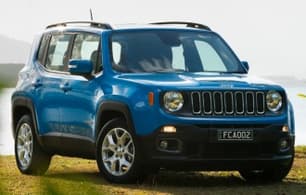
Jeep's Renegade might be late to the mini-SUV party but it comes with a pretty impressive back catalogue to suggest that this is a SUV that can cash the cheques its name can write.
The top of the range Trailhawk can write even bigger cheques than the lower models, bringing with it a range of off-road tech toys to let you really get down and dirty.
In many respects the reasons the Bronco is not available to Australian buyers are clear and understandable - demand remains high in the US market and it’s unclear just how many Ford Australia could sell. A pessimist would point to the modest sales of the Jeep Wrangler but an optimist would point out the sales gap between the Ford Ranger and the Jeep Gladiator and ask why Ford doesn’t think it could out-sell its competition.
Having spent so much quality time with the Bronco it’s clear it would have some major appeal to Australian buyers. The strong sales of the Ranger and Everest, as well as the entire off-road SUV market - the likes of the Isuzu MU-X, Mitsubishi Pajero Sport, etc - it’s obvious we love a rugged, adventurous vehicle.
Ford’s strength in that area, with the Ranger/Everest combination, would seemingly strengthen the case for the Bronco to join its ‘T6’ siblings, but only time will tell.
Having spent an extended period behind the wheel I’m more convinced that the Bronco would find a strong market in Australia. Both with the off-road set and those who like a Land Rover Defender to take the kids to school.
This is an SUV with capability and personality and that should be enough to make it a success in Australia. But for now, we need to play the waiting game…
Note: CarsGuide attended this event as a guest of the manufacturer, with travel, accommodation and meals provided.
Rugged, dependable and good off-road are the most obvious qualities of the Trailhawk. It stands out from the rest of the mini-SUVs by being able to do the S and the U with plenty of vigour.
It's just a shame that its on-road manners can't match that of its big brother, the Cherokee. Unless you're planning on proper off-roading, the Trailhawk might not be quite what you're looking for.
While we don’t have a history with the Bronco in Australia, it’s an iconic model in the US that was introduced in the 1960s to compete with the likes of the Jeep CJ-5 and Toyota LandCruiser.
It evolved throughout the 1970s, ‘80s and into the ‘90s eventually becoming an F-150-based SUV before being discontinued in ‘96.
For this revived Bronco Ford has gone back to its roots, taking inspiration from the ‘60s and ‘70s but also creating a car that is also very much contemporary.
It’s a great example of using retro design elements without getting lost in nostalgia.
It’s also hugely functional, with a removable roof and doors, which is a popular feature in the US where it’s legal to drive without the doors in place, and has deliberately short front and rear overhangs for improved approach and departure angles.
The Heritage edition takes this a step further with its pumped out Sasquatch flared guards, which are both functional and add to the chunky look of the Bronco.
Notably, the Bronco does not feature a Ford ‘blue oval’ badge, instead it only uses the ‘F-O-R-D’ on the grille and the rest of the badges are the ‘bucking Bronco’ - an alternative take on the ‘striding Mustang’ logo used for the iconic pony car.
The interior of the Bronco is interesting, showing very little commonality with the Ranger and instead embracing its unique history and design language.
The Heritage version also pops with its Oxford White dashboard inset, complete with bright red ‘Bronco’ lettering in front of the passenger.
In what is absolutely not a coincidence, the Renegade immediately conjures up the Wrangler. Upright grille from the Willys Jeep (references abound here), round headlights, squared off wheel arches to mimic the Wrangler's guards, short overhangs and big rear view mirrors.
The 17-inch wheels look completely lost in the wheelarches which are even more cavernous owing to the Trailhawk's 50mm of extra ride height. The wheels are also a bit cheap looking but will probably survive the belting the car is intended to take.
Less rugged is the interior, despite a fairly self-conscious effort to make it look and feel chunky. The front seats are flat and unsupportive with the rears just as lacklustre making sure everyone is sliding around together. Luckily, front passengers get a dash-mounted grab handle.
It seems quite well put together, however, but with carpets and easily-marked plastics, you'll hope your passengers don't bring the mud in with them too often. And the "Since 1941" stamped into the steering wheel can go.
The dashboard is reasonably clear and has plenty of information to share via the screen between the dials but whoever thought marking the redline with a water splash graphic in bright orange should probably rethink their design decisions.
Storage is limited to two cupholders up front, door pockets in each door and nets on the front seat backs.
Ford offers an extensive range of Broncos in the US market, with two-door and four-door variants, as well as the choice of removable hard or soft-tops before you get to the trim lines.
The range actually begins with a model variant simply known as ‘Base’ which has only the basic features, even simple steel wheels, so it can be used as a blank canvas for owners to customise with their own aftermarket additions for the ultimate off-roader.
But the Bronco isn’t a cheap vehicle, with even the Base starting at US$39,890 (approx. $52,000) and running all the way up to US$86,580 (approx. $132,000) for the high-performance Raptor.
In between there are seven other variants with some memorable names - Big Bend, Black Diamond, Outer Banks, Badlands, Heritage, Wildtrak and Heritage Limited.
The Heritage we tested starts at US$47,105 - roughly $70,000 in Australian money - which isn’t cheap but you do get plenty of car for the money.
In terms of standard Bronco equipment there’s a 4x4 system with Ford’s ‘HOSS 1.0’ off-road suspension system, terrain management system and 'EcoBoost' engine, plus keyless entry and ignition, dual-zone climate control and Ford’s 'SYNC 4' multimedia system on an 8.0-inch touchscreen.
Unique touches for the Heritage edition include a two-tone paint job with 'Oxford White' accents on the removable hard-top, front grille and 17-inch alloy wheels.
It also gets the huge squared-off fender flares from the 'Sasquatch' package that Ford offers for the Bronco, which also increase the track by approximately 50mm.
The Heritage treatment also includes a unique ‘plaid’ cloth trim for the seats, an Oxford White inlay in the dashboard and front and rear rubber floor mats.
The Renegade range starts at $28,000 for the 1.6-litre Renegade Sport manual front-wheel drive, climbing between $2000 and $3000 through the Sport Auto, Longitude Auto, Limited Auto with a final jump of $4000 to the 2.4-litre auto-only Trailhawk.
Standard is a nine-speaker stereo with Bluetooth and USB, 17-inch alloys, dual-zone climate control, reversing camera, rear parking sensors, keyless entry and start, cruise control, electric front seats with heating, satellite navigation, automatic bi-xenon headlights, auto wipers, leather trim, roof rails, front and middle bash plates, full size spare, heated leather steering wheel, privacy glass, trailer sway control and tyre pressure monitoring.
The lairy Omaha orange is $500, part of an eleven colour palette with only two no-cost paint options (black and white).
You can add lane departure warning, auto-parking and a black painted roof for $500 each, a removable and retractable roof called My Sky Roof for $2200 or a more conventional electric sunroof for $1900.
The Beats-branded nine-speaker stereo is run via Fiat-Chryser's UConnect system, accessible through the 6.5-inch touchscreen. While it improves with every attempt, it's still quite clunky and when the sat-nav is added, becomes a bit of a mess.
Thankfully, not every function has been crammed into the touchscreen interface, so you'll spend more time with your hands on the wheel rather than working out which bit of the screen has the climate control.
The Heritage edition is powered by Ford’s EcoBoost 2.3-litre four-cylinder turbocharged petrol engine and can be paired with a 10-speed automatic.
However, our test car was equipped with a seven-speed manual gearbox, but not in the way you might think. Instead of seventh gear being an overdrive for highway cruising, the extra ratio is actually for extremely low-speed off-road use.
Known as the ‘Crawler’ gear Ford says it makes the Bronco ‘almost unstallable’ when you find yourself in a tricky spot.
Specifications for the engine aren’t quite as straightforward as you’d like, with Ford offering power and torque figures for US standard and premium grade fuels.
With the former the 2.3-litre makes 205kW/427Nm, while if you put better petrol in you’ll get 223kW/440Nm - so it will pay to spend a bit more at the pump.
The Trailhawk is powered by Fiat's 2.4-litre four naturally-aspirated four-cylinder producing 129 kW and 230 Nm. Jeep reckons you'll get 7.5L/100km on the combined cycle. Our mostly city driving with a longish motorway run produced an 11.0L/100km average over a week.
The transmission is a nine-speed ZF automatic driving all four wheels.
The Trailhawk also has Jeep's five mode Selec-Terrain system which should cover pretty much every eventuality – Auto, Sport, Mud, Sand and, just for the Trailhawk, Rock. The Trailhawk is rated to tow 400kg unbraked and 907kg braked.
The Bronco is designed for off-road use, it isn’t a ‘soft-roader’ and has been created specifically for those who enjoy getting off the beaten path.
Ford claims an approach angle of 43.2 degrees, a breakover angle of 29.0 degrees and a departure angle of 37.2 degrees, plus 294mm of ground clearance and up to 850mm of water fording capability.
We, unfortunately, didn’t get a chance to drive the Bronco that way, instead spending three days behind the wheel driving it through US cities, along highways and winding our way through some picturesque mountain roads.
But despite being out of its element, the Bronco felt perfectly at home.
The fundamental qualities of the ‘T6’ platform, that makes the Ranger such a capable and popular offering with Australian buyers, shines through with the Bronco, too.
It steers with accuracy and has nicely weighted steering, rather than feeling too heavy and slow as some off-roaders can.
The ride is comfortable, too, which isn’t too surprising as it rides on 17-inch alloy wheels with huge 35-inch tyre, with bumps soaked up with ease.
Ford’s drive select system has modes for on-road - 'Normal', 'Sport' and 'Eco' - as well as off-road - 'Mud/Ruts', 'Sand' and 'Rocky' - so you’re covered whatever you want to do.
As for the powertrain, the EcoBoost engine does an admirable job most of the time, feeling powerful enough around town to move this sizable SUV.
However, there are times it will struggle and labour, most obviously when needing to overtake or climb a hill. There were several instances when we found ourselves shifting down from sixth to fourth gear to keep momentum up.
The Trailhawk name suggest that things are going to get muddy – compared to the rest of the range, the range-topper rides 50mm higher and has exposed, easy-to-reach tow hooks in the fairly unlikely event you get stuck. It also has a 20:1 low-range crawl ratio and Active Drive 4x4 which means it can switch between front and all-wheel drive. It'll also wade through almost half a metre of water. It's a genuine mud-plugging proposition and will take on some much bigger machinery out in the bush.
On the road, where we spent all our time in the Renegade, it's not what you'd call particularly inspiring. There's a number of sources of noise that contribute to a less than quiet cabin and having to constantly correct your course at freeway speeds adds to the tiring nature of the Renegade.
It's much better at lower speeds, pottering around but then again, its nine-speed transmission needs a lot more work on the shift mapping because it seems to forget which gear it needs to be in when you sink the right foot. If you don't need the Trailhawk's extra off-road goodies, consider the 1.4 litre Limited or Longitude.
In the US market the Bronco gets front, side and curtain airbags, with rollover sensors, as well as a reversing camera as standard equipment across the range.
But if you want more active safety features you need to add some optional safety packages, including on this high-grade Heritage edition.
That means items like pre-collision warning with autonomous emergency braking, blind spot monitoring and lane keeping assist are all additional extras.
For the Bronco to work in Australia, the company would need to offer a higher level of standard safety equipment in line with market expectations.
Seven airbags (including driver's knee bag), traction and stability controls, roll mitigation, blind spot monitoring, ABS and brake assist.
The Renegade does not yet have an ANCAP star rating although it scored five EuroNCAP stars in 2014.