What's the difference?
Picturing yourself driving a Ferrari is always a pleasant way to waste a few 'when I win Lotto' moments of your life.
It’s fair to assume that most people would imagine themselves in a red one, on a sunny, good-hair day with an almost solar-flare smile on their faces.
The more enthusiastic of us might throw in a race track, like Fiorano, the one pictured here, which surrounds the Ferrari factory at Maranello, and perhaps even specify a famously fabulous model - a 458, a 488, or even an F40.
Imagine the kick in the balls, then, of finally getting to pilot one of these cars and discovering that its badge bears the laziest and most childish name of all - Superfast - and that the public roads you’ll be driving along are covered in snow, ice and a desire to kill you. And it’s snowing, so you can’t see.
It’s a relative kick in the groin, obviously, like being told your Lotto win is only $10 million instead of $15m, but it’s fair to say the prospect of driving the most powerful Ferrari road car ever made (they don’t count La Ferrari, apparently, because it’s a special project) with its mental, 588kW (800hp) V12, was more exciting than the reality.
Memorable, though? Oh yes, as you’d hope a car worth $610,000 would be.
I think auto journalists are supposed to see vehicles a bit like parents see their children. You know, view them all as equals. No favourites. That kind of thing.
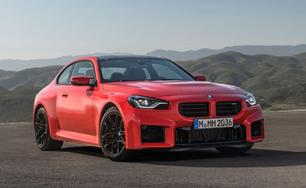
But I'm going to let you in on a tiny little secret, just between us. I liked this potent M2 before I even sat in it. And I like it just a little bit more than I love other bite-sized performance cars.
In fact, I like it more than I like bigger, more powerful, and more expensive models in the BMW M family.
Clearly, this is not a car for everyone, and you’d have to question whether it’s a car for anyone, really, but people who like spending $610,000 on Ferraris, and waiting in a queue to do so, will be delighted, because it delivers the kind of exclusivity, and bragging rights, that you’d have to hope a car called Superfast would.
Personally, it’s a little too much, a little too over the top and definitely too mad, but if rockets are your thing, you won’t be disappointed.
Proving good things still come in small packages, the pint-sized M2 remains my pick of the BMW M range. It's not the perfect daily drive, but I reckon the fun outweighs the foibles.
It’s very… big, isn’t it? And it looks even bigger in the flesh with a bonnet you could use to put a roof over your tennis court. In all, the Superfast is 4.6m long, almost 2.0m wide and weighs 1.5 tonnes, so it certainly has presence.
Making something this big look good is a challenge even for those as talented as Ferrari’s design team, but they have nailed it. The front has what appears to be a mouth, poised to swallow lesser cars whole like some whale shark Terminator.
The bonnet appears to be flaring its nostrils, and looks fabulous from the driver’s seat, and the swooping side and taut rear complete things nicely.
Personally, it still just looks too big to be a Ferrari, but then this is not a mid-engined super car, it’s a grand touring rocket ship, and the ultimate expression of unnecessary excess, and it pulls off that aura perfectly.
There have been mixed reviews of the design of the BMW M range, but I reckon this one looks pretty damn good. In fact, I've always thought this kind of hyper-aggressive styling looks better on smaller cars than it does on big ones.
And it certainly is aggressive, right? From the huge bonnet bulges to the meshed out grille and angry rear diffuser, to the staggered alloys and flared wheel arches, to the blocky rear end with its four massive exhaust exits.
But my favourite exterior item has to be the blacked-out carbon roof, which helps shrink the M2 visually, and makes the whole car look more potent.
Inside, it's plenty sporty feeling, with hard-backed sports seats, lashings of carbon-fibre-look trimmings and the bright red M buttons on the steering wheel.
It's nice, but some of the touch points – like the hard plastics on top of the doors, where, if you're like me, you rest your elbow when driving – feel less than premium.
Still, all the tech is present and accounted for, with its digital dash and huge centre screen, and there's no shortage of spaces to connect or charge your phone.
Practicality isn’t really your concern when you buy a two-seat mega car like this, so let’s just say it’s about as practical as you would expect it to be. Not very, then.
The M2 pocket rocket measures just over 4.5m in length, just under 1.9m in width, and just over 1.4m in height, and it rides on a 2747mm wheelbase. That makes it longer, wider and lower than the model it replaces.
Remember that 'lower' bit, as it will come up again in a moment.
Up front, you don't feel cramped, and there's the requisite cupholders, door pockets and hiding holes, as well as wireless device charging and USB connections.
But remember, this is a two-door, four-seat affair, which cuts into the practicality a little, or a lot.
Swing open the wide front doors, and push the front seat-back forwards, and the entire chair will slide forward automatically.
It does help create more room to climb into the back, but it's still a slightly embarrassing challenge to make getting back there look anything like graceful.
Once there, it's tight. I'm 175cm and my head was firmly pressed into the roof.
You do get your own vents and temp controls, but that's about it. Even the pull-down divider only gives you access to the 390-litre boot, rather than extra cupholders.
You do get two sets of ISOFIX attachment points, though, and let's be honest – if you're buying this to make Bunnings runs, you've probably got it wrong.
Is it possible that any car - save one made from gold, dusted with diamonds and stuffed with truffles - would represent good value at a price of $610,000? It seems unlikely, but then people who can spend that much assay value differently, and would probably say that something as profound as the 812 Superfast is worth buying at any price.
Another way to look at it is price-per-litre, which is less than $100,000, considering you do get 6.5 litres of V12 Ferrari donk. Or you could go by kilowatt, which works out at nearly $1000 each for your 588kW.
Other than that you do get a lot of leather, a high-quality interior, superior exterior styling, badge-snob value that’s hard to put a price on and vast swathes of F1-derived technology. And a free car cover.
First, the bad news. The M2 has only been getting more and more expensive over the years, and this new-generation model continues that charge.
Fun fact: When we first tested this model way back in 2016, you could get the Pure grade for less than $90K with a manual transmission.
Or you could spend just under $100K for the full-fruit version. This one, though, lists at $121,700, before on-road costs.
So, a little less bang for buck, but there's still a whole lot of bang on offer here.
You'll find staggered 19- and 20-inch lightweight alloys, while standard performance kit includes an 'Active M Differential', 'Adaptive M Suspension', 'M Compound Brakes' (with blue calipers), 'M Sport Seats' up front and, for the first time, a lightweight 'M Carbon' roof.
Elsewhere, there's adaptive LED headlights, a 12.3-inch instrument display and a 14.9-inch multimedia screen, a head-up display, a Harman Kardon 'Surround Sound' audio system and Android Auto and Apple CarPlay connectivity.
You'll sit on leather seats that adjust electrically and are heated up front. There's three-zone climate control, along with a heated steering wheel, wireless device charging and ambient interior lighting.
I did want to give the epic, enormous 6.5-litre naturally aspirated V12 engine a perfect 10 here, but when I paused to think about it I had to admit that it is, quite possibly, a little too powerful.
Yes, it is amazing to think Ferrari can build a car that has 588kW (800 horsepower - hence the 812 nomenclature; 800 horses and 12 cylinders) and doesn’t just dig itself a hole in the road as soon as you put your foot down.
And yes, it does provide the kind of performance that makes all other cars seems a bit piss poor and pathetic, even the really good ones.
But honestly, who could ever use it all, or need it all? They might seem like irrelevant questions, I guess, because it’s all about conspicuous over-excess, a car like this, so really the question is, would anyone want to live with 588kW and 718Nm of torque, or is it just too scary in reality?
Well, a little bit, yes, but Ferrari’s engineers have been wise enough not to actually give you all of that power, all the time. Torque is limited in the first three gears, and maximum mental power is actually only available, in theory, at 8500rpm in seventh gear, at which point you’d be approaching its top speed of 340km/h.
The fact that you can rev an engine this big, and this lusciously loud, all the way to 8500rpm is, however, a joy that would never tire.
In more practical terms, you can run 0-100km/h in 2.9 seconds (although cheaper, less crazy cars can do that, too) or 200km/h in 7.9 (which is a tiny bit slower than the far lighter McLaren 720S).
What you can’t do, of course, is achieve any of those numbers on winter tyres, or roads with snow on them.
Besides, this is what we're really here for, isn't it? The M2 gets the 'M TwinPower' 3.0-litre twin-turbo inline-six engine, producing a sizeable 338kW and 550Nm, sending that power to the rear wheels via an eight-speed auto or six-speed manual.
BMW says this engine is very, very close to the engine that powers the M3 and M4, and says it will rocket the M2 from 0-100km/h in 4.1 seconds, and to 200km/h in either 13.5 seconds in the automatic, or 14.3 seconds in the manual.
Much as you can’t have a good volcano without some serious lava, you can’t have 800 horsepower without burning a lot of dead dinosaur goo. The Superfast has a claimed fuel-economy figure of 14.9L/100km, but on our drive the screen just said "Ha!" and we burned through a whole tank of fuel in less than 300km.
Theoretical emissions are 340g/km of CO2.
A small fly in the ointment is fuel use, with the M2 said to use 9.7L/100km on the combined cycle. It also drinks 98 RON premium, and is home to a 52-litre fuel tank. Your theoretical driving range is around 540km.
Now, be warned, you'll be bored stiff if you drive it in the way that's required to get it that low. When we were being gentle, we were somewhere between 10.5 and 11.5 litres per hundred kilometres.
Emissions are pegged a 220g/km of C02.
Insane. It’s a word that people often lift from their lexicon when describing a supercar experience, because clearly, as forms of transport, things like Ferraris and Lamborghinis are not sane options.
But the Superfast really deserves the word, because it feels not only the opposite of sane, but truly bonkers. As if someone built it for a dare, realised it was a bad and possibly dangerous idea, and then put it on sale anyway.
Picture some tiny-handed child with his greasy, post-cheeseburger fingers poised over a big red button on his desk that could wipe out humanity, and that’s basically the situation your right leg finds itself in when driving the Superfast.
There is so much power on tap here - even the limited amount of it that the engineers allow you to access in lower gears - that it truly seems possible you’ll have a Road Runner moment, and simply dig a hole in the ground, if you push the throttle too hard.
Yes, on the one hand, the noises this extreme V12 makes above 5000rpm are memorable and moving, like Satan himself singing Nessun Dorma in a shower of sparks. At one stage we found a long tunnel, perhaps the only dry road within 500km that day, and my colleague forgot all about his licence and let rip.
The numbers on my 'Passenger Screen' spun like poker-machine wheels, then turned red and then implausible. I was shoved back into my seat as if by Thor himself, and I squealed like a small pig, but my co-driver heard nothing over the Monaco tunnel during F1 sound.
Even on dry road, of course, the winter tyres we were forced (by law) to run in the foul snowy conditions could not maintain grip, and we constantly felt the rear skipping sideways. Fortunately we were in Italy, so people simply cheered us on.
The likelihood that you will lose traction in this car is so high that the boffins have included a special feature in its new 'Electronic Power Steering' system called 'Ferrari Power Oversteer'. When you inevitably start going sideways, the steering wheel will apply subtle torque to your hands, 'suggesting' the best way to get the car back in a straight line.
A proud engineer told me that this is basically like having a Ferrari test driver in the car with you, telling you what to do, and that they used their skills to calibrate the system. You can override it, of course, but it sounds scarily like an autonomous-driving precursor to me.
What’s disappointing about this car having EPS at all, rather than a traditional hydraulic system, is that it just doesn’t feel muscular enough for a hairy-handed monster of a car like this.
It is accurate and precise and pointy, of course, and makes driving the Superfast, even in stupidly slippery conditions, almost easy. Almost.
It’s actually surprising how hard you can push a car like this along a windy and wet mountain road without careering off into a muddy field.
More time, and more traction, would have been appreciated, but you can tell it’s the sort of car you’d grow into, and perhaps even feel in control of, after a decade or so together.
So it’s good, yes, and very fast, obviously, but I can’t get past the idea that it’s all a bit unnecessary, and that a 488 GTB is simply, in every single way, a better car.
But as a statement, or a collector’s item, the Ferrari 812 Superfast certainly is one for the history books.
Let's be totally up front here: the BMW M2 isn't the most comfortable vehicle to live with. In fact, I recently climbed out of the M3 Touring, and found that to be more comfortable on broken city streets.
The M2 is fitted with adaptive suspension, but even in its most comfortable settings it can feel rough, bumpy and jarring on bad roads (of which Australia has lots), and unless you're gentle with the accelerator, it can feel a little jumpy when first taking off – a by-product of its prodigious power.
Now, let's be totally up front again: I don't care. The M2 is fun, plain and simple, and for mine, the above is a fair price to pay for something that brings so much joy.
The steering is lovely, the power immediate and the soundtrack intoxicating, and it's the kind of car that's fun no matter where, how far or how fast you drive it.
In fact, fun seems to be the very centre of the M2 proposition, which definitely doesn't take itself too seriously.
For evidence, look no further than the 'M Drift Analyser', buried in a hopelessly busy multimedia system that will have you praising the CarPlay and Android Auto gods.
It will rate your best drift out of four stars, measure it for distance, and basically give you a pat on the back for doing your best hooligan impression (not on a public road, of course).
Fun, then, is the order of the day here. And I bloody love it.
It might not surprise you to hear that, unlike every other company’s press kits, the Ferrari ones don’t generally include a section on 'safety'. Perhaps because driving something this powerful is inherently unsafe, or possibly because they believe their 'E-Diff 3', 'SCM -E' (magnetorheological suspension control with dual-coil system), 'F1-Traction Control', ESC and so forth will keep you on the road no matter what.
If you do fly off, you’ll have four airbags, and a nose as big as a house forming a crumple zone, to protect you.
The BMW M2 hasn't been assessed by ANCAP, but it arrives with six airbags, as well as all your usual traction and braking aids.
Elsewhere, you'll find lane change and lane departure warning, active cruise control, front and rear parking sensors, tyre pressure monitoring, and AEB with pedestrian detection.
There's also blind-spot monitoring, rear cross-traffic alert and lane centring assist, as well as a tyre-pressure monitoring system.
Once you’ve paid the vast cost of entry, it’s nice to know you will get some stuff for free, like your first seven years of servicing, including all parts and labour, carried out by trained Ferrari technicians, who even dress like pit crew. It’s called 'Genuine Maintenance', and is genuinely Kia-challenging in its scope.
The BMW M2 is covered by a five-year, unlimited kilometre warranty, and servicing is 'condition based', in that the vehicle will tell you what maintenance is required, and when.
You can prepay your service costs at the time of purchase for all BMW vehicles, covering the first five years of ownership, for $3480 (which means $695 per service).