What's the difference?
The Cupra Formentor is the most popular model in the Cupra stable and now the VZe Tribe Edition has joined the ranks.
Sitting one rung below the top petrol grade, the Tribe Edition combines the VZe plug-in hybrid powertrain with some great design upgrades, as well as features usually reserved for the top model.
Is this the most appealing Formentor model yet? We've spent a week with it to find out.
Meet the MG QS, the latest SUV from the Chinese giant, and one that the brand promises is a “true” seven-seater – not a five-seater with two dinky little seats in the boot, but a full-size SUV that can carry seven adult-sized humans.
And that promise puts it on a collision course with family favourites like the Toyota Kluger or the Kia Sorento.
So, how does this big MG measure up?
Read on.
The Cupra Formentor VZe Tribe Edition offers some great luxury features and is coupled with a plug-in hybrid powertrain that should entice those wanting something more efficient than the standard petrol grade. It's peak efficiency is only available with a fair amount of charging commitment, though, and the driving comfort isn’t always the best but its fun and looks hot. The price point also makes it appealing compared to its rivals.
What it lacks in driving panache it does make up for in terms of space and equipments, and there really is room for seven decent-sized humans on board. Combine that with a decade of warranty coverage, and the MG QS will no doubt be appearing on family shortlists.
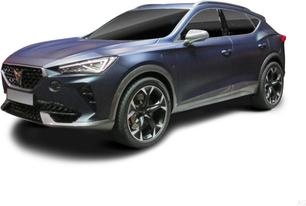
The Cupra Formentor sounds like a Transformers name and if it were one, it’d be a Decepticon, for sure. It’s way too sharply styled and sexy to be a good guy.
The special-edition model sees it paired with black and copper 19-inch alloy wheels and every design aspect doubles down on its sports-car presence from the crisp pleating across the body, to the twin exhausts and shapely grille. And this sporty presence is what its rivals lack.
Head inside and you'll notice the biggest change from the standard VZe model are the sport bucket seats in the front and the blue leather upholstery that has been liberally applied across the cabin.
The dashboard features gorgeous copper accents and contrasting stitching while being headlined with large tech screens that immediately catch your eye.
The interior has a killer design but it's not one you'd call plush as the edges and surfaces are as sharp as they look.
You’re not going to miss the MG on the road, are you? For one, it looks pretty big, and pretty athletic, plus it’s got that bold front-end and grille design that, if I’m honest, I can’t tell if I like, or if it’s over the top.
Elsewhere, though, it’s more traditional SUV styling, though there is some nice and gentle detailing in the body that makes it look less big, broad, and boring, and the slightly nose-forward design gives the QS something of an athletic stance.
Inside, it’s really quite nice. The twin screens look fantastic – and the subtle curve linking the two looks properly elegant – and there’s some lovely detailing in the through the dash panels, too, which also helps to break up the fact that there is simply a lot of dash here.
As always, I love the row of switches below the screen that act as shortcuts to the functions you need, when you need them, without having to rely on the screen all the time.
But I'd encourage you to have a good squeeze of all the materials used. Some look like stitched leather, but are actually harder plastics in disguise.
For something that leans more towards a sports car than SUV in its styling, the cabin is still fairly practical when it comes to space and access.
Front occupants enjoy the best of each, though, and it's easy enough for a taller driver to get into a comfortable position.
The rear row offers excellent headroom but the legroom may be cramped for a tall passenger. It's best to think of the car as a four-seater as the middle armrest won't go down when there is a car seat installed.
In terms of seat comfort, fatigue will set in early on a long trip for front rowers as they are decidedly hard under the butt but the padding is a lot better in the rear row.
Overall, storage options and amenities are great throughout the car with the tri-zone climate control, heated front seats and steering wheel functions giving a premium cabin experience.
The glove box is extra large and can easily fit a small handbag and a manual while the middle console is on the small side. There are four cupholders and drink bottle holders (4/4) but the front cupholders need to be spaced out more to accommodate two cups properly. A few loose coffee lids were had!
In the rear you also get two map pockets and the boot has 345L of capacity available which is on the tiny side for a medium SUV! However, the wide boot aperture tricks you into thinking it’s bigger and the powered tailgate is always a handy feature.
Technology looks great but the multimedia system is finicky to use and one that takes a while to get used to. At first it's difficult to recognise what you have to touch to access the different menus available but the screen is responsive and the graphics are clear.
The built-in satellite navigation is easy to use, and the Tribe Edition also has wired/wireless Apple CarPlay and Android Auto, four USB-C ports, a wireless charging pad and a 12-volt socket.
The MG QS is a smidge under five-metres long, just over 1.9m wide and just under 1.8.m high, which puts it right in the seven-seat SUV ballpark.
That pays dividends in the backseat. I’m 175cm tall, and I had heaps of room to spread out, and I don’t only have my own air vents, but I have my own temperature controls, too.
It’s a big and airy space, and I’d have no problem spending some serious time here on a longer road trip.
But the big question is, what do those dimensions mean for third-row riders, and does it live up to its promise of being a true seven-seater?
Well, yes and no. The fact that the middle row is on rails helps massively, because you can slide it forwards to maximise leg room for backseat riders, and the one-touch entry (which folds the middle row up and forwards) makes actually climbing back there pretty simple, too.
But... it's still a space in which I wouldn't want to spend too much time. Its big enough for shorter trips, but it's still best for the smaller kids in the family.
Now, as is often the case with three-row cars, how much boot space you get very much depends on how many people you have onboard. With all three rows in place, you get a miserly 203L, fold the third row and you get 517L, drop both rows and you get 1052L.
There are usually three variants available for the Formentor; the base V petrol model, the mid-spec VZe plug-in hybrid and the range-topping VZx petrol.
The Tribe Edition pairs the plug-in hybrid powertrain with some of the features you get in the VZx, making it technically sit right below the top model, despite being $2200 more expensive at $67,990 MSRP.
Yet still it offers great value compared to its luxury rivals, the Lexus NX350h Luxury Hybrid which sits at $71,600 MSRP and the Peugeot 3008 GT Sport Plug-in hybrid which starts at $82,915 MSRP, without feeling like the poor cousin.
For a $3K price hike over the standard VZe model, you enjoy heated front seats, sport bucket front seats, 'Petrol Blue' leather upholstery throughout the cabin, black and copper 19-inch alloy wheels, a black headliner, a 360-degree view camera and a powered drivers seat with memory and lumbar function.
Other standard equipment includes keyless entry and start, powered tailgate, heated steering wheel, dusk-sensing LED headlights, rain-sensing wipers, auto-start/stop function and a tyre repair kit and inflator.
Technology looks top-tier with the 12-inch touchscreen multimedia system with built-in satellite navigation, 10.25-inch digital instrument cluster, tri-zone climate control, wired and wireless Apple CarPlay/Android Auto, four USB-C ports, Bluetooth, AM/FM radio, digital radio and a nine-speaker Harman Kardon sound system.
You get introductory national drive-away pricing for the two-grade MG QS range, with the Excite yours for $46,990, and the Essence we’re testing sets you back $50,990 on the road.
In typical MG fashion, neither model is wanting for much in the spec department, but our Essence gets the lot and the kitchen sink.
Outside, there are 21-inch alloys, LED lighting with fog lights, a powered tailgate and a powered sunroof. Inside, there are leather seats which are heated and ventilated up front, tri-zone climate control and ambient interior lighting.
Tech is handled by twin 12.3-inch screens with wireless Apple CarPlay and Android Auto. There’s wireless charging, too, and a 12-speaker Bose stereo.
The top-spec model also gets all-wheel drive, adaptive suspension and six drive modes — Normal, Snow, Off-Road, Sport, Custom and Eco.
There are five exterior colours available on the QS, including Oxford White, Black Pearl, Camden Grey, Regency Green and Cashmere Silver.
The VZe Tribe Edition is a plug-in hybrid that has an electric motor that produces up to 85kW/330Nm. This is paired with a 1.4L four-cylinder turbo-petrol engine. Together, they produce outputs of up to 180kW and 400Nm.
However, once the lithium-ion battery is depleted, those figures drop to 110kW/250Nm and you notice the difference on the open road.
The Tribe has a smooth six-speed automatic transmission and can do a 0-100km/h sprint in 7.0-seconds. Not crazy fast but still fun.
Under this hood is a 2.0-litre turbocharged petrol four-cylinder engine, which produces 153kW and 360Nm. In this all-wheel-drive Essence, that power is channelled through a nine-speed automatic and sent to all four wheels.
I don’t have a zero to 100km/h time for this two-tonne-plus beast, but suffice it to say it won’t knock your hat off. I’m guesstimating just under 10 seconds.
Like all plug-in hybrids, you get the best efficiency if you recharge the Tribe often. If you want to get close to the official combined (urban/extra-urban) fuel cycle figure of 1.9L/100km you need to charge it every single time you use it.
Following this procedure over 347km of a mix of open and city driving, saw the real-world usage pop out at 2.3L/100km, which is outstanding.
However, the second half of the week saw 336km travelled and no recharge and the real-world usage stepped up considerably to 6.0L.
With its 40L fuel tank, you have a theoretical driving range of up to 2105km but expect less in real-world conditions. Worth noting Cupra recommends a minimum 95 RON unleaded petrol for this model.
The Tribe has a lithium-ion battery with a usable 10.9kWh capacity and the claimed pure EV range is up to 58km, as well as, a claimed 14.1kWh energy consumption figure.
Over my week with it, the consumption hovered around 22.8kWh/100km when cruising on the highway going 100km/h.
Now MG reckons you will see 8.8L/100km on the combined cycle, which would give you a theoretical driving range of around 738km from its 65-litre fuel tank. For the record, we saw more like 11 litres.
That tank, by the way, demands 95RON fuel, so you won’t be troubling the cheapest pump at your local service station.
The VZe Tribe Edition is happiest in the city and when you have a full battery. This is when it feels the most responsive with its power delivery. In the city, it’s quick and sure-footed.
However, once that battery hits empty and you’re on the open road, the power is there but it stops feeling as fun.
The firm steering keeps it nimble and the driver's cockpit makes you feel well connected with what the car is doing but the ride comfort is like the design, not what you'd call plush.
The suspension is firm and you feel every bump in the road. Road and wind noise are also pretty high and in general, you feel a bit weary at the end of longer trips.
The visibility is good despite having narrow windows but a car seat or passenger in the back seat compromises the rear view vision.
The Formentor shines in a tight car park with its 10.7m turning circle and compact proportions. The 360-degree view camera system is also most welcome but the quality of the feed is reflective of the grade level.
It all comes down to what you're looking for in your large SUV. Is it a vehicle that – against all odds – manages to somehow stir your emotions from behind the wheel, whether you're flying solo or you're riding with seven on board? Well, the MG QS won't do that.
But if you're looking for something big, comfortable, nicely trimmed and with just about every feature you can think of, then the MG QS ticks those boxes and then some.
But let's start with the not so good. The steering in the MG QS is super, super light, leaving it feeling largely disconnected from what's happening beneath the tyres, and giving the drive experience a weird and artificial vibe.
Now, it must be said that some drivers like that. A big car with light steering makes manoeuvrability easy in car parks and the like. But I don't. It makes me feel uninvolved in the drive experience.
The QS is equipped with Sport mode that does add heft to the steering, but which also appears to make the gearbox way to eager to shift down and hold a lower gear, adding a harshness to the drive.
It's also not a big engine, and this is a big car, and so there's a bit of delay when you first plant your foot as the engine figures out its next move, and you're always aware of the engine working fairly hard to get the QS moving along – though MG has done a good job of deadening much of that sound before it enters the cabin.
But if that's the not-so-good, there are still plenty of ticks in the MG's plus column. It's a largely smooth-riding, sweet-shifting proposition, the QS, and the space in all three rows is impressive, especially when the sliding second row is utilised to maximise the space where you need it.
The Formentor has a maximum five-star ANCAP safety rating from testing done in 2021 and now features 10 airbags including side chest bags for the rear row and a front centre airbag as standard.
Other standard equipment includes blind-spot monitoring, driver monitoring, tyre-pressure monitoring, LED DRLs, front and rear fog lights, forward collision warning, rear cross-traffic alert, lane departure alert, lane keeping aid, side exit assist, adaptive cruise control, park assist, front and rear parking sensors and a 360-degree view camera system.
The Formentor has AEB with car, pedestrian and cyclist detection and is operational from 5.0-250km/h. The Formentor also has two ISOFIX child seat mounts and three top tethers but the rear seat is only wide enough for two child seats.
The MG QS hasn’t yet been crash-tested by ANCAP, but all the expected safety kit is on board, including seven airbags, AEB, rear cross-traffic alert, adaptive cruise control, blind-spot monitoring, lane-keep assist and lane departure warning.
But be warned, it can bing and bong and random intervals. If it thinks you’re speeding, or that you’re not paying attention, and it is very, very annoying. Learn how to switch off the speed limit recognition and driver attention alert, and fast.
The Formentor has a five-year/unlimited km warranty but it’s becoming more common to see longer warranty periods being offered now.
You can pre-purchase a three- or five-year servicing program. The three-year program costs a flat $990, averaging $330 per service. The five-year option averages costs $1990, averaging $398 per service which is reasonable for the class.
Servicing intervals are good at every 12-months or 15,000km, whichever occurs first.
It’s a tale of goods and bads in the QS ownership world. The good is a near market-leading 10-year/250,000km warranty (so long as you regularly visit an authorised service centre), and solid service intervals of 12 months or 15,000km, whichever comes first.
The bad is eye-watering service costs – including a whopping $2920 dollar service at the six-year/90,000km mark.
All up, seven years/105,00km of servicing will cost you $6336 in the 2WD, or $6962 in our AWD – the latter averaging out at close to $1000 per year.