What's the difference?
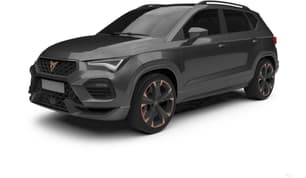
Meet the new Cupra Ateca. Actually, scratch that. Meet the new Cupra, the VW Group's Spanish performance brand that will be launching in Australia around the middle of this year.
Picture a pyramid, and then put VW at the top of it. Bottom left you've got Skoda, a brand that prides itself on practicality and clever features. Bottom right you've got Cupra, which promises to be the fun, sporty and energetic cousin, and to focus on performance, electrified or otherwise. But both are fed from Volkswagen.
Make sense?
The Ateca, then, is a nearly Tiguan-sized SUV that will launch in one hi-po trim level, and a significantly lower starting price than its better-known, R-badged relative.
It also promises to marry family duties with a fun-to-drive attitude. So how does it measure up?
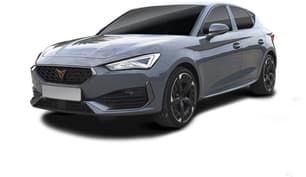
Behold the beautiful Cupra Leon VZe.
Like its name and multimedia screen, this enigmatic hatchback needs some decoding to make sense to Australians.
Essentially, the Leon VZe is a variation of today's eighth-generation Volkswagen Golf. Except it's built in Spain by VW Group subsidiary SEAT (remember them?), offering sleeker styling, and – in VZe guise – a plug-in hybrid electric vehicle (PHEV) powertrain.
In other words, this is similar to the intriguing Golf GTE grade not offered in Australia, but with more than a splash of Balenciaga about the way it looks, feels and drives – and with pricing to match (from $59,990, before on-road costs).
So, does the Leon VZe combine the sportiness of a hot hatch and torquey zing of an EV with the parsimony of a hybrid? Could this be the most complete small car on sale in Australia today?
Let's spill the tea to find out.
It's a racetrack taste test rather than a comprehensive road drive, but there's plenty to like about the Cupra Ateca, which fulfils its brief of injecting a little driving fun into the SUV space. The only question is whether its sportiness will be too sporty for your day-to-day, but for that, you'll have to wait and see.
CarsGuide attended this event as a guest of the manufacturer, with travel, accommodation and meals provided.
The Cupra Leon VZe demands you give it an appropriate amount of time to get to know.
Because, as an unknown challenger brand, as a hatch in an SUV world, as a PHEV wearing an EV price tag, it is up against it. And it's too interesting a car to be summarily dismissed.
But as long as you're not expecting a pure hot-hatch-cum-ultra-economical eco warrior, the VZe is a close-enough approximation of both for it to be an intriguing and enjoyable multi-faceted small car, while also possessing a fair degree of space as well as styling flair.
If you can forgive the screwy multimedia and cope with the high pricing, there's a lot to love here.
Cupra talks about its born-in-Barcelona design inspiration, but you can still see plenty of VW in the Ateca's side profile. But that's no bad thing, with the Cupra managing to look both polished and performance focused, but without looking like it's trying too hard.
The big change is in the front-end treatment, with a smaller centre grille that houses the Cupra badge (which looks a bit like a fox, and a bit like the Decepticon badge from Transformers, but which was actually "modelled on the attitude of tribal civilisations.")
The cool DRL designs, the two-tonne bronzed alloys and the quad exhaust tips all point a pretty strong picture of performance here, and for mine, the Ateca cuts a handsome figure.
Inside, though, it definitely feels a little less premium than modern VW products, with a greater use of hard plastics, and last-gen air-con and media controls, which – if you've driven the new Golf, for example – feel a little old-school by comparison.
One reason why you might want a Leon over, say, one of the more common PHEV SUVs like the Mitsubishi Eclipse Cross PHEV, or even Cupra's own Formentor PHEV, is because of its pleasing, conventional five-door hatchback size and shape.
Sleek and chiselled, it is quite a looker, especially from the rear three-quarter view. And the wheels are equally pretty.
Only from front-on does the Leon seem anonymous and somewhat dated in appearance. But at least it avoids the droopy fussiness of the 308.
The Ateca measures 4386mm in length, 1599mm in height and 1841mm in width, and there is some 485 litres of boot space with the rear seats in place, and a substantial 1579 litres with the back pews folded flat.
It's a strong back-seat story here, too, with ample leg and headroom, individual device charging ports, and a pull-down seat divider that houses two cupholders.
There are two more upfront, as well as storage in every door, along with the ISOFIX attachment points in each window seat in the back.
Now it must be said that our test was conducted on a racetrack, with limited laps, no on-road driving, and no chance to fill the vehicle with passengers or baggage, so for a full practicality play-by-play, you'll have to wait until we get the Ateca through the CarsGuide office for a more comprehensive test.
Once standard setters, VW interiors have copped flak lately, losing the lead they once enjoyed in terms of perceived quality and functionality. A big backward step.
Within this context, the Leon's cabin is as aesthetically appealing as the exterior's, with lots of interesting angles and textures set within a broadly familiar VW-corporate multi-level dashboard design and presentation.
Most of the basics are largely fine, too. From the superbly enveloping front bucket seats and commanding driving position, to excellent ventilation and plenty of storage, there's much to commend.
The same goes for the moody, techy ambience, though it's closer to ‘chilled Audi' than ‘zesty Latin' in flavour.
Directly ahead of the driver is a 10.25-inch instrument cluster, offering several combinations of vehicle speed/operation and multimedia views.
Some of it looks good, some suffers from info-overload, but at least it's all configurable. Pick your favourite. And build quality seems up to scratch, too.
Like the Golf, there's also above-average space for longer legs and outstretched arms, while – after having to duck down a bit to get in – head and shoulder room are sufficient.
Selecting gears is a matter of manipulating a charmless stubby toggle. It works well enough, but remember when VW Group owners could interact with a Tiptronic-style lever and feel more immersed in the driving process? Memories.
That's replaced by paddle shifters, a divisive substitute that's of debatable merit in an electrified vehicle such as this, since they would serve better as regenerative braking controls.
But that's only the beginning of the confusion that ensues in the Cupra.
Reach for the 12-inch touchscreen to scroll through your many and varied media options, try and figure out the trip computer or search for an odometer reading, and any goodwill earned will be severely curtailed by just how needlessly complicated these and other once-simple tasks have become.
Plus, frustratingly, our particular car's multimedia system would just switch off mid-operation. This is not good.
We're certain time and familiarity will help make sense of working out where everything is and how to access vehicle functions located within layers of that touchscreen's myriad menus, but it is distracting and complicated.
And how is it that we could not find how to switch on nighttime illumination for the climate controls? In a week we failed to find that answer. And who ever green-lit fiddly slide controls over good old buttons? It's maddeningly frustrating.
Moving to the back seat, the Leon makes up some ground.
Two larger adults should settle into the outboard positions comfortably and snugly, aided by a pair of rear-facing air vents accompanied by a climate-control panel, two USB-C ports, a folding centre armrest with cupholders, ski-port access to the boot and useful storage via door bins and map pockets. There's even enough space for a third, smaller passenger to squeeze in between.
Further back, while the boot floor is long and flat and with a large tailgate opening to aid loading stuff in and out, the actual cargo capacity is just 270 litres, or nearly one-third down on the regular petrol Leon grades' 380L offering. This is due to the battery pack and related EV gubbins.
Speaking of which, if you need to carry charging cables there's nowhere to properly store them other than in the main boot area. And don't forget, there's no spare wheel.
At least there's a sturdy parcel shelf to keep prying eyes from seeing what you're carting around.
The VZe's interior, then, is spacious and broadly sensibly executed, but is let down – and mostly unnecessarily so – by some of the details. We strongly recommend trying before buying.
Cupra describes itself as an "unconventional challenger brand", and it essentially sits below the mainstream VW line-up, with cheaper pricing and a focus on fun over finery.
So the Ateca – which is about the same size and offers similar outputs to the Tiguan R – lists at $60,990, or $65,990 drive-away, which is significantly cheaper than the VW product, which lists at $68,990 before on-road costs, or – according to Volkswagen's website – $77,279 drive-away for a NSW shopper.
Interestingly, Cupra has launched an agency model in Australia, which means you buy the vehicles from the brand itself, with the transition occurring online and for a fixed price with no negotiation, rather than from a dealer.
The Ateca might not deliver quite the same grunt as VW's R product, but that's a significant saving. Oh, and metallic paint is free, too – as is servicing for the first three years – which means more savings.
So what do you get? The Ateca arrives in a single VZx trim level, and outside you'll find 19-inch alloy wheels, LED lighting front and rear, roof rails, a powered boot, quad exhaust exits, auto headlights and keyless entry and start.
Inside, there's three-zone climate, blue leather-wrapped sports seats that are heated in the front, wireless charging for your devices and ambient interior lighting.
You're well served for tech, too, with the VW Group's 10.25-inch Digital Cockpit, a 9.2-inch centre screen with navigation, Apple CarPlay and Android Auto that works wirelessly as well as when you plug in, a nine-speaker (plus sub) Beats sound system, as well as Dynamic Chassis Control and custom driving modes - including full-attack Cupra mode.
There's lots to unpack here.
SEAT started in 1950 as a venture between Fiat, the Spanish government and some private banks, until VW took over in 1986 and turned it into a youth-baiting value brand. Think pre-current Kia positioning.
Meanwhile, Cupra – a portmanteau of Cup Racing – had began as SEAT's competition arm earlier that decade. And there's been a Leon (referencing both ‘lion' and a city in Spain) based on every Golf since the latter's Mk4 iteration, making this generation numero cuatro.
Halve that figure and you end up with the number of small-car PHEVs left in Australia – Cupra's and another big-cat evoking Euro, the Peugeot 308 GT Sport PHEV, costing a few grand more than the VZe from $64,990, before on-road costs.
These high prices are clearly hurdles for Australian small-car buyers. Even Mercedes-Benz recently axed the slow-selling A250e due to a lack of buyer interest. Kia dropped the Niro PHEV. And Hyundai canned the Ioniq PHEV.
So, why are these types of cars so expensive, then?
The Leon and 308 feature a turbo-petrol engine, backed up by a small motor and a battery pack that's large enough to provide a claimed 67km of electric-only range in the Cupra's case. On paper at least.
That's more than the cheaper non-plug-in hybrid alternatives like the wildly-popular Toyota Corolla and superb Honda Civic e:HEV can manage.
So, besides exclusivity and two powertrains, what does the Leon VZe give you for your circa-$65K drive-away ask?
On the safety front, you'll find the now-usual driver-assist items like autonomous emergency braking (AEB), lane-support systems and adaptive cruise control, as well as 10 airbags including a nifty front-centre item. More on this in the safety section below.
Buyers also score LED headlights, auto high beams, fog lights with cornering function, adaptive dampers, tyre-pressure monitors, a reverse camera, electronic instrumentation, three-zone climate control, variable-ratio steering, keyless entry/start, satellite navigation, wireless phone charging as well as wireless Apple CarPlay/Android Auto.
There's also rear privacy glass, four USB-C ports, sports front seats, a heated steering wheel, paddle shifters, ambient lighting, powered/heated exterior mirrors as well as 19-inch alloy wheels and a tyre repair kit. No spare wheel is offered.
The pricier 308 PHEV has most of these plus Matrix LED lighting, Nappa leather upholstery, panoramic opening sunroof, heated/massaging front seats, 360-degree surround-view vision and a digital radio, but has smaller (18-inch) alloys and no adaptive dampers.
Our test car was fitted with the 'Leather Package' that adds $2050 to the price, ushering in leather upholstery, heated front seats with driver's side power and memory, premium audio and dash-top stitching, while the sunroof costs $1800 more.
These take the VZe north of $65,000 drive-away. That's pure-EV territory. Little wonder buyers baulk at PHEV small cars in Australia.
Right, so the Ateca's 2.0-litre TSI petrol engine produces 221kW and 400Nm, which is slightly less than the 235kW and 400Nm generated by the new Tiguan R.
But the Cupra is faster, knocking off the sprint to 100km/h in 4.9secs compared to the VW's 5.1secs – and it feels plenty quick from the driver's seat with your foot pinned to the floor.
That power is fed through a seven-speed DSG, with AWD standard fit on the Ateca.
Under the Leon VZe's bonnet is a variation of the German parent brand's familiar 1395cc 1.4-litre direct-injection four-cylinder turbo-petrol engine, driving the front wheels via a six-speed dual-clutch transmission.
This Euro 6-rated unit produces 110kW of power between 5000-6000rpm and 250Nm of torque from 1550-3500rpm.
Meanwhile, the 85kW/330Nm electric motor also nestled under there is fed by a 12.8kWh Lithium-ion battery pack slung out back. The system outputs combined produce 180kW and 400Nm.
Weighing in at 1634kg (tare), the VZe's power-to-weight ratio is an impressive 110kW per tonne, explaining this portly small car's feisty 6.7 second dash in the 0-100km/h sprint. However, once the battery is depleted, that drops to a much-more mundane 67.3kW/tonne.
Based on VW's 'MQB Evo' modular transverse engine architecture, the Leon features a sports-tuned MacPherson-style strut set-up up front and a multi-link rear end, while adaptive dampers and variable-ratio electric power steering are also fitted.
Cupra is yet to reveal official fuel figures for the Ateca in Australia, but international guides claim an 8.9-9.5L/100km figure on the WLTP cycle.
That's not a small number, and it's one that will no doubt be made worse if you drive it the way you're almost certainly going to drive it, but such is the price of performance.
The Ateca will also demand 98RON fuel, which will sting at the bowser, too.
Cupra says the combined cycle average fuel consumption figure is a startling 1.8 litres per 100km, equating to just 40 grams per kilometre of carbon-dioxide emissions. The electricity consumption claim is 11.2kWh/100km.
Out in the real world, we averaged 5.9L/100km pump-to-pump, while the car's trip computer read 5.5L. This is a disappointment.
It must be all those extra kilos the VZe has to carry around, as most of our driving was inner-urban or casual freeway cruising. The stop/start system was working overtime once that battery depleted.
We managed fewer than 40km of pure-electric driving, against a WLTP rating of 52km (or 67km using the more-lenient NEDC number Cupra quotes), with the trip computer telling us we were averaging 5.9kWh/100km – a figure likely achieved in hybrid mode with the petrol engine chiming in.
Charging times vary, with the 12.8kWh battery needing between six and eight hours plugged in at home, or about four hours using a 7.0kW AC charger via the Type 2 connector. No DC rapid charging ability is available.
Filling up the 40L fuel tank with the required 95 RON premium unleaded petrol and giving the VZe the benefit of the doubt by using the official fuel consumption average of 1.8L/100km to find out its PHEV range, you could theoretically achieve 2220km between refills.
Or about one-third of that by our real-world experience.
Choosing to launch your new SUV on one of Australia's fastest racetracks shows either supreme confidence or bewildering foolhardiness, but in this instance, it was also a necessity.
See, Cupra is mere months away from official launch now, with orders for launch editions to open in May, and the only vehicles the brand could secure for its media preview were brought in from New Zealand, and unable to be driven on public roads.
And so Sydney Motorsport Park would play host to our first experience behind the wheel of the Ateca, and after only a handful of flying laps it was beginning to feel like a masterstroke.
This is not your average family SUV, and any vehicle in which you can drop the kids at school before clipping 200km/h-plus down the main straight of your closest race track is something to be celebrated.
The downside is that it's next to impossible to tell you what the Ateca is going to be like on your local streets, or whether the sporty suspension is going to be firm enough to shake the hairs loose from your head should encounter some questionable road surfaces.
But I can safely report that the power is prodigious, the steering smooth and confidence inspiring, and the AWD grip impressive in both tight and high-speed bends.
But perhaps the most surprising thing about the Ateca is its ability to feel both planted and agile in dynamic driving situations, with the SUV feeling altogether more stable than the smaller Cupra Leon, and hanging onto the tarmac in corners with more tenacity than the 140kW Cupra Formentor.
On first blush, engagement and enthusiasm are standard fit here, and that's likely no bad thing no matter what your daily commute looks like.
There aren't many PHEVs out there, and that may remain the case, for Australians at least.
But the Leon VZe is definitely one of the more enjoyable of the breed to drive and ride in, with a sporty bias that lives up to its sleek and sexy styling.
With a fully-charged battery, off-the-line acceleration is brisk, and remains rapid as the revs and speed rise. It's smooth and slick in the best VW Group manner, and is accompanied by an appropriately stirring exhaust note. Especially in racy 'Cupra' mode.
The extra torque provided by the electric motor is also felt at low speeds, with little hesitation or delay from the throttle and DCT if the driver wants to instantly plug gaps in traffic.
Expertly tuned, the Cupra ought to be commended for how well-modulated everything feels and responds.
Find a fast, curvy ribbon of road and the Leon's steering comes alive, providing plenty of feel and control, backed up by a taut and agile chassis tune. Whether in 'Comfort' or 'Sport' modes, this is an athletic little hatch.
What the VZe isn't is a hot hatch.
When pushed, even in Sport or Cupra mode, it feels far heavier and less zippy than, say, a Golf GTI, lacking the latter's lithe spirit and dynamic dexterity.
That's not to say the Cupra isn't an involving, capable and secure handler or road-holder, because in isolation this is a terrific little car to hammer along. But it doesn't excite or thrill like the best of them. For more clarity on this, please drive a Civic Type R.
The driver can switch between electric, hybrid and turbo-engine-only modes to help preserve electricity, but once the battery is spent, there isn't the same level of punchy torque available.
Better, then, to instead select Comfort mode and let the adaptive dampers isolate you from those irritating bumps; while not plush, the ride is compliant enough for the VZe to make a very good impression of a grand tourer. Road noise intrusion, too, is pleasingly muted.
We're also grateful Cupra allows the driver to mix-and-match the drive modes, so you can choose a spicy engine tune with cushy suspension if you wish.
Note, however, that our Leon insisted on defaulting to Sport mode after every start-up. Using the flummoxing touchscreen to figure out how to change that to Comfort or Normal was a challenge.
Otherwise, there's much to enjoy from behind the wheel of the VZe. Probably the most fun PHEV we've ever punted around.
The Cupra Ateca arrives with a swag bag of advanced safety kit – helped, no doubt, by only launching with one top-tier model – as well as the expected stuff like airbags (there are seven), and the traction and braking aids.
Expect active cruise control, AEB with pedestrian and cyclist detection, side and exit assist systems, front and rear parking sensors and a 360-degree parking camera.
On the road, functions like Lane Assist will help keep you between the lines, Travel Assist provides freeway autonomy, while a fatigue monitor will tell you if you're getting tired behind the wheel.
The Cupra Ateca is yet to be ANCAP crash tested.
Tested in 2021, the Leon range achieved an ANCAP crash-test rating of five stars.
The VZe is fitted with 10 airbags – dual front, side chest, side head, driver knee and a front centre item; the latter is there to help reduce occupant-collision injury in lateral impacts.
On the driver assist tech side of things, the AEB includes pedestrian, cyclist and reversing detection, and there's 'Lane Assist', park assist, blind-spot monitor, rear cross-traffic alert with exit warning, a driver-fatigue monitor, emergency assist and tyre pressure monitors.
The AEB is operational between 5.0km/h and 250km/h. Likewise, the lane-support systems kick in between 65-250km/h.
The VZe is also fitted with electronic stability control, traction control, anti-lock brakes with brake assist and electronic brake-force distribution, adaptive cruise control, an alarm, auto on/off LED headlights with auto high beam, cornering driving lights, front and rear parking sensors, rain-sensing wipers and a rear-view camera.
Plus, the outboard rear seats include ISOFIX child restraint anchors as well as three top tethers for top straps.
Cupra are trying to minimise the stress here, so the Ateca wears a five-year, unlimited-kilometre warranty, with three years of complementary servicing built into the purchase price, with five-year packs also available to purchase.
The Cupra comes with a five-year/unlimited kilometre warranty, which is standard fare nowadays, as well as five years of roadside assistance.
Service intervals are at 12 months or 15,000km.
The VZe is offered with a three-year or five-year service pack in place of capped-priced servicing. The price for three years is $990 (until December 31, 2023).