What's the difference?
You know Picasso? He died a long time ago. And now the Picasso badge - which has adorned Citroen’s people-mover models internationally since way back in 1999 - is set to die, too.
As a result, the Citroen Grand C4 Picasso is set to be relabelled the Citroen Grand C4 Spacetourer, following a new van naming convention set in Europe. It’s a shame, because Picasso is undoubtedly one of the better known nameplates that Citroen has… and let’s be honest, Citroen needs all the help it can get in Australia.
But before we see the name change, the company has made an addition to the current Grand C4 Picasso range: a new price-leader, the Citroen Grand C4 Picasso petrol, is now on sale - and it cuts the price of the seven-seat people mover by a huge $6000 compared to the diesel.
That amount of money will buy you a heck of a lot of petrol, so does the new base model version in the Citroen Grand C4 Picasso 2018 range make more sense than its expensive diesel sibling?
The large passenger car segment, meaning big sedans and wagons, has taken a huge nosedive in terms of sales and available models over the past decade or so.
The Holden Commodore, Chrysler 300, Kia Stinger and even the Volkswagen Passat? All axed locally.
The Toyota Camry remains a strong fleet and private buyer option (hello Uber). But it leans more towards medium than properly large car proportions, as confirmed by industry statistician, VFacts segmentation.
The only vehicle left now before you start considering premium players is the Skoda Superb. It has just launched locally in new, fourth-generation guise.
Sitting alongside the new Kodiaq as a flagship product for the Czech brand, the Superb continues to now only be offered in a single, fully-loaded Sportline trim level. Thankfully, you still get the option of either a liftback or wagon body style.
Skoda has made a wide array of changes to this new-generation Superb, including plenty of new ‘Simply Clever’ touches, but will Australians actually care about this new version of a dying breed?
@carsguide.com.au Simply Clever? The new 2025 Skoda Superb’s ‘Smart Dials’ are a set of three physical dials that are capable of altering the following: Climate control temperature Air direction Fan speed Seat heating, ventilation Drive mode Sat-nav map zoom Volume P.S. these Smart Dials also feature in the new 2025 Skoda Kodiaq SUV#skoda #superb #sedan #wagon #car #carsguide #fyp ♬ original sound - CarsGuide.com.au
Read along to find out.
The lack of third-row airbags and AEB could be enough for you to rule this version of the Citroen Grand C4 Picasso out of contention as a family vehicle. We’d understand that.
But there are plenty of other reasons that it could be a contender on your people-mover shopping list. It’s a largely thoughtful car in a small and beautiful package… no matter what badge is stuck on the back of it.
It’s safe to say the Skoda Superb is well… superb.
This car has consistently been one of my favourites, and that’s not something I say lightly. It's a fantastic package that combines all the best parts of comfort, practicality and driving dynamics.
All of those points stand out as key reasons why, despite the fact Australians are no longer buying passenger cars in substantial numbers, you should consider this over a similarly-sized SUV.
Note: CarsGuide attended this event as a guest of the manufacturer, with travel and meals provided.
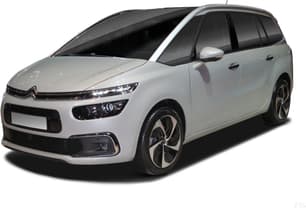
If you were to suggest there isn’t anything interesting about the design of the Citroen Grand C4 Picasso, it would pretty much intone that you’re vision impaired. This is - without question - one of the most intriguing and interesting looking vehicles on the market today.
With its front-end design mirroring the other models in the French maker’s range - sleek LED daytime running lights sitting either side of a chrome grille with central chevron, the main headlights below and some chrome trimming on the lower bumper - this is easily distinguishable as a Citroen. There’s no confusing it with a Kia, Honda, or anything else, in fact.
The large windscreen and panoramic sunroof help give it that two-tone look, and the beautiful silver C-shaped rim that surrounds the glasshouse is one of the best styling touches in the automotive business.
Our car rides on the standard 17-inch wheels wrapped in grippy Michelin tyres, but there are optional 18s if you want something that fills the wheelarches a little more.
At the rear there are some nicely styled tail-lights, and its hips are broad, giving it a nice amount of presence on the road when you’re sitting behind it in traffic.
I think Spacetourer works better as a name: Picasso was known for artworks that were challenging to make sense of. This vehicle presents no such conundrum.
The interior is also one of the most stunning in the business: I love the two-tone dashboard, the stacked twin screen layout, the minimalism of the controls and the massive windscreen with innovative adjustable headlining - yes, you can move the front part of the headlining back and forth, and the sun-visors move with it.
Our car had the optional 'Leather Lounge' pack, which adds dual-tone hide trim, seat massage functions for both front seats, plus heating for both front seats, and the front passenger seat has an electrically operated leg/footrest. This interior trim is nice, but it comes at a price… ahem, a big price: $5000.
As you might expect, that’s hard to justify if you’re trying to save money on your seven-seat people-mover. But ignore that: let’s take a deeper dive into the cabin.
On the outside of the new Skoda Superb its design is more of an evolution than revolution. This is no bad thing because I’ve always been a big fan of the Superb’s exterior design, even more so now because it’s the only one of its kind left.
From a lot of angles this new Superb gives major Holden ZB Commodore vibes, especially the wagon from the rear three-quarter.
While I like the sporty looks and glossy black highlights, I wish Skoda still offered a non-Sportline version of the Superb locally. Globally there are premium L&K versions available with chrome accents, and they look properly premium-pushing.
Inside, the Superb is a classic flagship Skoda through and through. It balances having beautifully high-end finishes with TARDIS-like practicality with ease.
Ahead of the driver there’s a sporty-looking perforated leather steering wheel which has Skoda script written out on the hub, rather than the classic winged arrow Skoda logo.
It’s an interesting look that forms as part of the new corporate design language. I imagine I’ll get used to it after a while, and it's all subjective, but I’m currently not a huge fan.
Looking around the cabin, the interior is dominated by the new 13-inch touchscreen multimedia system that’s high-resolution. It’s mounted high on the dashboard much like an iPad, which mightn’t be to everyone’s taste.
Flanking this new touchscreen is an interesting slotted air vent design that spans the entire dashboard. It’s a really cool look, though it’s finished in glossy black and will likely gather dust easily.
Speaking of black, a lot of the Superb’s interior is finished in black. I wish there were more pops of colour, whether that's with different finishes or textures to create some visual interest.
It’s kind of amazing just how much Citroen has managed to fit into the Grand C4 Picasso. It measures 4602mm long - which is just 22mm (an inch) longer than a Mazda3 sedan! As for the other dimensions, the width is 1826mm, and the height is 1644mm.
How many seats does the Citroen Picasso have? The answer is seven, whether you choose the petrol or the diesel - but notably, the petrol model has a space-saver spare wheel under its boot, where the diesel misses out because it has an AdBlue system.
Yep, by some marvel of packaging magic, the brand’s engineers managed to pack seven seats, a reasonable boot (165 litres with all seats up, 693L with the back row folded, 2181 with the five rear seats folded), plus a spare tyre and a lot of style into a very compact package.
That’s not to say this is a seven-seater to suit all the needs of buyers who want seven seats. The back row is tight for anyone nearing 183cm (six-feet) tall, and there is no third-row airbag coverage. According to the French brand, the occupants of those rearmost seats are inwards enough of the sides of the car that they theoretically shouldn’t need airbag cover. Depending on your safety stance, that may rule it out for you - or perhaps make you change your mind as to whether you use the back row regularly or not.
Even so, there’s a huge amount of practicality to the cabin. You can fold the third-row seats and stow them away under the boot floor, or if you need to use them there are vents as well as a fan speed controller and a set of rear reading lights. The boot also has a light that doubles as a flashlight, and there’s a 12-volt outlet. There is one shallow cupholder and two small storage boxes on top of the wheel-arches.
In the second row the seats are also individually operable, with all three sliding and/or folding as required. The outboard seats also have a clever seat base flip-up function, allowing them to move all the way forward for easier third-row access.
The space in the second row is easily good enough for three adults to slot across, though the roof-mounted middle seatbelt is a bit annoying. There are air-vents with fan controls mounted in the B-pillars, and the front seat-backs have clever flip-down tables with lighting, and there are mesh map pockets below. There is another 12-volt outlet, a pair of slim door pockets (not big enough for bottles), but no cupholders.
The front cabin is better sorted for storage of odds and ends - there is a pair of (small, shallow) cupholders between the seats, an enormous central console box that’s easily copious enough for phones, wallets, keys and the like, plus another storage area near where you plug in your USB/auxiliary device. The way the owners manual/logbook slots under the steering wheel is neat, and the glove box is fine, too, plus there are reasonably good sized door pockets, but again they lack sculpted bottle holsters.
One little issue I had was with the steering adjustment toggle - it’s quite springy… so much so that it sprung back and hurt my finger every time I adjusted it. That mightn’t be an issue if you’re the sole driver, but it’s worth noting.
As striking as the lovely leather trim is, the dashboard design is what I love most about this car. There’s a huge 12.0-inch high-definition top screen that shows you an enormous digital speed readout, plus you can have it show you the mapping and sat nav, or the car’s vital measures, or see where your car is positioned by way of the standard-fit 360-degree camera.
The lower 7.0-inch touchscreen is where the action happens: it’s your point of control for the media system, including Apple CarPlay and Android Auto smartphone mirroring, the dual-zone climate controls, car settings, and phone. There are supplementary volume and track controls, plus the steering wheel has things sorted pretty well in terms of ergonomics, too.
Okay, to clarify: I love this set up to a degree. I don’t like that the air conditioning controls (apart from de-mist for front and rear windscreens) are all within the lower screen, which means - on a really hot day, for instance - you have to fumble through menus and tap the screen repeatedly, rather than just turn a dial or two. Every sweaty second counts when it’s 40-degrees-plus outside.
This is where this car properly shines.
Up front there are deliciously comfortable leather seats that are electrically adjustable, heated, ventilated and have a massage function. The heating was well and truly cranked during our drive loop around chilly Canberra and it kept me nicely warm and toasty.
I also enjoy how adjustable the front seats are. No matter how tall or short you are, you’ll find a comfortable seating position.
As mentioned above there’s a leather steering wheel ahead of the driver which has perforations on it. This is handy if you get clammy hands out on the road. And I like how warm the steering wheel gets when the heating is turned on. In fact, it almost gets too hot.
The 10-inch digital instrument cluster behind the steering wheel is classic Volkswagen Group in terms of layout and design. It offers what feels like limitless configurations, allowing you to tailor the information you want to see.
Moving across, this larger 13-inch touchscreen multimedia system is a breeze to use. It features new software compared to the previous-generation Superb that looks considerably fresher.
The home screen can be configured and there are easily accessible shortcut buttons on the screen for things like the vehicle settings menu, among others.
I’m a particular fan of the shortcut buttons at the top of the touchscreen that show your favourite settings in the vehicle menu. You’re able to toggle things like auto hold, engine idle start-stop and numerous other features.
Underneath the touchscreen is one my favourite parts of this car. There are three physical rotary dials that initially look like they’re just for adjusting the climate control functions, but can do so much more. They’re called ‘Smart Dials’ and also feature in the new Kodiaq.
The outer two dials are able to adjust things like the temperature, as well as the seat heating and ventilation, whereas the centre dial can change the fan speed, air direction, driving mode, sound system volume and zoom function on the sat-nav map.
They’re incredibly intuitive to use and have fantastic tactical clicks when interacted with. It’s fantastic to see a new car that puts such a big emphasis on still having physical hardware, instead of opting for the minimal look that requires you to use the touchscreen for everything.
Another big change with the Superb is the gear selector has been relocated from the centre console to the steering column. This has been happening to a range of Volkswagen Group vehicles of late.
As a result, the centre console has been redesigned with maximised storage in mind. There are now things like a display cleaner and many generous storage spaces.
Also if you want to securely store items, there are retractable covers on the centre console which also help give it a clean look.
Moving to the second row, it’s an amazing place to sit. There is so much space on offer that it puts every single similarly priced and sized SUV to shame. You can’t beat a large sedan or wagon in terms of practicality.
Second-row amenities include heated outboard seats, retractable sun-blinds, a fold-down armrest with cupholders and a tablet holder, as well as airplane-style head restraints that fold out from either side of the head rest.
Regardless of where you sit in the Superb, you’ll be in proper comfort.
Around the back is the showstopper. As standard there’s a hands-free power tailgate which is handy if you’ve got hands full and need to open the boot.
Once the tailgate opens there’s a generous amount of boot space on offer. Skoda claims the Superb liftback has a 589L capacity with the rear seats upright, expanding to 1795L with them folded.
With the wagon on the other hand, there’s 634L of boot space with the rear seats upright, expanding to a massive 1920L with the second row lowered.
‘Simply Clever’ touches include an electrically retractable luggage cover, a retractable luggage sling, moveable luggage separators, and a vast net system.
Under the boot floor there’s a space-saver spare wheel.
With a sub-$40k price tag, the Citroen Grand C4 Picasso suddenly enters a realm of relevance that it didn’t before.
The official list price is $38,490 plus on-road costs, and if you haggle hard, you might be able to get one on the road for about forty grand.
As mentioned, it’s a seven-seater, and it comes rolling on standard 17-inch alloys.
Some of the other features include auto headlights, auto wipers, LED daytime running lights, puddle lights, smart key and push-button start, and an electric tailgate.
You don’t see it in the interior images here, but if you buy the most affordable Grand C4 Picasso model you get cloth seat trim, but still a leather steering wheel. And of course there’s the 7.0-inch media screen with built-in sat nav that displays on the 12.0-inch high-definition screen up top.
There’s Bluetooth phone and audio streaming as well as auxiliary and USB points - but in this day and age, just one USB isn’t terrific. I guess the first trip to the servo could include the purchase of a couple of those 12-volt USB adaptors.
As for people-mover competitors at this price point? There are a few, such as the LDV G10 (from $29,990 drive-away), the Volkswagen Caddy Comfortline Maxi (from $39,090), the Kia Rondo Si (from $31,490) and the Honda Odyssey VTi (from $37,990). The best people-mover we reckon you can buy - the Kia Carnival - is relatively exxy, starting at $41,490, and it’s more physically imposing, too.
Or you could be like the vast majority of buyers and forego the French charm and Avantgarde styling of the Citroen for a mid-sized SUV with seven seats. Examples priced near the entry-grade Grand C4 Picasso include the Mitsubishi Outlander, Nissan X-Trail, LDV D90, Holden Captiva or even the Hyundai Santa Fe or Kia Sorento.
The new Skoda Superb continues to only be offered in flagship Sportline trim level in either liftback or wagon body styles.
Pricing starts at $67,990, before on-road costs, for the liftback and extends to $69,690 before on-roads for the wagon.
While this is a circa-$2500 price rise over the outgoing model, Skoda has packaged in a considerable amount of equipment that was previously locked away in option bundles. As a result, this car is fully loaded.
Outside there are slimmer matrix LED headlights, new design 19-inch alloy wheels, gloss black exterior highlights, dynamic indicators and a hands-free power tailgate.
Inside there are new sport seats with integrated head rests that are also electrically adjustable, heated, ventilated and have a massage function.
Other interior highlights include a heated steering wheel, 10-inch digital instrument cluster, 13-inch touchscreen multimedia system, 12-speaker Canton premium sound system, wireless charging with ventilation, roll-up rear sunshades and heated outboard rear seats.
On the dynamics front, the new Superb picks up 'Dynamic Chassis Control Plus', which is essentially Skoda-speak for adaptive dampers. It’s an updated version which features two independently controlled valves, and allows for 15 stages of configurability. There’s now also progressive steering.
Under the bonnet is a 1.6-litre petrol four-cylinder turbo unit producing 121kW of power (at 6000rpm) and 240Nm of torque (at a low 1400rpm). If you think about what other seven-seat people-movers have, that’s only okay - for instance, the cheaper LDV G10 people mover has 165kW/330Nm.
The Citroen may have a smaller engine capacity and outputs, but it’s also quite light - it weighs 1505kg (kerb weight) because it’s so small. The LDV, by contrast, weighs 2057kg. In short, it punches at, but not really beyond, its weight.
The Grand C4 Picasso is front-wheel drive, and uses a six-speed automatic transmission with a manual mode and paddle-shifters… yes, that seems unnecessary. The shifter is up on the steering column, which is an ingenious use of space, but the fact it has a dedicated manual mode means you may often choose M rather than D, particularly if you’re in a hurry.
If you plan to do a lot of towing, this isn’t the car for you. The claimed towing capacity is 600 kilograms for a trailer without brakes, or just 800kg for a braked trailer. The diesel is a better bet if that matters to you, with a 750kg un-braked/1300kg braked rating… though that’s still below average compared to some similarly priced petrol seven-seat SUVs like the Mitsubishi Outlander (750kg/1600kg), LDV D90 (750kg/2000kg) or Nissan X-Trail (750kg/1500kg).
The new-generation Skoda Superb is still powered by a 2.0-litre turbo-petrol four-cylinder petrol engine, but it has been upgraded.
It produces 195kW of power, which is technically 9.0kW less than the previous-generation version, and 400Nm of torque, which is 50Nm more.
It’s worth noting this engine also features in the new Skoda Octavia RS, as well as the Volkswagen Golf GTI and Tiguan R-Line.
The engine is mated to a seven-speed dual-clutch automatic transmission with drive sent through an all-wheel drive system.
The claimed fuel use for the Grand C4 Picasso petrol model is just 6.4 litres per 100 kilometres, which is rather impressive. It requires 95RON premium unleaded, meaning the cost at the pump can be markedly higher than regular 91RON.
In the real world, a lot of turbocharged cars tend to be thirstier than the claim suggests, but we saw a relatively decent 8.6L/100km during our time in the Grand C4 Picasso.
By comparison, the diesel is said to use a miserly 4.5L (17-inch wheels) or 4.6L (18s).
Let’s do some maths: the average cost per 1000km, based on claimed fuel usage, works out to $65 for the diesel and $102 for the petrol, and you’ll get about 40 per cent more distance per tank out of the diesel, and typically diesel is cheaper. But even so, the extra $6000 outlay on the initial purchase of the diesel will still take plenty of mileage before you break even.
While the new Superb is claimed to be faster, it’s also claimed to be more fuel efficient. In liftback guise claimed combined cycle (urban/extra-urban) fuel consumption is 7.7L/100km, while in wagon guise the official figure is 7.8L/100km.
The entire range comes with a 66-litre fuel tank and it requires a minimum of 95 RON premium unleaded.
With this claimed fuel consumption you could theoretically travel up to 850km on a full tank of petrol. In our test cars however, they were displaying 900km of range when we started off the drive loop.
Unfortunately the Superb doesn't come with any form of electrification, whether that be a mild-hybrid or plug-in hybrid powertrain. Skoda Australia is currently evaluating and testing the Superb PHEV, but if it does launch locally, it won’t be until 2026 at the earliest.
I’ve mentioned the word ‘charm’ already in this review, and the adjective to describe what I think about the drive experience is ‘charming’.
I love it.
It has that French suspension set-up that just doesn’t get bothered by sharp bumps because it has been tuned to deal with cobblestone alleyways. It rides beautifully at high and low speeds, loping over speed humps with ease, cosseting those in the cabin from the surface below.
It’s also tremendously quiet, with hardly any road noise intrusion in the cabin compared to the vast majority of cars out there. The coarse-chip surfaces of the M4 in Western Sydney usually offer up an ear-bashing, but not here.
The 1.6-litre engine is perky enough.
The steering is like that of a hatchback, with a tight (10.8m) turning circle enabling you to pivot on yourself more readily than you might think. The steering is also quite enjoyable if you like to drive, but don’t push too hard - understeer is an imminent threat, though the grip on offer is quite good.
The 1.6-litre engine is perky enough, and responds well both in stop-start traffic and on the highway - but there is no doubt about it, the 2.0-litre turbo diesel model’s 370Nm of torque makes for motoring with a lot less effort and strain. Not that the engine in the petrol model feels like it can’t get the job done - it just feels like it could do with a little more pulling power… Again, not enough to rule it out of contention, because it’s nicely refined.
The six-speed automatic is geared towards efficiency, which means that you might find it in third gear before a hill and somewhat hesitant to drop back a gear to gather more pace. I didn’t find this too annoying, but it did help me finally understand why the manual shift and paddles are fitted.
On the whole, there is a lot to like about this: it’s a family-focused car with family-focused dynamics on all fronts.
Starting up the Skoda Superb Sportline you hear the familiar sound of this 2.0L engine, variations of which are used in numerous VW Group models. It’s fairly muted and smooth, which makes the cabin a serene place to be.
Setting off you use the column-mounted gear selector to change gears. It takes a little bit to get used to the new placement, but after a few uses it feels normal. This relocation has also allowed for so much more storage on the centre console.
Around town the Superb’s 2.0-litre turbocharged four-cylinder petrol engine barely makes itself known. The full 400Nm of torque comes on tap from as little as 1650rpm, making this car effortless to drive and almost turbo-diesel-like in practice.
Skoda claims the new Superb can do the 0-100km/h sprint in 5.6 seconds in liftback guise and 5.7 seconds in wagon guise. This is 0.3 seconds faster than the old version.
It barely requires any thought driving in the typical urban sprawl. The car does all the heavy lifting for you.
When it comes to parking, however, there’s no way around the fact this is a long car. You may find yourself needing to do three-point turns in order to navigate tighter urban car parks.
It doesn’t help that the surround-view camera system is surprisingly low-resolution, which is disappointing given the Superb is a flagship vehicle for Skoda. It’s more noticeable because the central touchscreen is incredibly high-resolution.
As standard there’s a seven-speed dual-clutch automatic transmission which has one more ratio than the previous-generation Superb. Though this isn’t necessarily obvious in everyday driving, the dual-clutch is still a classic Volkswagen Group unit, meaning it’s snappy and intuitive.
This car comes with a progressive ratio steering system which increases the amount the wheels physically turn as you feed on more lock with the steering wheel. It helps make the car feel more agile and sporty, while also requiring less effort.
With the updated adaptive dampers you can now configure the system in 15 different ways, which is wild. This spans all the way from beyond ‘Comfort’ through to ‘Sport’.
In ‘Normal’ mode the Superb still errs on the sportier side, which makes sense because the Sportline package is standard. This also brings a 15mm ride height reduction.
Despite feeling sporty as standard, the Superb is never uncomfortable. This is really surprising because there are sizeable 19-inch alloy wheels and low-profile tyres.
Dialling the car through to ‘Comfort’ mode makes the drive pretty much effortless. It’s incredibly comfortable and supple, ironing out virtually any road imperfection you can throw at it.
Unlike other Skoda vehicles with adaptive dampers, this Superb doesn’t get that bouncy cloud-like feeling in ‘Comfort’ mode. Instead, it still feels grounded.
There’s an ‘Eco’ drive mode which unsurprisingly prioritises fuel economy. It makes upshifts happen low down in the rev range, and also shifts the car into neutral when coasting.
Although the car is in ‘Eco’ mode, it doesn’t feel like you’re lacking any oomph. You’ll still be keeping up with urban traffic easily.
Slotting the Superb into ‘Sport’ mode immediately sharpens the throttle response and makes the car feel like it’s hunkering down, ready to attack. The suspension and adaptive dampers noticeably become stiffer, making you jiggle about in the driver’s seat more than in other drive modes.
It’s surprising how Sport makes this huge sedan and wagon feel much smaller than it is. This is likely credit to how dynamic the Volkswagen Group has made its 'MQB Evo' platform.
Thanks in part to the all-wheel drive system, this car is an absolute beast out in the twisties. You can take corners with a lot of heat and still feel incredibly in control.
Once again, the car does a lot of the heavy lifting, allowing you to focus on what’s going on with the road ahead. It’s very smile-inducing.
While this car is dynamic and thrilling to drive, it’s worth noting it’s no full-fat RS model. You reach a ceiling with the turbo-petrol’s outputs when accelerating hard, but there’s still plenty to play with. Only proper performance car nerds will care about this.
Out on the open road, the Superb becomes a great long-distance tourer. It feels like I could drive from Melbourne to Adelaide in one hit without stopping.
At higher speeds, however, there is a bit of road and tyre noise. This is common in European vehicles, but still ruins the ambience of the cabin if you don’t like listening to music behind the wheel.
More concerning, though, is the virtually brand-new Superbs we sampled at this media launch were already starting to develop noticeable rattles in the door cards. Underwhelming in a circa $70K car.
The Citroen Grand C4 Picasso was crash tested back in 2014, and managed the maximum five-star ANCAP rating. But the criteria has changed in recent years, and there are some omissions on the petrol model when compared to the diesel.
The diesel, for instance, has adaptive cruise control and auto emergency braking (AEB), but buyers of the petrol miss out on those items, and they’re not optionally available, either. And all Grand C4 Picasso buyers miss out on third-row curtain airbag coverage, with the curtain ‘bags only stretching to the second row (there are six airbags total - dual front, front side and two-row curtains).
All that said, the car is still quite well stocked with other assistance tech: it has a forward collision warning system that works above 30km/h, a 360-degree camera system (with reversing camera and front corner cameras, too), speed limit recognition, auto high-beam lights, semi-automated park assist, blind-spot monitoring with steering assist, lane-keeping assist with steering function and driver fatigue monitoring.
And for what it’s worth, the vision from the driver’s seats, combined with camera system and the clarity of the top screen, is great.
The new-generation Skoda Superb hasn’t been tested by ANCAP just yet, though Euro NCAP gave the car a maximum five-star rating. The two safety authorities have harmonised testing protocols so it’s likely the rating will eventually be carried across.
In terms of standard equipment, the Superb has 10 airbags, an upgraded autonomous emergency braking (AEB) system, blind-spot monitoring, front and rear cross-traffic alert, lane-keep assist, lane centering, adaptive cruise control, traffic sign recognition, driver fatigue detection, a surround-view camera, front and rear parking sensors and a semi-autonomous park assist.
There are ISOFIX points on the outboard rear seats, as well as top-tether child seat anchorages on all three rear seats.
Citroen has just updated its ownership promise to consumers, with passenger vehicles attracting a five-year/unlimited kilometre warranty plan, which is backed by a five-year/unlimited kilometre roadside assist package.
Previously, the plan was three years/100,000km - and that’s even what some of the paperwork on the company’s site still suggests. We assure you, though, the five-year deal is legit.
Servicing is due every 12 months or 20,000km, whichever occurs first, under the Citroen Confidence Service Price Promise plan. The costs for the first three services are $414 (first service), $775 (second service) and $414 (third). That cost cover spans nine years/180,000km.
The new Superb, like all other current Skoda models, is covered by a seven-year, unlimited-kilometre warranty.
This warranty length is slowly but certainly becoming the standard in Australia.
At this stage Skoda hasn’t detailed service intervals or service pricing. It has said it’ll offer pre-paid service packages, however.