What's the difference?
Visit Chery’s website, click on the Omoda 5 GT and you’ll find references to its “dynamic personality”, “distinctive face” and “cinematic elegance”.
Is this a show-stopping movie star or a new, sporty compact SUV? Maybe in the context of our video review of the car it can be both?
Either way, it extends the still fresh Omoda 5 line-up from two grades to four, adding the option of all-wheel drive at the same time.
It’s aimed at premium versions of small SUV favourites like the GWM Haval Jolion, Hyundai Kona, Mitsubishi Eclipse Cross and Subaru Crosstrek, expanding the new challenger brand’s scope in this intensely competitive segment.
So, read on to see if the Omoda 5 GT has the star quality required to enhance your urban life.
If the Acadia had an accent it would be a southern drawl because this big seven-seat SUV is built in Tennessee, USA, and wears a GMC badge when it’s at home.
In Australia of course it wears a Holden one and comes straight from the factory in right-hand drive. So how does it suit Aussie conditions? Does it even know the importance of a sausage on a piece of bread bought outside a hardware store on a Saturday?
All this and more was learnt when the entry grade LT front-wheel drive came to live with my family.
The GT AWD successfully adds a performance spark to the city-sized Chery Omoda 5 SUV formula. It’s sprightly and stacks up well in terms of value and practicality. It’s also space-efficient, safety’s great and the ownership package is hard to beat.
That said, despite the shift to a multi-link rear suspension, ride comfort and the steering could be better. But overall, no rotten tomatoes here. This is a worthy contender that shows how far and how quickly Chery has progressed.
The Holden Acadia is a proper seven-seater SUV in that it will fit adults in the third row without turning your friends into enemies. It’s also practical and well fitted out with storage places and utilities such as USB ports.
I was particularly impressed with the advanced safety equipment on-board even at this entry LT level. Yes, it’s a V6 petrol and it’s not the most fuel-efficient SUV, but our time with it showed that with cylinder deactivation and the stop-start system it might not be as thirsty as you’d think.
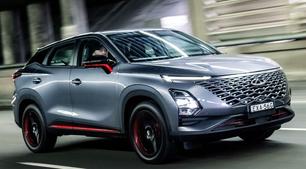
The Omoda 5 GT is a re-tuned version of the standard car, mechanically and visually.
We’ll cover the oily bits shortly, but from a design point-of-view, it retains the sweeping, diamond pattern grille and overall mix of intersecting surfaces and angular details from the entry models.
On three of eight available colours the GT shares red accents on the gloss black 18-inch alloys, exterior mirrors, lower part of the doors and underneath the roof spoiler also available on the Omoda 5 EX, but it somehow seems more appropriate here.
A car’s appearance is always a subjective call but I think the Omoda 5 looks contemporary in a sharply defined, Lexus kind of way, especially at the rear. The red highlights aren’t my cup of tea, but you might love them.
The interior tone is set by the dual 10.25-inch LCD screens installed together across a sleek flat panel, one is touch-sensitive for multimedia and other functions and the second for instrumentation and drive information.
Worth noting the GT’s centre console finish is gloss black rather than the standard car’s matt metallic-style treatment.
It all flows together nicely, the materials used look and feel good while the dash and front console layout looks sleek and works well from an ergonomic point-of view… with the exception of USB ports located low down on the passenger side of the console. Handy for the front passenger but likely a hangover from left-hand-drive production that’s uneconomic to change.
To fully understand the look of the Acadia, take a peek at the GMC website - but make sure you shield your eyes in the same way you would during a solar eclipse, or when welding, or in an atomic blast.
You’ll understand when you get there but suffice it to say contained within the site are some pretty confronting trucks and SUVs. Once you’ve recovered, you’ll realise the Acadia is the supermodel of the GMC family.
Yep, it has a big, blocky, truck-like look but it’s a refreshingly tough styling alternative to more elegant looking SUVs such as the Mazda CX-9.
The Acadia is also one of the smallest members of the GMC family, yet its dimensions position it as a large SUV in Australia. Even then it’s not huge compared to other large SUVs here, so you won’t have an issue piloting it in Aussie car parks or fitting into spaces.
The Acadia measures 4979mm end-to-end, 2139mm across (with the mirrors out) and 1762mm tall.
Along with the Mazda CX-9 the Acadia would also consider the Kia Sorento and Nissan Pathfinder to be among its rivals.
Inside, the Acadia is a modern and stylish looking place, although it’s a bit unrefined. Still, as one YouTube commenter reminded me parents will like the wipe clean surfaces.
Well her comment wasn’t written that politely but being a parent, I concur that the hard plastics have that advantage.
The interior is not all unrefined. The seats, even in the entry grade LT we tested, while cloth (and only available in Jet Black) are sculptured with bolsters and finished with a textured pattern that looks and feels great.
At a fraction under 4.4m long, just over 1.8m wide and close to 1.6m tall, with a roughly 2.6m wheelbase the Omoda 5 GT fits within the typical small SUV footprint.
At 183cm I’ve got more than enough breathing room in the front, the away slope of the twin screen array helping to open up the space.
For storage, there’s lots, including a decent-size, cooled lidded box between the seats, which doubles as a centre armrest, two cupholders, a generous glove box, a large area underneath the centre console and big bins in the doors with enough room for large bottles.
And in the back, sitting behind the driver’s seat, set to my position, I’ve got adequate foot room, plenty of legroom and heaps of headroom as well as adjustable ventilation. Big tick.
Storage options include map pockets, decent door bins and two cupholders in the fold-down centre armrest.
Power and connectivity runs to a 50-watt wireless charging pad as well as two USB-A sockets (one in the interior mirror housing ready for a dash cam) a USB-C and 12-volt socket in the front, a USB-A in the rear and another 12V in the boot.
Speaking of which, with all seats up the Omoda 5 GT offers 300 litres of storage space, which is relatively modest, but you have more than 1000 litres with the 60/40 split rear seat folded.
The upside is a full-size alloy spare sits under the floor (the 2WD has marginally more boot space but cops a space-saver) and the tailgate is power-operated. But those keen on towing are out of luck as the Omoda 5 isn’t rated.
The Acadia’s practicality game is strong. It boasts seven seats with third row positions actually able to fit adults, five USB ports sprinkled through the cabin, and a cargo capacity of 1042 litres with the third-row seats folded flat and 292 litres with them in place. If you have three kids, even teenagers, the Acadia could be the perfect family personnel carrier for you.
All three rows are spacious and even at 191cm tall I had good shoulder and elbow room up front, and in the second and third rows I had enough legroom to sit in each seat behind my seating position without feeling cramped.
Feeling a bit down because you might not be able to stretch the budget to get the LTZ-V? Well, cheer up – the LT has more headroom and that’s because it doesn’t get the sunroof which eats into the ceiling height.
Cabin storage is excellent. There’s a wide and deep centre console bin, a hidey hole in front of the shifter, a tray for second row passengers, six cup holders (two in each row) and decent-sized door pockets.
Directional air vents for everybody on board, three-zone climate control, two 12-volt power outlets, privacy glass and proximity unlocking complete a great practicality package.
Also offered in two-wheel drive, this all-wheel-drive version of the Omoda 5 GT cracks the $40K barrier with a drive-away price of $40,990.
At that money it starts to push into the upper end of the category where a healthy standard features list is more or less cost-of-entry.
In terms of similarly-priced competitors, think GWM Haval Jolion Ultra Hybrid 2WD ($40,990 drive-away), Hyundai Kona N Line Hybrid 2WD ($40,000), Mitsubishi Eclipse Cross Exceed AWD ($43,490) and Subaru Crosstrek Hybrid S AWD ($45,090).
Worth noting the category dominant MG ZS tops out at around $30K, drive-away, for the top-spec ZST Essence. So this Chery is out of the MG’s league price-wise.
And aside from the performance and safety tech we’ll look at shortly the Omoda 5 GT does well with the equipment list including dual-zone climate control, heated and power-adjustable sports front seats, adaptive cruise control, dual 10.25-inch multimedia and instrument screens, eight-speaker Sony audio with digital radio plus Android Auto and Apple CarPlay, synthetic leather trim, a power sunroof (with retractable blind), power tailgate, LED head- and tail-lights and 18-inch alloy wheels.
There are also front and rear fog lights, puddle lamps, auto rain-sensing wipers, heated power-folding exterior mirrors, synthetic leather trim (including the steering wheel and gearshift), configurable ambient lighting, keyless entry and start (plus remote engine start), remote window open and close and a heated steering wheel.
In the context of the small SUV segment this Omoda 5 GT delivers a solid basket of fruit for the money.
The front-wheel drive Acadia LT lists for $43,490, which is $4500 less than the all-wheel drive version.
The standard features list includes 18-inch alloy wheels, roof rails, LED running lights, three-zone climate control, proximity key, rear parking sensors, Bluetooth connectivity, six-speaker stereo, 8.0-inch screen with Apple CarPlay and Android Auto, noise cancellation, dual chrome exhaust tips, privacy glass and cloth seats.
The value is pretty darn good here and you’re not missing out on much by not stepping up to the $10K more LTZ grade, apart from wireless charging, and power and heated leather front seats.
The Acadia costs about the same as the Pathfinder ST but is better value; about $500 more than the entry grade Kia Sorento Si; but undercuts Mazda’s CX-9 Sport by about $3K.
The GT swaps out the Omoda 5 BX and EX’s 1.5-litre turbo-petrol four sending drive to the front wheels through a CVT auto for a more powerful 1.6-litre turbo-petrol four pushing 137kW (at 5500rpm) and 275Nm (from 2000-4000rpm) to the front, or as here, all four wheels via a seven-speed dual-clutch auto.
That means power is up 27 per cent on the standard car and torque is boosted by no less than 31 per cent.
The all-alloy engine is an in-house design produced by Chery’s Acteco powertrain subsidiary and features direct-injection and dual variable valve timing, while the dual-clutch auto comes from a collaboration with German transmission specialist Getrag.
All Acadias come with a 3.6-litre V6 petrol engine which makes big dollops of power and torque or 231kW (at 6600rpm) and 367Nm (at 5000rpm).
A nine-speed automatic swaps gears, and in the case of our two-wheel drive LT test car the drive went to the front wheels only.
The V6 gets the thumbs up for its stop-start fuel saving system and cylinder deactivation, plus good acceleration and the smooth power delivery you’d associate with a naturally aspirated engine, but a thumbs down for needing to rev hard to make that mumbo.
Chery’s official combined cycle fuel-economy figure for the Omoda 5 GT AWD is 7.4L/100km, the 1.6-litre turbo four emitting 176g/km of CO2 in the process.
Idling stop-start is standard and over a week covering mainly urban and suburban driving, with a hint of freeway running thrown in, we recorded an average of 10.2L/100km which is on the thirstier side of the spectrum.
Worth noting the minimum fuel requirement is the pricier 95 RON premium unleaded and you’ll need 51 litres of it to fill the tank which translates to a theoretical range of around 690km (roughly 500km using our real-world number).
We were surprised by the Acadia’s fuel efficiency. After filling up the tank I drove for 136.9km on a combination of hilly country roads and peak hour evening city traffic and then filled up again – only 13.98 litres were used. That’s a mileage of 10.2L/100km. The official combined consumption figure is 8.9L/100km.
So, while the engine is big and not particularly new (it’s an evolution of the V6 built by Holden in Australia for the Commodore) it does have fuel-saving tech like cylinder deactivation and a stop-start system – which you can’t switch off.
Still, not the most fuel-efficient seven-seater – those with turbos and smaller capacity engines such as Mazda CX-9 are truly amazing in the way they can deliver grunt without getting thirsty.
Chery doesn’t quote a 0-100km/h figure for this car but expect a time in the mid-seven-second range, and it feels quick. Particularly urgent in the mid-range.
That’s because maximum torque is delivered across a broad plateau from 2000-4000rpm, right where you want easy pulling power for safe lane changes and drama-free overtaking.
This car tips the scales at around 1.5 tonnes (100kg more than 2WD), which is par for the small SUV course and it feels nimble in traffic and on the open road.
As is often the case with relatively small capacity turbo-petrol engines, you need to ease into the throttle gently for smooth take-offs. And once underway there are multiple modes available, the default ‘Eco’ setting, then ‘Sport’, ‘Snow’, ‘Mud’ and ‘Off-road’.
While we didn’t explore the loose surface modes, in Sport the seven-speed dual-clutch auto holds onto gears that little bit longer and changes down more readily. In fact, the transmission’s first few ratios feel quite low, so even in Eco the Omoda 5 GT has an eager, sporty personality.
Although the central shifter easily transitions to sequential ‘manual’ mode a pair of wheel-mounted paddles, sadly missing, would be even better for direct gear control.
Suspension is by struts at the front and multi-links at the rear, the latter a change from the ‘standard’ car’s torsion beam set-up.
The 18-inch alloy rims are shod with 215/55 rubber and that 55 aspect ratio makes for a relatively comfy tyre sidewall. But beware the ride is firmer than the standard car with high-frequency bumps making their presence felt, although it’s far from extreme.
In fact, the car is refined in terms of engine or any other noise with standard acoustic front side glass playing its part.
No surprise the steering is electrically assisted and it can be swapped through ‘Sport’ and ‘Comfort’ modes. The latter is relatively light and road-feel is okay.
Switch to Sport and the weight increases noticeably but road feel remains the same. Not the best in the business but not the worst, either.
Given this GT’s get up and go and sporty pretensions you’re likely to enjoy a drive on your favourite twisty backroad and this AWD version grips securely through the bends.
On the highway, with the active cruise engaged, it’s worth noting steering wheel inputs from the lane-departure function are constant and relatively abrupt even in sweeping, well-marked bends.
Braking is by discs all around, ventilated at the front with the GT featuring bigger rotors front and rear (308mm vs 283mm fr - 313mm vs 263mm rr). Aside from the fact it’s unusual to have a larger disc at the rear they’re pretty smooth but you need to be firm with the pedal to wash off speed effectively.
Under the heading of miscellaneous observations, in 3D mode the ‘AVM’ panoramic view system plays with your mind. It’s literally an out of body experience thanks to four external cameras providing an exterior view of the car on the road on the central media screen.
At just over 10 metres the turning circle is agreeably tight while vision for parking, supported by the reversing camera and panoramic view, is clear.
The driver’s door armrest is kinda firm and the media system, complete with ‘Hello Chery’ voice recognition, is quick to respond and easy to navigate.
I drove the Holden Acadia back-to-back with the Nissan Pathfinder – you can watch the model comparison in the video above, but the upshot of that experience was important.
See, while I wasn’t a major fan of the Acadia driving experience when I first met the SUV at its Australian launch in 2018, when I drove it straight after the Pathfinder the difference was like night and day.
The Acadia is comfortable, from the big seats to the smooth ride. If you’re covering a stack of territory the Acadia makes a great highways cruiser and will chomp up big distances effortlessly.
That V6 does need to rev hard, but it’s powerful and acceleration is swift, while the nine-speed automatic shifts pretty seamlessly. Noise cancelling tech keeps the cabin fairly serene, too.
Look, it’s not the most dynamic of SUVs and there was a bit of tyre chirp in the corners when pushed, but this isn’t a performance car and nor is it trying to be.
Small windows mean a cooler, tough look, but the downside is a dark cabin and occasionally visibility is limited by the A-pillars or out the rear windows.
A 2000kg braked towing capacity will rule the Acadia out for many thinking of pulling a large caravan or big boat. The Pathfinder’s 2700kg braked towing capacity is a strength of that SUV.
Do you need all-wheel drive? Nope, but it’s handy for dirt and gravel roads. Still the 198mm ground clearance with only front-wheel drive should see you get down bumpy roads that regular sedans couldn’t handle.
The Chery Omoda 5 has a maximum five-star ANCAP score from assessment in 2022 and on-board active, crash-avoidance safety tech is impressive.
The highlights are blind-spot detection, AEB, intelligent headlight control, lane departure warning and prevention, adaptive cruise control, driver monitoring, a reversing camera (with 360-degree around view plus front and rear parking sensors), traffic sign recognition plus rear cross-traffic alert and braking.
If an impact is unavoidable, there are seven airbags onboard, including full-length side curtains and a front centre bag to minimise head clash injuries in a side-on crash.
Multi-collision brake minimises the chances of secondary collisions following an initial impact and there are three top tethers and two ISOFIX anchors for baby capsules and/or child seats across the second row.
The Acadia was given a maximum five-star ANCAP rating when it was tested in 2018 and even the entry-level LT we tested is equipped with an outstanding amount of advanced safety equipment.
Standard on the LT is AEB with pedestrian and cyclist detection, lane keeping assistance with lane departure warning, lateral impact avoidance, blind spot monitoring, rear cross traffic alert, adaptive cruise control, traffic sign recognition, rear seat passenger reminder and airbags which extend all the way to cover the third row.
Now, you should know the driver’s seat vibrates if your parking sensors detect you coming close to an object. Yup, it’s weird. If that’s not your thing you can go into the screen’s menu and change that to an audible ‘beep’. I’m more a ‘beep’ kind of driver.
A space-saver spare wheel is under the boot floor and I’d advise you to familiarise yourself with how to access it (it’s a bit tricky) in daylight before (or if ever) you’ll need to use it for real.
Chery covers the Omoda 5 with a seven-year, unlimited kilometre warranty, which is two years up on the majority of the mainstream market.
Roadside Assist is complimentary for the first year, renewed annually for up to seven years if you have your Omoda 5 serviced at an authorised Chery dealer.
The main service interval is 12 months/10,000km, which is a bit short on kays relative to most of the competition at 15,000, however, Chery offers capped-price servicing for up to 10 years/150,000km, the average cost for service over the seven-year warranty period being just over $350, which is in the ballpark for the category.
The Acadia is covered by Holden’s five year/unlimited kilometre warranty.
Servicing is recommended every 12 months or 12,000km. Expect to pay $259 for the first service, $299 for the second, $259 for the third, $359 for the fourth and $359 again for the fifth.