What's the difference?
Cadillac launched in Australia last year as an all-electric brand and its first offering was the Lyriq large SUV. It now has a follow up in the form of the Vistiq which has a similarly confusing name but is even larger.
With three rows of seating and an electric powertrain, it’s a key rival to the likes of the Hyundai Ioniq 9, Kia EV9 and Volvo EX90.
We’ve already had a spin of the Vistiq over in the USA but this is our first time on Australia soil, so let’s see how it stacks up.
This is a review with a difference. For three days, I had a Lexus RX450h and thought it was pretty terrible to drive. Every time I turned the steering wheel, the tyres would squeal as though they weren't inflated with air but instead with tiny, fluffy kittens.
I was bitterly disappointed. How could a car get out the door of the Lexus engineering division with such an aversion to corners. I mean, I know it's not meant to be a corner-carving monster, but normal cornering should have been okay.
After those three days, I'd had enough. The low tyre pressure warning light came on and the penny dropped. I hadn't even thought to check the pressures. They were very, very low. Like only at two-thirds of recommended. So after visiting three separate establishments to find a working pump, I had a whole different car.
The Vistiq is a properly luxurious car that cleverly undercuts all the premium players. It has a flashy exterior with a generously equipped and spacious interior. Plus, it’s got enough oomph to move a small mountain.
Cadillac seems to be onto a winner with this car, especially at this price point. However, it will be interesting to see whether buyers of big SUVs like this are willing to make the jump to electric. The upper large SUV segment has been dominated by the Toyota LandCruiser and Nissan Patrol for decades now and I don’t see this changing anytime soon.
The RX is a little frustrating - it's going after Mercedes and BMW and Audi in a hotly-contested space and falls over in a couple of key areas. The media/sat nav system is hopelessly outdated and the drivetrain fails to deliver a significant performance or fuel benefit (although, given its 2.2 tonnes, perhaps it delivers a miracle).
It does come with a rock-solid, scandal-free reputation, a reputation for spectacular customer service, it has a lovely cabin and it's certainly an individual looker. For plenty of people, that's quite enough.
There’s no way around it, the Vistiq’s exterior design is over the top and flashy. You’ll either love it or hate it.
I particularly like this car’s silhouette. It has a long and boxy roofline that gives off baby Escalade vibes, though you wouldn’t necessarily call this car small given it measures over 5.2 metres long…
One of the features that can read as gimmicky is the lighting animation that plays when you unlock and lock the car. They are rather long and obnoxious, though they’re a fun novelty feature to show off to your friends and family.
Inside, the design is jaw-dropping. It’s top-notch luxury with oodles of soft touches, premium-feeling switchgear and high-end tech.
The showpiece is the 33-inch curved display that houses not only the digital instrument cluster but the touchscreen multimedia system. It’s a stunning unit.
Out tester's brown interior combo looks gorgeous on the plush seats and contrasts well with the dark metal finishes.
Speaking of the seats, they’re surprisingly finished in synthetic leather but the smell in the cabin can convince you otherwise.
One of the few interior finishes I don’t love is the glossy piano black on the steering wheel and door cards. You interact with these often and they show fingerprints easily.
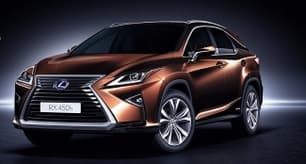
There's a lot of RX and there's a lot going on in that creased, folded and teased sheetmetal. It's a unique design, with a huge 'spindle grille', big lights and the fast glass both front and rear.
It positively screeches Lexus DNA and was a polarising force on our driveway for the week. Most weren't sure, but knew for certain it was a Lexus.
Aggressively flared wheelarches like this aren't common on SUVs (although the squared-off ones are). It's right up on stilts, but the 20s you find it rolling on help to reduce its visual bulk.
That wacky rear quarter glass reminds me of the BMW i3's but it's a Lexus SUV signature. It's quite striking. Do I like it? Not really, but that's completely subjective. You can tell, though, it's built tight as a drum.
Inside is a bit calmer, beautifully laid-out and built to last. The materials are almost all top notch, with lovely switchgear and the real leather is really nice.
There is absolutely nothing avant-garde in there (apart from maybe the pinstripe effect on the centre console), it's all terribly comfortable and easy on the eye. But not exciting, though not all Lexuses are.
This particular car is very US-centric and, if I may, a particularly sunny and humid part, so it can't be too wacky.
The front seats in the Vistiq are delicious. There’s so much adjustability, plus they’re heated, ventilated and have a fantastic massage function. It’s a great space to be in regardless of whether you’re driving or not.
Ahead of the driver the steering wheel has a lot of physical buttons and switches that are clearly labelled, though as I just mentioned, the fingerprints quickly make it look grubby.
The digital instrument cluster is bright, clear and easy to refer to at a glance, plus it has a number of layouts you can choose from. On the right-hand side there’s even a small touch section where you can cycle between the trip computer readouts, among other things.
Moving across, the central touchscreen multimedia system is big, bright and high-resolution. It’s also an easy interface to navigate through thanks to the shortcut buttons always at the bottom of the screen.
The far side of the screen can be a bit of a stretch from the driver’s seat at times, but thankfully Cadillac has included a rotary dial controller. It’s also a great way to minimise fingerprints on the screen.
There’s Google Built-in as standard, meaning there’s integrated Google Maps, the Google Assistant, plus you can download a range of different apps, like Spotify, from the Google Play Store. It’s a seamless ecosystem.
Thankfully there’s still wireless Apple CarPlay and Android Auto as standard. Connection with my iPhone 15 Pro Max was rock solid, though the resolution doesn’t appear as high as the native interface.
Underneath the central touchscreen is a secondary touchscreen for altering the climate control for all three rows, as well as the seat heating, ventilation and massage. It’s similar to the system Audi has in its flagship models and exudes a premium vibe.
Up front there are two cupholders, two wireless chargers, two USB-C ports, a large open section under the centre tunnel, a centre console box, plus a glove box that needs to be opened by using the touchscreen.
Moving to the second row, it’s an easy car to hop in and out of thanks to the easy access/exit system which drops the air suspension to its lowest setting. You’re not looking for sidesteps at all.
In Australia the Vistiq is only being offered with a six-seat configuration, meaning in the second row you get separate captain’s chairs. They’re lovely to sit in, have a dedicated armrest and are heated.
At a leggy 182cm I have an adequate amount of legroom behind my own driving position. Headroom is also great.
It’s worth noting that the second-row seats are fixed and don’t slide back or forward. They only recline which is still a nice way to get more comfortable.
Second-row amenities include a touchscreen on the back of the centre console to control the climate control, among other features, as well as air vents on the centre console and B-pillar, USB-C ports and a pull-out section with cupholders.
Going to the third row, you can either slide between the two captain’s chairs, or press a button on the side of the second-row seat which quickly pushes it out of the way. The latter allows for a clear entry/exit path.
The third-row seats are mounted low, making it feel like there’s a knee-up sensation, but there’s enough space for two adults to sit side by side. It’s a surprisingly usable space, though legroom isn’t palatial.
In terms of amenities there is a USB-C port, cupholder, air vent and padded armrest on each side.
At the back it took me a long time to figure out how to open the boot. Turns out you push the Cadillac badge… Thank you Google.
With all three rows of seating upright there’s 430L of boot space which is enough for a few shopping bags. Thankfully there’s a generous underfloor section which is big enough for charging cables among other odds and ends.
The third and second row seats fold electronically from the boot which is a lovely convenience feature. With them folded there’s over 2200L of space which is massive.
Like many EVs, there’s no spare wheel which isn’t great if you do long-distance driving away from tyre repair shops.
Continuing the gripes, there is no front boot despite the large bonnet. If you take a look it’s mostly taken up by electrical componentry.
There is plenty of room inside this big unit, which is very welcome. Front seat passengers have lots of storage, such as a deep central bin under the armrest, dual cupholders and big door pockets with bottle holders.
Step into the rear and there is a ton of leg and headroom although the transmission tunnel intrudes slightly for the middle passenger. Chuck them out, drop the armrest and you have two more cupholders and each door has pockets and bottle holders.
The boot is pretty big considering the angle of the rear glass. You start with 453 litres (but an expanse of flat floor), which rises to 924 litres with the split-fold seats down. That seems conservative given just how much space you appear to have.
Cadillac is only offering one fully-loaded version of the Vistiq in Australia, the Platinum, which is priced from $116,000, before on-road costs.
This is not a small amount of money, but it’s notably more affordable than its key rivals, the Hyundai Ioniq 9 and Volvo EX90. Only the Kia EV9 is cheaper but it’s not as well-equipped.
Speaking of standard equipment, the Vistiq is filled to the brim with it. Highlights include 22-inch alloy wheels, adaptive air suspension, rear-wheel steering, a 33-inch curved display, 23-speaker AKG sound system, four-zone climate control and six seats wrapped in synthetic leather.
You’re really not looking for anything more, however compared to the US-spec model it misses out on a head-up display.
The RX450h F Sport lightens your bank account of $102,460 before on-road costs, the only hybrid SUV within cooee of this price.
That nets you 20-inch alloys, a 15-speaker stereo, dual-zone climate control, heated and cooled electric front seats, reversing camera, that ever rare CD player, keyless entry and start, a solid safety package, reversing sensors, active cruise control, sat nav, a massive sunroof, auto LED headlights, head-up display, partial leather interior, power tailgate, auto wipers and a space-saver spare.
The Lexus media system is run from the gigantic dash-mounted screen that is shamed only by those massive Tesla units.
Sadly, the joystick-style control remains as does the very confusing software system that is less than delightful to use. It's such a shame that a tech-laden machine is let down by the world's most baffling entertainment system.
Once you get it working and understand it, it's okay, I guess, but several years into this job I still can't easily fathom how it works. And that naff analogue clock...
F Sport cars also pick up adaptive suspension and a several driving modes to liven things up.
The Vistiq is powered by a dual-motor all-wheel drive set-up with ridiculous total system outputs of 459kW and 880Nm.
This is enough to send it from 0-100km/h in just 4.2 seconds, which is wild given it has a kerb weight of almost 3000kg.
You can choose three different powertrains in the RX - a 3.5-litre V6, a 2.0-litre turbo four-cylinder, or this one, the 3.5-litre V6 with hybrid.
As a series hybrid it can run for short distances on electric only before firing up the V6 to supply charging and motivation.
The 3.5 produces 193kW/335Nm along with the electric motor. That torque figure seems low and it probably is, but that's a function of the weird way of measuring torque from a hybrid unit. The combined power figure, however, is 230kW.
The hybrid system is hooked up to Lexus' CVT auto and sends power to all four wheels. Lexus says the 450h will complete the sprint from 0-100km/h in 7.7 seconds, which isn't bad for a 2210kg SUV.
Feeding these electric motors is a 91kWh lithium-ion battery pack which allows for a claimed range of up to 461km, according to WLTP testing.
Cadillac claims the Vistiq consumes an average of 22kWh/100km, which is on the higher end, but you need to remember this is a hulking big SUV.
In terms of charging, AC charging is available at rates up to 22kWh, whereas DC fast-charging is offered at rates up to 130kW.
The former is rather competitive, allowing up to 95km of range to be added per hour, whereas the latter is mediocre as other luxury and Korean rivals can do well over 200kW of peak fast-charging.
The official combined cycle figure is listed as 5.7L/100km. And, uh, yeah, we didn't get that. I did manage 8.9L/100km over the week, which included a long motorway run from Sydney up to the Blue Mountains (a roughly 160km round trip).
Behind the wheel of the Vistiq there’s an immediate elevated and premium feel. Even though EVs are already naturally quiet, Cadillac seems to have installed a lot of insulation, making it very hushed in the cabin.
As a result you pick up on other noises and disappointingly this Vistiq tester had a random rattle coming from behind the dashboard when travelling at higher speeds. It’s unclear if it’s just this car, but it doesn’t speak well to great long-term quality as the car had only done 2000km.
The Vistiq is the kind of car you feel like being driven around in. It’s so smooth, measured and calm.
Despite this, there's a ‘V’ button on the steering wheel which activates the ‘Velocity Max’ drive mode. It unleashes the full 459kW and 880Nm, making this 3000kg box on wheels absolutely haul.
It’s frightening how quickly this car can accelerate from a standstill. You’ll be leaving virtually everyone in your dust at the lights.
As I alluded to before, the Vistiq is a very comfortable car and this is largely due to the adaptive air suspension system that comes as standard. There are a range of different heights to choose from, ranging from lifted to slammed. All of which look awesome from the outside.
The suspension does a great job of rounding off pimply urban road imperfections. It’s so good you forget there are huge 22-inch alloy wheels as standard.
Unlike many American cars, the suspension isn’t overly floaty and soft, instead creating a balanced ride. Goldilocks would approve.
The only times the suspension feels out of its depth is when you hit a bigger bump at a higher speed. It can feel a little crashy from inside the cabin, but it never feels too firm.
There’s no way around it, the Vistiq is a big car and it swallows up a lane with ease. Despite this, there’s a rear-wheel steering system as standard which turns the rear wheels the opposite direction of the front at low speeds.
As a result the turning circle is much smaller than you’d expect. This means you can zoot around tight, multi-storey carparks like you’re in a much smaller car. It also makes parking a breeze.
Although you’d expect this powerful and heavy car to come apart in the bends, it holds its own rather well. It’s far from a sports car, but it limits the body roll to an extent and the tyres provide enough grip.
Right. So this is a salutary lesson about tyre pressures. The first few days the tyres were only pumped up to 200kpa (29psi). That's an easy 100kpa (14psi) short of the required 300 (43psi).
Every time I, or my wife, went around a corner, the big Dunlop Sport Maxx SPs would squeal and squirm and it was most unsatisfactory.
So check your tyres, because the extra 100kpa makes all the difference. Also, the number of service stations it took to find a working pump was unacceptable. Pull your socks up, Sydney.
Anyway.
Correct tyre pressures enacted, the big Lexus turned into a comfortable, competent cruiser. Its motorway performance is super-impressive, purring along the M4 and it's ridiculously poor surface like it was born to it. Which it sort of was.
The hybrid drivetrain allied to the CVT is mostly whisper quiet. It's not the most responsive combination, the initial step-off of the electric motor's torque soon giving way to the rubber band effect of the transmission.
It doesn't feel as swift as the claimed 7.7 seconds and it would be nice if the drive select dial made a genuine difference to the throttle and transmission's response.
In the city, it's a proper wafter, moving about the broken down city streets of Sydney without fuss and a plush ride that's a bit of a surprise given the huge wheels and substantial weight of RX.
It's all very easy and pleasant but the wild looks do not match the experience. Which is not a criticism, just an observation.
The Cadillac Vistiq hasn’t been assessed by ANCAP yet and is therefore unrated.
As standard there are seven airbags, autonomous emergency braking (AEB), blind-spot monitoring, rear cross-traffic alert, lane-keep assist, lane centring, adaptive cruise control, front and rear parking sensors, as well as a surround-view camera.
It’s all pretty standard on this front, however, a cool feature is the ‘Night Vision’ system which comes up on the digital instrument cluster and allows you to see potential dangers like animals, for example, better at night.
The safety systems all do a good job for the most part, however the driver attention monitor is too sensitive. When it goes off it physically vibrates the seat, which feels a little too personal for my liking.
It also vibrates for the blind-spot monitoring, rear cross-traffic alert and even the parking sensors.
The RX ships with eight airbags (including knee airbags for both front seats), ABS, stability and traction controls, blind spot sensor, reversing camera, forward collision warning, forward AEB and reverse cross traffic alert.
There are three top tether restraints and two ISOFIX points.
The RX scored a maximum five ANCAP stars in January 2016.
At this stage Cadillac hasn’t fully detailed the ownership package for the Vistiq.
There is a five-year, unlimited-kilometre warranty, as well as an eight-year, 160,000km warranty for the high-voltage battery. There's also five years of roadside assistance.
Logbook servicing is required every 12 months or 12,000km, whichever comes first, however pricing hasn't been confirmed yet.
“Service pricing for the Cadillac Optiq and Vistiq in Australia will be announced in the coming months - as we progress our planned dealer expansion, including new franchised locations in Melbourne and Brisbane," said General Motors ANZ General Manager Jess Bala.
It’s worth noting that Cadillac is still scaling its dealer network in Australia and currently only has select locations in certain capital cities.
Lexus offers a fence-sitting four year/100,000km warranty with roadside assist thrown into the bargain for the same period.
Service intervals arrive at 12 month/15,000km and there is, sadly, no capped-price servicing.
Lexus will, however, promise you a car for the day or come and get your car from you and drop it back when the service is done. And it will be washed and vacuumed. The website makes a big deal about that.