What's the difference?
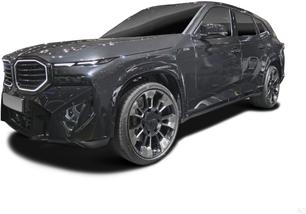
BMW’s new XM is a tricky customer to pigeon-hole. Yes, it’s a huge, super-lux SUV and, yes, it’s all-wheel drive and features a station-wagon layout.
But it’s also a M-car and that infers super high performance. Weighing in one the wrong side of 2700kg, however, makes that a difficult task for any engineer.
This car also left us wondering if perhaps the glory days of M Division sports cars and coupes might behind it and SUVs like this one represent the road ahead.
But fear not: The CEO of M Division himself, assured us that the XM is a showcase for what an M badge can do, rather than a mission statement for the brand.
So, with that in mind, does this car have the wow factor that places it somewhere between peak oligarch and a motor-show concept car? Does it move the goal posts for big luxury SUVs? Does it even matter that it’s a plug-in hybrid?
The V6 X-Class is big, bold and bloody expensive – and it has segment-topping safety tech– but its price-tag swiftly climbs above more than $80,000 when you start adding one of the many optional extras and is it really worth that much beyond the cache of the badge? Really?
Sure, the bigger engine is what most potential X-Class buyers were pushing for after the launch of the four-cylinder-powered utes as part of the first-gen X-Class wave, but is there room – or even actual demand – for such a high-priced supposedly luxury ute?
Read on.
It’s pretty obvious the XM is designed to impress people with big wallets and an appetite for a techy experience that’s also not without a few green credentials. The ability to motor around as a fully-electric vehicle for up to 80km or so is a big plus and the electric-ballroom interior vibe is hard to ignore, as well.
But from our perspective, the full-fat, twin-turbo V8, while offering startling performance, is perhaps a lost opportunity to follow some of BMW’s competitors into the engine-downsizing space. Then again, when you floor the throttle and 2700kg hurtles forward like a big dog on a short chain, you can see where BMW is coming from.
Perhaps the biggest letdown is the ride quality – or lack of it. While it’s understandable BMW wanted the most dynamic version of the XM it could manage, the end result plays against the vehicle’s otherwise long suit of hyper-luxury. Doubtless, BMW would argue that to soften the chassis would have been to introduce a chink into a no-compromise product. But, perhaps, sometimes a sensible compromise is the way forward.
The V6 X-Class is nice enough to drive on-road and it’s effective enough off-road, but it’s let down by its less-than-impressive interior and those elements combined certainly do not justify such a high price-tag.
Sure, its safety gear is top-notch but the X-Class, even in this V6 guise, feels like a lacklustre attempt at ute greatness, rather than a real effort.
Right now, if you’re in the market for a super-comfortable and capable V6 ute with real class and German precision, check out a top-spec V6 Amarok – and save about $25,000 while you’re at it.
There’s nothing subtle about the way the XM looks. It probably pulls up just short of brutalist (or maybe not) but even those who find its slabs and angles attractive have to admit that it’s bold.
The now-trademark giant nostrils set the mood and the rest of the exterior suggests some kind of armoured transport for presidents rather than wheels for the school run. Doubtless, this will hardly be seen as a fault by those in the market for such a thing.
The real surprise here is that the XM does not share a bodyshell with any other production BMW. Sure, the V8 petrol engine and wheelbase are common to other BMW and M models, but the sheet metal is the XM’s and the XM’s alone. That in itself, is quite a statement of intent.
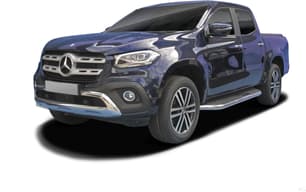
From the outside, the X-Class looks pretty impressive – it’s chunky and blocky and has a real tough-truck presence.
As mentioned, a fair few of the cool exterior touches are actually paid-for options, and our tester was loaded with these extras and, as a result, looked like a work-or-play ready luxury workhorse.
So, it looks pretty good but, as always, looks can be deceiving and the interior is a very different story.
Given the vast exterior dimensions and a weighbridge ticket the wrong side of 2700kg, it may come as a surprise to learn that the XM is strictly a five-seater with not even an optional third row.
That said, the uber-SUV Lexus LX in flagship, Ultra Luxury, trim offers just four seats in deference to the VIP clientele it’s pitched at, but also comes complete with reclining rear seats and a passenger’s side footrest which the XM can’t match.
Staying in the rear seat, there’s lots of legroom and plenty of space under the front chairs for feet. A lot of that is down to the wheelbase the XM shares with the BMW X7, and even behind a tall driver, there’s lots of space. In fact, compared with a BMW X5, there’s a full 150mm of extra legroom.
The pew itself flows into the door trims for a lounge effect which looks great with the contrasting light-coloured trim, and the centre arm-rest folds down to reveal a pair of cupholders. Extra storage space can be found in fold-out pockets in the rear of each front seat which also house a small, lidded panel that opens to reveal USB ports and power sockets. Dual-zone climate controls are also part of the rear-seat experience.
The gee-whizz stuff hasn’t been ignored, either, and the prismatic roof lining is nothing if not a talking point. But would a panoramic sunroof have been of more value to many buyers? The ambient lighting is a nice touch, too.
Up front, the view is dominated by the giant, twin curved animated dashboards. They deliver information and lots of it, to the point where it can almost seem a bit overwhelming.
The head-up display helps simplify things, but there’s absolutely no doubt there’s a lot going on in this cabin. Again, this is modern luxury motoring, but it remains that the menu system will take time to learn, even if the touchscreen function gives you an option on how you control things.
Multi-adjustable front seats are part of the deal and there’s an M-spec steering wheel which is heated. And although it features plenty of buttons, isn’t as daunting perhaps as the multi-spoked equivalent in some high-end AMGs of late.
The stereo system is also worthy of a mention, being a Bowers & Wilkins unit with roof mounted speakers and no less than 1500 watts of power. Digital radio is part of the package.
Even though it doesn’t offer a seven-seat option, luggage space in the rear of the XM is hardly class-leading. Cargo volume with rear seat up is 527L and 1820L with it folded.
Much of the wheelbase is devoted to rear-seat stretching room and although the batteries for the electric motor are positioned under the rear seat, the floor of the cargo area seems quite high.
I’m not a snob about interiors but if I spent almost $90 grand on a ute I’d expect it to have a very high level of fit and finish inside, plenty of storage options and an overall premium feeling inside.
That’s sorely lacking in here.
From the many hard-plastic surfaces, fake leather, brushed-aluminium sections and sort of half-hearted attempts at three-pointed star styling – such as the vents – no part of the interior looks or feels anything like the premium quality you’d expect to find in a Mercedes-Benz.
As for equipment inside, you get the 7.0-inch floating touchscreen and a few other bits and pieces but there are some glaring omissions: you don’t get a reach-adjustable steering wheel, heated seats, or real leather (our tester has the optional black leather seats fitted at a cost of $1750), you don’t get much in the way of storage anywhere, and you don’t get Apple CarPlay or Android Auto – you don’t even get a driver-side grab handle. All of those sort of mod cons, you get in a ute that costs much less than this X-Class.
Room and comfort inside is adequate but a long way from unreal for something so pricey.
Driving position is nice, with plenty of vision all-round, but everyone's seats could do with a bit more cushioning and length in the base.
In the grand tradition of all utes, the rear seat is really the realm of young children and, at a stretch, smaller adults, especially for longer trips in the saddle.
Storage is minimal in the back seat – you don’t even get a drop-down arm-rest with cup-holder.
The XM is one of those 'no options' vehicles. That is, you pay the basic price, you get one with the lot. The aged leather and even the optional 23-inch wheels and tyres are no-cost options, so it’s clear where BMW is aiming the thing.
As well as the plug-in driveline, all-wheel drive and all the M driving focus, the XM features plenty of tech including massaging front seats, heated seats all around, a high-end stereo, heated and cooled cupholders, four-zone climate-control, wireless phone charging and twin, curved info screens for the driver measuring 12.3 and 14.9 inches. The novel roof lining also features 100 pin-point LEDs for effect.
The cost of such detailing is a not insubstantial $302,200. That figure does, however, undercut two of its main rivals, the Lamborghini Urus ($395,888) and the Aston Martin DBX ($356,512).
It’s also worth mentioning that the XM is not even BMW Australia’s most expensive model; in fact, it’s fourth on the ladder.
The 350d Power ($79,415 plus on-road costs*) is the top-spec variant in a two-variant V6 X-Class range; the other variant is the Progressive, which starts from $73,270 plus on-road costs.
Our tester has a 3.0-litre six-cylinder diesel engine a seven-speed automatic transmission and permanent all-wheel drive system – all from Benz. All of those certainly make a refreshing change from the Navara-based four-cylinder model that preceded this X-Class. (Price as tested is $88,618, including GST plus on-roads.)
Standard gear includes steering-wheel paddle shifters, 19-inch alloy wheels (our tester had the optional 18-inch rim design, part of the $1990 Style Pack), body-coloured exterior parts with chrome accents, fog-lamps, dusk-sensing LED High Performance headlamps, ARTICO/DINAMICA seat upholstery, ARTICO dash and door sill covering with contrast stitching, Electric front seats with lumbar support, front foot-well, vanity and door illumination lamps, dashboard trim in aluminium and black roof liner and more.
Safety gear includes seven airbags, AEB, tyre-pressure-monitoring system, Active Lane Keeping Assist, Hill Start Assist, 360 degree surround-view camera, i-Size child seat anchorages and more.
The roof rails and side steps add to the X-Class’s commanding appearance, but those are part of the optional $1990 Style Pack, they are not standard.
The silver styling bar ($1551) and the tray liner ($899) also look cool– but they’re optional extras.
Here’s where the XM starts to justify its price-tag. While the use of an electric motor to boost a petrol engine has allowed some manufacturers to reduce the capacity of the latter, no such restraint has been shown for the XM. Instead, it gets the full 4.4-litre, twice turbocharged V8 that we’ve come to know and love from this brand.
It’s not that this is the engine’s first date with hybrid technology, but the mild hybrids that have come before it can’t match the XM for sheer brutality when both power units are unleashed.
The petrol V8 can muster up 360kW and 650Nm which, when boosted by the electric motor, jumps to a total of 480kW (combined) and 800Nm.
While the petrol engine drives through an eight-speed torque-converter automatic, the electric motor also drives through the transmission, an arrangement that is a bit different to some hybrids which use the petrol engine for the rear axle and the electric motor to drive the front wheels.
Of course, the requirement for the XM to feature permanent all-wheel drive, regardless of what power unit is running at the time, forces this layout.
Speaking of all-wheel drive, The XM’s version of BMW’s 'xDrive' layout has been specifically tuned for this vehicle and includes torque vectoring as well as a limited-slip rear differential.
The system has the ability to vary the torque split front to rear, with the default rear-bias giving a more sporting feel on good surfaces. An active rear differential also helps give the car a rear-drive feel.
As well as modes for 'Hybrid', 'Electric' and 'eControl' modes, the XM sticks with the M tradition of offering two M buttons which can be configured to set the parameters for steering, driveline, chassis and, in the case of the hybrid XM, the degree of braking regeneration offered.
Four-wheel steering is also part of the XM’s repertoire and, interestingly, there’s no air suspension here; just conventional steel springs.
But it does feature an electrically-adjusted anti-roll bar system which aims to strike a happy medium between what the driver wants and the road conditions demand.
The V6 350d Power V6 has a Benz-built 3.0-litre diesel engine (190kW at 3400rpm and 550Nm at 1400rpm-3200rpm), matched to a Benz-built seven-speed auto. It’s a mostly smooth combination and any perceived throttle or turbo lag can be swiftly overcome through switching to one of the more sporty of the five driving modes – one of which is actually called Sport – and making judicious use of the steering-wheel-mounted paddle shifters. The other driving modes are Comfort, Eco, Manual and Off Road and all are designed to adjust throttle input, gear changes and shift times to suit the terrain.
This X-Class has Benz’s 4Matic full-time 4WD system with 4MAT (40:60 torque split for daily driving), 4H (the X-Class’s high range, with 30:70 torque split for looser surfaces) and 4L (aka low range with a 50:50 torque split to suit low-speed 4WDing). The driver uses a simple dial – unfortunately tucked away low down, almost hidden, on the centre console – to switch between these modes.
A 25.7kWh lithium-ion battery provides the power for the electric drive. It’s mounted under the rear seat and can produce a purely electric range of between 82 and 88km (based on WLPT test protocols).
Charge time from a conventional wall-box is said to be about four hours but, interestingly, the XM has no provision for DC fast-charging.
Fuel consumption (combined cycle) is an EV-typical 2.7 litres per 100km, which equates to a low 61g/km of CO2.
Once you’ve depleted the battery on a highway journey, expect the petrol V8 to consumer somewhere between eight and nine litres per 100km at cruising speed.
Using EV mode means zero-emission operation but, as with any electric car, how the power is generated to recharge it determines its real-world green-ness.
Fuel consumption is listed as 8.8L/100km (combined).
We recorded 10.9L/100km on test and that included plenty of low-speed 4WDing.
The V6 X-Class has a 80-litre fuel tank.
While any M car is supposed to be rapid and dynamic, it’s also true that the over-arching perception of big SUVs is that they’re comfortable and plush. None of which explains the ride in the XM.
Regardless of how you fiddle with the settings, the ride is always brittle. Those big tyres with their minimal sidewall somehow manage to find every crack and join in the road, and it’s these sharp-edged imperfections that thump through to the cabin the most vocally.
It’s enough to make you wonder who this car is going to appeal to. Will it take to race tracks? Almost certainly not. So the whole point of these suspension settings might be a bit lost on some people.
Performance, meanwhile, is insanely rapid for something that could pass as a bulk carrier. The biggest giveaway to the mass is the transmission’s earnest attempts to keep everything moving by feeling a bit hyperactive on downshifts.
Using the ratios is always going to be the strategy, but with all that torque, maybe it’d be nice sometimes for the trans to hang on to a taller gear and let the boost blow it towards the next corner.
The sound track? Polarising. Even if it doesn’t convince you that Hans Zimmer (who developed the various electronically-synthesised noises the XM makes) should stick to winning Oscars, the augmented sounds are background noise rather than the main event here.
Even the petrol V8’s naturally stirring backing vocals have been electronically tweaked with debatable results.
That said, it’s nice to have something to listen to that isn’t the insistent tyre roar which becomes even louder on coarse-chip surfaces.
Steering effort is light but there’s not a lot of feedback in terms of actual feel. In fact, it’s borderline detached and only the sheer speed of the rack confers any athleticism.
Also, the rear steering seems to come in a few milli-seconds after the front has started to turn. And for all that all-wheel-steering agility, this is never a car that shrinks around you.
Well, this is where the news gets a little bit better.
The V6 is a much better fit for the X-Class than the four-cylinder and it works well with the seven-speed auto, punching the more-than-2190kg ute along – although there is, at times, a substantial delay between foot down and go-time but, as mentioned earlier, that can be overcome by switching to Sport and using the paddle shifters.
It does sit nicely on the road, and ride and handling are generally okay with the X-Class only infrequently revealing some of the skips and jitters you’d expect of an unladen ute.
The coil-spring suspension tends to yield a spongy, comfortable ride rather than the too-firm ride of a ute, especially those of the leaf-spring variety, with nothing onboard.
Steering is pretty sharp and, despite its bulk, the X-Class is reasonably easy to manoeuvre for its size on- and off-road. It has a 12.8m turning circle.
As well as the usual passive safety features, the XM also hides the latest active safety gear. In fact, BMW reckons the XM has more driver assistance than any other M car before it.
Those elements start with the 'Driver Assistant Professional' which bundles active cruise-control with stop-go ability, steering and lane-keeping control, automatic speed limit assist and active navigation.
Parking assistance is also featured which incorporates a reversing assistance function, front, rear and panoramic camera views with a 3D view built in.
BMW’s 'ConnectedDrive' includes an emergency call function in the event of a crash or other emergency.
No ANCAP assessment so far.
A big plus in the X-Class’s favour is its class-leading suite of active safety tech including AEB, lane keeping assist, as well as that 360-degree view camera and more.
It has seven airbags, and a five-star ANCAP rating.
Like a lot of manufacturers, BMW knows consumers can be leery of EV tech when it comes to the cost of battery replacement. So, as well as the five-year/unlimited-kilometre warranty on the whole vehicle, there’s also eight years or 160,000km of cover for the high-voltage battery.
Servicing intervals are based on how the car has been used and it will inform the owner when a service is required.
A servicing package is included in the purchase price and BMW even throws in three years of roadside assistance.
A three-year/200,00km warranty applies to this ute. Service intervals are up to one year/20,000km.