What's the difference?
To say the BMW M4 CS is a hot ticket in Australia is something of an understatement.
Consider this. There is an even more expensive one, the M4 CS Edition VR46 – at a cool $346,900 – and it sold out in less than an hour. Now, granted, Australia only got four examples, but still, demand was running hot.
That car makes this one, the regular M4 CS, seem like an absolute steal. It's only $254,900 (yes, the word 'only' is doing a lot of heavy lifting in that sentence), and it shares the same upgrades, and makes the same monstrous power, as the VR46 – for Valentino Rossi’s 46th birthday – only it does it for around $100K less.
See? A bargain. At least, that's how I'd be justifying it to myself if I had a quarter of a million burning a hole in my pocket.
So, this or a Porsche 911? Read on.
The Cadillac Lyriq really flies in the face of what has become our reality in the world of new cars.
It’s a brand-new, EV-only brand in Australia, but for once, it’s not Chinese.
It’s built in America and shipped to Australia, but it’s not converted from left-hand drive by Walkinshaw or a similar outfit. It’s built in right-hand drive at the factory for us.
And it’s a new player fighting for market share, but it’s not really trying to massively undercut its premium competitors, with the range kicking off north of $120,000.
So, iconic American brand Cadillac seems destined to do things a little differently with the Lyriq. The question is, is it good enough to forge its own path?
Let’s find out.
Brutal, bruising and utterly brilliant, the M4 CS will be an acquired taste due to its no-compromise approach, but those willing to take the leap will find a performance car like few others at their disposal.
It's got a couple of quirks, but the Cadillac Lyriq is a pretty convincing, and definitely American, take on a premium electric vehicle in Australia. The only issue, I think, is that, while the brand is obviously iconic in the USA, it's not that well known in Australia, and we are a market now awash with pretty good, and often much cheaper, EVs from China. It's a hyper-competitive market. Only time will tell if Cadillac can convince Australians that its badge belongs among the European premium marques.
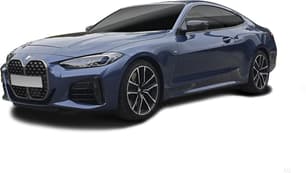
The M4 CS is familiar in all the right ways, but definitely looks significantly jacked up compared to its lesser siblings.
Part of that is the extensive use of carbon everywhere, from its bonnet panels to its roof, front lip, side skirting and boot spoiler. But also because of its super-muscular angles and creases, including the huge dome in its bonnet.
Also exclusive to this M4 CS is the light treatment, with the front LEDs lighting up with yellow highlights the brand says are supposed to be reminiscent of GT racing cars.
At the back, the rear lights are flush with fibre optic lighting, lending a flowing and unique light signature that looks epic at night.
Inside, it's a sea of carbon, with the lightweight racing seats, the dash inserts and the centre console all lined in it. It is a perfectly finished space, though, and one that's also flecked with red, including a 12 o'clock band on the thick-rimmed steering wheel, the seat backs, the contrast stitching and the paddle shifts.
Be warned, though, it takes some acrobatics to climb into or out of the CS. The seat bottoms have these super high edges that double as grab handles, but require some awkward contortions to navigate.
In short, it looks angry, this M4 CS, inside and out.
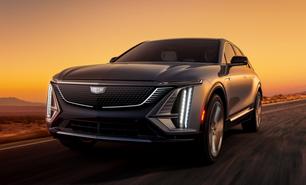
The Cadillac looks… well, it looks American, right? A kind of difficult-to-describe Americanness that’s somewhere between an SUV and state car.
That’s not an insult, by the way. I personally think the Lyriq looks kind of pretty, with its bold elements countered by the surprisingly gentle touch applied in places, like its razor-thin daytime running lights (DRLs).
I’ve got to say, it doesn’t look much like any of the other new SUVs arriving, or a knock-off German brand. It’s got its own persona.
The cabin of the Lyriq is predictably plush, with comfy massaging seats, soft-touch materials and plenty of tech, but it is a little shiny and busy in places for my tastes. Minimalist this is not.
But I do like the fact that – when I’ve got Apple CarPlay hooked up – I can just leave the screen be. My driving stuff is accessed by the wheel, and everything else I want is accessible through physical buttons.
There are some strange elements, though. The grab handle on the driver’s side, which isn’t replicated on the passenger side, is odd, and likely a byproduct of the factory moving the steering wheel. Some of the central storage bins are too small to be really useful, and I hate gloveboxes that can only be opened through the screen.
It all boils down to how you classify practicality in a car like this. I mean, the basic stuff is all there – it's got two doors, four seats and a boot capacity of 440 litres.
It measures 4801mm in length, 1918mm in width and 1399mm in height, and room for front seat riders is good, but less so for anyone you squeeze into the back. There are even ISOFIX points for a child seat.
But if you consider practicality the practical pursuit of performance, then the M4 CS has plenty of perks.
It’s a big boat, the Lyriq, stretching more than five metres long and almost two metres wide. That’s not much shorter than, and in fact slightly wider than, something like a Nissan Patrol, just to put it into perspective. Though of course it’s nowhere near as high as a proper 4WD.
Predictably, though, its dimensions mean plenty of room in the boot, which opens to reveal a very useable 793 litres of luggage space. Drop the seats, and that number grows to a massive 1722 litres.
But the Lyriq does without any spare wheel of any kind. A tyre repair kit is your only option.
Now, the backseat. And I know this is likely only of interest to parents of newborn babies, but that’s me, so I noticed. These are some of the best ISOFIX attachment points I ever used. Usually you’re fumbling around between the seat cushions trying to line up the latch points, but the Lyriq's solution — while perhaps not the most visually alluring – puts the brackets beneath plastic lift-up flaps, and they're so damn easy to use.
But there are some quirks in the backseat, too. Those same ISOFIX attachment points, which are so great for baby seats, are less great for the adults actually sitting in the back. You can feel the hard plastic covers, and what feels like the bracing bar running across the backseat, beneath the cushions. It's not diabolical, and if you shift your rear-end forward slightly you can't feel it at all, but it's a strange quirk all the same.
Elsewhere in the backseat, there is plenty of room for backseat riders, and you can control your own temps, too.
We're talking a $254,900 entry price for the M4 CS, which – despite my attempts at justification – is a lot. Remember, the regular M4 is $168,700, and the M4 Competition is $186,500, so we're talking a sizeable premium here.
BMW justifies that price increase in two ways. The first is scarcity, with the M4 CS limited to just 50 examples in Australia. And the second is by dialling up every aspect of the M4's performance to terrifying levels.
The engine outputs are up, the weight is 20kg down, there are better brakes, better seats, a louder exhaust, a stiffer chassis – it goes on and on.
We'll get to some of the performance stuff in a moment, but here's what else your money buys you with the M4 CS.
It starts outside with staggered alloys, 19-inch up front and 20-inch at the rear, wrapped in track-ready rubber. There's also hi-po 'M Compound' brakes with red calipers, lightweight carbon racing seats that are heated up front, an Alcantara-trimmed steering wheel, the 'M Carbon' exterior package with carbon bonnet and roof, adaptive 'M Suspension' and a titanium exhaust that howls like the winds of hell.
The less performance-focused stuff is similar enough to the other M4 models including a 12.3-inch centre screen with digital radio, Apple CarPlay and Android Auto, a second 14.9-inch screen that handles your driving data and a head-up display. There's also twin-zone climate control, Merino leather upholstery and ambient interior lighting.
But all of that is secondary, really. This is about performance, specifically of the brutal kind.
You can have your Cadillac Lyriq in two flavours — the Luxury, yours for $122,000 plus on-road costs. Or the Sport, which is two grand more, listing at $124,000.
Perspective time. The new Polestar 3 starts at around $118k, but climbs to more than $130k for the dual-motor options. The similarly sized BMW iX starts at more than $140k, and the Mercedes-Benz EQE is north of $135k. So if you consider the Cadillac a ready-made premium brand, then its looking like a relatively sharpish one.
Cadillac says the changes between the trims largely focus on the “aesthetic signature” rather than any major equipment differences. The Luxury gets chrome highlights, for example, while the Sport gets a darkened design theme, including the wheels, body highlights and windows.
Both trims are otherwise identically equipped, which means 21-inch alloy wheels, full LED lighting, an electric sunroof, an auto-opening boot and a touch-to-open charging port.
Inside, there’s a 33-inch digital dash, with Apple CarPlay and Android Auto, wireless device charging, a thumping 19-speaker AKG stereo and USB connection points galore.
The leather-wrapped front seats have heating, ventilation and a massage function, there’s heating and cooling for the window seats in the back, tri-zone climate control and there’s 126-colour ambient interior lighting.
BMW has found yet more grunt lurking in its trusty 3.0-litre 'M TwinPower' six-cylinder petrol engine, with the M4 CS now pumping out 405kW and 650Nm.
That's a decent jump from the 390kW and 620Nm served up by the M4 Competition, and a giant leap from the outputs of the 'base' M4 – 353kW and 550Nm.
Predictably, then, the CS is the fastest of the lot, knocking off the run from 0-100km/h in 3.4 seconds, compared to 3.5 and 4.2 in the Competition and M4, respectively. The top speed is also dialled up to 302km/h.
All that power is channeled through an eight-speed automatic and sent to all four wheels on demand, with the help of an 'Active M Differential'.
All Aussie Lyriqs are dual-motor affairs, with an electric motor at each axle producing a total 388kW and 610Nm, which in a car this big, which weighs just under 2.7 tonnes, is more than enough to get the Caddy up and moving, but not enough to make it feel like a supercar. The two motors mean AWD, of course.
The M4 CS is fitted with a 59-litre fuel tank, which – given the BMW's official fuel claim of 10.2 litres per hundred kilometres – should deliver a driving range on a full tank of 541 kilometres.
But... BMW also says the regular M4 – you know, the one that makes 52 fewer kilowatts and 55Nm less torque – uses 10.1L/100km, so do with that information what you will.
The Lyriq is equipped with a 102kWh lithium-ion NCMA battery, which delivers an ok 530km on the combined cycle. I say 'ok', because the BMW iX offers 600km-plus, while the dual-motor Polestar 3 is more like 630km claimed. Energy consumption is a claimed 22.5kWh per 100km on the combined cycle.
When it comes to plugging in, the Lyriq is set up for 190kW DC fast charging, with the brand promising 128km of range in 10 minutes, or 10 to 80 per cent in just under 30 minutes. At home, a 7kW wall ox will deliver more like 43km an hour.
The hardest and angriest M4 of all time is, perhaps unsurprisingly, hard and angry. This is a race track specialist, but because I don't happen to own one of those, my first experience with the barking (and barking mad) M4 CS was navigating my way back from BMW's inner-city dealership.
Like it or lump it, you're going to read some Porsche comparisons here, because you're talking not too far off base 911 Carrera money, and suddenly I find the two Germans doing battle for a spot in my dream garage.
First things first, the BMW won't be much chop for daily driving for most people. Happily, I have a sickness for uncomfortable sports cars. It tells me that no compromises have been made in the pursuit of punishing performance.
A good thing, too, because the BMW, at city speeds, can be punishing. Everything feels heavy, the seats aren't overly comfortable – especially the hard bits that tend to dig in when cornering – and it stiff-arms its way over road imperfections, that exhaust booming and barking as it does.
Again, I loved it, and you probably will, too. But it's still not the kind of car I'd relish sitting in the morning peak hour rush in.
But escape the confines of the city and the BMW M4 CS suddenly makes a whole heap of sense. The acceleration is genuinely brutal, and wonderfully theatrical, with that quad-tipped titanium exhaust barking and snarling as you rocket towards 100km/h.
The steering is brilliant, with feedback fed to your wrists via that thick-rimmed wheel, and the entire experience feels sharp, super engaging and edgy.
You can push the M4 hard and fast, and I'm certain my limited talents would run out far before the BMW's would, but there's this thrilling sense of peril sparked by the aggression of the experience, that I love.
It's like the magic of a roller-coaster, I guess. Even if you know nothing is going to happen, you never really know, right? And in that lies the magic.
But back to original question, this or a Porsche 911? There's no doubt a Carrera is a better all-rounder, in terms of comfy commuting and race track fun, but this angry M4 is all shouty theatrics, all of the time.
I bloody love it.
The first thing you notice behind the wheel of the the Lyriq is just how whisper-quiet it is on the road. Cadillac makes a big deal about its 'Active Noise Cancellation' tech that's deployed here – it uses sensors to monitor road vibrations and the like, and then uses the car's stereo to create what it calls an 'anti-noise' signal.
It all sounds pretty high-tech and complicated, but it also works, with the Lyriq a seriously quiet and composed way to get around, with only the artificial EV noise really noticeable in the cabin.
Even travelling past freeway speeds, the Lyriq remains quiet, which does lend the whole experience a sort of premium vibe.
The Cadillac is also one of those cars that thinks solidity means premium, from the solid 'thunk' of the doors shutting to a general heft and weight to the steering, there's nothing feather-light or agile about the Lyriq experience, but it does all feel a little artificial, and like it's trying to be heavy on purpose.
The Lyriq, then, is no out-and-out performance car – it's 2.5-tonne-plus kerb weight and Olympic swimming pool dimensions largely put an end that – but it's more than brisk enough to get up and moving, with its twin-motor powertrain finding grip even in slippery conditions. It's brisk, but not brutal.
The Lyriq hasn't been tested or tuned in Australia, but happily it doesn't have that floaty, wafty suspension style so popular in the USA. This one feels to have at least had an international tune, which removes some of that marshmallow softness and makes you feel connected to the road.
The steering, too, feels direct enough and easy to predict, and the overall impression is one of quiet, calm motoring, which is probably what it says on the tin of any premium vehicle.
Expect no ANCAP rating here, I'm afraid. But the BMW 4 Series does wear a five-star rating from 2019.
The M4 CS gets six airbags (driver and passenger, side airbags, head airbags), along with what BMW calls its 'Driving Assistant Professional', which bundles active cruise control (with stop and go function), front and rear cross-traffic warning, 'Steering & Lane Control' and 'Lane Keeping with Side Collision Warning'.
The Lyriq hasn’t been crash-tested in Australia, but it did get a five-star equivalent in American testing. There’s autonomous emergency braking (AEB) with pedestrian protection and junction assist, as well as active blind spot monitoring and assist. There’s also a side bicycle alert to stop you opening your door into someone, rear pedestrian alert, adaptive cruise and a total eight airbags, including knee bags for the driver and front passenger.
Interestingly, the Lyriq ditches those annoying safety bings and bongs for a novel, and far less intrusive approach which involves sending gentle vibrations through, well, your backside if the vehicle senses incoming danger.
Cadillac has built a pretty convincing ownership package around the Lyriq, which begins with a five-year, unlimited-kilometre warranty, and an eight-year, 160,000km battery warranty. Beyond that, you also get five years of servicing, and five years of roadside assistance, free.
Then you get a year’s free public charging through the Chargefox network and a free home wall box charger. If you have a wall box, or don’t want one, you can trade the home charging for an extra two years of free public charging.