What's the difference?
There’s no point waxing too lyrical here, because the facts surrounding the M3 Touring are more than exciting enough.
It’s a (kind of) family friendly wagon with oodles of space and practicality. It’s also an unhinged performance weapon with a thumping 3.0-litre twin-turbo-petrol inline six-cylinder engine.
And it has been years — decades, even — in the making. So, has it been worth the wait? Let’s strap in and find out.
One day Nissan's luxury sub-brand Infiniti could grow up to be as popular as Toyota's Lexus, but it'll take more than just time and brand awareness to get there – it will have to build outstanding cars that impress us, as well.
When I drove the top-of-the-range Q60 Red Sport at its launch a few months ago I called it the breakthrough car for Infiniti. Now we're testing the entry point into the line-up – the GT, which likes to imagine itself as keeping the BMW 420i and Mercedes-Benz C200 Coupe awake at night, but really rivals the Lexus RC 200t.
So, is the Q60 GT outstanding or should you ignore it and go straight to the Red Sport with its bigger engine and Sport + driving mode if you want to be impressed? And what is it like to live with when you've taken your race face off and need to pick up the toddler from day care, then do a load of shopping on the way home?
We found out pretty quickly when we lived with the Q60 GT for a week.
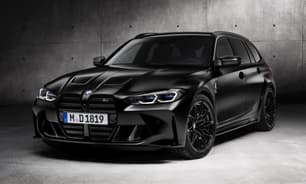
Long live the mighty wagon. The BMW M3 Touring is treat to look at, and an even bigger treat to drive.
If you want one, act fast. We waited a long time for a wagon-shaped M3, and with electrification increasing in the automotive industry, this will likely be your last chance.
Beautiful looks, good handling, but the driving experience of the Q60 GT is let down by a numbness and disconnection relative to what's happening under you. Refinement isn't on the same level as its BMW and Benz rivals, but the GT is a perfect match for the RC 200t, while remaining good value for money. If you have your heart set on an Infiniti Q60 then I'd skip straight to the top and opt for the Red Sport.
It looks spectacular, this M3 Touring, and even more so given a) wagons are so rare, and b) proper low-riding performance wagons with massive alloys are even rarer.
That said, I expect it will be polarising – and possibly too shouty for some – but I've got to say, I like it.
I’ve seen it described elsewhere as a bit of a sleeper, but for mine, you’d need painted-on eyes to not see there’s plenty going on with the Touring, especially one finished in the same Frozen Black paint as our test car.
It is at once sleek and swept back, and bulging and aggressive, especially at the flared wheel arches and fat exhausts poking from its diffuser-filled rump.
Inside, it’s mostly business as BMW usual, though with more carbon-fibre elements — our vehicle was equipped with the M Carbon Experience pack — but snug-fitting seats aside, it’s a premium, if performance-focused, place to spend time.
The Q60 GT is a head turner – literally. Whenever I was driving slow enough to notice, people were rubbernecking to look at the long, low-slung coupe. I'm sure most had no idea what brand of car it was, but in its 'Iridium Blue' paint the Q60 looked amazing with its curvy, sleek profile.
There's only one small issue – the RC 200t and Q60 GT are way too similar looking, right down to their 'signature' shaped c-pillars. I prefer the grille of the Lexus but the rear of the Q60. While there might be a bit of copy-catting going on, both are prettier than their BMW or Benz rivals.
The Q60 GT feels fairly large to drive and the dimensions don't lie – 4690mm end-to-end, 2052mm across with the wing mirrors unfurled, but low at 1395mm.
The cabin treatment is just as emotional as the exterior, with its dual screens, swoopy dashboard and sectioned off driver and passenger cells.
A performance-focused wagon is still a wagon, right? And that means there is oodles of space in the boot, though the seating choices in our test cars made the front seats less comfortable than they could, and should, be.
But first, the boot. The M3 Touring is a 4.8m-long wagon, which pays dividends when it comes to cargo. BMW says you'll find a minimum 500L of storage space, which grows to 1510L with the rear seat folded.
In the back, you’ll find seating for three, with the requisite ISOFIX attachment points, and with enough head and leg room to get comfortable.
But those carbon front seats are an option I wouldn’t be springing for. They arrive carved out of the rock-hard material, though with big holes throughout to reduce their overall weight, and they’re not only challenging to climb in and out of, but they’re awkward and hard to sit behind.
Stick with the regular seats and both rows will be happier.
The short answer is not very practical - but then no two-door sports car really is. So while the front two seats are roomy (although the optional sunroof restricts headroom) the same can't be said for the back seats – at 191cm tall, not only can I not sit up straight (because of the sloping roofline), I can't fit my legs in behind my driving position.
While those large doors open wide the roofline and the lack of rear doors means trying to insert a toddler into his car seat was painful and involved kneeling in the street, there were days we took our much less fancy SUV just because it was easier.
This is a four seater – with two cupholders in between the rear seats and two more cupholders up front. Storage elsewhere is limited, with tiny pockets in the front doors and a small centre console bin to hide your phone and wallet.
The boot is also on the small side at 341 litres – don't compare this to the 423 litre of cargo capacity in the RC 200t which is measured in VDA litres. That said, there was more than enough room for our weekly shop which fitted in snugly, although you have to hoist your shopping bags high to clear that boot lip.
The BMW M3 Touring lists at $180,100, which isn’t chump change, and positions the wagon body shape a fair way above a regular M3 sedan.
That’s before on-road costs, of course. According to BMW’s website, putting an M3 Touring on the road in NSW will be more like $194,039 — before you start ticking option boxes.
The 'M Carbon Experience' adds $17,500, and reduces overall weight by close to 10kg through carbon bucket seats, and adds more visible carbon and even more possible headroom to fit a helmet
The 'M Carbon ceramic brakes' add another $16,500, and while there are plenty of free paint colours, you can pay up to $7000 for the 'Frozen White' paintwork.
Our test car was finished in 'Frozen Black', a bargain at $5K.
Elsewhere, there is plenty of equipment on a stacked standard features list.
That includes staggered 19- and 20-inch alloys, BMW’s digital 'Laserlight' headlights, and an automatic boot.
Inside, there’s a 'BMW Live Cockpit' with a 12.3-inch instrument display, a 14.9-inch central screen, a head-up display, wireless device charging, Apple CarPlay and Android Auto and a premium Harman Kardon surround sound stereo.
You also get three-zone climate, leather seats, an 'Active M Differential' and 'Adaptive M Suspension', and seat heating up front.
Oh, and there is lots — lots — of performance, but we’ll come back to that shortly.
The Q60 GT has a list price of $62,900, undercutting the Lexus RC 200t by $2000, but what you might find surprising is that the Benz C200 Coupe is only $3500 more than the Infiniti, while the BMW 420i in the Luxury grade lists for $69,900. Depending on how you look at it, either the Germans are affordable or the Japanese are expensive. Perhaps a bit of both.
It's not bad value for money, but it would be good to see other features such as Apple CarPlay and Android Auto added.
What's for sure is that the Q60 GT's standard features list is substantial. There's 8.0-inch and 7.0-inch 'double-decker' screens, sat nav, reversing camera, front and rear parking sensors, six-speaker stereo, LED head- and fog lights, proximity unlocking, heated and power adjustable front seats and leather upholstery.
It's not bad value for money, but it would be good to see other features such as Apple CarPlay and Android Auto added along with adaptive cruise control.
The Q60 Sport Premium is the next grade up from the GT and lists for $70,900, while the Red Sport is $88,900.
The M3 Touring’s engine might well be one of the best in the business – a hard-charging 3.0-litre twin-turbo-petrol inline six-cylinder engine that produces a sizeable 375kW and 650Nm.
That power is sent to all four wheels via BMW’s 'M xDrive' with Active M Differential, producing a sprint to 100km/h of just 3.6 seconds.
The Q60 GT has a 155kW/350Nm 2.0-litre four-cylinder turbo-petrol engine with drive being sent to the rear wheels through a seven-speed automatic transmission. The same engine is also in the Q60 Sport Premium, while the Red Sport packs a twin-turbo V6.
Officially, you should see a claimed 10.4L/100km on the combined cycle, but as is often the case in cars with engines that tempt you to be aggressive with the accelerator, the reality can be a little different.
We saw more like 16.4L/100km, but in the big bruiser’s defence, we spent a lot of time in city and suburbs, and a lot more time standing on the accelerator.
The M3 Touring is fitted with a 59-litre tank, and will only accept 98RON premium fuel.
Range is close to 570km using the official consumption figure and around 360km using our real-world number.
An official combined fuel consumption figure of 7.7L/100km is fairly optimistic and our combination of urban, city and highway running saw the trip computer reporting back to us with 9.1L/100km. Still, that's not too bad considering how much time was spent in city traffic.
In a word? Delightful.
Don’t get me wrong, it’s not the easiest car in the world to daily drive. The carbon-fibre seats fitted to ours, for example, made getting in and out a slightly embarrassing challenge, and there’s a surging eagerness to the delivery of power that makes you look a little like you're showing off.
But the adaptive suspension serves up a far more comfortable ride than you might be expecting (more comfortable, in fact, than lesser, cheaper M models), making tootling around town easier and less chiropractic than I was expecting.
But it’s away from the city, with its traffic and red lights, that owning the M3 Touring becomes a delight, from its potent and punchy powertrain to the thrum of its exhaust, and the EV-like immediacy of its power delivery.
This is a driver’s wagon, there’s no doubt about it, with proper seatback-pushing acceleration, direct and confident steering and enough body stiffening and bracing that you really would have no idea you’re driving a wagon when cornering.
Engage its sportiest settings, and disengage its electronic nanny systems, and you can even set to work judging your drifting skills, courtesy of the (as yet untested, honestly) 'M Drift Analyser'.
A family car like few others, then. That you can also take it to Bunnings and throw some sleepers in the back is just a very welcome bonus.
I had a feeling this would happen - the GT was disappointing to drive after the Red Sport with the latter's twin-turbo V6, sports suspension, better steering and excellent Sport + drive mode. There's lots to like about the GT, though – the grip is great from the wide Dunlop SP rubber (235 40 R19 front and 255 40 R19 rear), the chassis feels taught, acceleration is good and it's a gorgeous looking car.
But there's a sense of disconnection from the driving experience I couldn't get past, such as the numb feeling in the steering which needed constant re-adjustment. I also think the suspension felt over sprung and lacked composure over small bumps in the road.
The GT and all Q60s don't have the same level of refinement as the C200 Coupe or 420i, evident from the clunky feel of the door handles to the road noise intruding into the cabin.
That 2.0-litre engine is great, but the transmission is a mood killer with it wanting to change up gears quickly to save fuel.
I'm not a fan of the cockpit. Sure it's brave and expressively designed, but the double-deck screens are confusing, there's one for nav, while the other's for media... I think. Then there are things you don't need, such as a digital compass – actually there are two, one on the display and another in the instrument cluster, but there's no digital speedo.
That 2.0-litre engine is great, but the transmission is a mood killer with it wanting to change up gears quickly to save fuel, even in 'Sport' mode.
Here's a curve ball call for you – I've just stepped out of a, Alfa Giulia Super. Close in price to the Infiniti, same sized engine, but infinitely more rewarding and fun to drive – plus you get an extra two doors.
Neither the M3 or M3 Touring have been independently crash tested to date, but it’s worth pointing out the 3 Series and 4 Series received maximum five-star scores from Euro NCAP.
Standard safety kit includes AEB with pedestrian detection, active lane keeping assist, blind spot monitoring, adaptive cruise control and rear cross-traffic alert.
You’ll also find six airbags on board.
The Q60 is yet to be rated by ANCAP, although it's good to see AEB with pedestrian detection is standard, even on the base grade GT. That said, it would be good to see blind spot warning and lane keeping assistance fitted as standard (as you'll find on the Benz C200 Coupe). It's not a lot to ask considering these comes standard on higher grades of the Nissan X-Trail.
There are two ISOFIX mounts in the back and two top tether anchor points.
The BMW M3 Touring is covered by a five-year, unlimited kilometre warranty, and servicing is "condition based", in that the vehicle will tell you what maintenance is required, and when.
You can prepay your service costs at the time of purchase for all BMW vehicles, covering the first five years of ownership.
The Q60 GT is covered by Infiniti's four-year/100,000km warranty.
Servicing is recommended every 12 months/25,000km. Servicing is capped at $538 for the first, then $643 and then $849 for the third.