What's the difference?
I think auto journalists are supposed to see vehicles a bit like parents see their children. You know, view them all as equals. No favourites. That kind of thing.
But I'm going to let you in on a tiny little secret, just between us. I liked this potent M2 before I even sat in it. And I like it just a little bit more than I love other bite-sized performance cars.
In fact, I like it more than I like bigger, more powerful, and more expensive models in the BMW M family.
A number of established small cars are becoming more expensive and less popular. The Toyota Yaris, Mazda2 and Suzuki Swift were once the go-to first car, but now start at around $25,000.
This repositioning was great for MG and its sub-$20,000 MG3, which has spent much of the last few years as Australia's most popular light car. It’s hard to deny a low price will open many wallets.
But now in its new generation, the MG3 is thousands of dollars more expensive than before, starting in the mid-$20K range and headed even further up with a new hybrid drivetrain option. We jump in the base petrol Excite to find out if the value is still there for this British-branded, Chinese-built hatchback.
Proving good things still come in small packages, the pint-sized M2 remains my pick of the BMW M range. It's not the perfect daily drive, but I reckon the fun outweighs the foibles.
The MG3 still makes a strong argument for a low-cost, low-fuss option just like the models it now beats on price (Yaris, Mazda2, etc) used to.
While it also falls short in some areas like dynamics when pushed, the improvements to interior tech and comfort mean the MG3 should be considered if you're looking for a city runabout.
However, with the MG3’s price jump, rivals from Japanese and Korean brands are closer in cost than they were for the sub-$20K first-gen MG3, and their ability to handle Australia’s conditions outside the city mean they’ll prove a more useful long-term companion for many.
The MG3 nails its brief as a convincing option for first-car buyers or as a second runabout when there’s another option for long trips. It has taken a big step up from the ‘budget-friendly’ vibe of the original.
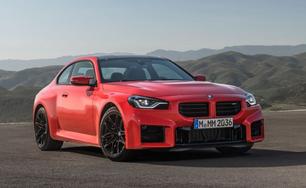
There have been mixed reviews of the design of the BMW M range, but I reckon this one looks pretty damn good. In fact, I've always thought this kind of hyper-aggressive styling looks better on smaller cars than it does on big ones.
And it certainly is aggressive, right? From the huge bonnet bulges to the meshed out grille and angry rear diffuser, to the staggered alloys and flared wheel arches, to the blocky rear end with its four massive exhaust exits.
But my favourite exterior item has to be the blacked-out carbon roof, which helps shrink the M2 visually, and makes the whole car look more potent.
Inside, it's plenty sporty feeling, with hard-backed sports seats, lashings of carbon-fibre-look trimmings and the bright red M buttons on the steering wheel.
It's nice, but some of the touch points – like the hard plastics on top of the doors, where, if you're like me, you rest your elbow when driving – feel less than premium.
Still, all the tech is present and accounted for, with its digital dash and huge centre screen, and there's no shortage of spaces to connect or charge your phone.
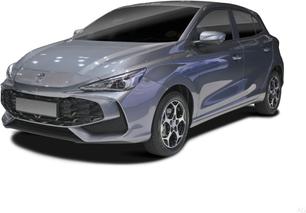
Following the new design language pioneered here by the MG5 sedan and MG4 electric hatch, the MG3 looks like it’s trying for a sportier vibe than its predecessor, and maybe even a hint of European flair.
A grinning front grille and pointed set of headlights are followed around the side by a couple of body creases that give the hatchback a sweeping look, an attempt perhaps to seem longer than it is.
It doesn’t look like any of its rivals, unlike the MG5 which is easily mistaken for a small Mercedes CLA at glance.
Here on our Dover White test car, some angles are unflattering (it's giving 'hire car'), though the model’s available Diamond Red or Brighton Blue are fairly distinctive. Yes, some of the colours reference the brand’s UK heritage, despite being built in China.
Inside, the cabin benefits from a fairly tidy layout, with some genuinely thoughtful attempts at making the otherwise budget-focused model feel a little nice. A cross-hatch design through the dash mirrors, the seat stitching and the steering wheel and its buttons are nicely angular.
The M2 pocket rocket measures just over 4.5m in length, just under 1.9m in width, and just over 1.4m in height, and it rides on a 2747mm wheelbase. That makes it longer, wider and lower than the model it replaces.
Remember that 'lower' bit, as it will come up again in a moment.
Up front, you don't feel cramped, and there's the requisite cupholders, door pockets and hiding holes, as well as wireless device charging and USB connections.
But remember, this is a two-door, four-seat affair, which cuts into the practicality a little, or a lot.
Swing open the wide front doors, and push the front seat-back forwards, and the entire chair will slide forward automatically.
It does help create more room to climb into the back, but it's still a slightly embarrassing challenge to make getting back there look anything like graceful.
Once there, it's tight. I'm 175cm and my head was firmly pressed into the roof.
You do get your own vents and temp controls, but that's about it. Even the pull-down divider only gives you access to the 390-litre boot, rather than extra cupholders.
You do get two sets of ISOFIX attachment points, though, and let's be honest – if you're buying this to make Bunnings runs, you've probably got it wrong.
That tidy design inside helps when it comes to making use of the space, as well as offering some generous storage spaces.
For starters, while the clean layout means the screen looks like the main point of access for much of the car’s function, there’s an all-important shortcut button for the climate control which means you don't waste time navigating to the vent and temperature controls.
The only issue is that while my phone was connected to the system for Android Auto, I had to navigate away from the mirroring screen back to the MG3’s home screen before being able to shortcut to the climate settings.
Demister and volume control buttons are also present, but the screen itself has an easy-to-navigate menu.
The steering wheel controls are similarly straightforward and clearly labelled, while the driver display is tidy and shows important information clearly.
While the steering wheel isn’t telescopically adjustable, it's easy to find a comfortable seating position thanks to the adjustability of the seats. The material on the seats doesn't feel rough or cheap.
Behind that, there is enough space for my 178cm frame in the second row for the most part, but headroom isn’t incredibly generous.
The rear pew is a single unit, rather than a 60/40 split, so the whole backrest folds down if you need to load anything long through the boot. There’s not even an armrest or little ski hatch for long, thin items.
Its 293-litre boot isn’t small, and there’s a space-saver spare tyre in both petrol variants, but the hybrids are stuck with repair kits.
First, the bad news. The M2 has only been getting more and more expensive over the years, and this new-generation model continues that charge.
Fun fact: When we first tested this model way back in 2016, you could get the Pure grade for less than $90K with a manual transmission.
Or you could spend just under $100K for the full-fruit version. This one, though, lists at $121,700, before on-road costs.
So, a little less bang for buck, but there's still a whole lot of bang on offer here.
You'll find staggered 19- and 20-inch lightweight alloys, while standard performance kit includes an 'Active M Differential', 'Adaptive M Suspension', 'M Compound Brakes' (with blue calipers), 'M Sport Seats' up front and, for the first time, a lightweight 'M Carbon' roof.
Elsewhere, there's adaptive LED headlights, a 12.3-inch instrument display and a 14.9-inch multimedia screen, a head-up display, a Harman Kardon 'Surround Sound' audio system and Android Auto and Apple CarPlay connectivity.
You'll sit on leather seats that adjust electrically and are heated up front. There's three-zone climate control, along with a heated steering wheel, wireless device charging and ambient interior lighting.
Even though it’s now more expensive with its $23,990 before on-roads price, it’s hard to deny the petrol-only MG3 Excite is a compelling offering when it comes to inexpensive runabouts.
Not only has the price been bumped up, but so has the apparent interior quality and features list.
A new 13.25-inch multimedia touchscreen is paired with a 7.0-inch driver display and both look pretty slick for the price point and operate well.
Apple CarPlay and Android Auto are both available, but are wired only and can’t be accessed with a Bluetooth connection, while a six-speaker sound system handles entertainment duties.
In terms of seating and material, the Excite gets cloth pews with some contrast stitching.
On the outside, folding mirrors and a set of 16-inch alloy wheels join the new MG3’s design, while this base model Excite is left with halogen headlights like it’s 2015.
The Essence scores a set of LED units and is otherwise distinguishable by its sunroof, though it shares the same wheels as our base car, so it won’t feel like you’re missing out on heaps.
Besides, this is what we're really here for, isn't it? The M2 gets the 'M TwinPower' 3.0-litre twin-turbo inline-six engine, producing a sizeable 338kW and 550Nm, sending that power to the rear wheels via an eight-speed auto or six-speed manual.
BMW says this engine is very, very close to the engine that powers the M3 and M4, and says it will rocket the M2 from 0-100km/h in 4.1 seconds, and to 200km/h in either 13.5 seconds in the automatic, or 14.3 seconds in the manual.
On paper, the MG3’s 1.5-litre four-cylinder engine is fairly underwhelming with its 81kW (peaking at 6000rpm) and 142Nm (at 4500rpm).
But these figures, including the engine size and even peak RPMs are not far off the likes of the Mazda2, which is a fairly peppy and fun car despite its lack of grunt.
Keen drivers will, however, be disappointed to hear the MG3 drives the front wheels via a continuously variable transmission (CVT) rather than a traditional torque-converter auto, taking much of the pep out of its power unit.
You can expect to hit 100km/h in a bit over 10 seconds.
A small fly in the ointment is fuel use, with the M2 said to use 9.7L/100km on the combined cycle. It also drinks 98 RON premium, and is home to a 52-litre fuel tank. Your theoretical driving range is around 540km.
Now, be warned, you'll be bored stiff if you drive it in the way that's required to get it that low. When we were being gentle, we were somewhere between 10.5 and 11.5 litres per hundred kilometres.
Emissions are pegged a 220g/km of C02.
MG claims the MG3 uses just 6.0 litres of 91 RON petrol every 100km on the combined fuel cycle, so with its 45-litre tank you can hypothetically bank on a 750km range.
Of course, that might be achievable in lab conditions, but on test we found the trip computer’s estimates looking closer to 500km on a tank for the kind of urban driving it was undertaking with us.
On a dynamic test drive route, the trip computer settled at a displayed consumption figure of 7.7L/100km, but stop-start driving was not great for efficiency, as you'd expect.
Let's be totally up front here: the BMW M2 isn't the most comfortable vehicle to live with. In fact, I recently climbed out of the M3 Touring, and found that to be more comfortable on broken city streets.
The M2 is fitted with adaptive suspension, but even in its most comfortable settings it can feel rough, bumpy and jarring on bad roads (of which Australia has lots), and unless you're gentle with the accelerator, it can feel a little jumpy when first taking off – a by-product of its prodigious power.
Now, let's be totally up front again: I don't care. The M2 is fun, plain and simple, and for mine, the above is a fair price to pay for something that brings so much joy.
The steering is lovely, the power immediate and the soundtrack intoxicating, and it's the kind of car that's fun no matter where, how far or how fast you drive it.
In fact, fun seems to be the very centre of the M2 proposition, which definitely doesn't take itself too seriously.
For evidence, look no further than the 'M Drift Analyser', buried in a hopelessly busy multimedia system that will have you praising the CarPlay and Android Auto gods.
It will rate your best drift out of four stars, measure it for distance, and basically give you a pat on the back for doing your best hooligan impression (not on a public road, of course).
Fun, then, is the order of the day here. And I bloody love it.
The higher quality look and feel of the new MG3 carries through to its day-to-day driving. Some of the car’s Chinese compatriots seem to fall down when it comes to the on-road part, which for some is the most important part of a car.
But for a small city car the MG3 is very user friendly, with light and direct steering, good visibility, and just enough power and torque to not feel like everyone’s getting the green light a couple of seconds earlier than you.
It’s comfortable at urban speeds when it comes to the suspension, and doesn't get rattled too much in the front end by tram tracks or other road imperfections.
In narrow streets, three-point turns aren’t a hassle and the car’s size means it’s easy to reverse parallel park, although the reversing camera takes a second to appear when using phone mirroring.
On the highway, however, and when it comes to high-speed cornering, the MG3 can feel a little uneasy.
The road noise becomes more and more obvious. Driving on well-maintained metro freeways at around 80km/h or above produces unpleasant noise, and a during a particularly breezy week the car felt susceptible to swaying in high wind.
Its power delivery starts to feel lacking out of town, too, and taking corners on fast back roads means plenty of slowing down to avoid the front-end sliding or the feeling of the MG3 leaning unsettlingly around corners.
If you’re considering the MG3 but you need to head out of town regularly, take a proper long test drive before opening your wallet.
But if you just need it as an urban runabout, the MG3 does a fine job.
The BMW M2 hasn't been assessed by ANCAP, but it arrives with six airbags, as well as all your usual traction and braking aids.
Elsewhere, you'll find lane change and lane departure warning, active cruise control, front and rear parking sensors, tyre pressure monitoring, and AEB with pedestrian detection.
There's also blind-spot monitoring, rear cross-traffic alert and lane centring assist, as well as a tyre-pressure monitoring system.
ANCAP hasn’t tested the MG3 yet, so there’s no crash safety information available. It’s worth noting ANCAP gave the MG5 a zero star score for its lack of active safety equipment, but the MG3 comes with more under its belt than its sedan stablemate.
Six airbags, two front, two side and two curtain, are joined by adaptive cruise control, blind spot detection, rear cross-traffic assist, forward collision warning, lane departure warning, lane keeping assist and speed limit assist.
None of these systems were intrusive on test, though lane-keep assist feels like it could do with some more fine tuning.
The BMW M2 is covered by a five-year, unlimited kilometre warranty, and servicing is 'condition based', in that the vehicle will tell you what maintenance is required, and when.
You can prepay your service costs at the time of purchase for all BMW vehicles, covering the first five years of ownership, for $3480 (which means $695 per service).
MG has a 10-year/250,000km warranty which is unmatched in the small-car market.
Servicing is scheduled at every 10,000km or 12-month intervals, with the first seven services averaging out at a fairly hefty $360 - the cheapest being $234 and the priciest $536.