What's the difference?
When BMW’s M2 first landed on Australian shores in 2016, one of the biggest criticisms levelled at it was a lack of grunt, which must have hurt its feelings.
With 272kW and 465Nm from the 3.0-litre single-turbo ‘N55’ six-cylinder engine, it was hardly tame, but the question it raised was whether it was special enough to be christened a full-fat M car? And the answer from enthusiasts was "perhaps not".
Fast forward to 2018 and BMW had rectified that criticism with the M2 Competition, powered by a 3.0-litre twin-turbo ‘S55’ engine from the M3 and M4 to punch out a more exciting and appropriate 302kW/550Nm.
For anyone crazed enough to think that was still not enough, the M2 CS is now available in showrooms, and turns the wick up to 331kW and 550Nm, thanks to some tweaks to the engine. It's now available with a six-speed manual gearbox, too. That sound you hear is purists rejoicing.
So, does this now make the 2021 M2 CS the ultimate BMW for the enthusiast driver?
What’s a point of difference you look for in the oversaturated SUV market? Is it price? Warranty? Features? How about comfort?
There are a lot of mid-size SUVs in Australia. Most of them like to trade on their features or value or, more than ever, sportiness.
You can see it in the huge wheels, aggressive body kits, stiff suspension. The list goes on. But not for the Citroen C5 Aircross.
The most recent offering from the storied French automaker is all about one thing. Comfort.
My question is why is comfort in SUV-land such a niche concept? And how does this quirky orange Citroen get it so right? Read on to find out.
As the ultimate form of the current M2, the CS distils the best aspects of what everyone loves about BMW into one tidy little package.
The driving experience is nothing short of divine, even if the manual gearbox shifts could be better, while the firecracker engine kicks things up to a whole new level.
If only BMW offered more equipment and safety to round out the $140,000 pricetag, or maybe they should have leaned harder into the lightweight aspect and ditched the rear seats to make the M2 CS even more special.
At the end of the day though, the M2 CS is still an unbelievably appealing driver’s car, and I can’t wait to see what BMW has in store for the next one.
The C5 Aircross might seem like a niche European 'alternative' SUV, but I wish it wasn’t. The more mainstream players could learn a lot from how brilliantly this Citroen is packaged.
It is truly class leading in terms of passenger comfort and even luggage space, even shipping with great multimedia and safety in this base Feel grade.
Unless you really need to be towing, performance (or in this case, lack thereof) should be low on your SUV priority list anyway.
We’re already big fans of the way the M2 looks, it’s just the right size and has the perfect proportions for a sporty coupe, and the CS just takes things to another level.
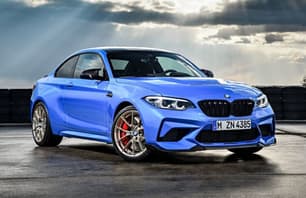
From the outside, the M2 CS scores a noticeably bigger bonnet bulge, as well as a vented hood to improve airflow.
The front splitter, side mirrors, skirts, bootlid spoiler and rear diffuser are also finished in carbon, and add to the car’s aggressive demeanour.
Filling the wheelarches are 19-inch wheels finished in black, but tucked behind those are massive drilled brake rotors and large calipers painted in red.
To call the M2 CS exterior design sporty would be an understatement, but we do have to point out that the Alpine White of our test car did look a little boring, despite the extra bling.
If we were buying one? We’d option the stunning Misano Blue hero colour with gold-coloured wheels to really turn heads around town and at the racetrack, although they will add another $1700 and $1000 respectively to the already dizzying price.
Inside, the M2 CS is let down a little by a spartan interior, which looks like it’s been lifted from the cheapest 2 Series coupe, due to the lack of climate-control screen.
However, BMW does try its best to spice things up with very tight-fitting bucket seats, an Alcantara steering wheel, CS-branded dashboard and that carbon-fibre transmission tunnel.
It’s definitely a case of function over form , but the lack of interior flare means you focus more on the road ahead than anything else, which is no bad thing when you have 331kW and 550Nm being sent to the rear wheels.
It wouldn’t be a French car without a solid dollop of style, and the Aircross has heaps of it.
From the orange paint, to its floating rear light fittings and chevron emblazoned grille, the Citroen is nothing if not unique.
Just like the C4 range before it, the C5 Aircross inherits the plastic 'airbump' fittings under the doors, with the plastic-clad soft-roader look continuing over the wheelarches and across the C5’s front and rear.
There’s a lot going on, on both the front and rear of this SUV, but somehow it’s not really over-complicated, all the flourishes and highlights manage to flow into each other to maintain some semblance of consistency.
The C5’s rear is a little more tame, with body coloured panels contrasted with the plastic strip, gloss black highlights, and dual-square exhaust facades. The floating gloss-clad roof rails are a flashy if silly touch.
I’d personally argue it’s a better-looking car than its Peugeot 3008 sibling, although it looks built entirely for city-slickers rather than the adventurous type.
Inside it’s normal. For a Citroen. Gone are the days of floating steering wheels or overtly wacky instrument clusters, it’s all quite tame and that’s for the betterment of the brand.
That’s not to say it’s not a cool place to be, and I was surprised to find myself surrounded by classy fittings, quality soft-touch materials and an understated blocky design theme. The C5 gets a small, oval steering wheel which feels great in the hands.
Those awesome memory foam seats are finished in a slightly odd grey synthetic denim kind of material. Some hated it, but I thought it contrasted the car’s exterior and interior schemes well. The raised centre console gives front passengers an extra secure premium sort of feel.
The grey materials will be slightly divisive, but the number one annoyance for me was the complete lack of tactile buttons for adjusting the climate control or media functions. Is a volume knob too much to ask?
Other than that, the C5 has one of the most tame, practical interior treatments on any Citroen… possibly ever… without managing to be boring.
Measuring 4461mm long, 1871mm wide, 1414mm tall and with a 2698mm wheelbase, and just two doors, the M2 CS isn’t exactly the last word in practicality.
Of course, front passengers are afforded plenty of space, and the electronically adjustable bucket seats allow you to get into the right position to row through the gears and eat up the road.
Storage is limited, however, with average-sized door bins, two cupholders, a small wallet/phone tray, and that’s it.
BMW is generous enough to include a single USB port to charge your device, but its location, where the armrest should be, means you’ll have to get creative with cable management to make it really work if you want to keep your phone in the tray under the climate controls.
Predictably, the two rear seats are less than ideal for anyone tall, but there is plenty of leg and shoulder-room.
A small centre-storage tray is fitted back there, as well as Isofix points for the seats, but there isn’t a whole lot to keep rear occupants entertained. They'll probably be too frightened to care.
Opening the boot reveals a small aperture that will swallow 390 litres, and is shaped in such a way that a set of golf clubs or some overnight bags will fit in nicely.
There are some luggage tie-down points and netting to keep your belongings from rolling around, and the rear seats fold down to accommodate longer items.
The C5 Aircross is one of the most practical SUVs you can buy in this segment in terms of interior space. There’s just loads of it, and plenty of smart features to back it up.
In the front you get some small trenches in the doors, lovely big cupholders in the centre console, along with a top-box which was a little shallow, but still handy, as well as a small cavity (seemingly designed to hold the key) and a big bin for stowing your wallet or phone.
Back seat occupants get decent leg and headroom, but what’s really special here is each passenger gets their own memory foam seat with enough width to travel in decent comfort. The centre passenger’s legroom isn’t even impeded by a big transmission tunnel.
Rear passengers also get pockets on the back of the front seats, dual air vents, small cupholders in the doors, and a 12-volt power outlet. With no drop-down armrest, it would be nice to see more practical cupholders in the door cards.
The boot is truly gigantic. Like, biggest in the segment gigantic. At a minimum it weighs in at 580L (VDA), but as an added boost, the rear passenger seats can be slid forward on a rail to grant a whopping 140 extra litres of space to 720L. With the rear seats down you’ll be able to make use of 1630L.
A power tailgate, able to be operated by waving a foot under the car is also standard, revealing a totally unimpeded aperture. So, not only does it have a class leading luggage area, but it’s also easy to use.
Pricing for the 2021 BMW M2 CS starts at $139,900 before on-road costs for the six-speed manual, with the seven-speed dual-clutch automatic bumping up to $147,400.
Let’s not mince words here, the BMW M2 CS is not cheap.
Compared to the M2 Competition , the CS adds about $37,000 to the bottom line – the equivalent of a well-specced small SUV – and sits perilously close to the new-generation M3 and M4 ($144,900 and $149,900 respectively).
For the price , buyers are getting exclusivity, with just 86 examples available in Australia out of a total global production run of 2220 units.
The engine is also tuned for a higher power output, but more on that below.
Standard equipment in the M2 CS also eschews luxury for sportiness, with carbon-fibre exterior highlights, a new exhaust, lightweight 19-inch wheels and Alcantara steering wheel.
The front seats are borrowed from the M4 CS, and trimmed in Alcantara and leather, but that’s about all you get for equipment.
The multimedia system shares the same dimensions as the rest of the M2 line-up, measuring 8.8 inches and including satellite navigation, digital radio and Apple CarPlay (no love for Android owners, sorry).
The climate controls do differ slightly, with the slender screen replaced with basic buttons and knobs.
Seat heating? Nope. Rear air vents? Sorry. How about keyless entry? Not here.
Also noticeably absent is a wireless smartphone charger, and centre armrest, as the usual transmission tunnel has been swapped out for a carbon-fibre piece.
To be fair, you do get a premium Harman Kardon sound system, push-button start and single USB port, so at least BMW does offer a way to charge your phone on the go.
Perhaps most egregious of all though – at least to me – were the rubber pedals fitted to our manual test car.
For $140,00 you’d expect a bit more in terms of convenience features, and before you make the argument that ‘it’s all about saving weight’, don’t bother, because the M2 CS and M2 Competition both tip the scales at an identical 1550kg.
The C5 Aircross enters Australia in just two spec levels, and the one reviewed here is the base Feel. Priced at $39,990, before on-road costs, it’s not exactly cheap, but is thankfully well specified.
And at the time of publication a Citroen drive-away pricing campaign pitched the Feel at $44,175 with all registration, dealer and other pre-delivery charges included.
In the box is a 7.0-inch multimedia touchscreen with Apple CarPlay, Android Auto, DAB+ digital radio and built-in sat nav, a 12.3-inch digital dash display, auto-dimming rear-vision mirror, auto headlights and windscreen wipers, keyless entry and push-start ignition, dual-zone climate control, LED DRLs, and an electric tailgate.
That’s the good. Not-so-good are the halogen headlights (kind of detracting from the slick front styling) and the lack of radar cruise control.
The Aircross does get a decent set of active safety features explored in the safety section of this review.
Competitors? Well there’s a good chance you’ll be cross-shopping the C5 Aircross against other alternate options in the mid-size space, including the Peugeot 3008 Allure (with which the Aircross shares an engine and chassis - $40,990), the Renault Koleos Intens FWD ($43,990), and perhaps the Skoda Karoq (just one spec-level in Australia - $35,290).
The Aircross’ secret weapon, which you can’t get on any other mid-size SUV, is its seats. Citroen calls them 'Advanced Comfort' seats, and they’re stuffed with memory foam “inspired by mattress technology.”
And it sounds like pamphlet hype, but it’s not. Once you’re seated, it’s like you're floating on air. A little bit of genius!
Citroen pairs this with reasonably-sized 18-inch alloy wheels and a unique suspension system which uses “progressive hydraulic cushions” (a nod to Citroens past) to soften the ride.
It’s a double down of comfort features, and really adds up to a lovely place to be behind the wheel. All for a similar price to its Peugeot sibling. Worth considering.
Powering the BMW M2 CS is a 3.0-litre twin-turbo ‘S55’ six-cylinder engine, developing 331kW/550Nm.
With drive sent to the rear wheels via a six-speed manual or seven-speed dual-clutch automatic transmission, the M2 CS can accelerate from zero to 100km/h in 4.2 or 4.0 seconds respectively.
Peak power is available at a heady 6250rpm, while maximum torque comes on stream from 2350-5500rpm.
The M2 CS actually put out as much grunt as the outgoing M3/M4 Competition, because it uses the same engine, and to say the amount of performance on tap is explosive would be to talk up explosions. This is a serious amount of bang for your buck.
The M2 CS easily outclasses the likes of the 280kW/460Nm Jaguar F-Type V6, 306kW/410Nm Lotus Evora GT410 and 294kW/420Nm Porsche Cayman GTS 4.0.
I do have to draw attention to the manual gearbox of our test car, though, which was great, but not excellent.
With such engaging shifters fitted to the Honda Civic Type R, Toyota 86 and Mazda MX-5, I expected rowing through the gears would be nirvana, but it was merely OK.
The throws are a little too long for my liking, and it takes just a bit too much effort to slot it into the right ratio. Still, we should all be glad to see a manual offered here, and I'm betting it is still a better option for purists than the auto.
The C5 Aircross is powered by just one powerplant no matter which grade you pick. It’s a 1.6-litre turbocharged four-cylinder petrol engine, producing 121kW/240Nm.
It shares this engine with the Peugeot 3008 and the outputs compare well with the Renault Koleos’ Nissan-sourced 2.4-litre four-cylinder engine (126kW/226Nm) considering it’s much smaller and (theoretically) less thirsty.
The ever-smart Skoda Karoq is tough to beat in this segment with its 1.5-litre engine (110kW/250Nm) putting strong torque figures on the board.
The C5 Aircross sends power to the front wheels only via a six-speed automatic transmission, for a comparison the Koleos has a lackluster CVT auto, while the Karoq benefits from a seven-speed dual-clutch automatic.
Official fuel-consumption figures for the M2 CS are pegged at 10.3 litres per 100km, while our week with the car yielded a more realistic figure of 11.8L/100km.
Engine start/stop technology is included to keep fuel consumption down, but our week with the car was spent mainly in Melbourne’s inner-city streets, with three trips out of town looking for some winding country roads.
No doubt if we were more restrained with our throttle application, we could have kept that fuel consumption figure down, but a sub-12L/100km result is still great for a performance car.
The 1430kg C5 is rated to consume 7.9 litres of mid-grade 95RON unleaded per 100km.
That’s about on-par for the segment, and in practice I managed a figure of 8.6L/100km. A litre over isn’t too bad for truly mixed driving.
The mid-grade fuel requirement is a bit of an annoyance, but it’s also to be expected from a small capacity turbocharged European engine. It’s primary competitors (with the exception of the Koleos) drink the same.
Let me be clear; driving the M2 CS is a simply sublime experience.
The M2 was always close to the top of the best modern M cars, and the CS simply cements its position as the king.
Step inside and the bucket seats and Alcantara steering wheel make sure you know you are in something special.
Push the red starter button and the engine comes to life, with a racy growl from the new exhaust system that immediately brings a smile to your face.
Out on the open road, the adaptive dampers fitted to the M2 CS do a good job at soaking up bumps and road imperfections, but don’t expect it to suddenly become a comfortable and cosseting cruiser.
The ride is firm in all settings, but dial it up to ‘Sport Plus’ and comfort really takes a hit, especially on the uneven inner-city roads of Melbourne, with its criss-crossing tram tracks.
Escape the unkempt roads of the city for the smooth blacktop of the country, though, and the M2 CS really flexes its handling prowess.
The Michelin Pilot Sport Cup 2 tyres fitted as standard also help in this regard, and while the rear end will step out with 331kW pushed through them, if you want to stick to the racing line and clip that apex, the M2 CS is a more than willing participant.
The suspension isn’t the only thing that can be changed, however, with steering and engine adjustments also available.
We found the best setting to be maximum-attack mode for the engine and suspension, while keeping the steering in its lightest setting, and even with the steering weight turned way down, the feedback and feel from the road is enough to communicate exactly what the M2 CS wants to do.
BMW has definitely nailed the feel of the M2 CS, which almost eggs you on to go faster and faster.
When things get a bit too furious, it is also comforting to know that the massive 400mm front discs and 380mm rear discs with six- and four-piston callipers respectively are more than up to the task of scrubbing speed.
I only wish I could have explored the capabilities of the M2 CS in the more controlled environment of a racetrack, because out on the open road, the M2 CS definitely still feels like it has so much more to give. And everything about this car just screams Race Track Time. Loudly.
Straight up, the C5 Aircross is not the most exciting car you can drive. It’s not even exciting for the segment, with the focus being refreshingly distant from sporty.
You’ll be getting sluggish acceleration comprised of an occasionally lazy six-speed auto transmission and a dollop of turbo lag every time you depress the accelerator pedal.
But the C5 Aircross is, refreshingly, not about being sporty at all. I’d argue Citroen is one of the few carmakers that really ‘gets’ what driving an SUV should be about. Comfort.
See, this SUV more than makes up for its lackluster performance by being possibly the nicest place to be behind the wheel in the segment.
We’ve covered how unreal the seats are in terms of their quality memory foam padding, but it doesn’t end there. The C5 has the same excellent well balanced steering from the rest of the Citroen and Peugeot passenger car ranges, as well as sensibly-sized tyres on small alloy wheels and the hydraulic cushion suspension.
It all adds up to a ride that’s quiet and makes most road corrugations, imperfections and potholes a complete non-issue.
The suspension does have its limits, hitting a particularly sharp bump or pothole will have the car bouncing off its shocks, but it’s simply awesome on 90 per cent of Australian urban roads. I wish more SUV mid-sizers rode like it.
It’s also super quiet thanks to “extra insulation” in the engine bay and the small alloy wheels.
The BMW M2 CS has not been tested by ANCAP or Euro NCAP and as such does not have a crash rating.
The car it is based on, the 2 Series, is also unrated, although the M2 CS differs wildly from the rest of the small coupe range.
Safety systems include front and rear parking sensors, automatic headlights, a reversing camera and cruise control.
Don’t expect autonomous emergency braking (AEB), blind-spot monitoring and lane-keep assist here, let alone rear cross-traffic alert or traffic-sign recognition.
Sure, the M2 CS is a track-focused special, but its also lacking some crucial safety features you’d expect out of any new car, and particularly one at this price point.
The Aircross has the same set of active safety features no matter which grade you pick. This means auto emergency braking (AEB – works up to 85km/h) with forward collision warning (FCW), lane departure warning (LDW) with lane keep assist (LKAS), blind spot monitoring (BSM), driver attention alert (DAA), and traffic sign recognition (TSR) are all standard.
You’ll get the added benefit of front and rear parking sensors and a 360-degree parking view, which is excellent in its functionality.
Expected refinements include six airbags and the regular suite of electronic stability and brake controls.
It’s an impressive suite and has everything you’d expect in a new car – apart from the strange omission of active cruise control.
The C5 Aircross has not yet been rated by ANCAP (although its European full-safety spec equivalents have a maximum five-star EuroNCAP score).
Like all new BMWs, the M2 CS comes with a three-year/unlimited-kilometre warranty, which falls short of Mercedes’ benchmark five-year/unlimited-kilometre offering.
Scheduled service intervals are every 12 months or 16,000 kilometres, whichever comes first.
Buyers can opt for a ‘Basic’ or ‘Plus’ service plan that covers the car’s first five years, priced at $2995 and $8805 respectively.
The ‘Basic’ plan covers oil changes, air filters, brake fluids and spark plugs, while the ‘Plus’ service adds replacement brake pads and discs, wiper blades and clutch.
With an annual cost of $599 or $1761 for maintenance, the M2 CS is actually pretty affordable to service.
All current Citroens are covered by a five-year/unlimited kilometer warranty, matching the widely accepted industry standard.
That’s all well and good, but it’s the very erm… European service pricing which is the killer here.
The C5 Aircross is covered by a capped price servicing program which costs between $458 and $812 per yearly visit, for an average of $602 per year for the life of the five year warranty.
It’s a bit of a let down given the Citroen’s cheapest fixed-price service is the equivalent to an expensive service at more mainstream brands.