What's the difference?
It was always going to happen - an electric version of the BMW 7-Series - but how well does the i7 handle the limousine fundamentals - comfort, power, room and style?
Well, luxury transport has been missing one major component all these years and the i7 has it.
Let me explain...
Large SUVs like the Toyota LandCruiser, Nissan Patrol and Land Rover Defender have dominated in Australia for decades now, however there’s now something new to shake up the segment.
BYD’s luxury spin-off brand, Denza, has launched in Australia with two plug-in hybrid (PHEV) off-road SUVs. The B8, which is the larger of the two, is on test here.
With three rows of seating, a bucketload of standard equipment and a jaw-dropping starting price, the B8 is being pitched as a PHEV alternative to the currently diesel-only LandCruiser 300 Series among other more premium alternatives like the Land Rover Discovery and Mercedes-Benz GLS.
We’ve already driven the B8 over in China and this is the first time we’re getting to test it out on Australian roads, so let’s see how it stacks up.
The i7 xDrive60 M Sport is close to the perfect 7 Series. From the comfort of being driven in it, to the ease of driving it, even for hours on end.
The i7's range of 625km is outstanding for an electric vehicle, but a petrol powered 740i will get you about 900km on a full tank. How many kilometres a day will you cover? Do you have time and a way to charge the i7 daily if you do cover a lot of distance?
If driving range isn't an issue, the i7 will reward you with a smooth, effortless driving experience and your passengers will have a serene journey in luxurious, high-tech surroundings. Just don't bump the door release button accidentally!
The Denza B8 is an incredibly luxurious car that has a lot going for it, including three rows of seating, a 3.5-tonne braked towing capacity and an eye-popping price tag, but it's held back by its overall heft and cumbersome ride.
If you don’t absolutely need the third row of seating, the smaller B5 is arguably the better pick and while it’s also not perfect, it’s a very compelling package and you’ll be saving thousands of dollars in the process.
Note: CarsGuide attended this event as a guest of the manufacturer, with travel, accommodation and meals provided.
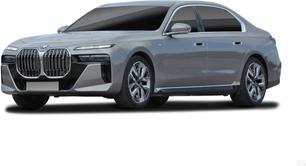
At 5.4m long and 2.2m wide the i7 xDrive60 M Sport is enormous and imposing - as a 7 Series BMW should be.
What's significantly different in the look of this latest incarnation of BMW flagship limousine is its show stopping face.
That LED-lined grille has Vegas pizazz and the pretty glittering Swarovski Crystal headlights are mesmerising. I doubt the words 'pizazz' and 'pretty' have ever been used to describe any previous generation BMW 7 Series.
Fear not, though, from every other angle the i7 looks business-like and serious… and solid as though carved from a single slab of marble.
Solid is also a good word for the i7's interior. Look at the seats in the images - they're hotel lobby sized and I'm still uncertain how they managed to fit them through the i7's doorway.
Our car had the Merino Tartufo brown leather upholstery which suited the 1970s-style futuristic design of the seats with their headrests wrapped in carbon fibre and the satin aluminium trim throughout the cabin. They look like seats from the bridge of a spaceship in a sci-fi series.
The enormous 31.3-inch screen in the rear is a show-stopper as are the tablets in the rear doors to control the screen functions along with the seat heating and adjustment.
Disappointing in comparison is the smaller media and instrument displays up front. And it's not just the lesser proportions but the styling of the screens that's a let down.
Surely this was a chance for BMW to integrate a large, flowing interactive screen over the dashboard and not something which looks propped up and an afterthought to the design of the cabin.
I also find the crystal-effect plastic that trims the dashboard and extends into the doors a little over-the-top, especially when it's backlit with LEDs.
There’s no way around it, the Denza B8 is a big car. It’s almost 5.2 metres long which makes it larger than a LandCruiser 300 Series and more in line with the likes of the Land Rover Defender 130.
It looks quite boxy and tough on the outside, though it doesn’t have any features that define it specifically as a Denza beyond the inconspicuous badging. There are many angles that are reminiscent of the aforementioned Defender.
The body lines look crisper than the smaller B5, as does the semi closed-off grille and LED light script that connect the big LED headlights.
Unlike the B5, the tailgate-mounted spare wheel is much more prominent in the B8 and this therefore exaggerates its heft, not in a good way.
Inside, it’s luxurious and high-end with lots of visual appeal. I particularly like the amount of soft-touch finishes around the cabin and the overall lack of glossy piano black.
While luxurious, there’s also a rugged edge to the interior. This is most present in the large grab handles which you do need to use when getting in and out.
The amount of physical buttons and switches inside is a nice touch as you don’t need to relate on the touchscreen all the time. The fact the gear shift lever rises up when you turn on the car also adds to the special, luxurious feel.
Sure, the i7 isn't an SUV but a sedan like this needs to be roomy and comfortable, it also needs to be an ergonomic place to work for passengers in the back with laptops, and it needs to be well appointed with internet connectivity and charging outlets. A boot that can take at least two passenger's luggage is also vital.
The i7 has all of that covered with good legroom in the second row even for me at 189cm tall. I spent two hours back there writing my script for the video for this review while the i7 was charging.
As I typed away I had plenty of elbow room but I could have done with a tray table for the computer.
There's a wireless phone charger in the fold-down rear centre console, along with USB ports galore.
You'll find another wireless phone charger up front and more USB ports. The i7 also has its own internet hotspot.
The sumptuous seats in the rear are power adjustable and also heated, but lack a massaging function.
There's also rear dual-zone climate control and sun-blinds which cover the back and side windows.
Cabin storage is good with large covered areas in the front and rear centre consoles, plus there are two cupholders in the rear and another two up front, with large door pockets, as well.
The cargo capacity of the boot is a healthy 500 litres but it's quite shallow due to the electric vehicle batteries eating into the luggage space.
The automatic doors can be opened several ways from the inside.
First there's a button inside which is high on the rear door and another on the dashboard which will open them automatically while using sensors to ensure they don't hit anything.
There's another button much lower down which will pop the door open slightly for you to push it the rest of the way.
Finally there's an emergency handle which will override the electric opening.
You can open the doors from the outside automatically by pushing a button near the door handle or by using the exterior door handle normally.
Closing involves pressing the high placed button if you're inside or by tapping the exterior button on the outside door handle if you've exited the car.
We did have a door mishap twice during our week with the i7. The first was when bags placed on the front passenger seat bumped the release button and caused the door to pop open, followed quickly by me lunging across to pull it shut again. It's lucky my arms are long.
The second was when my eight-year old son bumped the door release button with his knee again popping open the door but this time at 110km/h on the motorway. He was able to close the door but it rattled both of us, understandably and I kept the child lock on for the rest of the week.
He's been in a different test vehicle every week of his life since he was born and this is the first time we've ever had a door open unintentionally like this. I've also never had a door open, just because a bag has leaned on it, either.
So, the auto door opening function might create a nice impression and make opening and closing the heavy doors easier, but I think manual doors would be more practical.
Hopping into the B8 you need to acquaint yourself with how the flush door handles operate. Generally they pop open when you unlock the car but sometimes they can be a little delayed.
Also inside the car there are electronic door release buttons which are nowhere near as intuitive as regular door pull handles. Sure you’d likely get used to this over time but you’ll need to explain it to new passengers all the time.
The seats in Chinese cars usually look nice but aren’t that comfortable or supportive for long-distance journeys. The B8’s are the opposite, offering great support and almost limitless adjustability. Adding to this is the standard heating, ventilation and massage functions.
Ahead of the driver is a leather-wrapped steering wheel which feels nice and has plenty of physical buttons with a tactile click when pressed.
Behind this, the digital instrument cluster is clear and high-resolution and offers a number of different layouts and informative pages you can cycle through. This allows you to customise the display.
In the centre of the dashboard is the mammoth 17.3-inch touchscreen multimedia system which is the largest central screen I have seen in a car to date. It’s a big screen for a big car and Apple CarPlay satisfyingly takes up the entire screen.
Thankfully, the screen is snappy and has a native user interface that is easy to navigate around without getting lost. I particularly like the swipe-down control centre menu that allows you to change key settings without diving into sub-menus.
My only hassle with the screen is I struggle to reach the far left-hand side due to its overall size. Perhaps a trackpad would solve this.
As I noted previously, the amount of physical switchgear around the cabin makes adjusting key functions easy. Examples include physical buttons to change the drive mode, activate the surround-view camera, adjust the suspension position and switch between EV and hybrid driving.
In terms of storage up front there are two non-ventilated 50W wireless phone chargers, two cupholders with adjustable depths, a shallow storage section under the centre console, plus a fridge/hotbox under the centre armrest.
Moving to the second row and the luxury continues. The seven-seat model features a three-seat bench that three people can easily fit across as the floor is flat, whereas the six-seat model gets uber-plush captain’s chairs.
Regardless of variant, there’s plenty of room in the second row, even for adults.
Second-row amenities include a small screen on the back of the centre console box that allows you to change the climate control and change the seat heating/ventilation, among other functions.
There’s also a button that opens the fridge/coolbox so the second-row passengers can access it. This is a nifty touch though you’d want to make sure small fingers don’t get caught as the anti-pinch function isn’t the strongest.
A feature that’s unique to the six-seat version is a massaging function on the second-row captain’s chairs. This is a very cool touch that no other SUV at this price point offers.
Accessing the third row in the six-seat version is rather easy as you only need to walk down between the captain’s chairs. It’s also simple enough in the seven-seat version as long as you access it from the kerb side.
Third-row space is decent for adults, but this shouldn’t be surprising as the B8 is such a hulking vehicle. The backrests also recline allowing for extra comfort. Amenities include air vents in the headliner, USB-C ports and scattered storage. It’s enough for seats that will likely only get occasional use.
Around the back the B8 has a side-hinged tailgate which is a little problematic as you need to allow space for it to open up in parking spaces. This is hard when the car is already 5.2m long…
With all three rows upright there is 147L of boot space, which is fine, but this expands to a much more usable 920L with the third row folded.
The boot space is square and usable, though there is a large load lip which is body-coloured and would easily get scratched if you drop something on it. Not the best in a family-oriented vehicle.
Boot-related amenities include buttons to electronically fold the second and third row seats and lower the suspension to make things easier to load into the boot, a 12V socket, scattered hooks, as well as a small underfloor section to store the changing cables.
Although it stands out like a sore thumb, it’s great to have a full-size spare wheel on the back of the tailgate. This is very helpful in the unlikely and unfortunate event you get a puncture.
The BMW i7 xDrive60 M Sport sits in the middle of the 7 Series range with a list price of $306,900. That places it above the $273K 740i which is the only combustion engine variant in the line-up and below the $345K i7 M70 xDrive.
Whatever you do, don't dismiss the i7 xDrive60 M Sport as an overpriced electric version of the 740i because it has many more standard features that enhance the luxury and chauffeuring experience.
We're talking automatically opening doors, a 31.3-inch media display in the second row and control tablets for it in the rear doors.
There's a 35-speaker Bowers & Wilkins surround sound system (not the 740i's 18-speaker stereo), power adjustable and heated rear seats plus an 'Executive Lounge' console, and a BMW Individual Gran Lusso interior with a choice of Merino or Cashmere upholstery.
Our car had the Merino Tartufo brown leather upholstery and carbon-fibre M interior trim.
The i7 also rolls on larger 21-inch wheels which fill the giant wheel arches perfectly.
The rest of the standard features list is almost identical to the 740i's and includes the imposing LED-outlined grille, the Swarovski crystal headlights and the panoramic glass roof.
Inside, the double screens for media and driver instruments are also standard, there's sat nav, Apple CarPlay and Android Auto, a head-up display for the driver, front row seats are heated, massaging and power adjustable, there are also electric sun-blinds for the rear.
Our car wore the 'Oxide Grey Metallic' paint which made my videographer very happy because apparently it shows contours better than any other colour even on a bright, sunny day.
At the time we published this review BMW was also supplying as standard a charging wall box and a five-year Chargefox subscription.
The 2026 Denza B8 line-up starts at $91,000, before on-road costs, for the seven-seat version, which is strategically just under the Luxury Car Tax (LCT) threshold, whereas the flagship six-seat version is $97,990, before on-road costs.
Despite nearing $100K, this notably undercuts key rivals like the Toyota LandCruiser 300 Series and Land Rover Defender by a considerable margin, especially once you take the level of standard equipment into account.
The B8’s closest rival is currently the slightly smaller GWM Tank 500 PHEV which is priced even more competitively at $77,990, drive-away.
As a base there are 20-inch alloy wheels, adaptive LED headlights, soft-close doors, a 12.3-inch digital instrument cluster, a 17.3-inch touchscreen multimedia system, 18-speaker Devialet sound system, tri-zone climate control, leather upholstery, plus heated and ventilated seats in the first and second row.
Moving up to the six-seat version brings second-row captain’s chairs with adjustable legrests and a massage function, as well as a digital rear-view mirror, head-up display and Nappa leather upholstery.
This amount of standard equipment in a car that’s under $100K is wild and should definitely be enough to put in your consideration list if you’re after a big, three-row SUV. The smaller B5 offers similar levels of specification but goes without the third row.
The i7 xDrive 60 M Sport has two electric motors - one at the front one at the rear - making this large saloon all-wheel drive.
The combined output is outrageous. We're talking 400kW and 750Nm. That's enough oomph to fire this electric missile from 0-100km/h in 4.7 seconds.
When EVs first came out a lot of people saw the technology as lending itself to small city cars, but with the smoothness of motion is offers, the silent operation and the colossal grunt it can supply nothing suits a big limo like the 7 Series better than electric motors.
Power comes from a plug-in hybrid set-up combining dual electric motors and a 2.0-litre turbo-petrol four-cylinder engine.
Total system outputs are a meaty 425kW and 760Nm. They need to be, as the B8 has a kerb weight of 3.3 tonnes. Despite this, Denza claims it can still do the 0-100km/h sprint in just 4.8 seconds.
Power is sent to all four wheels with a rear mechanical diff lock as standard across the line-up. A front diff lock is only offered on the six-seat version.
What’s most surprising about this big beast is it offers a segment-meeting 3500kg braked towing capacity. It also has up to 700kg of payload, depending on the variant.
There are removal trucks shorter and narrower than the i7 but this limousine is possibly the easiest and most comfortable car I've driven in almost 15 years of testing vehicles from Toyotas to Bentleys.
The steering is pinky-finger light but accurate, the ride (as driver and passenger in the second row) is superbly composed and the electric powertrain add a smoothness to movement that no combustion engine on the planet can come close to.
The xDrive60 M Sport comes standard with BMW's 'Executive Drive Pro' feature which includes the 'Active Roll Stabilisation' and 'Active Roll Comfort' systems used on Rolls Royces.
The systems use motors to level the body through dips and corners, and the result has to be felt to be fully appreciated.
It's oddly amazing - you could have a bowl of molten lava in your lap and not spill any of it.
And then there are the seats. As a driver the under thigh support offered by the big, thick, wide seat base is exactly right for long distances, while the back rest is supportive without being too firm.
If I was to name any downsides to the driving experience it would be the limited forward visibility due to the narrow windscreen and thick. short A-pillars.
I found myself always having to peer around those pillars at intersections and pedestrian crossings.
Rearward visibility is completely blocked when the second row's large screen is folded down and the rear vision mirror doesn't have a camera function to get around this issue.
Sure there's a reversing camera but being able to see what's coming up behind you in traffic is important to for safe situational awareness.
I'm also not a fan of the synthesised driving sounds. It's unnecessary, especially in something like a chauffeur-operated limousine.
I think it only serves to cheapen what is such a high-end experience. Thankfully you can turn it off.
The same goes for 'Boost Mode' which provides all available grunt once a paddle behind the steering wheel is pulled and counts down like a missile launch. Seriously? Come on - this isn't a 2 Series!
Behind the wheel, the Denza B8 primarily acts as an electric vehicle (EV), meaning it’s largely quiet inside the cabin when driving around normally.
Once the battery charge gets down lower, the petrol engine typically switches on to top up the battery. It largely acts as a generator and a lot of the time you can’t tell whether it’s on or off.
You’ll likely only notice it if you floor the accelerator or go up a steeper hill. Even then the engine largely stays quiet and in the background.
When the battery charge gets down low enough and you gun it, the petrol engine can directly power the front wheels. This is rare, though, because the car leaves at least 25 per cent battery charge in reserve.
With 425kW and 760Nm thanks to the dual electric motors and 2.0-litre turbo-petrol engine, the B8 is far from slow. In fact, for a 3.3-tonne beast it absolutely hauls thanks to the instantaneous torque the electric motors provide.
However in the standard drive mode there is a noticeable input lag from when you push the accelerator pedal hard and when the car starts accelerating. This is reduced in the 'Sport' drive mode.
Although the B8 may produce lots of power and torque, it feels its weight. When you accelerate hard it pitches back dramatically, much like the Jeep Grand Cherokee. It’s much more pronounced than in the smaller B5, but still smile-inducing.
As standard, the B8 line-up gets an adaptive hydraulic suspension system that is claimed to be able to self-level the car. Despite this, the B8 gets a considerable amount of body roll regardless of which drive mode you select.
Many Chinese cars have floaty, comfort-oriented suspension tunes over firmer and a more dynamic-feeling ride, and the B8 is no exception. It feels like a 3300kg+ SUV.
The kicker is, like many body-on-frame vehicles, the ride gets busy on harsher roads with more frequent bumps. As a passenger you get jostled about in the cabin.
The steering tries to disguise the overall heft of this SUV but as a result it can feel overly assisted and vague at certain points. Depending on the drive it either artificially adds or reduces resistance.
Unlike the related BYD Shark 6, the B8 gets diff locks and a low-range mode which uses a clutch pack on the rear electric motor to allow for more controlled, low-speed crawling.
The adaptive hydraulic suspension allows the car to be lowered down or lifted up. In its highest mode there is a 890mm maximum wading depth.
Interestingly, compared to the smaller B5, the B8 feels more sorted off the beaten path. Its added heft helps round off bumps more easily, plus there’s added momentum behind it.
Lastly, in terms of noise, vibration and harshness (NVH), the B8 is a very quiet car to drive. As I mentioned above, the electric-first nature automatically makes this a quiet car.
Surprisingly, given the B8 is a huge 3.3-tonne box on wheels, there is very little road and wind noise. It seems Denza has put a big emphasis on sound insulation.
The BMW i7 has not been assessed by ANCAP and like many ultra high-end cars it probably won't be. But we would expect it to perform well given this is the flagship of the brand and fitted with every safety feature in BMW's arsenal.
There's AEB which works from car park pace to motorway speeds, there's lane keeping assistance and blind spot warning, rear cross-traffic alert and manoeuvre braking which will stop you from bumping into objects while revving and there are more than 35 different sensors.
One radar constantly gazes 300m ahead into the distance, although it would probably be bored in Australia with our lack of autobahns.
The i7 also has BMW's 'Evasion Assistant' technology which scans traffic in all directions and will activate an evasive manoeuvre into an empty safe lane if it detects you swerving to avoid a collision.
There are seven airbags onboard, including one between the front seats, full length curtains for the front seats and head protecting curtains for the rear occupants.
The xDrive60 M Sport also emits an acoustic warning to alert pedestrians that you're nearby.
The Denza B8 received a maximum five-star ANCAP safety rating based on testing conducted on the related B5 in 2025.
There are 14 airbags which notably includes coverage for the third row, plus autonomous emergency braking (AEB), blind-spot monitoring, front and rear cross-traffic alert, adaptive cruise control, front and rear parking sensors and a surround-view camera.
The majority of the active safety systems do a good job, remaining in the background and only activating when absolutely necessary. However, the driver attention monitor is over zealous and struggles to detect your eyes when you’re wearing sunglasses.
Thankfully, you can turn this off using the touchscreen but it needs to be done every single time you drive the car.
The i7 xDrive60 M Sport is covered by BMW's five-year, unlimited kilometre warranty. The battery is covered for eight years or 160,000km.
There's no regular servicing schedule but the car will identify any faults and maintenance issues and notify you. A six-year unlimited service plan is offered by BMW and is included in the purchase price of the i7.
The i7 also comes with a five-year subscription to the charge for charging network, and a home wall box charger.
The Denza B8 is covered by a six-year, 150,000km warranty, whereas the battery pack is covered by an eight-year, 160,000km warranty. There’s also three years of roadside assistance.
This isn’t a standout warranty in the mainstream market, though compared to premium marques it’s a notable step up.
Logbook servicing is required every 12 months or 20,000km, whichever comes first.
The first five years' of servicing totals $3762, which averages out to just over $750 per service. This is just a tad more than the smaller B5, but it’s much cheaper than premium rivals.