What's the difference?
It was always going to happen - an electric version of the BMW 7-Series - but how well does the i7 handle the limousine fundamentals - comfort, power, room and style?
Well, luxury transport has been missing one major component all these years and the i7 has it.
Let me explain...
Following the money comes pretty naturally to carmakers. It’s what happens when the product planning department smells a new direction on the breeze and then handballs that to the design and engineering folks who turn a perceived market trend into a showroom reality. And when everybody gets it right, you have a new default product. And everybody else has to keep up. Some even have to catch up.
We’ve seen it plenty of times before, too. Think about those early 1980s days when the default small car went from a sedan to the five-door hatchback. Didn’t that catch on? You might also remember more recently when a family car had to be a four-wheel drive. And what about the dual-cab ute revolution of the last 15 years?
The other strident market segment right now is the SUV, of course. And within that, most recently has been the march to electrification, starting with conventional hybrid technology and now progressing to the new must-have, a plug-in hybrid platform.
The fact is, if you’re a Chinese carmaker intending to sell on a world stage, you can’t ignore the plug-in SUV in any of its various sizes and marketing segments. There’s a good basis for this, too. Plug-in hybrids just make good sense. They offer the urban running-cost advantages of any hybrid, the option of zero tailpipe emissions, all-electric running over a normal commuting distance and – crucial for a big country like this one – they’ll keep motoring along for as long as the owner puts petrol in them.
Okay, so they can be heavy with all that tech on board, and there’s no denying that two power sources (petrol and electric) make for a more complex machine, but the advantages outweigh the downsides for many buyers.
The other graph you can plot with great certainty is that new tech will get cheaper as the industry moves forward. Which is exactly where BYD finds itself right now by being able to offer a plug-in hybrid variant of its Sealion 5 mid-sized SUV at a price that will have much of the opposition running scared. But how scared should the others be?
The i7 xDrive60 M Sport is close to the perfect 7 Series. From the comfort of being driven in it, to the ease of driving it, even for hours on end.
The i7's range of 625km is outstanding for an electric vehicle, but a petrol powered 740i will get you about 900km on a full tank. How many kilometres a day will you cover? Do you have time and a way to charge the i7 daily if you do cover a lot of distance?
If driving range isn't an issue, the i7 will reward you with a smooth, effortless driving experience and your passengers will have a serene journey in luxurious, high-tech surroundings. Just don't bump the door release button accidentally!
Cars that don’t always appeal to enthusiast buyers are often seen by manufacturers as a way of not bothering with the dynamics. Good enough is, apparently, good enough. Thankfully, BYD hasn’t taken that path here and the local suspension tweaks have turned what could have been a me-too product into a bit of a dynamic class leader. And even if buyers can’t verbalise the benefits of that, they will still be subliminally enjoying them with every kilometre.
The other stand-out feature is the price-tag which represents an awful lot of car for the money. And, in such a price-sensitive market as this one, that will get the BYD over the line for a lot of families. That it also offers a vastly better driving experience simply makes the value equation – and the purchasing proposition – even stronger.
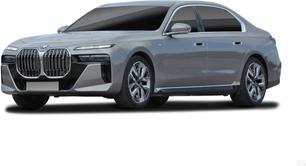
At 5.4m long and 2.2m wide the i7 xDrive60 M Sport is enormous and imposing - as a 7 Series BMW should be.
What's significantly different in the look of this latest incarnation of BMW flagship limousine is its show stopping face.
That LED-lined grille has Vegas pizazz and the pretty glittering Swarovski Crystal headlights are mesmerising. I doubt the words 'pizazz' and 'pretty' have ever been used to describe any previous generation BMW 7 Series.
Fear not, though, from every other angle the i7 looks business-like and serious… and solid as though carved from a single slab of marble.
Solid is also a good word for the i7's interior. Look at the seats in the images - they're hotel lobby sized and I'm still uncertain how they managed to fit them through the i7's doorway.
Our car had the Merino Tartufo brown leather upholstery which suited the 1970s-style futuristic design of the seats with their headrests wrapped in carbon fibre and the satin aluminium trim throughout the cabin. They look like seats from the bridge of a spaceship in a sci-fi series.
The enormous 31.3-inch screen in the rear is a show-stopper as are the tablets in the rear doors to control the screen functions along with the seat heating and adjustment.
Disappointing in comparison is the smaller media and instrument displays up front. And it's not just the lesser proportions but the styling of the screens that's a let down.
Surely this was a chance for BMW to integrate a large, flowing interactive screen over the dashboard and not something which looks propped up and an afterthought to the design of the cabin.
I also find the crystal-effect plastic that trims the dashboard and extends into the doors a little over-the-top, especially when it's backlit with LEDs.
The interior of the Sealion 5 feels pretty well-made and there are soft-touch surfaces on most of the touch-points. The steering wheel, too, is thick and chunky and nice to hang on to. But there’s a lot going on in terms of different colours, textures and surfaces, and it can all look a bit busy, despite the high-tech boardroom overall flavour. It’s also worth mentioning the trim material is synthetic but does a great job of looking and feeling like real leather.
Externally, there’s not a lot to grab the eye. Sure, it’s not an unpleasant looking vehicle, but neither does it stand out from the mid-size SUV pack. At least BYD decided against those cheap-looking plastic tack-ons on each wheel-arch.
Sure, the i7 isn't an SUV but a sedan like this needs to be roomy and comfortable, it also needs to be an ergonomic place to work for passengers in the back with laptops, and it needs to be well appointed with internet connectivity and charging outlets. A boot that can take at least two passenger's luggage is also vital.
The i7 has all of that covered with good legroom in the second row even for me at 189cm tall. I spent two hours back there writing my script for the video for this review while the i7 was charging.
As I typed away I had plenty of elbow room but I could have done with a tray table for the computer.
There's a wireless phone charger in the fold-down rear centre console, along with USB ports galore.
You'll find another wireless phone charger up front and more USB ports. The i7 also has its own internet hotspot.
The sumptuous seats in the rear are power adjustable and also heated, but lack a massaging function.
There's also rear dual-zone climate control and sun-blinds which cover the back and side windows.
Cabin storage is good with large covered areas in the front and rear centre consoles, plus there are two cupholders in the rear and another two up front, with large door pockets, as well.
The cargo capacity of the boot is a healthy 500 litres but it's quite shallow due to the electric vehicle batteries eating into the luggage space.
The automatic doors can be opened several ways from the inside.
First there's a button inside which is high on the rear door and another on the dashboard which will open them automatically while using sensors to ensure they don't hit anything.
There's another button much lower down which will pop the door open slightly for you to push it the rest of the way.
Finally there's an emergency handle which will override the electric opening.
You can open the doors from the outside automatically by pushing a button near the door handle or by using the exterior door handle normally.
Closing involves pressing the high placed button if you're inside or by tapping the exterior button on the outside door handle if you've exited the car.
We did have a door mishap twice during our week with the i7. The first was when bags placed on the front passenger seat bumped the release button and caused the door to pop open, followed quickly by me lunging across to pull it shut again. It's lucky my arms are long.
The second was when my eight-year old son bumped the door release button with his knee again popping open the door but this time at 110km/h on the motorway. He was able to close the door but it rattled both of us, understandably and I kept the child lock on for the rest of the week.
He's been in a different test vehicle every week of his life since he was born and this is the first time we've ever had a door open unintentionally like this. I've also never had a door open, just because a bag has leaned on it, either.
So, the auto door opening function might create a nice impression and make opening and closing the heavy doors easier, but I think manual doors would be more practical.
Here’s the other big shock relative to the price-tag of the Sealion 5: This is not a small car. Based on the price, you might have been thinking the vehicle would be a compact SUV. And you’d have been wrong. This is a proper mid-sized SUV with room for five and luggage and an overall length of 4.7 metres and change. And to put that into some kind of perspective, that’s just 30mm shorter than the Sealion 6 which costs about $9000 more at its starting point.
The wheelbase is long, too, and the 2712mm between the axles helps make the interior even more spacious. That means there’s lots of stretching room in the front, but also that a grown adult can comfortably sit in the back seat behind another grown adult at the wheel and still have enough room in every direction. The window sills are commendably low in the rear seat, too, ensuring even littlies can see out.
The biggest problem in the back is that the seat cushion is a bit flat, but, like the front chairs, it’s still pretty plush.
With all five seats in place, the Sealion 5 boasts 463 litres of luggage space and the cargo area is well done with storage pockets at each side, a light and an under-floor tray designed to transport charging cables and a tyre repair kit. Yep, that’s right, there’s no spare tyre of any sort here. No surprise, really.
Fold the rear seat down and you’re suddenly looking at 1410 litres of cargo space and your SUV is now a panel van.
As well as the dual-zone climate control, the Sealion 5 also offers a single USB -C and a USB-A charging port in the front and rear compartments.
The Sealion 5 also offers a V2L (Vehicle to Load) function, meaning it can power camping or on-site work equipment and even act as your home’s battery.
The BMW i7 xDrive60 M Sport sits in the middle of the 7 Series range with a list price of $306,900. That places it above the $273K 740i which is the only combustion engine variant in the line-up and below the $345K i7 M70 xDrive.
Whatever you do, don't dismiss the i7 xDrive60 M Sport as an overpriced electric version of the 740i because it has many more standard features that enhance the luxury and chauffeuring experience.
We're talking automatically opening doors, a 31.3-inch media display in the second row and control tablets for it in the rear doors.
There's a 35-speaker Bowers & Wilkins surround sound system (not the 740i's 18-speaker stereo), power adjustable and heated rear seats plus an 'Executive Lounge' console, and a BMW Individual Gran Lusso interior with a choice of Merino or Cashmere upholstery.
Our car had the Merino Tartufo brown leather upholstery and carbon-fibre M interior trim.
The i7 also rolls on larger 21-inch wheels which fill the giant wheel arches perfectly.
The rest of the standard features list is almost identical to the 740i's and includes the imposing LED-outlined grille, the Swarovski crystal headlights and the panoramic glass roof.
Inside, the double screens for media and driver instruments are also standard, there's sat nav, Apple CarPlay and Android Auto, a head-up display for the driver, front row seats are heated, massaging and power adjustable, there are also electric sun-blinds for the rear.
Our car wore the 'Oxide Grey Metallic' paint which made my videographer very happy because apparently it shows contours better than any other colour even on a bright, sunny day.
At the time we published this review BMW was also supplying as standard a charging wall box and a five-year Chargefox subscription.
The plug-in hybrid in question is the BYD Sealion 5. It has a claimed EV-only range of better than 100km, relatively quick charging, a decent sized battery, adequate performance, enough interior space for a family, good safety and lots of equipment. Oh, and it costs just $33,990, before on-road costs, in its entry-level Essential form. Incoming!
Equipment-wise, that sub-34K sticker gets you a 10.1-inch central info-screen, an 8.8-inch driver display, digital radio, a six-speaker stereo, wireless connectivity for Android Auto and Apple CarPlay and dual-zone climate control.
Throw another four grand on the table and you move up to the Premium version which adds plenty of kit for the $37,990 ask. That includes a panoramic sunroof, automatic tailgate, roof rails, heated and electrically folding mirrors, one-touch power windows, a six-way powered drivers seat and four-way powered co-pilot’s chair, a heated and ventilated driver’s seat and wireless charging.
The step up from Essential to Premium also includes a battery upgrade, and we’ll cover that off in the Under the Bonnet section below.
The i7 xDrive 60 M Sport has two electric motors - one at the front one at the rear - making this large saloon all-wheel drive.
The combined output is outrageous. We're talking 400kW and 750Nm. That's enough oomph to fire this electric missile from 0-100km/h in 4.7 seconds.
When EVs first came out a lot of people saw the technology as lending itself to small city cars, but with the smoothness of motion is offers, the silent operation and the colossal grunt it can supply nothing suits a big limo like the 7 Series better than electric motors.
Both variants of the Sealion 5 have the same driveline – mostly. They each use a 1.5-litre petrol engine teamed with a single electric motor, both driving the front wheels. Unlike the bigger Sealions, there’s no all-wheel drive version. Power peaks at 156kW and torque at 300Nm.
Why a non-turbocharged engine? BYD tells us the non-turbo engine helps keep cost out of the vehicle and, since the engine really only runs to power the electric motor and charge the batteries, it does so at a relatively constant engine speed, negating the need for a wide spread of petrol power.
The only major difference is that the Essential version has a 12.9kWh battery-pack, while the Premium gets a bigger, 18.3kWh pack for longer range, but precisely the same output and, therefore, performance.
A single-speed transmission is part of the BYD driveline package, also made possible by the fact that the vast majority of the driving of wheels is done by the electric motor.
There are removal trucks shorter and narrower than the i7 but this limousine is possibly the easiest and most comfortable car I've driven in almost 15 years of testing vehicles from Toyotas to Bentleys.
The steering is pinky-finger light but accurate, the ride (as driver and passenger in the second row) is superbly composed and the electric powertrain add a smoothness to movement that no combustion engine on the planet can come close to.
The xDrive60 M Sport comes standard with BMW's 'Executive Drive Pro' feature which includes the 'Active Roll Stabilisation' and 'Active Roll Comfort' systems used on Rolls Royces.
The systems use motors to level the body through dips and corners, and the result has to be felt to be fully appreciated.
It's oddly amazing - you could have a bowl of molten lava in your lap and not spill any of it.
And then there are the seats. As a driver the under thigh support offered by the big, thick, wide seat base is exactly right for long distances, while the back rest is supportive without being too firm.
If I was to name any downsides to the driving experience it would be the limited forward visibility due to the narrow windscreen and thick. short A-pillars.
I found myself always having to peer around those pillars at intersections and pedestrian crossings.
Rearward visibility is completely blocked when the second row's large screen is folded down and the rear vision mirror doesn't have a camera function to get around this issue.
Sure there's a reversing camera but being able to see what's coming up behind you in traffic is important to for safe situational awareness.
I'm also not a fan of the synthesised driving sounds. It's unnecessary, especially in something like a chauffeur-operated limousine.
I think it only serves to cheapen what is such a high-end experience. Thankfully you can turn it off.
The same goes for 'Boost Mode' which provides all available grunt once a paddle behind the steering wheel is pulled and counts down like a missile launch. Seriously? Come on - this isn't a 2 Series!
You don’t have to drive very far to realise that the local input into the Sealion 5’s suspension and steering have been worth the effort. BYD Australia has a local engineering team on call these days, and it shows here.
Actually, the steering is not the highlight; it has some weight but not a whole lot of feel, or, indeed, feedback for the driver. The ride and handling combination is what stars. Obviously well-damped, the suspension allows for a ride that is both complaint and quiet, without causing the car to wallow around like some jacked-up designs can with their higher centre of gravity.
In fact, the BYD is athletic to the point where keener drivers will find it an entertaining drive; hardly something that can be said for the majority of medium SUVs.
Performance is strong without being overwhelming and even though the Sealion 5 has that signature electric-drive feeling of effortlessness, the accelerator pedal has been calibrated to avoid the neck-snapping surge of grunt off the line. As such, it emerges with a fairly flat acceleration curve, and no hint that the petrol motor is cutting in or out.
Until, that is, you bury the throttle all the way at which point the petrol engine takes a few second to join in. And when it does, it’s pretty vocal – shrill, almost – as it catches up with the rest of the car and starts directly driving the wheels. To be fair, though, this is not going to be a common occurrence in everyday life thanks to the flexibility of the petrol-electric system for 99 per cent of circumstances.
On the move, the cabin is perhaps most notable for its soft, plush seats that are a nice change from the church pews of some manufacturers. And although the driving position is about right, taller drivers might prefer a steering column that extends out another few millimetres.
The driver display screen is another source of annoyance. It’s pretty small and contains lots and lots of information, to the point where the typeface is too small to be read on the run by anybody who relies on reading glasses.
The BMW i7 has not been assessed by ANCAP and like many ultra high-end cars it probably won't be. But we would expect it to perform well given this is the flagship of the brand and fitted with every safety feature in BMW's arsenal.
There's AEB which works from car park pace to motorway speeds, there's lane keeping assistance and blind spot warning, rear cross-traffic alert and manoeuvre braking which will stop you from bumping into objects while revving and there are more than 35 different sensors.
One radar constantly gazes 300m ahead into the distance, although it would probably be bored in Australia with our lack of autobahns.
The i7 also has BMW's 'Evasion Assistant' technology which scans traffic in all directions and will activate an evasive manoeuvre into an empty safe lane if it detects you swerving to avoid a collision.
There are seven airbags onboard, including one between the front seats, full length curtains for the front seats and head protecting curtains for the rear occupants.
The xDrive60 M Sport also emits an acoustic warning to alert pedestrians that you're nearby.
Passive safety in the Sealion 5 starts with no fewer than seven airbags including full-length side-curtain bags.
There’s also a front-centre airbag, something we’d like to see in more cars, particularly at this price-point. Child restraint points in the rear seat are the ISOFIX type.
The BYD gets pretty much the full suite of driver aids, including autonomous emergency braking, blind-spot monitoring, rear-cross traffic alert with active assistance, stability control, active cruise-control, traffic-sign recognition, front and rear collision warning and tyre pressure monitoring.
The Sealion 5 also incorporates a driver-attention monitor which seems better calibrated than some earlier efforts from some of the Chinese carmakers. Also improved in calibration terms is the lane-keeping assistance which is still too violent for our tastes, but more subtle than some of the competition’s systems. But while the savagery of this system has been toned down, it appears to have been at the expense of sensitivity and, time and time again, the cameras missed road markings that were faded or dirty.
The major safety benefit in paying more for the Premium variant is the addition of front parking sensors and a 360-degree camera instead of the Essential’s simple reversing camera.
The Sealion 5 has not been ANCAP tested as yet, although BYD says this is largely down to ANCAP’s scheduling rather than any hesitance on BYD’s part.
The i7 xDrive60 M Sport is covered by BMW's five-year, unlimited kilometre warranty. The battery is covered for eight years or 160,000km.
There's no regular servicing schedule but the car will identify any faults and maintenance issues and notify you. A six-year unlimited service plan is offered by BMW and is included in the purchase price of the i7.
The i7 also comes with a five-year subscription to the charge for charging network, and a home wall box charger.
Like other BYDs, the Sealion 5 comes with a six-year/150,000km warranty. Some of the competition have unlimited kilometre warranties, but to be honest, 150,000km in six years is going to be beyond the need and aspirations of most owners.
The EV battery is covered by an eight-year/160,000km warranty, and let’s not forget, BYD was a battery manufacturer before it started making whole cars. Certainly, the company is very bullish about the quality and safety of its 'Blade' battery technology, claiming it easily passes the technically-daunting 'nail-puncture' test.
BYD plans to have capped-price servicing for the Sealion 5, but no pricing announcements have been made yet.
Servicing also falls into line with other BYD models, so that means 12 months or 20,000km intervals.