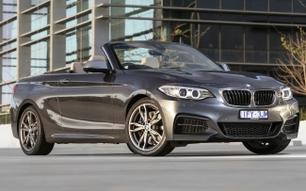
What's the difference?
If one is good, two must be better, right? Or twice as good. The question is whether that simple equation adds up for BMW's upgraded 1 and 2 Series siblings – the former, a range of five-door hatches, the latter, a line-up of cabriolets and coupes, with a major addition in the shape of the full-house, performance-focused M2.
Prices are up, and changes are mostly under the skin, so you're not getting big visual bang for your extra bucks. But the new and improved 2 has plenty to offer when it comes to added spec and tech.
BMW invited us to the new car's Australian launch program along Tasmania's wet and wild west coast.
Nobody really needs to drink beer and absolutely nobody needs to go skydiving. You don’t need tattoos nor to eat ice cream, nor put art on their walls, and absolutely nobody needs to play Stairway to Heaven, badly, on guitar. Likewise, nobody needs to buy a Chevrolet Camaro.
And there’s your answer if anybody has a go at you for arriving home in this big American muscle car, because if we only did things we needed to do, I’m pretty sure we wouldn’t be having as much fun.
The Chevrolet Camaro has been the Ford Mustang’s recurring nightmare since 1966, and this latest, sixth generation of the Chevy icon is available to continue the fight here in Australia, thanks to some re-engineering from HSV.
The SS badge is also legendary and was emblazoned on our test car, although it’s really a 2SS, and we’ll get to what that means below.
As you’re about to see, there are many good reasons to buy the Camaro SS and a few that might make you reconsider, but think about this – within the next two decades it’s entirely possible a car like the Camaro, with its 6.2-litre V8, may be banned because of emission regulations. Outlawed. You also never know how much longer HSV will continue to sell it in Australia. Maybe that’s reason enough to get one? Before it's too late.
The BMW 2 Series coupes and convertibles combine understated good looks with great dynamics and top-shelf quality. Extra equipment, especially the iDrive6 multimedia system, has brought it up to speed in terms of tech and value, while the M240i sets the compact performance benchmark. And if you really want to push the envelope, the M2 is right there at the top of the under $100k performance pyramid.
The Camaro 2SS is a real-life Hot Wheels car. This beast looks amazing, sounds incredible and is not overpowered, making it usable as a daily driver.
Now about that score. The Camaro 2SS lost big marks for not having AEB, lost more marks for the short warranty and no capped-price servicing and also some for its price, because compared to the Mustang it’s expensive. It’s also impractical (space and storage could be better) and uncomfortable to drive at times, but this is a muscle car, and a great one at that. It's not for everybody, but truly perfect for some.
The biggest visual clue to the revised 2 Series is the circular design bi-LED headlights, now standard on the 2 Series entry 220i, and mid-range 230i models, while hexagonal adaptive LEDs are standard on the top-shelf M240i.
But BMW couldn't leave those little light-emitting diodes alone, with LED front fog lights joining one-piece L-shaped LED tail-lights across the range.
Luxury Line-equipped cars feature a subtly revised nose treatment with larger intakes and a reshaped 'kidney' grille. There are also four new alloy wheel designs – a 17-inch alloy fitted standard to the 220i Luxury Line, and three optional M alloys for M Sport models (all no-cost options on the M240i).
The 230i M Sport features black, high-gloss bars in its kidney grille, as well as a black chrome finish for the exhaust finishers.
On the inside, there's the addition of a 'Black Panel' digital instrument cluster, which remains matt with the ignition off, and lights up with sharp graphics, configurable across conventional speed and rev readouts, as well as gear position, engine-efficiency data, vehicle settings and nav guidance.
There are also high-gloss finishes across the centre stack and front console, and even greater attention to detail around panel joins, trim stitching and switchgear.
But the hero is the latest iDrive6 multimedia system, run through an 8.8-inch colour touchscreen (6.5-inch on 220i), providing access to live content, radio and audio, navigation and maps, phone functionality, and vehicle settings through a simple and customisable app-style interface. The iPhone really as inspired car companies.
The M2 boasts M-specific instrument display content and a go-fast red needle on the tachometer.
As was the case with Ford’s Mustang, something seemed to go bizarrely weird in the styling of the Camaro in the early 2000s, but by 2005 the arrival of the fifth generation saw a design that re-imagined the original (and I reckon the best) 1967 Camaro. Now this sixth-generation car is a sharper resolution of that, yet not without causing a bit of controversy.
Along with styling changes, such as redesigned LED headlights and taillights, the front fascia was also given a tweak, which involved repositioning the Chevy ‘bow-tie’ badge from the upper grille to the black-painted cross bar that separates the top and bottom sections. The reaction from fans was enough for Chevrolet to quickly redesign the front and move the badge back.
Our test car was the version with the ‘unpopular’ face, but I reckon it gets away with the look, thanks to the body colour being black, which means your eye isn’t drawn to that cross bar.
Here’s some pub ammo for you – Chevy calls the ‘bow tie’ on this Camaro a ‘Flow Tie’ because its hollow construction means air can pass through it to the radiator.
Big on the outside but small inside, the Camaro’s dimensions show it to be 4784mm long, 1897mm wide (not including mirrors) and 1349mm tall.
Ford’s Mustang is elegant, but Chevy’s Camaro is more macho. Big haunches, long bonnet, flared guards, nostrils. This is one mean-looking monster. Those high sides and ‘chopped’ roof design may also make you assume the cabin is more cockpit than lounge room.
That assumption would be right and in the practicality section further down I’ll tell you just how cozy the interior is, but for now we're just talking about looks.
I’m not sure what David Hasselhoff’s apartment looks like, but at a guess I reckon it would have a hell of a lot in common with the interior design of the Camaro 2SS’s cabin.
Soft, black leather seats with SS badging, giant metal air vents, door handles that look like chrome exhaust tips and a display screen that is oddly tilted towards the floor.
There’s also an ambient LED lighting system that lets you choose from 1980s-neon colour palettes, the likes of which we haven’t seen since Ken Done’s outstanding depiction of a Koala family sitting down to a barbecue lunch.
I’m not knocking it, I love it, and even though the guys in the office thought it would be hilarious to set the lighting to hot pink, I kept it that way because it looks awesome.
Surprisingly, at a little over 4.4 metres long, the 2 Series (Coupe) is around 10cm longer than its 1 Series hatch stablemate (M240i +15cm), but aligns with its just under 1.8m width, and 1.4m height.
It seats four, with plenty of room up front and multiple storage options, including two cupholders in the console with an oddments tray behind, a 12-volt outlet, a lidded storage box between the seats with USB connection, a reasonably sized glove box, and segmented bins in the doors big enough for large water bottles.
While it was coupes only on the launch drive, we know the convertible has a pair of cupholders in the back, but not so in the coupe, and while headroom in the soft-top is okay (especially with the roof down) it's a squeeze in the hardtop.
More a 2+2 than a full four-seater, getting into the rear is an athletic exercise, and once installed, leg and headroom for this 183cm tester is tight. That said, kids up to teenager-size would be fine.
Boot volume is 390 litres (a 3 Series Coupe is 480 litres), with run-flat tyres on the 220i and 230i meaning there's no spare (or repair kit) under the floor, but the performance-focused M240i and M2, pack a 'BMW Mobility Kit' (compressor and tyre sealant to cover minor damage) in line with their high-performance (non-run-flat rubber).
A 60/40 split-folding rear backrest liberates extra load space, and a 'Through Loading System' with luggage compartment dividing net, and 40/20/40 split-folding rear seat is optionally available (220i & M2 Pure - $350 / 230i - $385 / M240i & M2 - $500).
And if you're keen on towing the 220i can pull 680kg of unbraked trailer, and 1500kg braked, with the minimum number stepping up to 715kg for the 230i. The M240i and M2 are no-tow zones.
The Camaro 2SS’s cabin is cozy for me at 191cm tall, but even with a similarly proportioned photographer riding shotgun it wasn’t too cramped. Believe it or not, we were able to carry all his equipment and lights, plus batteries for our night shoot (have you seen the video above – it’s very good). I’ll get to the boot size in a moment.
The Camaro 2SS is a four-seater, but those rear seats are only going to suit small children. I was able to fit my four year old’s car seat into place with a bit of gentle persuasion, and while he could sit behind my wife, there was zero space behind me when I was driving. As for visibility, we’ll get to that in the driving section below, but I can tell you he couldn’t see much from his tiny porthole.
Cargo capacity of the boot is small, as you’d expect, at 257 litres, but the space is deep and long. The problem is not the volume, however, it’s the size of the opening, which means you’ll have to cleverly angle larger items to get them in, like pushing a couch through your front door. You know, houses are big, but their openings aren’t. I know, profound.
Cabin storage is also limited, the door pockets were so thin my wallet couldn’t even slide into it (no, it’s not the wads of cash), but there was just enough room in the centre console storage bin for it. There are two cupholders, which are more like elbow holders, (because this part wasn’t swapped over in the conversion and that’s where your arm lands while driving) and a glove box. Rear-seat passengers have a large tray to fight over in the back.
The 2SS doesn’t have a wireless-charging pad like the ZL1, but it does have one USB port and a 12V outlet.
The 2 Series coupe and convertible line-up ranges across four-cylinder, turbo-petrol models, in 220i Luxury Line, and 230i M Sport grades, with the six-cylinder M240i sitting at the top of the main line-up. Then for the more single-minded enthusiast, there's the hardcore M2; after a year on-sale it's now BMW Australia's best-selling M car (and it's easy to see why; it's fantastic).
Depending on the model, prices have risen by between $1100 and $1900 across the main range, largely because of the extra equipment, especially the tricky iDrive6 multimedia system.
At $52,990 for the coupe and $59,900 for the convertible version, the 220i Luxury Line is the entry-point to the 2 Series range. Equipment highlights include 17-inch light-alloy wheels, the previously mentioned LED headlights and fog lights, 'Driving Assistant' functionality (combines camera-based 'Lane Departure Warning and Approach' and 'Pedestrian Warning with the City Brake Activation'), digital radio, 'Navigation System Business' with 'iDrive6' accessed via a 6.5-inch display, dual-zone climate control air, reversing camera, a leather sports steering wheel, sports front seats, 'Dakota' leather upholstery, plus front and rear parking sensors.
Next rung on the 2 Series ladder is the 230i M Sport in Coupe ($63,000) and Convertible ($73,000) form, which adds M Sport suspension, aero, and brakes, 'Variable Sport Steering', 18-inch alloy rims, high-gloss 'Shadow line' exterior trim, a BMW Individual anthracite roofliner, a leather-wrapped M Sport steering wheel, cloth/Alcantara upholstery in the coupe, 'Dakota' leather and front seat heating in the convertible, electric (front) seat adjustment, plus 'Navigation System Professional' with iDrive6 and a customisable 8.8-inch touchscreen.
As its name implies, the M2 Pure ($93,300) makes spec sacrifices in the name of light weight.
Opt for the M240i as a Coupe ($76,800) or Convertible ($85,800), and you're getting more than extra performance from the 3.0-litre turbo six. On top of the lengthy equipment list detailed above, you'll also pick up 18-inch alloys in 'Bicolour Jet Black', 12-speaker, 360W harman/kardon surround sound audio, 'Adaptive M Suspension', 'Adaptive LED Headlights', the Dakota leather trim, and front-seat heating.
As its name implies, the M2 Pure ($93,300) makes spec sacrifices in the name of light weight, including manual seat adjustment and a base (yet, still seven-speaker) audio package, but one of the biggest pay-offs is a standard six-speed manual gearbox. Save the manuals!
It also features 19-inch BMW M light alloy wheels, an M rear spoiler, quad exhaust pipes in high-gloss chrome, bi-LED headlights (with variable light distribution, including cornering lights), 'Dakota' leather upholstery, carbon fibre trim finishers, an M leather multi-function steering wheel, cruise control (with braking function), 'Driving Assistant', 'Rear Park Distance Control', and a reversing camera.
The full-fat M2 Coupe ($99,900) reinstates electric seat adjustment, plugs in the 12-speaker, 360W harman/kardon sound system, and adds 'Comfort access' (keyless entry and start), 'Adaptive LED Headlights' (with variable light distribution), and 'Selective Beam with anti-glare High-Beam Assistant'.
A vast array of individual options and packages covers everything from steering-wheel heating to a smoker's kit (naughty), and (amazingly, given it's standard on the Hyundai Accent) Apple CarPlay (220i & M2 Pure - $436 / 230i - $479 / M240i & M2 - $623).
You know how people talk about cars not always being a rational purchase? This is the type of vehicle they’re talking about. The Camaro 2SS lists at $86,990 and the total tested price of our car was $89,190, because it was fitted with the optional 10-speed auto for $2200.
In comparison, the V8 Ford Mustang GT with the 10-speed auto is about $66K. Why the big price difference? Well, unlike the Mustang, which is built as a right-hand-drive car in the factory for places such as Australia and the UK, the Camaro is only built as a left-hand drive. HSV puts about 100 hours into converting the Camaro from left to right-hand drive. That’s a big job and involves gutting the interior, taking out the engine, swapping the steering rack and putting it all back together again.
If you still think $89K is a lot to spend on a Camaro, then think again because the top-of-the-range hardcore race-car-for-the-road ZL1 Camaro lists for about $160K.
Those are only the two grades of Camaro in Australia – the ZL1 and 2SS. The 2SS is a higher-specified version of the 1SS sold in the US.
Standard features in the 2SS include an eight-inch screen, which uses Chevrolet’s Infotainment 3 system, a nine-speaker Bose stereo, Apple CarPlay and Android Auto, head-up display, rear-view camera and rear camera mirror, dual-zone climate control, leather seats (heated and ventilated, plus power adjustable in the front), remote start, proximity key and 20-inch alloys.
That’s a decent amount of kit and I’m particularly impressed by the head-up display, which you don’t get in the Mustang, and also with the rear-vision-mirror camera, which turns the entire mirror into an image of what’s behind the car.
The 220i is powered by a 2.0-litre 'TwinScroll' turbo-petrol four, featuring 'Valvetronic' variable valve control and 'Double-VANOS' variable camshaft control, and developing 135kW at 5000rpm, and 270Nm between 1350-4600rpm.
Using a retuned version of the same engine (lower compression ratio, more turbo boost), the 230i pumps out a solid 185kW at 5200rpm, and a grunty 350Nm from just 1450-4800rpm.
The same (8HP50) eight-speed auto transmission is used across the board, pushing drive to the rear wheels only.
Then, the M240i is powered by a 3.0-litre, six-cylinder, turbo-petrol, pushing out no less than 250kW at 5500rpm, and a thumping 500Nm between 1520-4500rpm.
The same (8HP50) eight-speed auto transmission is used across the board, pushing drive to the rear wheels only, and happily, a six-speed manual gearbox is a no-cost option on the M240i.
The full-house M2's 3.0-litre turbo six produces 272kW at 6500rpm, and 465Nm from just 1400-5650rpm (500Nm from 1450-4750rpm on overboost), driving the rear wheels through a seven-speed dual-clutch auto, although a six speed-manual is a no-cost option (and standard on the M2 Pure).
Sure, the 2SS doesn’t produce the mammoth 477kW of the ZL1, but I’m not complaining about the 339kW and 617Nm it does make from its 6.2-litre V8. Besides, 455 horsepower from the 2SS’s naturally aspirated LT1 small block is plenty of fun and the sound on start-up through the bi-modal exhaust is apocalyptic - and that’s good.
Our car was fitted with the optional 10-speed auto ($2200), with paddle shifters. The automatic transmission was developed as a joint venture between General Motors and Ford and a version of this 10-speed is also found in the Mustang.
This traditional torque-converter automatic isn’t the quickest shifting thing, but it suits the big, powerful and slightly lethargic personality of the Camaro 2SS.
Claimed fuel consumption for the 220i Coupe, on the combined (ADR 81/02 - urban, extra-urban) cycle, is 5.9L/100km, emitting 135g/km of C02 in the process. The 220i Convertible rates 6.1L/100km (140g/km).
The 230i Coupe is line-ball with that at 5.9L/100km (134g/km), and the the 230i Convertible at 6.2L/100km (142g/km).
The price of performance starts to bite with the M240i consuming 7.1L/100km (163g/km) in coupe form, and 7.4L/100km (169g/km) as a convertible.
Then, as you might expect, the M2 is thirstiest of all, the dual-clutch auto consuming 7.9L/100km (185g/km), while the six-speed manual version slurps 8.5L/100km (199g/km).
Auto start-stop is standard, fuel tank capacity is 52 litres across the board, and although technically these engines can run on anything from 91-98RON unleaded, BMW recommends 95RON premium as a minimum.
Okay, brace yourself. During my fuel test I traveled 358.5km and used 60.44L of premium unleaded, which comes out to be 16.9L/100km. That sounds awfully high, but actually it's not as bad as it looks, considering the Camaro 2SS has a 6.2-litre V8 and I wasn't driving it in a way that would conserve fuel, if you get my drift. Half of those kilometres were on motorways at 110km/h, the other half would have been in bumper-to-bumper city traffic, which would have driven up the fuel usage, too.
The official fuel consumption after a combination of open and urban roads is 13L/100km.
Four 2 Series variants were offered for the launch drive program, a 230i Coupe (which BMW nominates as the most popular model in the range), M240i Coupe, M2, and M2 Pure.
Claimed 0-100km/h acceleration of 5.6sec for the 230i M Sport Coupe is quick, with the convertible stopping the clocks three tenths later.
Peak torque of 350Nm is plenty, and with that number available from 1450-4800rpm the mid-spec 2 Series is an entertaining drive.
It's M Sport (strut front, five-link rear) suspension keeps the body well buttoned down in quick going, while the beefier M brakes provide strong and progressive stopping power.
Even a firm squeeze of the throttle can't side-step some hesitation as the turbo spools up before right foot pressure translates into forward momentum, but despite the sporty tune, ride quality is good (even riding on notoriously harsh 18-inch run-flat rubber), while response and road feel from the variable-ratio steering are excellent.
The eight-speed auto is beautifully slick, with manual changes, via wheel-mounted paddles, sharp and positive.
Add the grippy leather sports wheel, snug sports front seats, and racy cloth/Alcantara trim (leather in the convertible), and you have a comfortable, nicely balanced and fun-to-drive package.
Accelerating from 0-100km/h in 4.6sec (convertible 4.7sec), the M240i effortlessly achieves 'genuinely rapid' status. Yes, it's fast, but never furious, in the sense that even under the pressure of enthusiastic peddling it remains civilised and composed.
Maximum torque of 500Nm is not to be sneezed at, and when you realise that mountainous maximum is actually a flat-top plateau stretching from only 1520rpm up to 4500rpm, satisfying urge is never far away. And the flexible 3.0-litre turbo-six is an aural treat as it howls its way towards a 7000rpm rev ceiling.
The standard 'Adaptive M Suspension' offers settings from 'Comfort' through to 'Sport+', but even in the most forgiving mode the car remains taut and communicative.
The 18-inch rims, shod with Michelin Pilot Super Sport rubber (225/40 front / 245/35 rear) don't upset the ride as much as you'd expect, although coarse-chip surfaces send rumble through to the cabin.
In terms of ergonomics and general function, the new iDrive6 system is simple and intuitive to use, the current BMW dash and console layout is a model of efficiency, but the two-stage (depress small button on stubby lever, then shift) process to select drive or reverse can be a frustratingly hit-and-miss affair if you need to get going quickly.
Then, the M2 is all business, with a properly focused feel, and the ability to accelerate from 0-100km/h in a claimed 4.5sec for the six-speed manual, and just 4.3sec for the seven-speed dual-clutch. Try not to smile as that g-force shoves you back in your seat. You won't succeed.
Although peak power arrives at a relatively high 6500rpm, maximum torque of 465Nm (500Nm for limited periods on overboost) is ready for action across a broad spread from 1400-5650rpm, so the M2 has adrenalin flowing through its veins at all times.
An electronically controlled 'Active M Differential' manages torque distribution across the rear axle to optimise power down, with the ability to send anywhere from zero to 100 percent of drive to either back wheel.
The 'M Servotronic' steering, switchable through comfort and sport modes, is feelsome and linear in its response, the mega 'M Compound Brake' package (borrowed from big-brother M4) is professional grade, and while the seven-speed dual-clutch may shift faster, snicking up and down the manual's six ratios is a rare pleasure.
Rolling on 19-inch, ultra-high-performance Michelin semi-slick rubber (255/35 front / 275/35 rear) the M2 is never going to waft like a limousine, but if you're signing on for this kind of performance and dynamic ability, some ride harshness over less than perfect surfaces goes with the territory.
Exactly how an American muscle car should be – loud, a bit uncomfortable, not all that easy, but a hell of a lot of fun. Those first three attributes may sound like negatives, but take it from somebody who owns and loves hot rods - it’s part of the appeal. If an SUV is not easy to drive or comfortable there's a problem, but in a muscle car it can enhance the engagement and connection factors.
That said, there will be many who think the ride is too firm, the steering heavy and that it feels like you’re staring out a letterbox slot through the windscreen. It’s all true, and there are other performance cars out there which make as much horsepower, handle better and are so easy to drive they can almost (and some do) pilot themselves, but they all lack the feeling of connection the Camaro offers.
Wide and low-profile Goodyear Eagles (245/40 ZR20 at the front and 275/35 ZR20 at the rear) provide good grip, but also feel every blemish in the road, while four-piston Brembo brakes all round pull the Camaro 2SS up well.
Acceleration from 0-100km/h isn’t disclosed by HSV or Chevrolet, but the official line is that it’ll nail it in under five seconds. Ford reckons its Mustang GT can do the same in 4.3 seconds.
If you were wondering if you could live with the Camaro daily, the answer is yes but, much like wearing leather pants, you’ll have to suffer a bit to look this rock and roll. I put 650km on the clock of our 2SS during my week with it, using it daily in peak-hour traffic into the city, in supermarket car parks, and for daycare drop offs, with country road and motorway drives on the weekend.
The seats can get uncomfortable over long distances and those low-profile ‘run-flat’ tyres and firm dampers don’t make life any comfier. You’ll also find that wherever you go people will want to race you. But don’t get sucked in; you’re slower than you look - another muscle-car trait.
Sure, it’s not the quickest performance car I’ve steered and on winding roads its handling capability is not up there with many sports cars, but that V8 is responsive and angry in Sport mode and smooth in its delivery of grunt. The exhaust note is sensational and the steering, while heavy, offers great feel and feedback. The sound isn’t electronically enhanced but it uses bi-modal valves, which open and close at different engine and exhaust loads to produce its addictive bark.
Across the mainstream 2 Series line-up (220i to M240i) driver-assistance tech including AEB, forward-collision warning, pedestrian-detection and lane-departure warning is standard.
There are also 'Approach Control Warning', 'Attentiveness Assistant', and 'Pedestrian warning' systems, plus 'Dynamic braking lights, DSC, ABS, 'Braking Assistant', 'Cornering Brake Control' (CBC), 'Dynamic Traction Control' (DTC), cruise control with braking function, a reversing camera, 'Park Distance Control' (PDC) rear (front and rear on 120i and up), and run-flat safety tyres (including a run-flat indicator) for the 220i and 230i. Tyre pressure monitoring is standard on the M240i and M2.
There are two child restraint top tethers across the back seat, with ISOFIX anchor points in each position.
On the passive safety side, all 2 Series models feature airbags for the front, side and head, as well as 'Intelligent Emergency Call' assistance.
The current BMW 2 Series Coupe/Convertible hasn't been tested by ANCAP or EuroNCAP.
The Chevrolet Camaro 2SS doesn’t have an ANCAP rating, but it’s certain that it wouldn’t achieve the maximum five stars because it doesn’t have AEB. There is forward-collision alert which warns you of an impending impact, there’s also blind-spot warning, rear cross traffic alert and eight airbags.
For child seats (and I did put my own four-year-old in the back) there are two top-tether points and two ISOFIX mounts in the second row.
There's no spare wheel here, so you’ll have to hope you’re within 80km of home or a repair shop, because that’s how far the Goodyear ‘run-flat’ tyres will get you.
The low (ish) score is for the lack of AEB. If the Mustang can be fitted with autonomous emergency braking, then the Camaro should be, too.
BMW uses 'condition-based' servicing, with the car effectively telling you when it's time to visit the workshop, but the 'BMW Service Inclusive' program offers distance and time options to fix maintenance costs (on a 'Basic' or 'Plus' plan) for up to 10 years/200,00km.
For example, a five year/80,000km service package for the 2 Series costs $1340 for the Basic option (oil service/top-up, annual vehicle check, microfilter, air filter, fuel filter, brake fluid, spark plugs), and $3550 for the Plus pack (adds brake pads and discs, wipers rubbers, and clutch disc and plate).
The standard BMW warranty covers three years/unlimited km.
The Camaro 2SS is covered by HSV’s three-year/100,000km warranty. Servicing is recommended at nine-month/12,000km intervals, with a complimentary inspection at the end of the first month. There is no capped-price-servicing program.