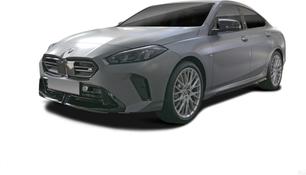
What's the difference?
Sometimes a name change can make all the difference.
Google used to be called “Back Rub”. The Spice Girls started off as “Touch”. And – particularly in Germany – some premium sedans became known as “coupes”, as they struggled to stay popular against SUVs.
Case in point: what is essentially a 1 Series hatchback with a boot has been more glamorously badged the “2 Series Gran Coupe” since 2020.
Still following the sedan script with four doors, it’s BMW’s tilt at Mercedes’ booted A-Class hatch, the rakish CLA, unveiled early last decade as the Concept Style Coupe and now in its third series-production iteration – though since 2019 a more conservatively styled A-Class Sedan has also existed, that goes up against Audi’s A3 Sedan.
But we digress. Now there’s a “new” 2 Gran Coupe, coded F74, though it’s really a heavy facelift of the superseded F44. Oh, and the ‘i’ no longer exists in the badge, so (M-enhanced models aside) it’s just numbers from here on in. 218. 220. M235.
Regardless of names, does it live up to the BMW promise?
For off-road adventurers, having the flexibility to be able to tow your camper-trailer off the beaten track, out bush and along a beach, opens up a whole new realm of fun and possibility – and that's why Jayco's Outback versions of the company's mainstream camper range have a growing legion of fans.
But the question for camper buyers is: should they upsize? Bigger is often better, but does that hold true in the camper-trailer world? Is a big camper actually worth the extra cash? And is it more difficult to tow?
We take the Jayco Swan Outback (from $30,490), the biggest camper in the Outback range, on a trip into the bush to answer these questions and plenty more.
The badge might say one thing, but the 2 Series Gran Coupe sticks to the time-honoured template of being a compact yet comparatively practical three-box, four-door sedan, complete with a big boot.
More importantly, it drives and behaves like a BMW – which means sufficient-to-strident performance depending on grade, athletic dynamics and pleasing refinement on one hand, as well as a stiff price and a hard ride on the other.
A true BMW in name and nature, then..
Note: CarsGuide attended this event as a guest of the manufacturer, with travel, accommodation and meals provided.
The Jayco Swan Outback is a nice solid camper, packed with features and suited for most trips away.
Sure, it's not the roomiest or flashiest camper around and – you've been warned – it is definitely not up to hard-core 4WDing, but it does come from a company responsible for sharply priced units with plenty of flexibility regarding optional add-ons so that counts for a lot.
During the media presentation at its launch, BMW described the 2 Series Gran Coupe as being almost as large as a 1990s E46 3 Series, and it is in all major dimensions except wheelbase.
Plus, being a front-drive-biased/transverse engine proposition instead of rear-wheel drive should make it roomier than the F74’s iconic ancestor.
The sense getting in is that this is certainly not too low or cramped as per a more-traditional coupe, with plenty of space for legs and shoulders, while even the optional sunroof fitted to our 218 left us with headroom to spare.
The redesigned dash is a visual and operational treat, with crisp, clear instruments, a logically presented and intuitive centre display screen offering fast and easy operation, excellent ventilation and ample storage. Full marks here.
Better still, attaining the perfect driving position is possible for most people, on brilliantly supportive front seats. This is the stuff BMW does right.
Improvement suggestions for the next update? Some people may complain about the somewhat less-than-premium feel of some of the lower-lying plastic trim; not everybody will love the swatches of colour stitching (we love it); why does the steering wheel have to be so wide-of-rim? Side and rear vision is restricted by fat pillars, rising shoulder lines and a shallow rear window; and there is quite a bit of road noise that enters the cabin at speed.
Still, even the back seat is sufficiently spacious for most users, with the sole exception of taller folk having to negotiate a sloping rear roofline. If you’re below 180cm, this should be fine. Most amenities minus overhead grab handles are also fitted.
Further back, the boot is surprisingly accommodating, with 430 litres of cargo capacity that’s enhanced by a 40:20:40 split-fold backrest, and the aperture should be big enough for bulkier loads, but the lack of a spare wheel will be bad news for many buyers. The supplied tyre-repair kit is just not good enough.
But, you know what is good enough? The engines BMW builds, that’s what.
Correct me if you reckon I'm wrong, but no camper-trailer from any company will ever be in the running for a 'Gorgeous Temporary Home' award. But that's part of this camper's appeal; it's highly practical and functional, not pretty and useless.
The forward bed is to the left as you step inside; the rear bed is to the right. Its kitchen is in front and to the right of the door as you enter the camper.
Interior height is a standard 2070mm and inside is spacious, but tempers will likely fray if all four adults and two kids are standing or sitting around inside at the same time. Hope for no rain.
The interior includes a four-burner stove, Dometic 95-litre fridge (Touring models get the 90-litre fridge), stainless-steel sink, dinette seat, table, club lounge, and the two beds plus the dinette-convertible bed.
If you can't find some places in which to stow away your gear in this Outback, then you're not looking hard enough.
The 'Ezi glide' pull-out drawers include room enough for your large pots, cutlery, kitchen gear and numerous other bits and pieces.
Interior lighting includes overhead LEDs for the dining/entertainment area and reading lights for the beds. There’s a fan for the beds.
Earlier, we mentioned that the 2 Series Gran Coupe is way more expensive than fine alternative sedans like the Mazda3 and Toyota Corolla.
And while that still stands, there is a remarkable solidity and refinement difference between those and the BMW that helps justify the premium. And nowhere is this more evident than from behind the wheel.
Sat on body-hugging seats and clutching that (too chunky) steering wheel, there is a sense of sporty occasion, backed up by quality trim and an aroma of expensiveness.
For a turbo three-cylinder car weighing 1.5 tonnes, the 218 does a lot with a little, offering spirited off-the-line acceleration and pleasingly lag-free throttle responses at lower speeds. You’d never call it fast, but it is a quick point-to-point urban mover. Only the unavoidable three-pot thrum lets you know you’re in the lowest mechanical spec. And, also, the delay at freeway speeds in building momentum when overtaking.
Which is why, for less than five per cent extra, the 220 with the 2.0-litre four-cylinder turbo would probably make a better buy. Sadly, that isn’t on sale yet in Australia, so we missed out on driving it during the Sydney launch. But in the scores of other BMWs and Minis we’ve tested this in, it’s a cracking little powertrain.
Whether the big leap (nearly $25K worth) to the M235 is worth it depends on how fast you drive and how much you value/need AWD. This is a terrifically muscular machine, since it provides rapid performance via a tidal wave of power, even with the lightest flex of your right foot. On-point and on-brand, this fun and fiery flagship possesses the grand-touring spirit that the rakish design and tech-heavy engineering promise.
To that end, in both the 218 and M235, the steering makes the driver feel connected to the car, resulting in precise and controlled handling. The driver-assist safety tech is beautifully calibrated and nuanced in its intervention, and the brakes are second-to-none.
What is also on-topic for a BMW is the firm suspension, despite the adaptive dampers fitted as standard equipment.
It isn’t stiff or overly uncomfortable, but bumps are certainly always felt, and they’re accompanied by fairly constant road-noise drone over some surfaces.
As such, you’re constantly reminded that dynamic athleticism is the priority here, rather than sumptuous comfort. We’ve experienced much worse from BMW, but a magic-carpet ride isn’t what’s in store for the 2 Series Gran Coupe owner.
So, what’s our verdict then? The 218 is a rorty little tryer that never fails to involve the driver, while the M235 ushers in an elevated level of acceleration, grunt and grip. We suspect that the 220 will be the Goldilocks-zone happy medium.
For (largely) better as well as for (occasionally) worse, these drive and feel like a BMW should.
Jayco campers are easy to tow and the Swan Outback is no different. It towed steady and stable – no worries – behind our long-termer 2019 2.0-litre four-cylinder bi-turbo Ford Everest 4WD (157kW/500Nm).
We did decent stretches of highway, country back-road and gravel track, deeply rutted in places, with no strife.
The extra length (305mm) over its top-tier stablemates – Hawk and Eagle – was hardly noticeable and only took a little adjustment and increased vigilance when turning in between trees on pinched bush tracks.
With a 130kg towball weight, it feels marginally livelier than Hawk (145kg) and Eagle (150kg), but nothing drastic – again, as long as the driver pays attention there's no issue.
Visibility back along both sides and over the top is good without need for towing mirrors.
The single-axle Swan Outback has a hot dip galvanised 'Endurance' chassis on Jayco’s 'JTech' coil-spring suspension with a little extra ground clearance over road-focussed Touring models. (Note: Jayco’s Outback models are made for dirt tracks and gravel roads, not 4WD-only tracks. They are not built for hard-core off-roading.)