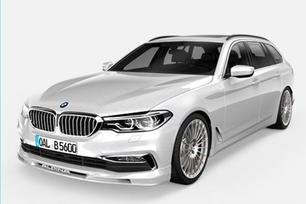
What's the difference?
The BMW Alpina B5 Bi-Turbo is not actually a BMW. Not according to the German Federal Motor Transport Authority, at least.
Nope, the modifications applied by tuning house Alpina to the 5 Series are deemed so significant that if you open the bonnet and look inside the engine bay, you'll see that the BMW VIN has been struck through twice and an Alpina vehicle number stamped underneath it.
The B5 is not the first model to be recognised in this way, either; the German government has recognised Alpina as a seperate car manufacturer since 1983.
The B5 has other ‘B' siblings, too. There's the B3 S Bi-Turbo, which is based on the BMW 3 Series, the B4 S Bi-Turbo (the BMW 4 Series) and the B7 Bi-Turbo (I don't need to tell you what this is based on, right?) which I've reviewed, too.
So just what has Alpina done to this unsuspecting BMW 5 Series? Is it really worth the extra money? How does the B5 compare to an M5? Could it actually be superior? And did they really take the speed limiter off to let it warp-speed to beyond 300km/h?
It’s still early days for battery-electric workhorses in Australia but Chinese brand Foton is making a concerted push into the zero-tailpipe-emissions commercial-vehicle market with its T5 EV.
The Beijing-based manufacturer, which has topped commercial-vehicle sales in China for almost two decades, is offering the ‘new energy’ electric T5 cab-chassis with a choice of GVM ratings: 4500kg for car licence operation or 6000kg for Light Rigid truck licence holders.
With a claimed fully-loaded driving range of 180km and unique-for-EV 3500kg braked tow rating, Foton says the T5 EV can also provide fleets with upfront and operational cost reductions of around 20 per cent compared to diesel. And it can be fitted with a wide variety of service bodies, including its own ready-to-work Tipper variant.
Foton is aiming to expand local sales by focusing on customers involved in last-mile logistics, local councils, construction and infrastructure support, for which this vehicle is best suited. We recently trialled a T5 EV to see how it stacks up as an alternative to diesel.
The Alpina B5 is a special car – more special than most people will ever give you credit for if you own one. Those that do know what an Alpina is will let you know; people will cross dangerously busy streets to talk to you about your car. Insanely fast, almost incomprehensibly comfortable and effortlessly powerful to drive.
The T5 EV would be best suited to short-haul city and suburban tasks, with daily back-to-base operations ensuring the convenient and dependable charging infrastructure required (compared to the lottery of public charging). Given Foton’s claim of upfront and operational cost reductions, the T5 EV could be what some commercial fleet managers are looking for.
Interesting is the right word for it, because while it might be questionable that Alpina's changes to the exterior are aesthetic pleasing, they are definitely intriguing to those who aren't familiar with the brand.
First, there are those 20-spoke wheels. Alpinas have worn this style of wheel forever and they've become the most famous outward sign that this is not just another BMW. So don't under any circumstances take them off and replace them with anything else. You'd be run out of town by the Alpina mafia.
Yes, they're more painful to clean than a cheese grater (trust me, I know. And if you look closely at these images you can see the dirty bits I've missed), but if you really don't like them then perhaps it's a sign this car isn't for you.
Then there's the boot-lid spoiler. It's square and 1980s'-looking, it also appears a bit like it's been bought online and installed by a teenager, but again, this is another Alpina tradition and it suits the car's character perfectly.
All right, those pinstripes; they're known as the Deco-Set and are a hat-tip to the Alpina racecars of the 1970s and '80s. Again, don't take these off, your Alpina will drop through the centre of the Earth in value. These are also part-and-parcel of owning one of these cars. I'm not a massive fan of them.
But I'm all about that front spoiler, with the floating Alpina lettering that you can option in silver, high-gloss black or gold.
Inside, there are fewer Alpina additions, but they're nonetheless unmissable. There's the Alpina-badged steering wheel, and a new virtual instrument cluster, embossed headrests and illuminated door sills.
There's also the little numbered plaque on the centre console which proves its authenticity, ours was number 49. Out of how many? I don't know. But I do know Alpina produces only about 1700 cars globally a year. Rolls Royce does about 4000. So, you can rest assured your B5 is exclusive.
At almost 5m long, 1.9m wide and 1.5m tall, the B5 is a large saloon, but having recently reviewed the Alpina B7 it feels small in comparison. How does it drive? We're getting there.
The T5 EV has a 3360mm wheelbase and steel ladder-frame chassis, with a leaf-spring solid front axle, leaf-spring rear axle and rear-wheel drive. Braking is by front discs and rear drums.
Its 81.14kWh of energy capacity is provided by two 60Ah lithium-ion batteries, one on each side, mounted in long parallel cradles. Drivetrain maintenance items, including motor and battery cooling systems, are accessed by unlocking and tilting the hinged cab forward.
The cab offers sufficient head, shoulder and legroom for up to three occupants, including tall people in the often-compromised centre seat. However, the centre seat is only equipped with a lap-belt.
Practicality is not really a BMW strong point no matter which model you pick. See, BMW mostly makes the car equivalent of uber-stylish and skin-tight active wear which looks good and performs brilliantly, but sometimes you just want pockets and a bit of room for your… um… bits and pieces.
So while there are two cup holders up front and two in the back, the bottle holders in the doors aren't huge, the centre console bin is on the small side, there's a hidy-hole in front of the shifter, the glove box is just a box for little more than gloves and there's no other great cabin storage options.
Legroom in the rear is good but not great, too - I'm 191cm tall and have about 30mm between my knees and the seat back in my driving position. Middle-seat passengers will also have to straddle the drive shaft hump in the floor. Headroom is restricted in the back, too (you could blame the sunroof) with my hair just skimming the headlining (I do have big hair).
Under that power tailgate, the B5's boot capacity is 530 litres which is 15L more than its big sister, the B7. There are two plastic storage areas either side of the luggage space for wet things. While there is one USB outlet in the front there aren't any in the rear.
With a maximum claimed kerb weight of 2500kg, the T5 EV has a 2000kg payload rating for car licence operation and up to 3500kg for drivers with a Light Rigid truck licence (these payloads include the weight of service bodies).
Its 8000kg GCM (how much it can legally carry and tow at the same time) means car licence drivers can tow up to 3500kg of braked trailer while carrying its maximum payload. For Light Rigid drivers, the maximum trailer weight drops to 2000kg, given the larger payload allowance.
The Pantech body fitted to our test vehicle has twin rear doors, with 270-degree opening and sturdy hooks on the body sides to hold them in place.
Cabin storage includes narrow bins but no bottle-holders in the doors, an overhead storage shelf on the driver’s side, a small compartment with spring-loaded lid in the dash and a single glovebox.
The centre console only offers a single bottle-holder. However, the centre seat backrest folds forward and flat to reveal a small desk on the back of it, complete with a hidden storage compartment and two cup/bottle-holders.
The BMW Alpina B5 lists for $210,000, making it only $10K more the BMW M5 which comes with almost identical features apart from the Alpina engineering to the engine and chassis.
Arriving standard is leather upholstery, four-zone climate control, nav, the Alpina embossed-headrests, a 10.25-inch display, digital radio, Alpina door sills, sunroof, proximity key, power front seats, 12-speaker Harman Kardon stereo, head-up display, Alpina virtual instrument cluster, heated front and rear seats, and the 20-inch Alpina wheels.
The test car I drove had been optioned with a limited-slip differential ($5923), steering-wheel heating ($449); soft-close function for doors ($1150); sunblinds ($1059); TV function ($2065) ambient air package ($575), and front-seat ventilation ($1454).
The T5 EV cab-chassis comes equipped with a single electric motor and 81.14kWh battery capacity for MSRP of $139,450 plus GST.
Standard equipment includes 16-inch alloy wheels (dual rears) with 205/75R16 LT tyres and a full-size spare, seating for three, remote central-locking and height/reach adjustable steering wheel.
There’s also a reversing radar and camera, cabin roof air-deflector, lower rear and side guards, 24-volt dash socket and basic multimedia including radio, Bluetooth and MP3/MP5 connectivity.
The Alpina B5 uses the same 4.4-litre V8 engine found in the BMW M5 (and also the B7). But, and it's a big but, the M5 makes 441kW and 750Nm, while the B5 outdoes it with 447kW and 800Nm. Admittedly, the B5's torque arrives at the 3000rpm mark, while the M5's is all there from 1800rpm.
How does the B5 beat it? Alpina installed its specially developed twin turbochargers and intercoolers, a high-performance cooling system, a reconfigured air intake set up and a different exhaust system.
The B5, though, is a tenth of a second slower to 100km/h compared to the M5 with a time of 3.5 seconds, but it will blast on to a top speed of 330km/h while the M5 is limited to 250km/h in regular form and 305km/h with the optional M Driver's package.
Both uses the same ZF eight-speed automatic transmission with identical gear ratios, and both are all-wheel drive.
The T5 EV’s single electric motor has a peak power output of 115kW and maximum torque of 300Nm. It also offers two drive modes: ‘Eco’ which minimises energy use with a top speed of 73km/h and ‘Power’ which uses more battery charge but increases top speed to 94km/h (both speeds achieved during our test).
The Alpina B5 needs petrol. By that, I mean it needs quite a lot of it if you want to enjoy it properly. What type of mileage does it get? Officially, it should use 11.1L/100km after a combination of urban and open roads, where as the M5 is set to 10.5L/100km.
That makes sense, the B5 produces more power and torque, and it's 85kg heavier than the M5 at 2015kg.
Our test car's trip computer was reporting 13.2L/100km after flying low over country roads and slow city piloting. The more time spent in the urban warfare that is the daily peak hour commute, the more that figure crept and hovered around the 15L/100km mark.
Foton does not publish an official kWh/100km consumption figure, but claims a fully loaded driving range of 180km from its 81.14kWh battery capacity.
According to the dash readouts at the end of our test, which we did on a single charge, we drove 142km with 38km of estimated range remaining. Our displayed average consumption was 51.3kWh/100km, so based on that figure you could expect a driving range of around 160km, which is less than the dash estimate.
Our testing was conducted without a load (see Driving) but it did include considerable freeway travel required to collect and return the vehicle, so regenerative braking was minimal. And we had to use Power mode to maintain freeway speeds.
Foton claims that DC fast-charging allows for a full recharge in 1.5 hours, while the 11kW onboard AC charger takes 7.2 hours which is suitable to overnight turnarounds.
Ok, stay with me here. For this next bit you'll need a fresh egg, a lounge chair, and it might be a good idea to have some plastic bags and carpet cleaner on hand.
First, in front of the lounge chair flatten out the plastic bag and place the egg on it. Next, sit down on the chair and very carefully rest the ball of your foot on the egg with as little pressure as humanly possible.
This is exactly how little force you need to apply to the go-pedal of the B5 to accelerate from a standstill to 60km/h in about five seconds.
If anything sums up the driving experience of the B5, it's that sense of effortlessness.
Stomp on that accelerator, and you'll be shot to 100km/h in 3.5 seconds, without a hint of broken traction thanks to the all-wheel-drive system.
The ride should have been terrible on 20-inch wheels shod in low-profile rubber (Pirelli P Zero 255/35 front, and 295/30 rear), but the Alpina-tuned air suspension is close to miraculous in the way it cushioned and censored the potholes out of Sydney's worst roads. Yes, it can be a touch floaty, particularly in the Comfort Plus setting, but this is benchmark-setting stuff for a comfortable ride.
Don't expect this beast to roar. Unlike the M5, the B5 gets its work done without deafening everybody around it. Sure, the B5's V8 sounds amazing when you push it, but it's not brash, not loud and not lairy. Buy an M5 or Mercedes-AMG E63s if you want to be heard half a block before you get home, but you won't get that with the B5 and its exhaust system.
The B5 also handles well, but I have to say the engagement factor is low. I piloted it effortlessly through the twists and turns of my country test circuit and roads which normally have me grinning like a maniac behind the wheel had me feeling a bit disconnected in the B5. That air suspension, the numb steering and pedal actions make it difficult to ‘feel' the road.
It's highways where the B5 is a king, but even at 110km/h there's the sense that this car is still fast asleep and won't get out of bed for anything less than 150km/h - making it perfect for Germany's autobahns, but maybe not for here in Australia.
There are large handles on the windscreen pillars to assist climbing aboard and the driving position offers adequate comfort, with its steering wheel adjustments and left footrest. However, some rake adjustment in the flat base cushion would be welcome, as it can feel like you're sliding forward at times.
The drive selector dial on the console has three settings (Reverse, Neutral, Drive) marked by the letters R-D-N, so it’s simple to use. Because of its near-silent operation at low speeds, the T5 EV is equipped with an audible pedestrian warning system. This activates at speeds below 30km/h and makes a unique sound that defies description.
We drove in Eco mode when not on the freeway and found that its quiet and smooth surge of acceleration was more than adequate for a vehicle weighing more than 2.5 tonnes. We did briefly try the Power mode but did not detect a significant boost in performance.
It has good steering feel (with electric power assistance) and its noticeable lightness at low speeds is appreciated when manoeuvring in tight spots. The brake pedal provides vigorous response and a strong regenerative effect (as displayed on the energy gauge) that optimises battery range.
The instrument display shows drive mode, estimated driving range, battery charge and temperature, energy use, average energy consumption and other useful data relating to drivetrain operation. Useful enhancements would be speed-sign recognition and a clearer image for the reversing camera.
Although almost silent under 60km/h, increased noise at freeway speeds includes some faint drivetrain hum and wind-buffeting around the large door mirrors, which compensate by offering excellent rear vision.
We didn’t get to do our usual GVM test, due to a software glitch in the public charging facilities we arranged to use on the day. Back-to-base operations with in-house charging would avoid these issues.
The Alpina B5 is based on the BMW 5 Series which had a five-star ANCAP rating awarded to it in 2017.
Along with the comprehensive suite of airbags, traction and stability control, there's an impressive array of advanced safety equipment. Coming standard is AEB (front and rear), evasive steering, front and rear cross-traffic warning, blind-spot alert and lane-keep assist. The Alpina B5 also comes with BMW's emergency call function.
For child seats you'll find two ISOFIX mounts and three top tether points across the rear row.
safety
If you're unfortunate enough to get a flat tyre, there's a puncture repair kit in the boot which works provided the hole isn't giant, as I've experience in the past with these systems.
Includes driver and passenger airbags plus AEB, lane departure warning, hill-start assist, traction control and other active safety features. There’s also the low-speed pedestrian warning system, reversing camera/radar/buzzer, fire extinguisher, unlocked cab warning and more. The lap-belt for the centre passenger seat, though, needs upgrading to a full lap-sash type.
The Alpina B5 is covered by BMW's three-year/unlimited kilometre warranty. Servicing is recommended every 12 months or 15,000km.
Five years/200,000km warranty plus an eight years/300,000km traction battery warranty. Also 24/7 roadside assist. Scheduled servicing every 12 months/20,000km whichever occurs first. Total scheduled servicing cost for five years/200,000km is $7850 or a pricey average of $1570 per year. No capped-price servicing is offered.