What's the difference?
If you're looking for a sleek, two-door coupe with a sparkling chassis, rear-wheel drive and a charismatic turbo straight-six, BMW has you covered with about eight choices. That should be that, then. But wait. There's more.
Since 1965, Alpina - the name of a resurrected a typewriter company - has collaborated closely with BMW to produce distinct, high performance Alpina-badged cars. It actually started with a Weber dual-carburettor unofficial conversion for the BMW 1500 in 1962 and over the years built into a racing operation winning championships and races like the Spa 24 Hours.
Alpina returned to Australian shores in 2017 after a long hiatus with a new range including the BMW 4 Series based B4. Not long after, BMW updated the 4 in what it calls LCI (Lifecycle Impulse), so Alpina followed suit with a price drop, new gear and called it the B4 S.
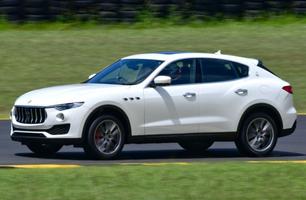
Driving a whopping great SUV down the straight on a race track at more than 200km/h sounds like fun, but it actually feels a bit wrong, like entering a baby elephant in a dog show.
These are strange times, of course, and the Maserati Trofeo Levante is a suitably strange vehicle - stylish, classy, expensively appointed family hauler that also has the heart and soul of a race car.
Indeed, while performance SUVs are an increasingly commonplace vehicle, the Levante - which was actually getting along in the tooth as a model before this significant upgrade - has higher performance credibility than most.
That's because it has a big Ferrari V8 driving all four of its wheels and delivering a properly supercar-like 433kW and 730Nm.
It's not what you might call a typical Maserati buyer's car, but then only those who know what the Trofeo badge stands for - shouty insanity, basically - will be interested in this end of town. It is a lot of car, but is it worth the large load of money on the sticker ($330,000)?
You could almost call the B4 S the anti-M4. It's still fast and practical but from a completely different perspective. It's much more a grand tourer than the M4 and even with the Akrapovic exhaust (usually a byword for joyous, anti-social racket), subtle.
For some, the price won't matter because the Alpina delivers what they want - M4-like straight line performance without the histrionics or the uncompromising chassis. And there's also a bit of that perverse exclusivity of the styling that you won't get anywhere else.
Maseratis are built for a fairly specific niche buyer; someone with a lot of money, someone slightly older and certainly someone who likes the finer things in life and appreciates Italian style, quality and heritage.
They are not, typically, the kind of buyers who want to tear around race tracks like fiends in big, shouty SUVs. But apparently there is a niche within the niche of Maserati fans who do, and they are willing to invest big dollars in vehicles wearing the Trofeo badge, like this Levante.
It might seem a slightly strange creation, a track-mad SUV with a screaming Ferrari engine, but surprisingly, it really does work.
Alpina has always had a particular aesthetic that could uncharitably be termed as mid-'80s West German - all set square angles and body graphics. Think David Hasselhoff's Berlin Wall look. The company has never really deviated from adding squared-off body bits to the various BMWs it has rebadged under its long-running agreement.
For the B4S, Alpina adds the signature billion-spoke alloy wheels (only a slight exaggeration), a new front splitter complete with Alpina lettering, a weirdly proportioned boot lid lip spoiler and - not even joking - pinstripes. Like I said, mid-'80s West German. You can still recognise the sleek 4 Series Coupe but perhaps the worst of it is the super-sized, wonky-looking ALPINA B4S on the boot.
Inside is rather more restrained apart from the ill-fitting Alpina plaque under the climate control. Again, it's all 4 Series in here, with the lovely Merino leather liberally applied across the cabin. Less lovely is the wood on the door pulls and console but the door cards have an oddly appealing woven leather which looks and feels good.
Sadly the standard 4 Series steering wheel is along for the ride. There's nothing wrong with it - although the Alpina logo does look out of place - but if I were a product planner, I'd beg for the lovelier M wheel.
While the other two Maseratis to get the Trofeo treatment - the Ghibli and Quattroporte sedans - are undeniably lovely, the Levante is not quite as pretty.
Admittedly, for an SUV, it looks very good, and the Trofeo touches - that big, nostrilled bonnet, the red gills on the sides, the carbon, the badges - really do lift its game to another level.
Overall, though, the Levante has just never felt beautiful enough to me to be a Maserati. These guys really do style well, as you'd expect from a premium Italian brand, but making an SUV sexy is beyond even them.
I'll grant you, it does look good from front on, but at the rear they just seem to have run out of ideas.
Credit is due for feeling properly special inside, however.
If you're in the front, you're in luck - it's a comfortable place to be, with plenty of leg and headroom. Down back isn't terrible despite the coupe roofline. The two seats are nicely shaped for maximum comfort and separated by an odd plastic tray. The fold-down armrest has two cupholders.
Front seat passengers score a pair of cupholders (bring the total to four for the car) and the long doors will hold a bottle each.
The boot swallows a reasonable 445 litres, which isn't at all bad.
If you've got to move five people in a genuine hurry, the Levante is a pleasant way to go about it.
There's plenty of head and shoulder room, the seats, while firm in the front, are pleasant to the touch and supportive and there's a 580-litre boot with an electric tailgate and split-folding seats.
The boot feels properly spacious, too, with a 12-volt power outlet and four tie-down points. You won't, however, find a spare wheel out there, so serious off-roading is out (although it probably was already if you look at those expensive wheels).
There are huge door pockets with room for bottles and two big cup holders in the front. The centre-console bin looks lovely, it's all carbon fibre, but is quite small.
There are also three USB points, one in the front and two in the rear, and Apple CarPlay and Android Auto connectivity.
If you thought BMW don't mess about when pricing up its cars, you best strap yourself in. The 440i-based B4S starts at a solid $149,900. That's $48,000 more than the 440i and significantly more than an M4 Pure. But there's plenty of gear on offer and some genuine, bespoke Alpina additions.
Standard are 20-inch signature Alpina alloys, 16-speaker harmon kardon-branded stereo with DAB, super-soft Merino leather everywhere, dual-zone climate control, around-view cameras, reversing camera, sat nav, keyless entry and start, front and rear parking sensors, active cruise control, heated and electric front seats, head-up display, auto headlights and active LED headlights, LED taillights and electric sunroof.
The stereo and sat nav are run by BMW's iDrive. It's a cracker of a system and almost gets away without Apple CarPlay and Android Auto. The absence of such simple pleasures at this price point is a bit lame, but here we are.
I'm sorry, but $330,000 for an SUV, of any kind? Personally I can't see the value, but then personally, as we'll discuss below in the Design section, I can't see the attraction.
This is one of the most expensive SUVs money can buy, well above things like Range Rover Sport SVR ($239,187) or even Porsche Cayenne Turbo Coupe ($254,000), although a pricier Ferrari one is surely on the way.
You'd want a lot for that, and the way it drives and sounds, thanks to that Ferrari engine, accounts for quite a few dollars.
There's also an undeniably high-quality feel to everything you touch on the car, inside and out, and a vast quantity of carbon fibre everywhere as well.
Other highlights include the 21-inch machine polished wheels, an 8.4-inch touchscreen with Navigation and DAB radio, full matrix LED headlights, and incredible Pieno Fiore natural leather, “the best the world has ever seen”, as Maserati says.
The lovely if firm front seats are heated and ventilated, sporty and 12-way adjustable, with Trofeo logos stitched into the headrests. The rooflining is lovely Alcantara, the steering wheel is sporty and features carbon-fibre shift paddles, ad the stereo system is Harman Kardon Premium and has 14 speakers.
And even the rear seats are heated. It feels expensive, and it should. But still, $330K?
A lot of your extra money turns up under the bonnet. These days the 440i packs BMW's slick B58 turbo straight six and the B4S does likewise. The boys from Buchloe in Bavaria (there are certain to be women there, too, I just liked the alliteration) added a pair of Alpina-spec turbos to generate a whopping 324kW and, more importantly, 660Nm. Alpina says 600Nm (the max torque figure of the brilliant M4 CS) is available from 2000-5000rpm, while the full 660Nm is available from 3000 to 4500rpm.
The M4 Pure has 317kW and 550Nm from the S55 straight-six. Just so you know.
Like the 440i but unlike the M4, the B4S employs the dependably brilliant eight-speed ZF automatic found throughout the BMW range.
This will be the last time Maserati gets a proper Ferrari engine like this a 3.8-litre twin-turbo V8 shouty monster, which is good for 433kW and 730Nm.
The future, as is the case everywhere, is going to be more electric and less noisy. For now, anyone who can should enjoy this V8 masterpiece, which drives all four wheels through Maserati's Q4 on-demand all-wheel drive system via a limited-slip rear differential and uses an eight-speed automatic transmission.
Its claimed 0 to 100km/h time is 3.9 seconds, which puts it in what used to be super-car territory, and is still very quick indeed, while top speed is an unimaginable 304km/h.
Alpina quotes 7.9L/100km on the combined cycle and we went through the premium unleaded at the rate of 11.7L/100km. I enjoyed myself, so that's not a terrible result.
The official claimed fuel economy for the Maserati Levante Trofeo is 13.5 litres per 100km, but good luck with that.
A more realistic number would probably sit somewhere above 17 litres per 100km, and we would have easily exceeded 20 litres while driving it like lunatics around a track.
But you just paid $330K for an SUV, what do you care about fuel economy?
One of the key differences between the B4 and M4 is the ride. While the M4 can crash over bumps and generally be a little hard to live with, the crew in Buchloe have gone after a much more plush ride. And in that they have succeeded because the B4 S is a mighty fine cruiser. Bumps are dismissed with a haughty disdain, even Sport + silliness doesn't completely write-off ride quality.
Very impressive too, is the steering. While still not at Lotus Elise levels of feel (few cars are), the Alpina tweaks connect the your palms to the road with more clarity than what you'll find in the 440i or M4. Where the M4 particularly adds too much weight, the 440i is a bit more circumspect in that regard.
And then we come to the engine. The B58 six is a belter, better even than the N55 that preceded it. It's still a 3.0-litre straight six but is part of BMW's modular engine family that starts with a 1.5-litre triple in the Mini and 1 Series. The Alpina-spec turbos are noisier, the Akrapovic exhaust lighter and also noisier. It doesn't have the all-out crackle and pop of an Audi or Merc (perish the thought), but when you're on it, the B4 means business. The 660Nm of torque, available over a wide rev range, delivers a steel fist wrapped in a velvet glove and bubble wrap - the speed builds rapidly but smoothly.
The approach to the chassis tune seems to be based on the driving talents of mere mortals on normal roads, which is kind of like the 440i. It's terrific fun to drive hard but it's very forgiving and patient. The great thing about it is that you wouldn't think twice about jumping in it for the long haul, so comfortable and quiet is the cabin. The M4 will leave it for dead on a winding road, but that's perfectly fine.
One irritant is the replacement of the admittedly cheap BMW gearshift paddles with weirdly non-tactile buttons. They're not particularly easy to use and, probably worse for a sporty car, unsatisfying. It's an odd detail with which to go off the reservation. Cheeringly, the eight-speed ZF is its usual perfect self, so you don't have to worry too much about manual mode or go old school and use the shifter.
We got to drive all three Trofeo-fettled Maseratis on track at Sydney Motorsport Park, and before that on the road, where the Levante felt very pleasant, and pleasantly expensive at all times.
As you might expect, a vehicle with 433kW is difficult to fully appreciate on public roads, although there was the occasional and exciting change to give it a quick, loud blat between gears.
It only takes hearing that engine note, and feeling that torque surge, a few times to see why someone might fall in love with this car, or at least this engine.
Out on the track, the rear-driven Ghibli and Quattroporte, which share the Levante's engine, were surely the more fun and frenetic things to drive, but there were those who chose the Levante as their best of the three, even for circuit driving.
There's no doubt that its on-demand all-wheel-drive system, which is biased towards the rear but asks the front wheels for help when required, made it feel the most planted, and the safest, through fast and slow bends.
There's a definite sense that its engine is being asked to work the hardest, though, to push all that bulk through the air (although its brakes never seemed to fade, which is impressive with more than two tonnes of SUV to stop).
While the big, deafening V8 is willing and keen to rev all the way to 7000rpm (where it bangs on the redline waiting for your upshift, if you're driving in manual mode - I do like that), it started to make large sucking sounds towards the top of each gear, as if it was desperately trying to get more oxygen in.
It genuinely sounded different to the other two Trofeo cars, which is odd, but perhaps they just weren't as near their limits. That bulk also slowed it slightly in terms of top speed down the straight, but it still exceeded 220km/h with ease.
What should be said is that I was genuinely shocked at how good the Levante Trofeo was around a track. So much so I asked to have a second go, just to make sure I wasn't going mad.
Sure, it makes no sense to me personally, and I don't know why anyone needs an SUV that's good on a track, but if you do, I can recommend the Levante for sure.
That hugely enjoyable engine is just too much fun, although it's even better in a sedan like the Ghibli...
The Alpina ships with six airbags, ABS, stability and traction controls, ABS, stability and traction controls, forward collision warning, forward AEB, road sign recognition and active cruise control.
There are also two ISOFIX points in the rear. Neither the Alpina nor the 4 Series has an ANCAP safety rating.
Maserati's safety offering on the Levante includes six airbags, a reversing camera and 360-degree overhead camera, parking sensors front and rear, adaptive cruise control and Blind Spot Detection, Forward Collision Warning Plus, Pedestrian Detection, Lane Keep Assist, Active Driver Assist and Traffic Sign Recognition.
There is no ANCAP rating for the Levante as it's not been crash tested here.
Alpina offers a two-year/unlimited-kilometre warranty which is a bit behind the times and not in keeping with the price point. Servicing is another matter altogether and you're subject to your dealer's standard charges for servicing.
Maserati offers a three-year, unlimited kilometre warranty, but you can choose to buy 12-month or two-year warranty extensions, and even a sixth or seventh-year drive-train warranty extension.
When much, much cheaper Japanese and Korean cars are offering seven and even 10-year warranties, this is so far off the pace that such a fast vehicle should be embarrassed. And if you're buying something Italian, a better, longer warranty would seem like a must. I'd be negotiating at sale for them to throw the longer warranty offer in.
Maserati says servicing for the Ghibli has a "ball park costing of $2700.00 for the first three years of ownership" with a service schedule of every 20,000km or 12 months (whichever occurs first)
Also, "please note that the above is indicative only of the manufacturers basic routine service maintenance schedule and does not include any consumable items such as tyres, brakes etc or additional dealership charges such as environmental levies etc."