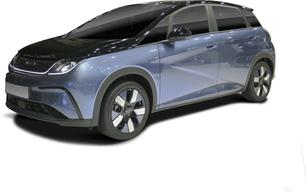
What's the difference?
Hybrid campers are no longer a new development in caravanning and camping. We've been seeing trailers like them, in some form or another, for nearly two decades.
The concept is straightforward: hybrid campers offer some of the best comforts of a caravan (solid walls, proper beds, little to no set-up time) with the best aspects of camper trailers (light, small, rugged and able to be towed nearly anywhere).
Although Blue Tongue Campers has been a leader in the traditional camper-trailer market for more than a decade, its first hybrid has been a long time coming. First chance we got, we hooked it up and headed out to Wee Jasper to see what it's about.
It’s about time for a change. Since the beginning of the EV era, Tesla has been the dominant name, and not without good reason.
Tesla made electric cars popular, cool, and above all, accessible. To this day, the Model 3 and Model Y remain excellent purchases in their respective categories.
And yet, the tide seems to be turning. Many buyers haven't been thrilled by Elon Musk's antics, how popular the Tesla brand has become or maybe they never liked the look and feel of Tesla to begin with.
For those prospective EV buyers, it looks like BYD is set to be the next big thing in electric cars.
Offered at a far more accessible price-point, the Chinese brand still stands out with its distinctively styled vehicles and innovative features.
And the new car we’re looking at for this review, the Dolphin hatchback, could be the one to elevate the brand to the levels of popularity and recognition Tesla currently enjoys.
At the time of writing, it was also the most affordable electric car you can buy in Australia. But is it more than that? Read on to find out.
Given that Blue Tongue is a relative latecomer to the hybrid caravan market, it’s done its homework.
For $50,000, the HX15 is a great value, highly capable off-road camper with a comprehensive list of features to keep it self-contained and self-sufficient when you're camping.
That it includes an island bed, 2000-watt inverter, grey-water tank and enough battery capacity to free camp almost endlessly, is a testament to all that.
Chinese manufacturers have been impressing us lately with the strides they’ve been making, and BYD is no exception with its Dolphin.
Not only does this hatch help bring the price down for prospective EV buyers, but it leaves a solid impression of a cohesive, well-built car, which is also quite a bit of fun to drive.
It’s not the fastest, nor is it the most practical, and there are a handful of downsides to its design and software, but when it comes down to it, this is simply a great value entry-level electric car.
A lot of these hybrid campers are little more than expensive metal boxes with a large bed inside, although the Blue Tongue is a little more than that.
It has a fold-out extension from the driver's side of the camper, which contains the queen-sized bed. By expanding sideways, rather than rearwards, Blue Tongue's managed to create access around the bed from three sides. The upside is, no one ever has to climb over the other, or shuffle along it, to get in. It's a feature almost unique in the genre.
Considering the XH15 also fits a small shower and toilet cubicle, cosy dinette, a small sink, bunk bed and heaps of storage, it's quite a practical little space that doesn't feel as cramped as it sounds.
The dinette lounge is good for the occasional meal away from the bugs, while the bunk above it folds up to improve access. And even if you're not travelling with a child, it makes a great shelf.
The en-suite, if we can call it that, is naturally compact. With its own toilet and shower plumbed into the grey-water tank, this is a fully self-contained camper, which is becoming increasingly more important at many free and remote bush camps.
The clever design bits don’t end with the controls and themed motifs, either. While the Dolphin’s cabin feels a bit smaller than many of its rivals (because, physically, it is), efforts have been made to make it a versatile space.
There are plenty of little storage areas throughout. There’s the floating one below the touchscreen, which suits wallets and sunglasses. There’s one with a roll-out cover set low below the controls which is good for smaller objects you don’t want moving around the cabin.
A large cubby is located underneath the armrest between the two seats for bigger objects and a slick wireless phone charger cut out from the top.
The two centre bottle holders are a little small, as are the cut-outs in the doors, so if you’re negotiating with an XL takeaway soft drink you might run into trouble.
The dark theme for the interior in our car doesn’t help the more closed-in feel, but the standard panoramic fixed sunroof (mercifully with a rolling shade) helps to keep the space airy.
I found it easy to set up my driving position, another clever touch being the little digital instrument panel perched on the steering column, so no matter how you adjust it you can always see it.
I was a little concerned the rear seat would be tiny, because this car doesn’t look big from the outside, but I was most definitely wrong.
Behind my own seating position, at 182cm tall, I had leagues of knee room and plenty of space for my feet thanks to the flat floor. I also had sufficient but not stellar headroom, and the soft-touch materials continue into the doors and seat trim.
I will say, the abundance of synthetic leather is much more evident for rear passengers, but it feels like a minor complaint.
Again, the bottle holders in the doors are tiny, but at least the ones in the drop-down armrest are generous. The middle seat is very useful thanks to the flat floor, although there are no adjustable air vents for rear passengers.
The backs of the front seats have a variety of pockets in different shapes and sizes, and there are USB-C and USB-A ports on the back of the centre console, alongside a bizarre centre bottle holder which is on an angle.
Boot space is 345 litres if you move the false floor to its lowest position. I was just able to squeeze in the three-piece CarsGuide luggage set with a bit of fiddling around.
With the second row down, room expands to 1310L, and you can bring the false floor up in the boot to make the load area flat.
The space underneath is quite good for storing charging cables and such, but keep in mind the Dolphin doesn’t offer additional frunk storage.
What it does offer is a vehicle-to-load adapter, which lets you power household appliances via its external charging port. Neat, and rare at this end of the EV market.
The 15-foot off-roader is well balanced behind our tow car. At tare, there's 150kg on the ball, which gives it room to move up once a load is added. We carried a load of camping gear, nearly 200 litres of water and the fridge, all of which helps add stability to the combination.
Towing the XH15 along the highway, it tracked beautifully and even with soft, off-road suspension it didn't wobble around. Onto the narrower, winding roads into Wee Jasper, it was compliant and followed without incident.
When the drive became a bit challenging, such as when we had to navigate steep, loose tracks into our campsite, the camper's high-clearance, angled cutaways and off-road hitch made sure none of its underbody scraped or bumped on the ground.
It rides on coil-spring, independent suspension with dual-shock absorbers each side and this is a robust, well-proven system, which is really great when roads become a little rougher.
The Dolphin is immediately impressive. From the get-go I was greeted with a feeling of quality from the car in ways I didn’t expect. The steering feels nicely balanced and not too artificial like it can be on some EVs, while the interior is refreshingly ergonomic.
The ride might be the Dolphin’s most impressive trait, with a feeling of balance across both axles, and a spritely feel to the whole car.
It is trim for an EV, with a kerb weight of 1658kg, which no doubt helps the steering feel, and the efficiency.
As it is, I didn’t experience the kind of crashing and wallowing many EVs suffer from on larger bumps, and smaller bumps seemed to be filtered out with ease.
It even feels nicely balanced in the corners, pairing nicely with the great steering feel which is not something we’ve come to expect from Chinese cars.
The motor is also willing, with software tuning keeping power delivery on the right side of overwhelming, although the warm-hatch equivalent's seven second 0-100km/h sprint time is a hint at what it’s capable of.
Unfortunately, it is let down by a pretty sub-standard factory tyre package. The LingLong Comfort Masters are designed for the Dolphin, complete with little Dolphin markings on them, but are hardly inspiring for traction when you plant the accelerator or tip it into a corner with enthusiasm.
They are better than the pretty much no-name Atlas Batman A51 tyres which came on the Atto 3, but even MG has wised up to putting tyres from renowned manufacturers on its Australian-delivered cars.
The Dolphin is also easy to park, thanks to its excellent surround camera suite and tight footprint, but visibility out of the tiny rear window is limited and made worse by the huge headrests for the outboard back seats.
In terms of electric driving characteristics the Dolphin offers two levels of regen braking, one which is virtually non-existent, and another mild tune.
Surprisingly, there’s no single-pedal mode, and the Dolphin leans on blended braking more than some of its rivals. It feels a lot more traditional to drive in this sense, so may be well suited to someone hopping out of a combustion car.
The drive modes are quite dramatic, with 'Eco' mode limiting motor torque and even switching off the climate control, while 'Sport' will make bouts of wheelspin a bit too easy by upping the response time from the motor. I found it best to stick to the nicely-balanced 'Normal' setting.
Tl;dr? The Dolphin is impressive. It’s responsive, relatively light, and has a sense of quality to it through its great ride and decent handling. Not bad for the cheapest EV in Australia.