What's the difference?
In any other super car, it would seem deeply strange, wrong even, to loll (and LOL) in the back seats while a colleague blasts you around a race track at insane speeds, and not just because cars with V12 engines making 575kW and 1000Nm don’t normally have more than two seats.
The Bentley Flying Spur Speed is, of course, no ordinary car, it is a super sedan, a luxe limousine crossed with a rocket ship, and if Sir wants to get to the rooftop helipad in a spectacular hurry, then these are the back seats to be sitting in.
We flew to Japan, and the spectacular setting of the Magarigawa Club, a members-only race track carved out of the rolling hills outside Tokyo at a rumoured cost of $US2 billion, to try the back seats, and the driver’s seat, of the new and very impressive Flying Spur Speed.
Coincidence is a funny thing. The same week I had the Mini Cooper S 60 Years, the last VW Beetle rolled down the line in Mexico. VW blamed its mammoth €25bn investment in electric, but the reality is that nobody was buying that nostalgia trip anymore.
The story of Mini is quite different. BMW's aggressive expansion of the range beyond the three-door hatch has breathed all sorts of life into a brand that could have disappeared up its own Union Jack. Instead of sticking to the formula, the brand tried all sorts of things but has since settled on the hatch (three- and five-door), the Cabrio, the wacky Clubman semi-wagon and the Countryman SUV. BMW is now making lots of cars on the same platform, a nice two way street.
The Mini Cooper S is 60 years old and unlike the Beetle, it's powering on past its birthday and the company - no stranger to a special edition - has slapped together a classic combo of colours, stripes and badges.
The Bentley Flying Spur Speed is a whole lot of car, for a whole lot of money. Sure, I’d rather have a Ferrari or a Porsche with similar power (and the Panamera shares the same V8 and hybrid set up), but then if you’re in the market for a Bentley like this you already have a garage full of other options. And I can see why you’d add one of these to your collection. Because you can.
Note: CarsGuide attended this event as a guest of the manufacturer, with travel, accommodation and meals provided.
The Mini 60 Years is another classic special edition Mini and its definitely one for the fans. I'm not at all fussed by it and would quite happily save my money for a standard Cooper S. The Mini is still one of the most playful, interesting cars from a mainstream car maker and while it doesn't please everyone with its size and weight, it's tremendous fun to drive.
It's the kind of car I could own and I always feel comfortable in - it's the perfect size for urban environments but is just as much at home belting down a freeway on a long trip or scooting down a B-road just because.
Bentley seems to have spent the design budget on the Continental GT Speed, which was launched at the same time and gets the same new engine under its slightly sexier bonnet. The big move there has been going from Bentley’s traditional four headlight face to a smoother more modern one with just two lights, or eyes.
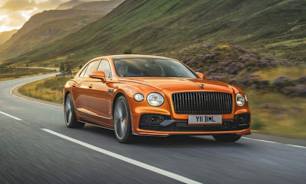
The Flying Spur, by comparison, sticks with the more traditional look, and four eyes, but that doesn’t necessarily mean it looks nerdier. Indeed, it’s still an impressive and handsome beast and does a mighty fine job of making this much metal and mass look bold and desirable.
Truly, vehicles this large tend to look lumpen and making one look as good this Flying Spur Speed does is an impressive feat. Look at the photos and be impressed.
The interior fit out and fittings are stunning, with Bentley boldly claiming it makes the best car cabins in the world. It’s not an outrageous claim, either.
Always readily identifiable, Mini updates always add detail without touching the main game. I quite like the indicators, which are big LED rings surrounding the headlights, but then again I'm a sucker for lighting. I think the Mini looks terrific in three-door form and the Union Jack rear lights have grown on me. They're a bit silly but in a good way, which kind of sums up the car. The British Racing Green looks pretty good, too. Amusingly, the puddle lamp even has a 60 Years flavour.
You can spot the Cooper S by the centre exhaust and the 60 Years has its own set of 17-inch alloys.
The cabin is pretty much the same apart from the particularly warm hue of the leather. It's a classic colour for British cars but works nicely. In the Cooper S, the panoramic sunroof is split in two, but the front section opens. It does make the car feel a bit bigger, which is handy given it's pretty tight in there. The piping is a nice touch, too, although the Piano Black on the dash was so last decade rather than so last century but at least there isn't a slab of tacky wood. The fact the interior is otherwise unchanged means there are other cheap touches that somehow fail to ruin the ambience.
Mini calls its version of iDrive 'Visual Boost' for some reason, and it's displayed via a 6.5-inch screen set in a big round dial ringed by changeable LED lights.
I’m not going to pretend that I had my laptop out taking notes while we were hitting 200km/h down the back straight at Magarigawa, but at more sane speeds there’s no doubt the rear seats of this car would be a very relaxing, plush, cosseting and pleasant smelling place to sit and work.
That’s at least partly what the Flying Spur Speed is for, a limousine for those who don’t like, or perhaps can’t quite afford, a Rolls-Royce, but still want great British solidity, class and that sense of obscene wealth, probably inherited.
The bonus of the Flying Spur is that it’s also a lovely place to be should you choose either of the front seats, with hugely comfortable seats that are more like couches, endless adjustability and many soothing massage settings for your heated and ventilated pews.
The spinning central 12.3-inch display remains the highlight, offering you a modern touch screen, which can disappear to reveal either three classic analogue dials or a plan piece of dashboard, if you prefer a “digital detox”.
Yep, it's a small car so expect things to be reasonably cosy. I fit in there fine but I am neither particularly tall nor broad. Taller folks will fit just fine in the front (but not too tall, don't be greedy) while larger people might find themselves uncomfortably close to their passengers.
The rear seat is bearable for children and patient adults on short trips. At least they'll be well hydrated because as well as the pair of cupholders up front there are a further three in the back for a total of five. The Mini joins the NC Mazda MX-5 as a car with a greater cup capacity than passenger capacity. Front seat passengers can keep the water topped up as there are also small bottle holders in the doors.
There are two USB ports in the front seat and a wireless charging pad that doesn't fit bigger phones under the armrest. If your iPhone is the smaller size, the combination of wireless CarPlay and charging pad is excellent.
The boot is surprisingly big for such a small car, beating many of its cheaper rivals with 211 litres with the seats in place and 731L with them folded down.
Is “value” even a word that people use when they can afford to shop for a Bentley that costs $581,900, and will not be their only car? At very least, it’s a term that means something different to the people who breathe that kind of rarefied air.
The kind who have memberships to the exclusive Magarigawa Club where the Flying Spur Speed was launched. When just being a member costs a rumoured $1 million a year (and there’s a waiting list to get in), then half that much for a car probably isn’t so much.
The Flying Spur Speed comes with everything you would expect from a Bentley, incredible levels of comfort, a modern hybrid system that allows you to pretend you’re an eco-warrior while driving through the zero-emission zones of big cities like London and plenty of space and shiny things to look at.
The stereo is a Naim for Bentley audio system "arguably the finest in-car hi-fi available in any production car", while you also score a panoramic sunroof and mood lighting and even lovely deep-pile mats in the footwells. Ahh.
Sure, you could buy Ferraris and Lamborghinis for that kind of money, but they don’t have comfortable back seats like this Bentley, for those days when you really need to get to the chopper (parked on your personal helipad) in a hurry.
There are four ways you can have your 60th Anniversary Mini. If you're happy with 1.5-litres of power, there is the three or five-door Cooper for $33,900 and $35,150 respectively. If you want a bit more grunt, you can step up to the Cooper S three-door (the car I had) for $43,900 and the five-door for $45,150. Eagle-eyed readers who know their Mini pricing will see a price rise of $4000, and Mini Australia says you get $8500 of value. All of those prices are before on-road costs.
The standard Cooper S package brings dual-zone climate control, keyless entry and start, driving mode selection, leather interior, reversing camera, sat nav, auto LED headlights and wipers, wireless Apple CarPlay, run-flat tyres and you can add all the 60 Years stuff on top of that.
Without putting too fine a point on it, the Mini isn't cheap to begin with, so whacking four grand on top of the already stiff pricing obviously doesn't improve matters. You do get more stuff, obviously, as suggested by the claimed $8500 figure.
That means British Racing Green IV metallic paint with Pepper White mirrors and roof or Midnight Black Lapis Luxury Blue with black mirrors and roof. Inside you get a choice of Dark Cacao with the green paint or Carbon Black with the blue paint. If you choose the latter you miss out on the special piping and details.
Cooper S buyers pick up wireless phone charging, Comfort Access pack, heated front seats and LED headlights while the Cooper S adds a panoramic sunroof, Harmon Kardon-branded system and head-up display.
If you’re going to put the word “Speed” in the title of your car, you really can’t mess about when it comes to the powerplant, and Bentley also has a proud history of making hugely powerful V12 engines to live up to. That’s a history that has now ended, with the announcement that the new 4.0-litre twin-turbo V8 in this Flying Spur Speed will be the one and only in all Bentleys, henceforth, including the Continental and the Bentayga SUV.
Bentley’s W12 engine is, sadly, no more, which might well make some older Flying Spurs quite collectable.
The V8 will come in different flavours, of course, and it’s also a hybrid, as is the modern way. Bentley calls the 140kW electric motor attached to the engine an “e-machine”.
Using that machine, the Speed can whisk you around in silent, EV-only mode for up to 81km. With such a stupendous sounding V8 on offer, it’s hard to see why you’d bother, but it’s an option, and the hybrid system is cleverly set up so that the harder you drive, the quicker the battery recharges, so effectively you’d almost never have to actually plug this PHEV in.
With the engine and e-machine combined, you’re looking at a staggering 575kW and 1000Nm, enough to propel all 2646kg of this Flying Spur Speed to 100km/h in just 3.5 seconds.
It might not sound quite as orchestrally moving as the big, sassy W12, but it’s still a hell of a replacement, as it is, in fact, “the most powerful Bentley engine ever”. That will do nicely.
The Cooper S has the usual 2.0-litre turbocharged four (the Cooper has a 1.5-litre turbo three-cylinder), serving up 141kW and 280Nm. Power finds its way to the front wheels via a seven-speed twin-clutch transmission and will push the 1265kg Cooper S to 100km/h in 6.8 seconds.
So, if you were very careful to use your 81km of EV-only range, as often as possible, and you drove very slowly and treated the accelerator pedal with great care, you might, possibly, achieve the Flying Spur Speed’s claimed fuel-economy of 10.7 litres per 100km.
That’s the great thing about hybrids like this, they are theoretical fuel misers of the highest order. But if you aren’t careful and you care more about enjoying that twin-turbo V8 engine you’ve paid so much money for, you’re never, ever going to get it under 15L/100km, and you’ll quite likely exceed 20L/100km, as we did, with ease, by driving it around a track all day.
Theoretically, again, this Bentley will emit just 33 grams of CO2 per kilometre.
Mini reckons you'll get 5.6L/100km on the combined cycle. Maybe you could if you don't drive it like I did (I got an indicated figure of 9.4L/100km).
The Mini has stop-start to help cut fuel use around town and launch control to ruin those efforts.
Any car with a whopping 575kW and 1000Nm is going to be interesting, even invigorating to drive, but you’d have to say the smaller and lighter it is, the more excitement, and even fear, you’re going to be faced with.
In the case of the Bentley Flying Spur Speed, you’re talking about an enormous, and enormously luxurious and comfortable, sedan that’s designed to carry more than two people, and weighs a hefty 2646kg.
It’s a limousine powered by a rocket, as I said earlier, but looking at the size, and pondering the weight of it, you really don’t expect too much in the way of thrills. Effortless performance, sure, titanic overtaking thrust, perhaps, but then you read the fine print and note that this Flying Spur Speed can hit 100km/h in 3.5 seconds.
That’s seriously fast in anything, but in a car this big, and filled with as much luxury as a mid-sized super yacht, it feels other worldly.
Hammering the big Speed around a tight, intense race track feels strange at first and then strangely comfortable. Even sitting in the back wasn’t so much frightening as amusing, as the big Bentley simply slopes through any challenge you throw at it.
Sure, I’d like it to be louder, and you do miss the sound of the old 12-cylinder engine (and Bentley fans in particularly might find its absence upsetting), but the V8 is still throaty enough to please your ears, and it’s important to consider that it’s actually more powerful than the old W12, which is no mean feat.
Compared to the shorter, sharper Continental GT Speed we drove on the same day, the Flying Spur does have a bit more body roll, a bit more pitch and dive under braking from 200km/h, or when accelerating ballistically out of slow corners, but it’s still stupendously impressive for what it is.
And that is a luxury limousine that can turn itself into a race track weapon if you, and your three passengers, want it to.
Driving a Mini is a unique experience. Almost no other car on sale today has the combination of that far-away, near-vertical windscreen and an A-pillar that is almost slim by today's standards. The side of the car is almost fifty percent glass, so vision is terrific.
It had been a little while since I drove a Mini Cooper S so I was looking forward to the Mini bounce that I've always loved and my wife despised. Somewhere along the way, that bounce has faded somewhat, to the point where my wife says she doesn't mind it anymore. That must be a good thing, because while the ride is more refined, it's still a blast to drive, even if you're just getting around in traffic.
The Mini just loves point and squirt driving. The quick, well-weighted steering helps you swing the nose in and out of gaps and the handy slab of torque from the 2.0-litre ensures you stay out of trouble while doing it. The Mini also loves haring down a country road, the more secure-feeling ride belying its short wheelbase. The weight of the car probably helps keep things on the straight and narrow. It's pretty clever to make the car feel grown-up while also maintaining its sense of playfulness.
The driving mode switch doesn't make a huge amount of difference, with Sport mode adding a few apologetic pops from the exhaust.
Complaints are few, but there are too many buttons on the steering wheel and to my mind are all in the wrong place. By necessity, the controller for the media screen is practically on the floor and is crowded in by the cupholders and huge handbrake lever. But that doesn't mean Mini should take away the handbrake.
I have my reasons.
The Flying Spur Speed comes with 10 airbags and it has not been crash tested. Bentley also has its own 'Safeguard' suite of technologies including auto emergency braking, 'Swerve Assist' and 'Turn Assist'.
Other tech includes 'Predictive Adaptive Cruise Assist with Lane Guidance', lane departure warning, emergency assist, remote park assist and 3D surround-view monitor.
Like the rest of the range, the 60 Years has six airbags, ABS, stability and traction controls, forward collision warning, AEB (auto emergency braking), a reversing camera, speed sign recognition, and tyre pressure monitoring (it also has run-flat tyres and no spare, so that's an important consideration).
There are two top tether and ISOFIX points for the kiddies.
The Mini scored four out of a possible five ANCAP stars in April 2015. This was before AEB became standard earlier in 2019.
The Bentley Continental GT Speed comes with a five-year, all-inclusive servicing plan as standard.
That sounds good, but stunningly, Bentley still only offers a three-year manufacturer warranty, albeit one with no mileage limitations. That's way below industry standard these days.
The battery that forms part of the hybrid system is, however, warrantied for eight years, or 160,000km.
As with parent company BMW, Mini only offers a three-year/unlimited kilometre warranty with roadside assist for the duration. You can buy an extension to five or hold your breath during negotiations with a dealer.
Servicing is condition-based - the car will tell you when it needs one. You can buy a servicing package that covers the basics for five years for about $1400 or step up to the near-$4000 option which throws in consumables like brake pads and wiper blades.