What's the difference?
Spoilt. That's what we are. If you're in the market for a hot hatch, you can have your pick of German-built and French ones from as little as $27,000. There isn't a dud among them now that the VW Polo GTI has had a bit of an update and you can pick and choose your style. Audi's S1 is aiming to be king of the kids with its stiffly-priced S1.
Set the finances aside and consider for a moment what's on offer. As it turns out, a lot.
The Polestar 2 was one of the first electric vehicles (EVs) in Australia to break through to the mainstream, however it has always been relegated to the Tesla Model 3’s shadow.
As a result Polestar is constantly playing catch up, releasing update after update for this premium-pushing electric liftback. The most notable was a major mid-life update in 2024.
Two years after this, Polestar has just rolled out the 2026 model year (MY26) update which introduces a range of subtle changes, largely under the surface.
It comes as Polestar is now introducing newer models, there’s mounting pressure from legacy carmakers who are only now catching up to EV tech, and Australians are moving away from buying passenger cars to SUVs.
Has this latest update improved the appeal? Read on to find out.
Cars this small shouldn't be this fast and useable at the same time, but the Audi S1 is. It isn't without its problems - the ride is harder even than the Fiesta ST which might weary some prospective buyers.
It's also a bit difficult to justify the price - in its basic form it's missing a few creature comforts that you'd expect in a $50,000 car - reversing camera, high-res screen, that sort of thing.
However, in the hot hatch world, those things don't matter. It has the bragging rights, the tech and the outright blinding speed to take on the bonkers Focus ST and equally zany Megane RS. And even the Audi S3.
This latest update for the Polestar 2 is lovely, but driving the original is a reminder of how solid this car has always been if you overlook the inherent impracticalities of being an EV on a combustion-engine platform.
The fact you still get steady flow of over-the-air software updates bringing new features, plus you can now upgrade to the new Qualcomm processor chip, saving some coin and getting a second-hand model that’s a couple of years old isn’t a bad option at all.
Note: CarsGuide attended this event as a guest of the manufacturer, with meals provided.
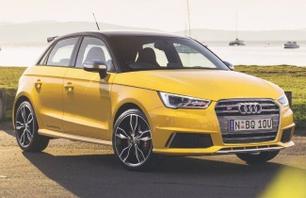
The A1 is so small it starts to strain Audi's design language. When you cram on the S-style bumpers and raccoon-eyed trim on the hatchback, it's starts to look a bit busy.
It isn't quite a shrink-wrapped A3 - Ingolstadt's designers know better than that - but it's full of Audi design cues, such as the strong, light-catching character lines, distinctive LED daytime running lights and fondness for big wheels.
Inside is along the themes of the A3, with what are becoming Audi's trademark; round eyeball air-con vents, the manual fold-down screen familiar to Q3 owners (but smaller) and a good clear dash. The handbrake jars slightly as it feels cheap to hold and wobbles a bit.
The S Sport seats are big and comfortable, and the top half of the backs are capped in plastic, which was colour-coded on our car. The rear passengers will certainly get an eyeful of whatever terrifying hue you've chosen, so choose wisely.
Despite the five doors, the back seats are occasionals, like the Mini the A1 is gunning for, and the boot is very small, but okay for shopping for couples or singles.
I’ve always been a fan of the Polestar 2’s exterior design and unlike many new cars it has aged like fine wine over the years. You need to remember the Polestar 2 dates back to 2016 when it was first revealed as a Volvo concept.
It still has clean lines, iconic lightning signatures, plus a tough stance that evokes just a touch of muscle car.
While it has taken me a while to come around to the new blanked-out grille insert, it suits the character of this car given it’s an EV. It also aligns with the wider Polestar design language.
For 2026 there haven’t been any major changes to the exterior. There’s a new sandy-like ‘Dune’ exterior paint colour replacing the silver ‘Jupiter’, plus a new 20-inch forged alloy wheel design for the Long range Dual motor Performance.
Inside, the Polestar 2 looks fundamentally the same as it did when it first launched, in the best and worst ways.
I appreciate how traditional car-like the layouts of the steering wheel, digital instrument cluster and touchscreen multimedia system are. Sure it doesn’t scream ultra high-tech anymore like some of its rivals, but there’s still an understated premium feel to it.
The same can be said for the rest of the Polestar 2’s interior. Everything feels purposeful in a minimalist way which helps make for a clean design.
Speaking of purposefulness, the optional Bowers and Wilkins sound system features a prominent tweeter on top of the dashboard. It looks stunning and is functional, helping to create an incredibly punchy and full sound stage in the cabin.
One of the few finishes I dislike in the interior is the glossy piano black on the steering wheel buttons. You interact with these frequently and it doesn’t take long for fingerprints to present themselves.
There’s now a new synthetic leather upholstery finish for those who opt for the $4700 Plus package. It’s quilted which helps emulate a premium puffer jacket-like look.
Although it’s expensive, the $4400 ‘Bridge of Weir’ Nappa leather upholstery is beautiful and required if you want ventilated front seats. You can only get black and white finishes, which is fine, but bringing back a tan or caramel option would be delicious.
Starting at $49,900, Audi S1 is by far the priciest of the small-hatch based hotties, at least until Mini's madcap JCW arrives. This price is just almost double that of VW stablemate's forthcoming 2015 Polo GTI.
Standard on the manual-and-five-door-only S1 is a ten speaker stereo, climate control, ambient lighting, remote central locking, cruise control, satnav, headlight washers, auto headlights with xenon low beams, partial leather seats, leather-bound steering wheel, auto wipers and rear parking sensors.
Our Misano Red ($990 option) came with two extra packs. The Quattro Exterior Package ($3990) adds bi-xenon headlights with red trim, red brake calipers, spoiler, quattro logos on rear doors (ahem!) and five-spoke 18-inch alloys that are part matt black, part polished.
The Quattro Interior Package ($2490) adds S Sport front seats with Nappa leather and red backrest capping with quattro logo (ugh), more nappa around the cabin with contrast stitching, flat bottom steering wheel and red rings on the air vents.
There's an S Performance Package that brings the best of these two packs together for $4990, saving about $1500 and the embarrassment of the quattro logos.
Our test car also had aluminium air vents ($220), black contrasting boot lid ($300) and black roof ($720).
The A1 is so small it starts to strain Audi's design language
The grand total is a sobering $58,610. There's a couple more options that'll easily pop you over $60,000.
Audi's MMI is dash-mounted in the A1 as there's no room on the narrow centre console. As ever, it works well and doesn't take much getting used to. The satnav is a bit grainy on the smaller screen but is otherwise a competent unit.
Sound is from a ten-speaker stereo and you can stream across Bluetooth or plug in a memory card. The sound was good but the system did take a while to find the phone whenever we came back to the car.
The 2026 Polestar 2 starts at $62,400, before on-road costs, for the Standard range Single motor and extends all the way to $85,080, before on-road costs, for the Long range Dual motor with the Plus and Performance packages.
This is more expensive than the similarly premium-pushing Tesla Model 3 ($54,990 to $80,900, before on-roads), as well as the more budget-oriented BYD Seal ($46,990 to $61,990, before on-roads).
Despite this, Polestar currently has some major deals and offers on new 2026 Polestar 2 stock to the tune of up to $13,000 off the drive-away price. This can see you drive away in a brand-new model for as little as $55,763, drive-away, in Victoria, which is around $5000 less than a base Model 3 RWD.
There’s a catch though… options. There is a slew of option packages and singular options available and they add up quickly.
Most notable is the new $3500 14-speaker Bowers & Wilkins sound system that must be bought in conjunction with the 'Plus package' which is $4700 on all trims besides the Long range Dual motor as it’s already standard.
Annoyingly, a heat pump is part of the $1500 'Climate package' which also brings heated rear seats, a heated steering wheel and heated wiper nozzles. So many carmakers now include heat pumps as standard fare in EVs as they help reduce energy consumption during colder months.
Beyond this, there’s a standard base of equipment which is fine for the price point. Highlights include LED headlights, a 12.3-inch digital instrument cluster, 11.2-inch touchscreen multimedia system, wired Apple CarPlay and Android Auto, wireless charger, dual-zone climate control and heated front seats with electric adjustment.
This is where the action is. The S1's tiny body packs a 2.0-litre turbocharged four-cylinder producing 170kW and 370Nm of torque. The S1 will streak to 100km/h in 5.9 seconds thank to the traction aid of quattro all-wheel drive.
All Audi S1s come with a six-speed manual
Despite a pretty solid hammering during its week with us, including more time than we'd have liked in Sydney traffic, the stop-start function helped deliver a pretty reasonable 10.2L/100km, however that's a long way over claimed 7.1L/100km.
All Audi S1s come with a six-speed manual, so dual-clutch haters can save the whining. The only downside from not having a self-shifter is the ECU can't deliver the boy racer farts, parps and crackles of the other S cars.
No changes have been made to the Polestar 2’s electric motor set-up for 2026.
Both the single-motor versions have been rear-wheel drive now for a few years and produce either 200kW or 220kW, depending on the battery pack.
The Long range Dual motor adds a front-mounted electric motor bringing total system outputs to 310kW and 740Nm. It’s capable of doing the 0-100km/h sprint in 4.5 seconds.
The $8980 Performance pack (available only on the Long range Dual motor) bumps the total system power output to 350kW. It also reduces the 0-100km/h sprint to 4.2 seconds.
If you're buying the S1 as a comfortable urban runabout with a cool badge, you're half right. While the seating for front passengers is certainly supportive, the hard suspension tune will ensure you're well aware of road surface imperfections.
The S1 is a rocket
Thankfully, what it missed out on in the ride department it makes up for in every other way - the S1 is a rocket. The 2.0-litre turbo jammed under the bonnet has almost no lag and is paired with a slick six-speed manual that is terrific fun to manhandle through the gears.
The way the S1 picks up speed when it's on boost is addictive and licence-endangering. A flattened accelerator in second or third will obliterate just about anything this side of $100,000 and you'll be having more fun in this than big brother S3 because the chassis is more adjustable and there's a bit more life.
You can hear the turbo sing to accompany the bassy exhaust growl. Hit the massive brakes hard and the car remains stable even over rutted roads. Turning the wheel brings almost-instant turn-in, mashing the throttle again a fun little wriggle. It's superb.
It's tremendous fun point-to-point on a twisty road
You'll have to be a bit patient with the throttle to get the wriggle, though - give it too much too early and it will want to push wide, the quattro system shuffling power around to try and quell understeer while the electronic diff fiddles with the braking system to do the same thing. It gets there in the end, but you're better off meting out the power with your right foot for maximum rewards.
It's tremendous fun point-to-point on a twisty road - despite being a bit heavy for its size (1415kg), it's as chuckable as the next best thing, the Fiesta ST.
While outright practicality isn’t the Polestar 2’s strong suit, once you get on the road this melts away almost instantly.
This EV is and has always been a driver’s car that’s engaging and rewarding to steer. It’s a shame that many people’s first experience with it was likely in the second row as a rideshare with a driver that has a bad case of taxi foot.
Surprisingly, during the media launch drive program we had the opportunity to sample the original MY22 Long range Single motor and compare it back-to-back to the MY26 models. It’s rare this kind of thing happen.
This is notable because single-motor versions made the switch from front- to rear-wheel drive back in 2024.
While the MY22 example feels like a bulldog yet still capable of carving up corners, it holds up well if you ignore the odd cabin rattle and creak. You can also feel a marked difference with how the rear guides the latest MY26 Long range Single motor instead of the front when pushed.
This isn’t apparent in calmer, everyday driving situations. If you’re not a car person you likely wouldn’t be able to tell the difference.
The rear-mounted electric motor produces an adequate amount of oomph, allowing you to get up to speed with ease. Like all EVs you get snappy acceleration from a standstill, which is thrilling.
This is dialled up to 11 in the Long range Dual motor Performance. Although the Model 3 Performance is technically faster, it still feels like this Polestar 2 is quick enough.
In the fully loaded all-wheel drive trim you’re able to carve corners enthusiastically. It’s incredibly confidence-inspiring to chuck into corners as there’s grip for days and a bucketload of power to back it up.
Although the regenerative braking system is pretty powerful already, the Performance pack adds chunky Brembo physical brakes for added peace of mind. Perhaps Tesla could take note of this?
The aforementioned Performance pack also adds manually adjustable Öhlins dampers with a ‘Polestar Engineered’ performance chassis. It’s an incredible package with a dialled-in feel, though if you want to adjust the dampers you need to jack up the car.
If you’re not keen on outright performance, the regular Polestar 2’s suspension set-up still holds its own but has an added level of all-around comfort. It’s an improvement from the original which was a little too firm.
Across the line-up the steering is direct and makes this car feel nimble regardless of where or how you’re driving. You’re able to select from different steering feels which increase or decrease the resistance.
Given EVs have no engine noise, they can sometimes have more noticeable road and wind noise out on the open road. Thankfully the Polestar 2’s cabin is quiet enough, that is unless you’re driving on coarse-chip roads.
Six airbags, stability and traction control, ABS, brake assist and distribution all add up to a five star ANCAP rating.
The Polestar 2 received a maximum five-star ANCAP safety rating based on testing conducted in 2021.
Standard safety equipment includes eight airbags, autonomous emergency braking (AEB), blind-spot monitoring, rear cross-traffic alert, adaptive cruise control, lane-keep assist, lane centering, front and rear parking sensors as well as a surround-view camera system.
This amount of safety tech is pretty standard fare now, but I particularly like how well they are tuned. It’s more noticeable in a world where new cars from new carmakers continually chime at you even though you’re driving normally.
There are ISOFIX child seat anchorages on the two outboard rear seats, plus top-tether points on all three rear seats.