What's the difference?
If you’re looking for a sedan version of the RS 6 Avant, then you’ve come to the right place – sort of. See there is no RS 6 Sedan, but the RS 7 Sportback is the next best thing – you may even find it an even better thing because not only does it share RS 6 Avant’s outrageous engine and high-performance hardware, it’s also a sedan …but with a hatchback.
And if that kind of thing makes you happy, sit down – because the new generation RS 7 Sportback has just landed.
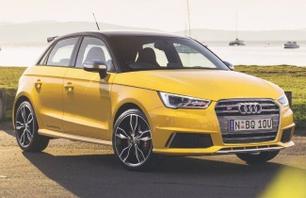
Spoilt. That's what we are. If you're in the market for a hot hatch, you can have your pick of German-built and French ones from as little as $27,000. There isn't a dud among them now that the VW Polo GTI has had a bit of an update and you can pick and choose your style. Audi's S1 is aiming to be king of the kids with its stiffly-priced S1.
Set the finances aside and consider for a moment what's on offer. As it turns out, a lot.
The new-generation RS 7 Sportback heralds the further evolution of this large majestic beast, with more features, a beautifully finished cabin and with more grunt with the looks to match. You’d be hard-pressed to find a better combination of power, dynamics and comfort in the Audi range – apart from in the RS 6 Avant of course.
Cars this small shouldn't be this fast and useable at the same time, but the Audi S1 is. It isn't without its problems - the ride is harder even than the Fiesta ST which might weary some prospective buyers.
It's also a bit difficult to justify the price - in its basic form it's missing a few creature comforts that you'd expect in a $50,000 car - reversing camera, high-res screen, that sort of thing.
However, in the hot hatch world, those things don't matter. It has the bragging rights, the tech and the outright blinding speed to take on the bonkers Focus ST and equally zany Megane RS. And even the Audi S3.
The big news is the RS 7 Sportback now comes with five seats. The previous generation car had just two seats in the second row. I'll talk more on practicality below but for now let's examine the new styling.
This RS 7 Sportback has new broad, black mesh grille, flanked by gigantic side air intakes, narrow headlights, and a thin upper air inlet which is a hat tip to early racing Audis.
While that new angrier, more angular and menacing face is a showstopper, everything about the new RS 7 Sportback seems to be accentuated further.
Look at the wheels. The previous generation came with 21-inch rims, now the new normal for the RS 7 are 22-inches – they're huge. Those wheel guards also flare out 20mm more than a regular A7's and the rear haunches have bulked up massively.
Come to the back of the car and the diffuser and bumper have also been beefed up. Nobody sitting behind you in traffic is going to think this is just a regular A7.
Don't expect the RS 7 Sportback's insides to be just as hardcore as its exterior. The cabin is almost identical to a regular A7's. It's a stunning cockpit dominated by a dash which protrudes back towards the passengers and houses the media screen. Anther display for climate is set into the big centre console which divides the driver and co-pilot into almost cocooned cells.
The cabin isn't without its RS touches though – there's the sports seats with honeycomb stitching, fully digital instrument cluster with RS specific meters, the RS steering wheel, the Nappa leather on the dashboard and the doors, the aluminium inlays. The level of fit and finish is up there with the best that I've seen on any production car.
The RS 7 Avant is 5009mm long, 1424mm tall and 1950mm across for a wide planted stance.
The A1 is so small it starts to strain Audi's design language. When you cram on the S-style bumpers and raccoon-eyed trim on the hatchback, it's starts to look a bit busy.
It isn't quite a shrink-wrapped A3 - Ingolstadt's designers know better than that - but it's full of Audi design cues, such as the strong, light-catching character lines, distinctive LED daytime running lights and fondness for big wheels.
Inside is along the themes of the A3, with what are becoming Audi's trademark; round eyeball air-con vents, the manual fold-down screen familiar to Q3 owners (but smaller) and a good clear dash. The handbrake jars slightly as it feels cheap to hold and wobbles a bit.
The S Sport seats are big and comfortable, and the top half of the backs are capped in plastic, which was colour-coded on our car. The rear passengers will certainly get an eyeful of whatever terrifying hue you've chosen, so choose wisely.
Despite the five doors, the back seats are occasionals, like the Mini the A1 is gunning for, and the boot is very small, but okay for shopping for couples or singles.
The Audi RS 7 Sportback lists for $224,000, which is exactly $8K more than the RS 6 Avant.
Coming standard are the enormous 22-inch alloy wheels, the matrix LED headlights with laser lights, metallic paint, a panoramic glass sunroof (which is new to the model), privacy glass, head-up display, soft-close doors and red brake calipers.
Inside there's the Bang and Olufsen 16-speaker sound system (that new, too), sat nav, the 12.3-inch virtual instrument cluster, wireless Apple CarPlay (new, as well), wireless charging, full leather upholstery with RS sport front seats that are heated and now come with ventilation as standard, and four-zone climate control.
I've left off all the standard RS mechanical equipment, but I'll cover that in the driving section below.
Is it good value? Well the Mercedes-AMG CLS 53 S is $186,435 but it has way less grunt, the Alpina B5 which I've also road-tested lists for $210,000 and there's the Porsche Panamera 4 Sport Turismo for $236,300.
Starting at $49,900, Audi S1 is by far the priciest of the small-hatch based hotties, at least until Mini's madcap JCW arrives. This price is just almost double that of VW stablemate's forthcoming 2015 Polo GTI.
Standard on the manual-and-five-door-only S1 is a ten speaker stereo, climate control, ambient lighting, remote central locking, cruise control, satnav, headlight washers, auto headlights with xenon low beams, partial leather seats, leather-bound steering wheel, auto wipers and rear parking sensors.
Our Misano Red ($990 option) came with two extra packs. The Quattro Exterior Package ($3990) adds bi-xenon headlights with red trim, red brake calipers, spoiler, quattro logos on rear doors (ahem!) and five-spoke 18-inch alloys that are part matt black, part polished.
The Quattro Interior Package ($2490) adds S Sport front seats with Nappa leather and red backrest capping with quattro logo (ugh), more nappa around the cabin with contrast stitching, flat bottom steering wheel and red rings on the air vents.
There's an S Performance Package that brings the best of these two packs together for $4990, saving about $1500 and the embarrassment of the quattro logos.
Our test car also had aluminium air vents ($220), black contrasting boot lid ($300) and black roof ($720).
The A1 is so small it starts to strain Audi's design language
The grand total is a sobering $58,610. There's a couple more options that'll easily pop you over $60,000.
Audi's MMI is dash-mounted in the A1 as there's no room on the narrow centre console. As ever, it works well and doesn't take much getting used to. The satnav is a bit grainy on the smaller screen but is otherwise a competent unit.
Sound is from a ten-speaker stereo and you can stream across Bluetooth or plug in a memory card. The sound was good but the system did take a while to find the phone whenever we came back to the car.
The RS 7 may look like a large, well-mannered business class car, but think of it as a thug in a suit because this thing is a monster with a 441kW/800Nm twin-turbo petrol 4.0-litre V8.
That's almost 600 horsepower and the supercar acceleration that goes with it is brutal: we're talking 0-100km/h coming in 3.6 seconds. That also matches the RS 6 Avant and it's a tenth of a second faster than the Audi R8 V10 RWD supercar, (and also the previous-gen RS 7 Sportback Performance) and this is a large, four-door, five-seater.
Compared to the previous generation RS 7 Sportback Performance the power is down by 4kW, but torque is up by a whopping 100Nm. Give me torque over power any day.
Shifting gears is an eight-speed automatic transmission, sending the drive to all four wheels.
This is where the action is. The S1's tiny body packs a 2.0-litre turbocharged four-cylinder producing 170kW and 370Nm of torque. The S1 will streak to 100km/h in 5.9 seconds thank to the traction aid of quattro all-wheel drive.
All Audi S1s come with a six-speed manual
Despite a pretty solid hammering during its week with us, including more time than we'd have liked in Sydney traffic, the stop-start function helped deliver a pretty reasonable 10.2L/100km, however that's a long way over claimed 7.1L/100km.
All Audi S1s come with a six-speed manual, so dual-clutch haters can save the whining. The only downside from not having a self-shifter is the ECU can't deliver the boy racer farts, parps and crackles of the other S cars.
I've never met an RS model that hasn't been great to drive – these cars are way more than just tough body kits and big wheels. The engineering which separates the RS 7 Sportback from the A7 makes them more distant cousins than siblings.
As I mentioned before the RS 7 Sportback and RS 6 share more than the same twin-turbo V8, there are also the giant brakes in form of 420mm discs at the front with 10 piston calipers and 370mm discs at the rear.
The optional carbon ceramic brakes are the largest ever to be fitted to a production vehicle at 440mm at the front and 370mm at the rear, saving 34kg in mass over the steel brakes.
Now standard for the first time is Audi's Dynamic Package, which adds dynamic steering (a variable ratio) paired with all-wheel steering, a sport differential, and a 280km/h top speed.
Coming standard is adaptive air suspension and for $2850 you can option the Dynamic Ride Control suspension, which is a hydraulically activated adaptive damper system
At the Australian launch, Audi supplied two RS 7 Sportbacks: one with the air suspension and the other with not only the Dynamic Ride Control system, but also the RS Dynamic Package Plus which adds the ceramic brakes and increases the top speed to 305km/h – this was the car I started off in.
I'm going to say right away that you don't need ceramic brakes for regular road use. Sure it means you can tell people that you have the biggest brakes in the world and they save you almost 35 kilos in weight, and, yes, they're resistant to fading, but they're expensive to replace and the steel ones are incredibly good.
I also feel the Dynamic Ride Control sports suspension isn't necessary in a car like the RS 7 Sportback. This is a Grand Tourer designed to eat up hundreds of miles at lightspeed in comfort.
So, while I found the first RS 7 Sportback with the big brakes and sports suspension sharper and firmer than the standard car, it didn't seem to fit with this vehicle's intent.
The regular RS 7 Sportback still accelerated with the same brutal force and roared at the scenery flashing past. It still handled through the tight corners superbly with excellent turn in, mind-boggling traction and grip, and excellent body control, but all in far more comfort.
This is the point – we covered hundreds of miles at the Australian launch of the RS 7 Sportback in a range of RS models, and sports suspension can go from great to gruelling on Aussie roads with their coarse-chip bitumen and potholes. The RS 7 Sportback, with its air suspension, not only made driving far more comfortable, but easier, too.
If you're buying the S1 as a comfortable urban runabout with a cool badge, you're half right. While the seating for front passengers is certainly supportive, the hard suspension tune will ensure you're well aware of road surface imperfections.
The S1 is a rocket
Thankfully, what it missed out on in the ride department it makes up for in every other way - the S1 is a rocket. The 2.0-litre turbo jammed under the bonnet has almost no lag and is paired with a slick six-speed manual that is terrific fun to manhandle through the gears.
The way the S1 picks up speed when it's on boost is addictive and licence-endangering. A flattened accelerator in second or third will obliterate just about anything this side of $100,000 and you'll be having more fun in this than big brother S3 because the chassis is more adjustable and there's a bit more life.
You can hear the turbo sing to accompany the bassy exhaust growl. Hit the massive brakes hard and the car remains stable even over rutted roads. Turning the wheel brings almost-instant turn-in, mashing the throttle again a fun little wriggle. It's superb.
It's tremendous fun point-to-point on a twisty road
You'll have to be a bit patient with the throttle to get the wriggle, though - give it too much too early and it will want to push wide, the quattro system shuffling power around to try and quell understeer while the electronic diff fiddles with the braking system to do the same thing. It gets there in the end, but you're better off meting out the power with your right foot for maximum rewards.
It's tremendous fun point-to-point on a twisty road - despite being a bit heavy for its size (1415kg), it's as chuckable as the next best thing, the Fiesta ST.
ANCAP tested the A7 in 2018 and gave it the maximum five-star ANCAP rating, however, this rating does not apply to the RS 7 Sportback high performance model.
That said, the RS 7 Sportback is fortified with nearly every piece of advanced safety tech there is in Audi's cupboard. There's AEB which can detect and brake for cyclists and pedestrians at speeds between 5-85km/h and vehicles up to 250km/h; there's rear cross traffic alert and intersection crossing assistance with braking; lane departure warning and corrective steering to keep you in your lane, and blind spot warning.
Not a fan of parking, the RS 7 Sportback can do it by itself, or there's a 360-degree camera that'll help you do it yourself. There's an exit warning system, which will warn you if a vehicle is approaching as you go to get out, too, and if the RS 7 Sportback detects that it will be hit from behind, it will prepare the cabin by tensions the seatbelts and closing the windows, including the sunroof.
Along with all that there are Audi's new Matrix LED headlights with laser lights, rain sensing wipers and adaptive cruise control.
For child seats you'll find three top tether points and two ISOFIX mounts across the second row.
There's no spare wheel – instead, there's a tyre repair kit.
Six airbags, stability and traction control, ABS, brake assist and distribution all add up to a five star ANCAP rating.