What's the difference?
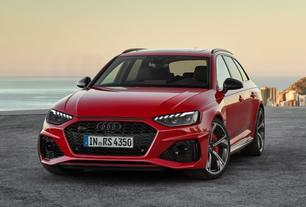
It's the end of the line for that Audi A4 as we know it. In saying goodbye to the ‘B9’ generation A4 that launched in 2015, we welcome the Audi RS4 Competition Plus.
It is the most hardcore example of the breed yet, sitting lower to the floor with hard-edged gear changes, lightweight wheels and snuggly bucket seats. You can also get it in swoopy RS5 Sportback guise.
Audi is only bringing 75 units of each down under as a swan song for the B9 generation RS4 and RS5 before the even-numbered model moves into its all-electric future.
As we’ll go on to discover, these two special models see the A4 and A5 bow out in style.
There is nothing quite like a car company occasionally building a car that could be considered a risk. And there are all kinds of risks in the car business - the market isn't ready for that car, people don't identify your brand with this or that type of vehicle, the list goes on. And it's long. It's very easy for me to sit on the sidelines and say, "Pft, what were they thinking?" Few cars land on your driveway without years of thinking having already gone into their development.
The Kia Stinger is the kind of car that would have caused lots of thinking and plenty of hand-wringing at Kia HQ in Korea. Not because it was a bad idea - it wasn't. Not because it's a bad car - it is, in fact, the opposite. And not because SUVs have already changed the way we look at cars - Kia has done well out of that.
It's just that Kia has never produced a car like the Stinger. A five-door coupe-sedan, rear-wheel drive and with a focus on driver dynamics. Most of us know very well how the Stinger GT burst on to the scene in a blaze of well-deserved glory. It's not all about the GT, though. There's a whole range of Stingers and just below that very accomplished sports sedan is the Stinger GT-Line.
What a way to send off this generation of Audi RS4 and RS5. The extra focus courtesy of those trick coil overs and drama from the exhaust plus the sharper gear changes deliver the best Audi has done with these RS products.
There are some compromises, with the suspension favouring outright control over low-speed comfort. It’s also true that the current BMW’s M3 and M4 are more impressive, but when the products are nearly seven years fresher than Audi’s, what do you expect?
Plus, those looking for a more restrained and polite fast executive sedan (or wagon) will gel with the Audi’s sophistication. There aren’t many of these Competition Plus RS4 and RS5s coming to Australia and they are impressive visually and from behind the wheel. It’s a fitting way to send off the current generations.
Note: CarsGuide attended this event as a guest of the manufacturer, with accommodation and meals provided.
The Stinger GT-Line is a great machine. It looks good, feels good to drive and while it's not the cheapest large sedan, it's also not a Camry. With a strong European vibe, it's a nice bridge between boring-dependable and out-of-reach European. Boasting a strong link to Europe in its chassis DNA, it has it all apart, maybe, from the badge.
But Kia has a habit of doing unexpected things and the Stinger was a bold move worth making just for the halo effect of having such a cool car in the range. It has done good things for the company's reputation, as though the rest of the range isn't proof already.
The RS4 Avant’s 'Progressive Red' metallic helps the black milled 20-inch alloy wheels pop. Its stance is hugely purposeful with wheels tucked right up in the blistered arches courtesy of the lowered ride height — it's how the Avant would have looked in a design sketch.
The visual bulk of the long-roofed RS4 gives it the sort of proportions motoring journalists love to wax lyrical about, even if plenty of buyers still prefer coupes or lifted SUVs.
The RS5's more flowing, elegant lines match well with the Navarra Blue paint work, silver-accented wheels and conventional leather-appointed seats within.
Both cars have effectively identical front cabins reflecting Audi’s classy and sleek design language. The integration of technology is pretty good and the RS4’s additional red styling pack really makes it feel sporty within.
The Stinger looks fantastic. I know the car has its detractors, but there's a massive Euro influence here that sits well in my visual cortex. It's maybe not as ooh-aah as the A5 or the outgoing BMW 4 Series Gran Coupe, but the Stinger can and should be mentioned in the same breath. It looks terrific, even if it is a bit fussier in the details.
From the signature grille, the low beltline, big wheels and sports coupe roofline, it looks sleek and sophisticated.
Inside is a bit more conventional, with some real classic touches such as circular air vents, conventional-looking gear selector and a flat-bottomed steering wheel. It's cool, clean and, with the big new screen, a bit more techy-looking than before. There are lots of nice materials and the odd rogue one, but it's a good cabin that feels well put-together.
The RS4's cabin is excellent, with a good mix of physical buttons and responsive touchscreens for control. There’s enough storage space for this kind of vehicle, with good door bins and well-sized cupholders in the centre as well as USB-C and -A charge points.
Audi’s multimedia system is friendly though the large touch targets and dark background aren’t as crisp as those fitted to the latest rivals. The screen isn't as big, either, measuring 10.1 inches for the multimedia item. The RS4 supports wireless Apple CarPlay and Android Auto.
That said, Audi’s 12.3-inch digital driver’s display with bright and poppy mapping software and generous customisation remains right at the head of the pack.
There is a panel of switches below the touchscreen for climate control, physical selection of the five-or-so drive modes and a collection of helpful buttons on the perfectly-shaped and sized leather-appointed steering wheel.
It lacks F1 or DTM wow-factor compared to the C63 and M3 with their easy-access driver mode buttons and toggles on the steering wheel but the RS4's restrained looks will resonate with those that prefer a bit more elegance inside.
Neither the RS4 nor RS5's back seats are designed for those over about 175cm. The RS4’s roof is a little higher so it is good enough for most adults but the RS5’s sloping profile compromises things. It has two individual buckets compared to the RS4’s three-wide bench.
Rear seat passengers get air vents, an individual climate zone, bottle holders in the doors, USB charge points and ISOFIX attachments for the outboard seats, with matching top tethers in the seat backs.
The Audi RS4’s boot is a generous 505L with under floor storage and a netted area on the driver’s side. Folding the 40/20/40 split-fold bench increases space to 1495L. That said, the RS5’s 465L is still very good, though it is not quite as practical in the real world.
Being fitted with roof rails makes for sleek integration of roof racks for the RS4 to slip roof pods, bike racks or whatever else you might choose to take on a trip away.
This is really a four-seater car. While there is good legroom in the rear, the falling roofline, small door aperture and huge transmission tunnel box you in a bit, almost rendering the middle seat useless for all but the shortest of folks. You do get your own air vents, though, which is generous.
The low roof also means limited headroom, made a little worse by the standard sunroof. I had room but taller people might brush the headlining. There are two cupholders front and rear for a total of four and each door has a bottle holder.
The boot is a modest-for-this-size 406 litres, rising to 1114 litres with the seats down. Access to the boot is good if not spectacular; the hatch opens wide but a slightly narrow aperture means loading and stowing flat packs and things like that could be a struggle.
You'd expect the RS5 to be more popular given how uncool wagons are these days but Audi's whole thing is wagons — or Avants, for the initiated — so it makes sense that the RS4 Avant outsells the RS5 Sportback about two-to-one.
For the RS4 Avant’s basic asking price of $165,015, before on-road costs, you get luxury features such as LED headlights, an RS design package, Nappa leather upholstery, power-adjust seats, a Bang & Olufsen 19-speaker sound system and metallic paint on top of the significant changes to the RS4’s chassis and zingy 331kW V6.
The RS5 is a little dearer, reflecting the addition of Matrix LED headlights that aren’t available on the wagon.
But we have the 'Competition Plus Pack', which is a $13,990 indulgence that swaps adaptive dampers for Audi’s 'RS Sport Suspension' coil over package with manual rebound and compression adjustment and height adjustment.
The cars sit 10mm lower than a normal RS4 but you can go to a dealer to move the ride height up or down from there.
That’s not it, though. You also get a louder exhaust system with matte black pipes, fixed-ratio steering system, a retuned eight-speed automatic with more aggressive shifts, different rear differential programming, black exterior badging, 2.0kg lighter 20-inch Audi Sport wheels (in silver or black), special LED entrance lights and your speed limiter raised to 290km/h.
The 'Navarra Blue' RS5 pictured is a ‘basic’ Competition Plus. You can go further, as done with the RS4 Avant with its manual-adjust bucket seats ($1300), 'Interior Design Pack' in red ($3400), matte carbon exterior pack ($6300) and carbon trim, bringing its total cost to $191,405, before on-road costs.
That makes the RS4 and RS5 the most affordable in their competitor set, below a BMW M3 Competition xDrive Touring ($183,500) and Mercedes-AMG C63 S E Performance hybrid, which is $187,900, before on-road costs.
As is the custom at this time of the year, the Stinger scored a mild update for that minty-fresh taste at the dealer. Not much has changed in the looks department (good) and the most obvious tweak is the brand-spanking new media system already seen in the brilliant new Sorento.
The GT-Line is one of two four-cylinder variants of the Stinger, priced at $57,230 or $60,690 driveaway, a solid $7000 more than the 200S and it's $730 more than the MY20. It's also uncomfortably close to the 330S, which has the delicious twin-turbo V6, but obviously a lower equipment level.
For your money you get 19-inch alloy wheels, a 15-speaker stereo, dual-zone climate control, camera package that includes a reversing camera, side cameras and front camera, keyless entry and start, front and rear parking sensors, active cruise control, powered heated and ventilated front seats, sat nav, automatic LED headlights, head up display, leather seats and wheel and even more besides. It's a lot, which is fair given the price.
The 15-speaker stereo is run by the excellent new media system on the excellent new 10.25-inch touchscreen. It's great to look at, has some really cool ideas in it (including the hilarious soundscapes list which includes, for some reason, a noisy cafe environment), DAB and Apple CarPlay and Android Auto.
Audi’s 2.9-litre twin-turbo petrol V6 has seen plenty of use across performance products from Audi and Porsche, including the Macan S and Audi S6.
In the RS4 and RS5 Competition Plus, it develops the same 331kW (at 5700-6700rpm) and 600Nm (at 1900-5000rpm) as the regular car. This makes it an extremely flexible engine that delivers predictable punch anywhere in the power band.
That said, it lacks the explosive character of BMW’s twin-turbo inline six — the figures are only 15kW and 50Nm higher on paper yet the M3’s response is that much more ferocious.
Audi’s RS division has tried to capture a bit more emotion, retuning the eight-speed torque converter automatic transmission for crisper shifts. This also benefits the RS4’s 0-100km/h sprint time, which falls two tenths to 3.9 seconds in Competition Plus guise.
The V6 breathes a little easier, too, with a different exhaust. Audi says the extra sound is down to 8.0kg less sound deadening in the car.
There’s more resonance at idle that does feel tiring sitting in traffic idling but the trade-off is a brawny mid-range baritone that develops into a shrill bark approaching the redline.
Under the GT-Line's bonnet is Kia's Theta II 2.0-litre four-cylinder turbocharged engine. It's the same as before, with a stout 182kW and 353Nm. Driving the rear wheels is an eight-speed automatic from the Hyundai-Kia empire.
It's pretty rapid, knocking out the 0-100km/h spring in just six seconds, a mere 1.1 seconds slower than its faster sibling's 4.9 for the benchmark.
The Audi RS4 wagon is rated to use 9.5L/100km in ADR combined cycle (urban/extra-urban) consumption testing while the slipperier RS5 returns 9.4L/100km in the same test.
We weren’t able to run accurate or particularly relevant fuel figures on the event but the trip computers showed around 12L/100km in both RS4 and RS5.
While these numbers are high compared to your average passenger car, the Audi is more efficient than BMW's rivals, and gets remarkably close to the hybrid C63 in the real world.
The fuel tank is quite small for this kind of vehicle at 58 litres. That limits the RS4’s theoretical driving range to 611km.
Unsurprisingly, the Audi RS4 and RS5 require 98 RON premium unleaded petrol.
Kia's claimed combined cycle figure is 8.8L/100km. As the Stinger goes without trickery like stop-start or mild hybridness, it's no surprise that my week with it yielded an indicated 10.4L/100km, which isn't bad for a 1750kg sports sedan that was not molly-coddled and also spent some time in a resurgent case of crap traffic in Sydney.
It also drinks standard unleaded, which is a nice touch.
The time allocated to driving the RS4 Avant Competition Plus was fairly limited and we were sadly unable to sample how the highly adjustable coil over suspension performed where it makes most sense — on the racetrack.
Still, winding country roads between Sydney and the Southern Highlands served up some challenges, demonstrating how the Competition Plus pack changes the character of the RS4 and RS5.
The only real negative is comfort, specifically over those horrible plastic speed bumps that litter shopping centre car parks. With adaptive dampers, carmakers can set programs for these kinds of obstacles to soften and stiffen the clever shocks at just the right time. Not so the Competition Plus pack cars, which ride these bumps harshly.
That about does it, though, and everything thing else is a net benefit. The steering system addresses some criticism of the earlier RS4s. Further than a retune, the Competition Plus gets a new rack, that is non-progressive with a fixed ratio of 15:1 (instead of 13.3:1) and 2.4 turns lock-to-lock. The reactions to each input feel a hint more faithful.
When above 40km/h the coil overs come into their own. Even though the RS4 rides firmly it doesn’t constantly jiggle over small bumps. Over sharp-edged hits, the suspension rounds the hits off so, while you feel them, there’s a sense of control and sophistication.
Having speed limits to contend with means it is essentially impossible to find the limits of grip of the 275/30R20 Continental SportContact 6 tyres on the road and there isn’t much body roll, either.
The RS4 is still rewarding, though, getting up on its toes just enough through a series of bends to feel engaging. It gives an impression of being quite light and at 1820kg it is now considered featherweight next to rivals.
The RS4's Quattro all-wheel drive system favours the rear wheels when driving normally (60 per cent rear) and can send up to 85 per cent of the drive to the back axle.
The tweaked electronically-controlled rear limited-slip differential amplifies the throttle steer-ability of the RS4, giving you the confidence to squeeze the gas on exit.
It helps that the Competition Plus bucket seats are a little thinner and set closer to the floor giving you more feedback. This is the key differentiator between the RS4 and RS5 we drove — the buckets make the car feel alive.
Strong brakes are made up of 375mm front rotors clamped by six-piston calipers. Optional carbon ceramic brakes with larger 400mm front rotors help save 6.5kg and, if you plan to use the RS4 on track, are a smart buy along with a set of Pirelli P Zero Corsa semi slick tyres ($850).
Really, though, neither the RS4 nor RS5 are the perfect car for the track. They are plenty capable and fast on the road with just enough fun, reward and character thrown in to keep you coming back for more.
I have driven and loved the Stinger GT. It's tremendous fun, goes like a rat running away from a cut snake, which itself is being chased by a mongoose with its bottom on fire, and it handles like a proper sports sedan.
The GT-Line is obviously not that quick, but it's not slow, either. But it does take a bit of the GT's DNA and delivers a driving experience eerily reminiscent of an E90 BMW 3 Series. That seems like an out-of-date reference, but it was a beautiful car to drive with a lovely balance of ride and handling.
The steering has good feel and you know what's going on underneath the front wheels. You sit towards the centre of the car, also a BMW trademark. Turn the wheel and the car goes with you, despite its bulk, and it's happy to dance a bit with its limited-slip diff.
The 2.0-litre turbo does a good job in most conditions but you feel it coming up short when you're hustling it. It's never breathless, but the torque deficit to the turbo six is clear. If you've not driven the faster Stinger, you may not notice, but there's a touch of lag in the 2.0 that contributes to the idea it's working hard to move the big sedan.
But back off a little and it becomes a fluid, fun drive. In town it's firm but very comfortable, gently bumping rather than crashing into potholes. The rear suspension is a complicated five-link set-up that costs money and eats into boot space but delivers the goods.
Given its length the Stinger is a bit tough to manoeuvre in tight spaces and its 11.2m turning circle isn't too flash either, but you soon get used to it.
The Audi A4 range was rated a maximum five stars in ANCAP safety testing in 2021, with the rating now considered expired. The stamp also only applied to four-cylinder models — so not the RS4 we drove.
It has lots of safety equipment, including eight airbags (dual frontal, side chest, front and rear side head curtains), autonomous emergency braking (AEB) functional up to 250km/h with pedestrian detection, front and rear cross-traffic alert, lane-keep assist, blind-spot monitoring, safe exist warning and tyre pressure monitoring.
Adaptive cruise control with lane-trace assist makes it an easy car to use on the motorway. The systems are well integrated and easy to switch on and off as you like.
The Stinger ships with an impressive safety package that includes seven airbags, ABS, stability and traction controls, high- and low-speed forward AEB with pedestrian and cyclist detection, intersection assist, lane-keep assist, steering assist, driver attention alert, high- and low-speed forward collision warning, front cross traffic alert and rear cross traffic alert.
You get two ISOFIX points and three top-tether anchors.
The Stinger scored five ANCAP stars in 2017.
Audi covers the RS4 and RS5 with a five-year/unlimited kilometre warranty which is now the expected norm across the premium part of the market.
A five-year service plan can be pre-purchased, costing $3630 for both models with maintenance due annually or every 15,000km.
After the five-year warranty period, owners can choose to extend the service packaging and warranty for two extra years at a cost of $4260. This can be done twice, extending the warranty up to nine years.
Kia's ground-breaking seven year/unlimited kilometre warranty along with roadside assist for the first 12 months. Each time you service your car at Kia, you get an extension on your roadside assist for up to eight years.
Perhaps the only thing that makes you go, "Oh, what?" about the Stinger is the 12 months (Good)/10,000km (Oh...) service intervals. That's pretty common with Kia's turbo engines but is a little inconvenient. Then there's the cost - prices range from $312 to $685, which adds up to $3459 over the first seven services. If you stay under 10,000km/year, that's not bad going at under $500 per year for servicing, but if you're a high-miler, it will add up.
The servicing isn't outrageous - and the prices are capped - but it's not cheap, either.