What's the difference?
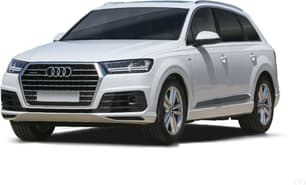
Audi’s big banger Q7 relaunched late last year with a slimmer-hipped, lower slung replacement for the old bruiser.
Interestingly there was just the single variant, a 200kW diesel turbo V6 with a six-figure starting price. A few months down the track we’ve finally scored a lower-powered, entry-level Q7.
There are a few bits missing that are standard on the more highly powered version, so with a relatively narrow price difference, is it a good fit for options-box tickers?
Richard Berry road tests and reviews the 2016 BMW X5 xDrive40e with specs, fuel consumption and verdict at its Australian launch.
Do you know why we haven't walked on the moon since Christmas, 1972? No deadline, that's why. “Oh the moon's not going away we can go there whenever...” you say. Wrong! Just like this road test, nothing happens without deadlines, including the small steps to save the world like BMW's first plug-in hybrid SUV, the X5 xDrive40e.
At the launch of the X5 xDrive40e in April this year BMW's executives freely admitted that without this hybrid and others like the 330e sedan there'd be no way they could meet the hard-core emission target Europe will bring in for carmakers. The emission deadline: The year 2020. Fail and they'll be fined, heavily. That's how things get done. And that's why you can now gorge yourself on a big, fat 2.2 tonne luxury SUV that can glide silently to work and back on electricity. Sure the electric power runs out after 30km but don't most of us live within 15 kays of where we work? That's what the Department of Infrastructure says.
There's only one grade of xDrive40e, it sits towards the top of the X5 line-up and it's a match in price and specs for its xDrive40d diesel brother. That emission deadline doesn't just have Bimmer under the pump, Mercedes-Benz has just launched its hybrid rival to xDrive40e, the GLE 500e and Audi has its Q7 e-tron on the way.
The 200kW Q7 is a brilliant car and the 160kW is little different. It’s hard to make the economic case for spending less, though, as options will quickly land you in 200kW price territory unless, of course, you’ve stretched yourself for the $96,300 in the first place.
If you have stretched, you’re getting an even better overall car than the excellent BMW X5. The fundamentals of the Q7 are such that you could almost whack the 2.0 TFSI from the A3 in it and it would still be just fine.
The hybrid technology in the xDrive40e is awesome and it makes so much sense fitting it to an X5, which if we're honest with each other won't leave the city much and will probably sit in a lot of traffic. A big issue is the range – sure most Aussies live close to work, but in real world conditions it's less about range and more about energy needed to move the car. Just climbing a small hill over a short distance in electric only will see your charge drop fast. To get the super low fuel economy you'll need to charge it fully and regularly and fairly flat commuting terrain.
The xDrive40e is just the start of things to come, so we can forgive it for not being perfect. As the 2020 deadline looms the technology will get better and become more common place.
The new Q7 is, thankfully, a lot less imposing than the first generation. That car really did loom and as time went by it became ever more covered in bling. The restraint of the new car is admirable (and good business sense – there’s bound to be a bigger Q8 before long) and looks more like a jacked-up wagon than a full-on SUV.
As is Audi’s wont, there’s lots of aluminium, particularly in the MQB Evo chassis itself (shared with some pretty posh things like the Bentley Bentayga) as well as doors and bonnet.
Despite being smaller, there are still seven seats in the Q7, with a reasonably accessible pair of rear pews providing you’re at least four years old and in possession of two working legs. That third row gets its own air-conditioning vents, cupholders (there are six in total) and somewhere to store your ration of Smarties.
The middle row of seats can be slid fore and aft through about 15cm to liberate or rob the third row of space. The middle rear seat passenger does have to contend with a fairly solid transmission tunnel, however.
Storage is well scattered around the cabin, with four bottle holders, a shallow bin under the centre armrest and a few cubby holes here and there to supplement the good-sized glove box. Audi says the minimum boot volume is 770L with the third row of seats down and 1955 with both rows folded away. With the third row up, an educated guess says somewhere in the region of 300L is still available. There's also ISOFIX child seat mounts for all five rear seats.
The driver gets a clean, clear dashboard with two big dials flanking the central info screen and, as usual, everything is spot-on ergonomically. The dash is considerably less visually weighty than the old car, with full width air-con vents, the middle section blowing diffuse air so you’re not in a windtunnel from a 1980s music video clip.
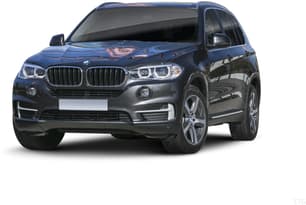
Aside from some tiny eDrive badges and the flap at the front for filling up with electricity, the xDrive40e is identical in looks inside and out to the X5 xDrive40d.
Like all X5s the xDrive40e is 4886mm end to end, which makes it 67mm longer than the GLE 500e. To put that in perspective a Commodore sedan is another 80mm longer at 4966mm. But it's the width and height which makes the X5 the car equivalent of a woolly mammoth – 2184mm across and 1762mm tall.
Ground clearance is 209mm and if you're keen the wading depth is 500mm.
The third generation X5 arrived in 2013 and its pretty-but-tough looks have aged well. Inside is the familiar BMW cabin landscape of the slab-like dash with orange LCD climate controls and display screen, plus comfortable and supportive seating.
At 2230kg it's 120kg heavier than the diesel X5 because it's carrying a stack of batteries and an electric motor, along with all the accompanying cabling.
With a price just a few thousand down on the original 200kW version, it almost seems like Audi doesn’t really want you to buy the base model. The price difference is “only” $7600. Remember that bit.
Despite the lower sticker, there is a generous equipment list, particularly on the safety front. Standard are a 10-speaker stereo with DAB+, Bluetooth and dual USB ports, 19-inch alloys, dual-zone climate control, blind spot sensor, reversing camera, keyless entry and start, front and rear parking sensors and park assist, cruise control, electric front seats with driver’s seat memory, satnav, bi-xenon headlights with level adjustment, auto headlights and wipers, leather trim (some real, some not), electric tailgate and tyre-pressure monitoring.
Our car had the optional Audi Connect wifi hotspot feature ($750), metallic paint (at a hefty $2400), Assistance Package - which adds adaptive cruise, active lane assist, pre-sense front, traffic jam assist, collision assist and turn assist ($4075), LED headlights ($2800!), Parking Assistance Package, which adds auto-parking and 360-degree cameras ($1300), full body paint finish ($1300) and interior inlays of high gloss black and oak (an even more mystifying $1690). This brought the total to an eye-watering $110,615.
That’s only $5000 less than a similarly optioned 200kW, which has a few more standard additions, more power obviously, bigger wheels and the full digital “virtual dashboard” from the lovely TT. Of course, neither Q7 is particularly cheap. If you’re willing to lose all-wheel drive, you can have a BMW X5 starting at $86,200 for the rear-wheel drive 170kW 2.0 diesel (but only with five seats).
Audi’s MMI system controls the operation of the retractable 8.3-inch screen that rises majestically from the centre of the dash. MMI looks after the entertainment, satnav and various settings of the car and does a fine job of it, supplemented by a generous touchpad for you to write out your destination with your finger, or choose your radio station.
You can also speak in reasonably normal terms to the nav via voice activation and it will take you to the nearest public toilet, or a petrol station or a nearby Italian restaurant.
The X5's pricing ranges from $86,200 for the front-wheel drive sDrive25d and heads north to $149,900 for the X5 M50d. The xDrive40e matches the $118,900 price of the xDrive40d and just like the diesel comes standard with leather upholstery with aluminium trim, 10.25-inch touchscreen with sat nav, reversing camera and surround view camera, park assist, head-up display, Harman/Kardon sound system active cruise control and 19-inch alloys.
The eight-speed automatic transmission
The price of the xDrive40e we tested is $130,400, because it was fitted with the $3300 M Sport Package that gave it 20-inch rims, adaptive M suspension, the M leather steering wheel and M body kit. Another $3700 added the panorama sunroof, which isn't all that panoramic. Adaptive LED headlights cost $2000; then there's lane change warning for $1400 and $1100 for the ceramic surrounds to the media system dial.
For that much money, you'd expect proximity unlocking, which comes standard on a $27K Hyundai i30 SR.
The 160kW is the same basic unit as the 200kW, just with the lower power figure and 500Nm of torque (down from 600Nm) to push its 2135kg frame to 100km/h in 7.3 seconds.
Fuel economy, courtesy of the ZF eight speed automatic and stop-start, is a claimed 5.8L/100km and, it must be said, a fairly unlikely figure to achieve. We saw 9.2L/100km on the dash display, which is still pretty impressive for such a large vehicle.
The Q7 is also rated to tow 3500kg with trailer brakes.
Under the bonnet is a 180kW/350Nm four-cylinder turbo-petrol engine, back a bit further near the gear shifter is the 83kW/250Nm electric motor, combined they make 230kW and 450Nm. It's enough grunt to do 0-100km/h in 6.8 seconds. The quickest X5 is the V8 xDrive50i which can smash 0-100km/h in 4.9 seconds. Still the hybrid is 0.9 seconds faster than the four-cylinder xDrive25d diesel, so that motor does add considerable shove. The eight-speed automatic transmission is damned-well superb.
It might be down 40kW and 100Nm of torque, but the Q7 still feels pretty nimble for what is a very heavy car, despite its average weight loss of 325kg. The mid-range is very strong, meaning effortless overtaking from rarely more than a toe on the throttle pedal. When your car is this big, the last thing you want to be worrying about is whether it will trip over itself when you’re in the cut and thrust of the school pick up or daily commute.
This is the first Q7 I’ve driven without the air suspension and it was a pleasant surprise. It rode and handled almost as well and you’d have to wonder whether it’s worth the extra outlay. When a press fleet has nothing but air-suspended cars, it makes journalists suspicious; I’m pleased to say there was no need. The only real difference is more noticeable body roll when you’re getting a bit ambitious in the corners. Not really a Q7’s core business.
The steering is quite light but weights up nicely in dynamic mode. It’s tidy in the bends and excels in the wet or dry; its stay with us coincided with some truly apocalyptic rain, which the car simply shrugged off. Needless to say, the cabin is extremely quiet, with just a slight rustle around the wing mirrors and a distant growl from the engine.
As much as I would like to say that I did the 9.8km commute from home to work on just electricity, I didn't. I wasn't able to charge the batteries more than 17 per cent in my daily driving. That said on 17 percent I could get close to work and then travel the last few remaining kilometres just on petrol. It was the hill near my house which drained the juice most rapidly, but the rest of the commute is flat and bumper to bumper with other suckers like me crawling to work at about 15km/h – perfect conditions for xDrive40e.
In the driver's seat it feels almost like any other X5. The ride is comfortable, the steering is pinky-finger light and pin-point accurate while the forward visibility is excellent.
The X5 will flick over automatically from electric motor to petrol engine when the charge runs out and the transition is almost imperceptible. Not so seamless is the handling, the batteries combined with the rear suspension seems to be a recipe for a bit of roll. On one trip I was a passenger in the back seat and wasn't too impressed with how much movement I experienced back there.
Eight airbags, blind-spot sensor, forward-collision mitigation, forward-collision warning, lane-departure warning, rear cross traffic alert and active safety bonnet all add up to the maximum five ANCAP safety stars.
The Assistance Package, which adds adaptive cruise control, active lane assist, pre-sense front (to keep you from crashing into the car in front), collision assist (helps you out with your braking and steering when the car thinks you’re heading into a crash) and turn assist (stops you turning into the path of an oncoming car).
BMW are awaiting results for ANCAP testing. There's warning systems for lane departure, forward collisions and pedestrians but while there's 'light city braking' it doesn't have AEB.
Being almost totally silent in electric-only mode an artificial sound is played to warn people that you're coming through at speeds under 30km/h.
There are three top tether anchor points and two ISOFIX mounts for child seats.