What's the difference?
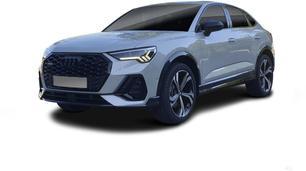
The 2025 Audi Q3 Sportback is a small but not-too-small SUV that sits within a close-knit segment. The Q3 Sportback attempts to spice up the premium end of this small SUV market by offering a design-focused 'coupe' body style, but is it enough for it to go 'tyre to tyre' against its main rival, the new BMW X2?
It's other rivals are also renowned for their luxury and on-road prowess - think the Mercedes-Benz GLA and Lexus UX. However, the changes for the new Q3 are small and its rivals have all benefitted from a recent refresh.
In this review we explore how the top-model Sportback S line 40 TSFI quattro handles being an urban dweller.
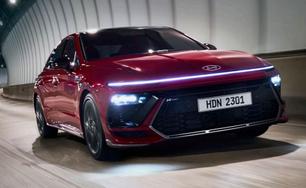
The Hyundai Sonata N Line is a sedan. Not a hatchback, not a fastback, nor a coupe and definitely not an SUV.
And even though only a handful of people in Australia buy the Sonata N Line each year it’s been updated with a completely different look and new technology, making it an outstanding car in many ways.
The thing is, because we’re obsessed with SUVs in Australia most people will never know how good this sedan is - unlike you.
So, let me congratulate you for making it this far. There’s probably so few of you I could possibly congratulate all of you in person. In an afternoon.
The big question is, though, is the Sonata N Line fit for Aussie families? Well, it scores well, but maybe not where it counts…
Let’s see what’s new and what the Sonata N Line can do.
The Audi Q3 Sportback S line 40 TFSI quattro is a quiet achiever.
Not as flashy or performance driven as some of its rivals, it still manages to tick almost every box when it comes to comfort and features. Like most models in the class, space in the back seat is modest but for a top-spec non-performance model, the price is alright and it’s lovely to drive.
The updated Sonata N Line looks beautifully modern from its new face to the refreshed cockpit, while remaining a ‘driver’s car’ with good dynamics, and a sporty engine.
The Sonata isn’t an ideal family car, however. This is down to a lack of practicality. Although the cabin is fairly roomy, if that roofline wasn’t so coupe-like and cabin storage was better, and the boot had a large hatch opening, and the ride height was more elevated then it would be a great family car. Oh, I’ve just described an SUV.
Note: CarsGuide attended this event as a guest of the manufacturer, with meals provided.
The Q3 Sportback blends the practicality of an SUV with a sports-car presence due to its wide 2022mm stance and coupe-styled rear. With the black accents across the body, big 20-inch alloys and sharp Matrix LED headlights, the Q3 Sportback more than holds its own against the sporty prowess of its rivals.
The cabin establishes that it sits within the premium market with its leather mix upholstery and flashy-looking tech that headlines an angular dashboard. However, it's understated compared to its rivals, which all boast a stronger cabin presence.
Overall, it's not a ‘look at me car’ but the longer you look, the better it gets.
So, we’ve established that the Sonata N Line is a sedan and that means if you’re still reading this you are, a) A Sonata owner looking to trade the old one in for this new one, b) Driving another type of sedan such as a Toyota Camry or Volkswagen Passat and looking to update your trusty steed with one from Hyundai or c) Not in the market for an SUV.
Whatever the reason, sedans lend themselves to being sleek and sophisticated in their styling just by being lower to the ground than SUVs and generally longer than sports cars.
The Sonata N Line is long at 4.91m end-to-end. That’s only 8.0cm shorter than the gigantic Hyundai Palisade which has eight seats. I know… it bends the mind.
This new Sonata N Line looks even wider than the previous version, too, with that broad flat bonnet meeting the Seamless Horizon LED strip.
Fact is the Sonata N Line is 1.86m across - exactly the same as the previous version. Remind me never to wear a 'seamless horizon' T-shirt on days I’m feeling rotund.
If you look closely at the photos you can see the hidden LED headlights flanking the large, dark and low-set grille.
The rear of the new Sonata looks so different from the previous version, too, with its boot lid spoiler and LED tail-lights.
The menacing body kit comes with the N Line grade and accentuates the sporty nature of this car. It’s a good thing it has an engine to back up the looks, but more on that later.
Inside, the Sonata has been given the new 12.3-inch curved screens and a digital climate control display, while the steering wheel is new and adorned with the Hyundai 'Morse Code' badge (the letter H is four dots in Morse Code). It’s a premium and modern looking cockpit topped off with suede and leather leather N Line sports seats.
The Q3 Sportback offers plenty of head- and legroom up front, with access that is accommodating because of the wider door apertures.
Like its rivals, the back seat offers modest space for my 168cm height, but it might be a squeeze if you taller. The middle seat suffers the most with legroom due to the tall transmission tunnel – keep this seat for kids only.
However, all other seats offer well-rounded comfort with decent-padding, side bolsters and the front get extendable under-thigh and lumbar supports, as well as heat functions.
The rear row also gets directional air vents, reading lights, two USB-C ports and a 12-volt socket. Longer trips will be comfortable for four occupants but five will elicit some grumbles.
Storage is good for the class with a glovebox that can fit a manual, a medium-sized middle console and a large phone tray. There are four cupholders and four drink-bottle holders throughout the car, and the rear row also get two map pockets.
The boot offers class leading space with its 530L capacity and only the BMW X2 beats it (by 30L). Storage options open up again with the 40/20/40 split of the rear row. The top model gets a powered tailgate with gesture control and temporary spare tyre.
Technology looks high-end and the touchscreen multimedia system is easy enough to use once you get your head around the menus. The built-in satellite navigation is top notch and the directions are pulled through to the digital instrument cluster.
The Q3 now gets wired/wireless Apple CarPlay and wired Android Auto. The CarPlay maintained a steady connection this week. Charging options are great with a total of four USB--C ports, two 12-volt sockets and a wireless charging pad to choose from.
Sedans might be sleek and sophisticated but practicality is not typically their strength because their low height means passenger access isn’t as easy as it is with an SUV, but mainly because the cargo carrying ability is limited by the relatively small boot opening.
Still, the Sonata N Line does have a big 480-litre boot and cabin storage has been improved thanks to the gear shifter being relocated to the steering column and freeing up space in the centre console for stowing items and a wireless phone charger.
Rear legroom is also good. I’m 189cm tall and I can sit behind my driving position with space to spare. Headroom back there is also good thanks to contoured heading which has a ‘carved out’ section for extra space.
Along with the wireless phone charger there are two Type-C USB ports up front and another two for the second row.
There are four cupholders (two up front and two in the second row) and decent sized bottle holders in the doors.
This lack of practicality compared to an SUV or even a station wagon means the Sonata N Line really isn’t the perfect family car.
There are four variants for the Q3 before you hit the high-performance model, and our test vehicle is the top S line 40 TFSI quattro model, which is priced from $70,800, plus on-road costs, making it the most affordable compared to its rivals.
Its closest rival is the Lexus UX300h AWD F Sport with a price tag of $73,210, then the BMW X2 20i M Sport at $75,900, and the Mercedes-Benz GLA 250 4Matic sits at the top at $79,700.
Our test vehicle has also been fitted with an upgraded Sonos 3D surround sound system and sunroof for an additional $3900.
As one would expect for a top model, the S line is well-equipped and includes electric and heated front seats, leather upholstery and high-end technology throughout, which includes a 10.1-inch touchscreen multimedia system, a 12.3-inch digital instrument cluster, satellite navigation, wireless Apple CarPlay, wired Android Auto, Audi Connect app with over-the-air updates, four USB-C ports, a 12-volt socket and a wireless charging pad.
Practical features include keyless entry and start, adaptive LED headlights, a frameless auto-dimming rearview mirror, rain-sensing wipers, a powered tailgate (with gesture control) and a park assist feature.
It's features list mostly mirrors that of its rivals, but it does miss out on ventilated front seats.
Hyundai offers one type of Sonata in Australia, so there’s not a lot of choice. Actually there’s no choice: it’s the petrol version of the Sonata in the sporty N Line grade or nothing.
But if I were to choose one Sonata this would be the one, even if at a list price of $55,500 it’s quite expensive and about $3500 more than the previous Sonata N Line.
In return for the almost $56K price you’re getting a lot of standard features, including a mountain of new equipment for this updated model.
So, new for this 2024 Sonata are dual 12.3-inch curved screens for media and driving instruments, the digital climate control display, there’s a column-mounted gear shifter, LED ambient lighting and a hands-free boot lid. That’s in addition to proximity unlocking, sat nav, Apple CarPlay and Android Auto and a 12-speaker Bose sound system.
There’s also suede and Nappa leather seats, a leather steering wheel, sunroof, dual-zone climate control, heated and ventilated front seats, a heated steering wheel, LED headlights and the LED strip which wraps around the front of the Sonata.
Hyundai calls it the 'Seamless Horizon', which sounds beautifully poetic and leads us nicely into the Design section of this review.
Our test vehicle keeps it's tried and tested 2.0-litre four-cylinder turbo-petrol engine, which produces 132kW of power and 320Nm of torque. Those outputs are slightly less than most of its nearest rivals and it sports a slower sprint time of 7.8 seconds.
The Q3 Sportback is a quattro, which means it has an all-wheel drive and it boasts a silky-smooth seven-speed auto transmission.
While it doesn't induce strong sports-car vibes on road, it’s not a car you'd ever have the audacity to call slow.
The Sonata N Line comes with a 2.5-litre turbo-petrol four-cylinder engine making 213kW and 422Nm, which is plenty of oomph, and it all goes to the front wheels through an eight-speed dual-clutch automatic transmission.
So no, there’s not a diesel version nor an all-wheel drive version, but this sporty engine suits the Sonata N Line perfectly.
That said a hybrid variant would be good seeing it’s 2023.
The official combined fuel cycle figure is 8.2L/100km, but the real-world usage is at 8.6L after doing a mix of open-road and urban driving. Considering the lack of restraint shown for really giving this model a real 'go' on the open-road, the fuel usage is respectable.
Based on the official combined fuel cycle and 60L fuel tank, you should see a theoretical driving range of up to 732km, which is good for any longer road trips you might want to tackle.
As we were saying above there’s no hybrid variant of the Sonata N Line and there should be. Actually there is, but Hyundai says it isn't available for the Australian market.
So, this turbo-petrol four-cylinder is all we have and according to Hyundai it uses 8.1L/100km on the combined cycle.
When we tested it at the launch our trip computer was reporting exactly 8.1L/100km, but the roads were clear, the traffic was nowhere to be seen, so you can expect that consumption to climb higher if you’re commuting around the city.
The power delivery for the Q3 Sportback S line model is effortless. It doesn’t have the thrum or burbling of a turbo, but the power is well and truly there whenever you need it. So, while not as ‘powerful’ as some of its rivals, you don’t feel like you’re missing out.
The low and wide stance of the Q3 Sportback translates to nimble and direct handling – you can take corners at speed with almost no roll and the steering sits within the goldilocks zone for firmness.
A downside is the cabin noise, which is fairly loud with road and wind no matter the speed – but you don't have to raise your voice. You'd expect a bit of noise with the big wheels, but you always hope for more refinement at this grade level.
The Q3 isn’t difficult to park, but it does take a moment to get your bearings on how it fits a space, as it’s bigger than you might expect. The 360-degree camera is super clear, which takes out a lot of the guesswork.
The car feels like an extension of you as a driver which elevates the overall on-road experience despite not being a performance model. This would be well-suited for a driver who wants great on-road performance without feeling like someone who is in a mid-life crisis.
The Sonata N Line’s performance matches its sporty looks. That turbo-petrol engine is responsive and provides great acceleration, the transmission shifts fast and the steering is nicely weighted and accurate.
Add to this better rigidity in the car’s structure in this updated model and a feeling of stability thanks to this being a sedan with a low centre of mass and you have a dynamic and enjoyable vehicle in your hands.
Sure it doesn't have the sky-high visibility that comes from the pilot’s seat of an SUV, but the Sonata N Line is for those who like to drive but still want the practicality of four doors, back seats and a boot.
The Q3 has a maximum five-star ANCAP safety rating from testing done in 2018 and it scored highly with the adult protection score sitting at 95 per cent, child protection score at 88 per cent, and safety assist systems score at 85 per cent, and it's vulnerable road sits at 76 per cent.
Unfortunately, the Q3 only features six airbags, which is fairly low for this day and age and misses out on a front centre airbag.
Standard safety equipment is robust and includes blind-spot monitoring, driver attention alert, a First Aid kit, a warning triangle, tyre pressure monitoring, rear cross-traffic alert, lane keeping aid, lane departure alert, traffic sign recognition, intelligent seatbelt warning, adaptive cruise control with stop/go function, park assist, a 360-degree camera and front and rear parking sensors.
There are two ISOFIX child seat mounts and three top tethers but two seats will fit best.
The Q3 has AEB and forward collision warning with car, pedestrian and cyclist detection. This system is operational from 5-85km/h (and up to 250km/h for car detection).
The Sonata N Line hasn’t been tested by ANCAP, but it does have an extensive armoury of safety tech including AEB (which also works at intersections) able to detect pedestrians, cyclists, other cars and now motorbikes.
There’s blind spot warning which pulls you back into your lane and lane keeping assistance, plus rear cross-traffic alert with braking, as well.
A rear occupant alert will remind the driver there are passengers in the back seat and 'Safe Exit Assist' will protect children from opening the door into moving traffic.
Along with all this, which Hyundai bundles together in its 'Safety Sense' package as standard on the Sonata N Line, there are also side airbags protecting the rear passengers and plenty of airbags in the front for the driver and passenger.
The Q3 comes with a five-year/unlimited-km warranty, which is a normal term for the class.
You can pre-purchase a five-year servicing plan, which costs $3330 overall, or $666 per service which is competitive for the premium segment.
Servicing intervals are reasonable at every 12 months or 15,000km whichever occurs first.
The Sonata N Line is covered by Hyundai’s five-year, unlimited-kilometre warranty.
Servicing is recommended annually or every 10,000km. There’s no capped price serving but you can buy a 'Lifetime' or a five-year plan that work out to be between $350-$400 on average a year.