What's the difference?
Since 1949, Abarth has been giving the venerable Italian brand, Fiat, a patina of performance, based largely on giant-killing feats in small modified cars like the Fiat 600 of the 1960s.
More recently, the brand has been revived to boost the fortunes of the smallest Fiat on sale in Australia. Known formally as the Abarth 595, the tiny hatch packs a bit of a surprise under its distinctive snout.
I know, picture Ferrari and you'll likely be conjuring images of potent V12 or V8 engines, a scenery-shaking exhaust bark on start-up and a fuel bill that would make a Sheikh wince.
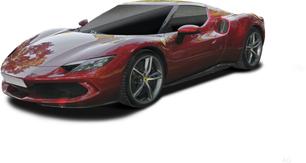
But this one, the 296 GTS, doesn't have, or do, any of those things. In fact, it doesn’t so much explode into life as it does kind of whirr gently, as though you’ve just switched on a photocopier.
And yet, people I trust on these matters reckon this just might be the best Ferrari to have ever worn the badge. So, I guess we better get to figuring out what the hell is going on with this plug-in Prancing Horse.
It’s tough to be kind to the Abarth 595. Based on a platform that’s more than a decade old, the car has been left behind by its rivals in many ways, including basic ergonomics and its value equation.
The larger engine does work well in this smaller package, and its road-holding ability belies its size. However, only die-hard fans of the Abarth brand will be able to cope with the uncomfortable seating position and a complete lack of even the most perfunctory features that cars costing $10,000 less are able to offer.
Anyone who says electrification somehow muddies the Ferrari formula is wrong. This plug-in Prancing Horse is among the most potent and direct vehicles I’ve ever driven, and the electric motor only adds to the experience.
Despite being based on a design that’s a decade old, the Abarths still stand out. Based on the classic Fiat 500 shape of the 1950 and '60s, it’s more cute than cut-throat, with a narrow track and tall roof giving it a toy-like presence.
The Abarth attempts to beef things up with deep front and rear bumper splitters, go-fast stripes, new headlights and alternate-colour wing mirrors.
The 595 rides on 16-inch rims, while the Competizione runs 17s.
Inside, it’s definitely different to most mainstream cars, with colour-coded plastic panels on the dash and a very upright seating position, along with a dual-tone steering wheel.
It’s a love-it-or-hate-it proposition. There’s no middle ground here.
It is hard not to swoon when you gaze upon the 296 GTS, and I say that with no bias - I don’t think all Ferraris have looked this good.
But this is Ferrari at its dreamy, sweeping best, from the tarmac-kissing front — which generates so much downforce and cooling it negates the need for active aero — to its swollen haunches and the glass-topped engine window.
So what’s the difference between this and the GTB? Largely it is the ability to drop the folding roof, meaning you can feel the wind in your hair and that exhaust in your soul. To be honest, though, I reckon it looks better top up...
It’s a cockpit-style driver’s set-up inside, and there’s lots I love and some things I don’t. But let’s start with the steering wheel, which might be one of the best in existence.
It feels magic under the touch, as do the giant flappy paddles which remain fixed in place as you turn the wheel.
It’s also surprisingly comfortable in the figure-hugging sports seats, though climbing in and out of them is not necessarily something you want to do in front of a crowd.
Downsides? There is plenty of tech in the 296 cabin, but it’s all controlled from the steering wheel, making it fiddly and annoying to use.
Also, there are F1-levels of complexity on the control-everything steering wheel, and if I’m being honest, there are some buttons or switches, the function of which I still don’t fully understand.
This is another area where the Abarth falls down. First and foremost, the seating position for the driver in both cars is utterly compromised.
The seat itself is mounted far, far, too high, and has little adjustment in any direction, and there is no reach adjustment in the steering wheel column to allow a taller (or even an average height) driver to get comfortable.
The more expensive Competizione we tested was fitted with a set of optional sports bucket seats from racing company Sabelt, but even they are mounted literally 10cm too high. They are also ultra firm, and even though they look supportive, lack decent side bolster support.
The tiny multimedia screen is okay to use, but the buttons are miniscule, while there’s a complete lack of storage places in the front.
There are two cupholders under the centre console, with two more in between the front seats for rear seat passengers. There are no bottle holders in the doors and no storage for rear seaters.
Speaking of the rear seats, they are the very definition of cramped, with little headroom for moderately sized adults and precious little knee or toe room. There are two sets of ISOFIX baby seat mounting points, though, should you fancy wrestling your wriggling toddlers through the narrow aperture.
The seats flip forward to reveal more cargo space (185 litres with the seats up, and 550 litres when the seats are down), but the seat backs don’t fold flat into the floor. Under the boot floor is a can of sealant and a pump, but no space saver spare.
In truth, it was a long day testing this car… at 187cm, I simply could not get comfortable in it at all.
What do you want to know around practicality? We’re talking two seats, about 200 litres of cargo space total and a couple of smallish storage spaces in the cabin. And… that’s about it.
Next question, please.
The range has been stripped back to just two cars, and costs has come down slightly, with the 595 now starting at $26,990, plus on-road costs.
A new 5.0-inch touchscreen multimedia system (with digital radio), a leather wrapped steering wheel, TFT dash display, rear parking sensors, alloy pedals, 16-inch alloy rims, and (front-only) adaptive dampers are standard on the base 595.
A convertible, or more accurately, a rag-top (cabriolet) version of the 595 is also available for $29,990.
The 595 Competizione is now a whopping $8010 cheaper at $31,990 with a manual gearbox, leather seats (Sabelt-branded sports buckets are optional), 17-inch alloys, a louder Monza exhaust, as well as front and rear adaptive Koni shocks, and Eibach springs.
Unfortunately, what stands out more on the Abarths is what they don’t come with. Auto lights and wipers, cruise control of any sort, driver aids including AEB and adaptive cruise… even a rear view camera is missing.
What’s more puzzling is that the Abarth’s architecture, though a decade old, has provision to accept at least a rear view camera.
Abarth’s explanation that the car’s home market doesn’t see these inclusions as important doesn’t really hold water, either.
In terms of value, the lack of basic content sends the Abarth to the bottom of a competitive pile that includes both the Ford Fiesta ST and the Volkswagen Polo GTI.
Okay, hold your breath for a moment. The 296 GTS lists at $668,146, which is a sizeable jump over the hard-top GTB, which is more like $551,800. But what price a little open-air freedom?
What you get for that investment is a two-part (solid) folding roof, of course, but also what might be Ferrari’s most high-tech offering to date, with a plug-in hybrid system delivering potent performance rather than a usable EV driving range, a mega-clever braking system and an almost telepathic six-way 'Chassis Dynamic Sensor' designed to link the car’s key functions to make the experience, and the driver, somehow better.
Elsewhere, there are sports seats, Matrix LED headlights, 20-inch alloys, keyless entry and a very cool engine start touch-button on the even cooler steering wheel.
Oh, and there's wireless charging and Apple CarPlay, both thankfully standard in Australia, the latter controlled through the steering wheel and digital driver display.
It's all beautifully finished and a joy to behold and sit in.
The Abarth 595 pair use the same 1.4-litre 'MultiJet' four-cylinder turbo engine in differing states of tune. The base car makes 107kW/206Nm, while the Competizione makes 132kW/250Nm, thanks to a freer-flowing exhaust, a larger Garrett-branded turbocharger and an ECU re-tune.
The base car can do 0-100km/h in 7.8 seconds, while the Competizione is 1.2 seconds quicker; the optional 'Dualogic' automatic is 0.2sec slower to the mark in both cars.
A five-speed manual gearbox is standard, and neither car is fitted with a limited slip diff.
Now we're talking. The powertrain here is both tremendous and terrifying, pairing a 3.0-litre twin-turbo-petrol V6 with a rear mounted electric motor, and a 7.5kWh battery, to deliver a total 610kW and 740Nm. That power is fed through an eight-speed dual-clutch auto transmission.
Those are, frankly, scary numbers, and enough, Ferrari says, to dispatch 100km/h in just 2.9 seconds, and to push on to a top speed of 330km/h.
Over 150km of testing, the Competizione consumed a dash-indicated 8.7 litres per 100km, against a claimed combined fuel economy figure of 6.0L/100km. Our brief test of the 595 revealed a similar number, against the same claimed figure.
The Abarth will only accept 95 octane fuel or better, and its small 35-litre tank is good for a theoretical 583km between fills.
As well as the ability to start up and slink away silently, the Ferrari 296 GTS’s little battery will deliver a 25km EV-only driving range, and contribute to the overall claimed fuel use of just 6.5L/100km.
Charging is AC only, and the the brand reckons it takes around 90mins to top up using an 11kW charger. The self-charging is on-point, though, with the Ferrari able to quickly recoup energy from braking and the like to top up the battery without needing to plug in.
Ergonomics aside, the combination of torquey engine and lightweight car is always a good one, and the 1.4-litre turbocharged four is a good match with the front-drive Abarth.
There’s always enough mid-range urge to give the Abarth the hurry-up, and the longer-legged five-speed gearbox is a good match for the engine.
It also grips and turns surprisingly well, despite the Sport button adding too much artificial weight to the Abarth’s steering feel.
That same button also firms up the front dampers on the 595 and all four on the Competizione, which works well on smoother terrain, but stiffens it too much over more undulating surfaces.
Around town it can be hard to strike a good balance between ride and comfort. The difference between soft and firm is much more pronounced in the Competizione, but it will still get tiring if your commute is a bumpy one.
The turning circle, by the by, is ridiculously large for such a small car, making u-turns - already compromised by the lower front bumper - unnecessarily fraught.
The Monza exhaust on the Competizione gives it a bit more presence, but it could easily be louder (or at least more crackly) again; you’re not buying this car to be a wallflower, after all.
The engine is undoubtedly a highlight, and we’ll get to that in a moment, but I first want to talk about the steering in this car.
It might sound like a weird point to get hung up on, but it is sensational, and maybe the best I’ve ever experienced. Generally speaking, super-responsive steering can risk feeling overly sharp and uncomfortable when cruising, but somehow the 296 manages to feel super natural, super responsive, and super engaging, without every feeling sharp or darty. It’s just predictable, responsive, and spectacular.
Honestly, it is a highlight of a drive experience filled with highlights, with another being the dual-nature of this drop-top supercar. Long before I got anywhere near a twisting road I needed to navigate the usual nightmare that is Sydney, tackling traffic, suburbia, freeways, tunnels and expansion joints galore, and the 296 never felt uncomfortable.
Instead, the 296 slipped into a comfortable kind of lope, never jarring or rough, and eminently easy to get along with. And yet, when you arrive on the right road that veil of sensibility drops, and the Ferrari quickly reminds you of its potential.
For a start, the acceleration is properly, startlingly aggressive. Engage the 'Qualification' drive mode (which unlocks the full might of the Ferrari's electrified powertrain) and flatten your right foot, and you'll find the world suddenly hurtling past your windows, and your knuckles will no doubt whiten as you feel the rear tyres fighting for traction against the onslaught should you try it on anything but the straightest of roads.
It's addictive, but it's just one element of a near-perfect combination on offer here, with the 296 GTS the stiffest Ferrari drop-top to date, which becomes immediately clear as you start to attack corners with ever-growing confidence.
Grip, stability and stiffness in spades, the GTS delivers. And all accompanied by an exhaust howl so angry and evil it’s hard to believe it’s being generated by a V6.
It’s a thing of very near perfection.
Despite a lack of electronic safety aids – and, somewhat amazingly in the current age, a rear-view camera – the Fiat 500 that forms the Abarth's basis still carries the maximum five-star rating from ANCAP it was awarded in 2008, by dint of its seven airbags and bodyshell strength.
It wouldn’t have the same luck if it were judged under new ANCAP regs coming into force in 2018, though.
Not much chance of the 296 GTS being crash-tested in Australia — you’d be able to hear the Italians weeping across the ocean.
You do get front and side airbags parking sensors, a reversing camera, auto high beam and tyre pressure monitoring.
A three-year/150,000km warranty is offered as standard on the Abarth 595 range, with a suggested service interval of 12 months or 15,000km.
Abarth importer Fiat Chrysler Automobiles Australia offers three fixed-priced services for the 595 range at 15,000, 30,000 and 45,000km, with the first costing $275.06, the second $721.03 and the third $275.06.
Standard is a three year warranty, but you can extend that for up to five years. Then, if your car has less than 90,000km on the clock, you can opt into the 'New Power15', which gives you up to 15 years total warranty coverage and is fully transferable.
The first seven years scheduled maintenance is free-of-charge.