What's the difference?
When you take on a classic you’d better get it right.
Which is why, back in 2016, when Fiat released a new 124, many an eyebrow was arched.
The original was an icon from the late 1960s, the golden age of roadsters. Styled by Pininfarina, it also oozed Italian swagger and, to top it off, its double overhead cam engine (modern at the time) helped introduce a swathe of innovations to the Italian automotive scene.
Even 50 years later, those old boots were looking awfully hard to fill, and the complexity and demands of today’s economy had Fiat working with Mazda to use its MX-5 chassis and Hiroshima manufacturing facilities to get it right.
A travesty? To some, maybe. But the MX-5 once aimed to emulate cars from the original 124’s golden era, and was a runaway success since, arguably making few missteps.
Thus, the apprentice has become the master. So, does today’s 124, which we only get in angry Abarth spec in Australia, bring something different to the ultra-refined roadster formula in 2019? Is it more than just a badge-engineered MX-5?
I took an Abarth 124 – the latest Monza limited edition – for a week to find out.
A number of established small cars are becoming more expensive and less popular. The Toyota Yaris, Mazda2 and Suzuki Swift were once the go-to first car, but now start at around $25,000.
This repositioning was great for MG and its sub-$20,000 MG3, which has spent much of the last few years as Australia's most popular light car. It’s hard to deny a low price will open many wallets.
But now in its new generation, the MG3 is thousands of dollars more expensive than before, starting in the mid-$20K range and headed even further up with a new hybrid drivetrain option. We jump in the base petrol Excite to find out if the value is still there for this British-branded, Chinese-built hatchback.
The Abarth 124 Spider is a flawed but dramatic little car that should put a smile and a big, fat Italian moustache on any weekend warrior’s face.
As long as you don’t expect it to do much more than that in terms of its daily driving ability, it hits the nail on the head as a spicy alternative to the well-rounded MX-5 formula.
Whether it hails from Hiroshima or not is irrelevant. Its ancestors would be proud.
Now, if only all of them had this Monza Edition’s glorious exhaust…
The MG3 still makes a strong argument for a low-cost, low-fuss option just like the models it now beats on price (Yaris, Mazda2, etc) used to.
While it also falls short in some areas like dynamics when pushed, the improvements to interior tech and comfort mean the MG3 should be considered if you're looking for a city runabout.
However, with the MG3’s price jump, rivals from Japanese and Korean brands are closer in cost than they were for the sub-$20K first-gen MG3, and their ability to handle Australia’s conditions outside the city mean they’ll prove a more useful long-term companion for many.
The MG3 nails its brief as a convincing option for first-car buyers or as a second runabout when there’s another option for long trips. It has taken a big step up from the ‘budget-friendly’ vibe of the original.
I love the way the 124 looks. The more you pore over its small frame, the more you discover how different it is to its MX-5 counterpart.
It’s angrier. It’s more beautiful, and it’s definitely more Italian.
References to the original have been tastefully applied without transforming it into bloated caricature. These include the dual indents on the hood, the rounded-out light clusters, and the squared-off rear.
From there it goes beyond the original 124 and seems to take influence from contemporary Italian designs. I would argue there’s more than a little modern Maserati in this car’s tough wheelarches, scoopy mouth, rear light fittings and alloy wheel design.
The quad-exhaust pipes (actually just two tailpipes with four apertures) is arguably overkill, but adds a bit of extra aggression to this car’s rear. I’m not a fan of the oversized Abarth badgework on this car’s nose and rear. It removes a bit of subtelty from the equation, and the one on the bootlid is entirely unnecessary.
I’d also argue our test Monza Edition car looks best with its white paint and red highlights throughout. It’s also available in red and black.
The inside breaks the illusion a little. I’d argue not enough has been done to differentiate the 124 from its MX-5 roots here. It’s all Mazda switchgear.
There’s nothing wrong with that switchgear, of course. It’s well built and ergonomic, but I’d love to have something different to mix it up here. A Fiat 500 steering wheel… some switches that look cool but barely function properly… Just a little more of the Italian personality that’s so well expressed on the outside…
The seats are unique to the Abarth and are lovely, and the red highlights carry through them onto the dash and wheel stitching. The Monza edition has the official logo of the famed Italian circuit between the seats, with the build-number etched on it.
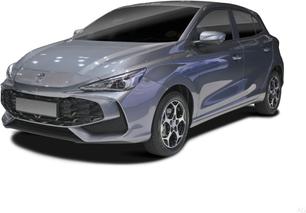
Following the new design language pioneered here by the MG5 sedan and MG4 electric hatch, the MG3 looks like it’s trying for a sportier vibe than its predecessor, and maybe even a hint of European flair.
A grinning front grille and pointed set of headlights are followed around the side by a couple of body creases that give the hatchback a sweeping look, an attempt perhaps to seem longer than it is.
It doesn’t look like any of its rivals, unlike the MG5 which is easily mistaken for a small Mercedes CLA at glance.
Here on our Dover White test car, some angles are unflattering (it's giving 'hire car'), though the model’s available Diamond Red or Brighton Blue are fairly distinctive. Yes, some of the colours reference the brand’s UK heritage, despite being built in China.
Inside, the cabin benefits from a fairly tidy layout, with some genuinely thoughtful attempts at making the otherwise budget-focused model feel a little nice. A cross-hatch design through the dash mirrors, the seat stitching and the steering wheel and its buttons are nicely angular.
When it comes down to a practicality score, it’s only fair to compare a car like this to its direct competitors. A sports car like this is never going to take on a hatch or SUV in the practicality stakes.
Even so, and just like the MX-5, the Abarth 124 is tight on the inside. I fit inside it perfectly, but there are problems.
Legroom is super tight for me at 182cm tall. I had to adjust to having my clutch foot at an angle, otherwise I’d smack my knee on the bottom of the steering wheel, a problem that also makes this car tough to clamber into. The handbrake takes up a massive amount of room in the limited centre-console space, and as to storage in the cabin? You may as well forget it.
There’s a tiny flip-up binnacle in the centre, shallow enough maybe for a phone and nothing else, a slot under the air-conditioning controls seemingly designed expressly for phones, and two floating cupholders between the seats.
There’s no storage in the doors, nor is there a glovebox. You do get a rather large storage area behind the cupholders, accessible through a hatch opening, but it’s a little awkward to use.
Once you’re in, though, this car fits like a glove in terms of ergonomics. The wheel is nice and low, the seats are surprisingly supportive and your elbow rests nicely on the centre, leading your hand to the excellent short-action shifter. Headroom is tight no matter which way you cut it, but it’s such a small car you hardly expect more.
How about the boot? It’s better than you might hope, but with just 130 litres on offer it’s still no more than a weekender. It’s also less than the Toyota 86/BRZ (223L) which also have back seats, always handy no matter how small they are.
There’s no spare to be found. The 124 has a repair kit only.
That tidy design inside helps when it comes to making use of the space, as well as offering some generous storage spaces.
For starters, while the clean layout means the screen looks like the main point of access for much of the car’s function, there’s an all-important shortcut button for the climate control which means you don't waste time navigating to the vent and temperature controls.
The only issue is that while my phone was connected to the system for Android Auto, I had to navigate away from the mirroring screen back to the MG3’s home screen before being able to shortcut to the climate settings.
Demister and volume control buttons are also present, but the screen itself has an easy-to-navigate menu.
The steering wheel controls are similarly straightforward and clearly labelled, while the driver display is tidy and shows important information clearly.
While the steering wheel isn’t telescopically adjustable, it's easy to find a comfortable seating position thanks to the adjustability of the seats. The material on the seats doesn't feel rough or cheap.
Behind that, there is enough space for my 178cm frame in the second row for the most part, but headroom isn’t incredibly generous.
The rear pew is a single unit, rather than a 60/40 split, so the whole backrest folds down if you need to load anything long through the boot. There’s not even an armrest or little ski hatch for long, thin items.
Its 293-litre boot isn’t small, and there’s a space-saver spare tyre in both petrol variants, but the hybrids are stuck with repair kits.
I should make this clear at the beginning, this Monza edition is an ultra-limited trim, with just 30 cars available in Australia. Ours was number 26, a manual, wearing a drive-away price of $46,950.
That’s expensive, but not outrageously so. An equivalent high-spec manual MX-5, for example (GT 2.0 Roadster), comes in at a before-on-roads cost of $42,820. Looking outside Hiroshima, you can also be hopping into either a Toyota 86 GTS Performance manual ($39,590), or a Subaru BRZ tS manual ($40,434) for less.
So, the Abarth is the most expensive of a limited pool of choices. Thankfully it does offer a little more than just Italian spunk and some oversized scorpion badges.
Standard on every car are 17-inch gunmetal alloy wheels, a 7.0-inch touchscreen with Mazda’s rather good MZD software (but no Apple CarPlay or Android Auto support), a Bose premium sound system, heated front seats, and keyless entry with push-button start.
Performance-wise, every car gets four-piston Brembo front brakes, Bilstein suspension and a mechanical limited-slip differential.
The Monza edition adds the normally optional ($1490) contrast-stitched ‘Abarth’ red and black full leather seats, and the ‘Visibility Pack’ ($2590) consisting of full LED steering-responsive front lighting, rear parking sensors and camera, as well as washers for the headlamps. The pack also adds items to this car’s rather limited safety suite, which we’ll talk about later.
Most notably, this edition finally grants the 124 the exhaust system it deserves, the neatly named “Record Monza” system, which uses a mechanically actuated valve to have the 1.4-litre turbo barking and spitting away in a stupidly smile-inducing way.
Every 124 should have this system, it adds much needed drama to the engine note, but isn’t as obnoxiously loud as something like the outgoing AMG A45.
The Abarth isn’t as crazily specified as some of today’s run-of-the-mill SUVs, sure. But that’s not what this car is about, and for what it’s worth, it has just about everything you’ll really need and certainly more than the 86 or BRZ, helping to justify its extra cash ask.
Even though it’s now more expensive with its $23,990 before on-roads price, it’s hard to deny the petrol-only MG3 Excite is a compelling offering when it comes to inexpensive runabouts.
Not only has the price been bumped up, but so has the apparent interior quality and features list.
A new 13.25-inch multimedia touchscreen is paired with a 7.0-inch driver display and both look pretty slick for the price point and operate well.
Apple CarPlay and Android Auto are both available, but are wired only and can’t be accessed with a Bluetooth connection, while a six-speaker sound system handles entertainment duties.
In terms of seating and material, the Excite gets cloth pews with some contrast stitching.
On the outside, folding mirrors and a set of 16-inch alloy wheels join the new MG3’s design, while this base model Excite is left with halogen headlights like it’s 2015.
The Essence scores a set of LED units and is otherwise distinguishable by its sunroof, though it shares the same wheels as our base car, so it won’t feel like you’re missing out on heaps.
Unlike the MX-5 and 86/BRZ combo, which offer a choice of naturally aspirated engines, the 124 carves its own path by dropping Fiat’s 1.4-litre ‘MultiAir’ turbo four-cylinder under the hood.
The word ‘turbo’ should rightly prick your ears in a car this size, but this this is hardly a high-performance unit when compared to its non-turbo counterparts.
Outputs are set at 125kW/250Nm. That power figure might seem a little low when compared to the new 2.0-litre MX-5 (135kW/205Nm) and 86 (152kW/212Nm), but the extra torque is welcome. It comes at a cost, which we’ll explore in the driving section of this review.
On paper, the MG3’s 1.5-litre four-cylinder engine is fairly underwhelming with its 81kW (peaking at 6000rpm) and 142Nm (at 4500rpm).
But these figures, including the engine size and even peak RPMs are not far off the likes of the Mazda2, which is a fairly peppy and fun car despite its lack of grunt.
Keen drivers will, however, be disappointed to hear the MG3 drives the front wheels via a continuously variable transmission (CVT) rather than a traditional torque-converter auto, taking much of the pep out of its power unit.
You can expect to hit 100km/h in a bit over 10 seconds.
The 124 has a bold-souning official combined fuel consumption figure of 6.4L/100km, which I overshot by quite a margin. At the end of my week, (involving truly mixed freeway/city driving) I landed on 8.5L/100km, which was exactly on this car’s ‘urban’ estimate, so take that as a realistic figure.
It’s also less than I’d expect to consume in an 86 and perhaps also the MX-5, so all-in-all it's not too bad.
The turbo Fiat engine requires a minimum of mid-grade 95 RON unleaded to fill a 45-litre tank.
MG claims the MG3 uses just 6.0 litres of 91 RON petrol every 100km on the combined fuel cycle, so with its 45-litre tank you can hypothetically bank on a 750km range.
Of course, that might be achievable in lab conditions, but on test we found the trip computer’s estimates looking closer to 500km on a tank for the kind of urban driving it was undertaking with us.
On a dynamic test drive route, the trip computer settled at a displayed consumption figure of 7.7L/100km, but stop-start driving was not great for efficiency, as you'd expect.
I drove the 124 up NSW’s Old Pacific Highway from Hornsby to Gosford at dusk on a Saturday. Talk about the right car in the right place at the right time.
It was absolutely in its element, darting around tight hairpins, then blasting up straights, giving the short shifter a thorough workout. That new exhaust added 150 per cent to the theatre of it as each aggressive down-shift was accompanied by crackling, spitting and barking.
It’s an absolute joy, a proper nod to how cars used to be in the good old days of a ‘Sunday drive’, and thus a proper nod to the 124’s history.
And, of course, it has flaws. Many of them fall into the subjective category on a car like this, however.
Take the engine, for example. I’ve heard endless criticisms of it as laggy and annoying. And it is. Catch the wrong gear and get the revs too low and no matter how hard you stomp that go pedal, you will be stuck fighting a mountain of lag. Seriously. Several seconds of it.
Even trying to ascend my steep driveway had me concerned it was simply going to stall out in first gear.
It’s a bit strange, but then when you’re on the open road it’s worth relishing the challenge that it offers. Grab the wrong gear and this car will let you know how foolish you are. And yet, when you get it right it offers a surge of excitement in the straights that’s arguably far more dramatic than either the MX-5 or 86 can muster.
Another annoyance is the speedometer. It’s tiny and counts 30km/h increments all the way up to 270km/h. How fast was I going, officer? No idea. I have about two inches to tell whether I’m going between 30 and 90, so it’s anyone’s guess.
An obvious benefit of the MX-5 chassis is its go-kart handling, and it seems as though the excellent, fast and direct steering hasn’t been messed with, either. Sure, the suspension is a little crashy, and the convertible chassis a tad rattly, but it’s all part of being that much closer to the road. It would be tough to ask to find a better transmission with its fast, short action and sensible ratios.
Ultimately, the 124 is just plain (literally) old-fashioned weekend fun, offering a challenging but rewarding drive.
The higher quality look and feel of the new MG3 carries through to its day-to-day driving. Some of the car’s Chinese compatriots seem to fall down when it comes to the on-road part, which for some is the most important part of a car.
But for a small city car the MG3 is very user friendly, with light and direct steering, good visibility, and just enough power and torque to not feel like everyone’s getting the green light a couple of seconds earlier than you.
It’s comfortable at urban speeds when it comes to the suspension, and doesn't get rattled too much in the front end by tram tracks or other road imperfections.
In narrow streets, three-point turns aren’t a hassle and the car’s size means it’s easy to reverse parallel park, although the reversing camera takes a second to appear when using phone mirroring.
On the highway, however, and when it comes to high-speed cornering, the MG3 can feel a little uneasy.
The road noise becomes more and more obvious. Driving on well-maintained metro freeways at around 80km/h or above produces unpleasant noise, and a during a particularly breezy week the car felt susceptible to swaying in high wind.
Its power delivery starts to feel lacking out of town, too, and taking corners on fast back roads means plenty of slowing down to avoid the front-end sliding or the feeling of the MG3 leaning unsettlingly around corners.
If you’re considering the MG3 but you need to head out of town regularly, take a proper long test drive before opening your wallet.
But if you just need it as an urban runabout, the MG3 does a fine job.
No Abarth model carries a current ANCAP safety rating, although the MX-5 this car shares most of its underpinnings with carries a maximum five-star rating, as of 2016.
Feature-wise, you get dual front and side airbags, “active head restraints”, seatbelt pre-tensioners and something called “active pedestrian protection”. The regular suite of stability controls are also present, alongside a reversing camera and sensors.
There’s no auto emergency braking (AEB - which has now become an ANCAP requirement), active cruise or any lane-assist technologies, but the ‘Visibility Pack’ standard on the Monza edition adds Rear Cross Traffic Alert (RCTA) and Blind Spot Monitoring (BSM).
Four airbags and rudimentary active safety is a let-down, but probably not one that this car’s target audience will particularly care about.
ANCAP hasn’t tested the MG3 yet, so there’s no crash safety information available. It’s worth noting ANCAP gave the MG5 a zero star score for its lack of active safety equipment, but the MG3 comes with more under its belt than its sedan stablemate.
Six airbags, two front, two side and two curtain, are joined by adaptive cruise control, blind spot detection, rear cross-traffic assist, forward collision warning, lane departure warning, lane keeping assist and speed limit assist.
None of these systems were intrusive on test, though lane-keep assist feels like it could do with some more fine tuning.
It’s a shame that the 124 is only offered from Abarth with a three-year 150,000km warranty. Its counterpart MX-5 is now offered with a five-year unlimited promise, and Fiat could really do with a bit of positive warranty coverage right now.
You’ll need to service the 124 once a year or every 15,000km. Capped price servicing? Ha. No such thing over at Abarth, apparently. You’re on your own.
MG has a 10-year/250,000km warranty which is unmatched in the small-car market.
Servicing is scheduled at every 10,000km or 12-month intervals, with the first seven services averaging out at a fairly hefty $360 - the cheapest being $234 and the priciest $536.