What's the difference?
For a small SUV that technically starts under the $40,000 mark, the 2024 Volkswagen T-Roc has a fair bit going for it.
It’s still in its first generation, but updates have made some parts of the T-Roc feel properly up to speed. And the parts that haven’t? Well, maybe that’s not such a bad thing.
We’re driving the mid-spec Style 110TSI, which sits above the base CityLife, but below the R-Line. Then of course, there’s the wicked R variant.
But is this a Euro that could replace your trusted Japanese small SUV?
This is probably the most important new car launch of the year.
The 2026 Toyota RAV4 needs to be bang-on exactly what customers want, because it’s not only Toyota’s most popular model globally, it was the most popular new car in the world last year.
It’s also Toyota Australia’s second-most popular model behind the Toyota HiLux the highest-selling non-ute in the nation.
Crucially, The HiLux has just been launched in a new generation albeit not a revolutionary change, and it somewhat overlaps with the generation changeover of the RAV4.
Toyota is also facing a significant sales dip, the first quarter of sales for the brand in 2026 is down 23 per cent compared to the same time last year. It’s a bigger dip than the industry as a whole, as its market share is down from 19.9 per cent to 15.7 per cent in the same periods.
The new RAV4’s launch must bring strong sales as the vast majority of the brand’s dip is thanks to the mid-size SUV’s changeover.
But as well as an influx of new competitors, the RAV4 must also contend with a lack of ANCAP safety rating for its first few months on sale.
Has Toyota done enough to convince Australia its family SUV is still worthy of its position as the best-selling passenger car getting around? We headed to its Australian launch in Tasmania’s north to find out.
So that’s the T-Roc, a bit of Euro style that’s still priced to take the fight to some small SUVs from Japan or Korea.
Is it the cheapest style-forward small SUV you can get? No, but it’s far from the expensive end of things.
Plus, if you can resist ticking some option boxes, it beats some value-focused rivals and looks good doing it.
If the feeling of a sturdy fit-out and a confidence inspiring drive is important to you, I reckon the T-Roc should be an entry on your shopping list.
The RAV4 is undeniably better than the last generation, and brings with it a level of driving refinement the most popular car in the world should have.
It also levels up its tech without falling into the overcomplicated, messy systems newcomers to the market think will impress buyers. While the base GX is a sound option, the few extra mod cons in the GXL are worth the extra cash.
But its lack of ANCAP rating is surely a point of anxiety for Toyota, and while the safety systems seem sound, we can’t definitively say this RAV4 is as safe as Toyota claims it is.
If you’re willing to trust Toyota on that, you’ll find a very enjoyable car that’s uncomplicated and efficient. But if those five stars from ANCAP matter to you, give it a few months and see how the new RAV4 performs before you put your money down.
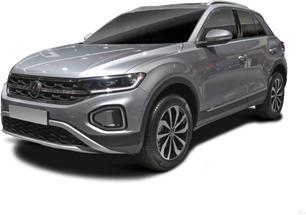
The T-Roc subtly stands out without being garish, avoiding becoming part of the highway or suburban camouflage without relying on extreme design decisions.
For example, the LED daytime running lights that wrap around the shapes below the LED 'I.Q' headlights where vents would otherwise be on the R performance variant are quite cute.
In fact, the whole front end of this small SUV has a friendly look, even if there’s nothing specific that’s particularly exciting about it.
This 'Petroleum Blue Metallic' colour is a $700 option, but anything other than white costs extra.
However, the black roof two-tone look is a standard for the Style, as are the black mirror caps and its 18-inch alloys.
There are roof rails up top, tinted privacy windows for rear passengers and for the rear window and a sloping roofline at the rear that adds a touch of ‘sport’ to the silhouette along with a small spoiler at the top.
Each RAV4 in the range is more visually distinct than before, but most variants feature a similar honeycomb grille that’s a departure from the ‘safe’ design language Toyota is known for.
The outlier is the Edge variant, which gets a more traditional front-end treatment as well as its 20mm wider wheel tracks to go along with the intended purpose of light off-roading.
Despite the fact Toyota has clearly tried not to change the new RAV4 too much in too many ways compared to the last generation (and why would you when it was already so popular), the new design feels a little more adventurous.
It includes elements of Toyota’s latest design language including the ‘c-shaped’ headlights and more streamlined tail-lights but retains the overall size and shape of the RAV4.
The RAV4 is 4600mm long, 1855mm wide and 1680mm tall, a very similar size to before and as such its interior feels similarly spacious.
Inside, the layout is tidy with a little more visual distinction for controls than the last-gen RAV4.
Updated, sleeker buttons and controls replace the ageing fixtures and large screens make the mid-size SUV feel much more up to modern standards.
Inside the T-Roc is a bit of an interesting dichotomy.
Some of what’s in here is ‘old-gen’ Volkswagen stuff, but it still holds up today against even some recently introduced models.
The dichotomy is that while it’s very usable and slick, some of its materials and surfaces let it down a touch.
The good points are that the cabin tech is a perfect level of physical and digital. The buttons and controls are easy to use and feel solid and even though the climate controls could be more physical, they’re still good as far as touch panel style controls go.
The older VW gear is arguably better than a lot of what’s found in newer models where some use of touchscreens and haptic panels has drawn negative feedback from customers.
The multimedia software managed via the 8.0-inch touchscreen is more simple and sensible than the new version, plus the Digital Cockpit Pro display for the driver is clear and, importantly, customisable. It’s a similar cockpit system that used to seem quite impressive in high-end Audis.
But what doesn’t feel very high-end is some of the plastic and the decisions around function in the rest of the space.
The leather on the seats is not a cheap option box to tick at $3450, but it feels a little cheap to the touch. It’s a tad hard and even has a bit of a rough look to it.
That option also makes them heated and electrically adjustable, though, which is welcome in winter. Otherwise, cloth seats without the optional leather or heating would be absolutely fine, and that means you get a storage space under them, too.
This central space between the driver and front passenger, too, is a little awkward with the cupholder placement. It’s behind the shifter meaning a tall bottle will be in the way and it’s got slightly odd sizing for bottles or cups with nothing to stop them wobbling.
I am, however, a fan of the angled-away phone slot under the climate controls to minimise phone screen visibility (and distraction) and the traditional shifter itself is welcome.
Look up, and (in our test car) there’s an optional ($2000) panoramic sunroof there. It’s yours if you want it, and it does have an electric blind, but some Japanese and Korean cars at this price point get that as standard.
An average-sized adult will find the second row is spacious enough and relatively comfortable. There’s an armrest, dual-directional vents and two USB-C ports.
Behind that, boot space is generous at 445L with the seats up thanks to an adjustable floor, which is very useful for tall items and even manages to fit a space saver spare tyre under it.
It’s a total of 1290L with the split-fold seats down, too, though they’re not super flat with the adjustable floor down.
But despite the sleeker look inside the new RAV4, Toyota hasn’t fallen into the trap of shoving as many digital features into the system as possible.
Many newcomer brands create confusing digital environments by having menus upon menus filled with options and features, but Toyota has avoided this by retaining a simple, almost siloed system.
In the multimedia display, navigation, media, phone and settings are the key shortcuts visible down the side of the screen, though a customisable home screen allows you to make the system your own.
It’s far preferable to the many sub-menus and confusing layouts some manufacturers (especially newcomers) use, and means you’re able to focus on driving.
There are also still plenty of physical controls for the key functions of the car, no need to go into digital settings to sort your drive mode or climate.
The new system, dubbed 'Arene' by Toyota, is a much-needed update for the RAV4, bringing it into the current decade when it comes to tech.
Its voice command system is still a little too keen to interrupt, but the general function is extremely easy to get acquainted with.
The interior is also physically extremely sensible, with good vision and light thanks to a low dashboard and large windows, well-considered ergonomic positioning, comfortable seats and storage options.
The centre console storage bin lid is also able to be opened from either side, or removed and flipped between a hard plastic surface or cushioned elbow rest, though a bit of non-slip surface on the plastic side wouldn't go astray.
Behind the front seats, the second row passengers don’t have a massive amount of amenity, but are far from cramped. The vents, armrest with cupholder, bottle storage in the door and document holder on the backs of the seats are all quite standard, though the outboard seats are heated in the top spec Cruiser.
Behind that, a huge 705L of space in the boot includes a netted pocket if you opt for the Edge grade, plus there's a proper spare wheel under the boot floor. Wins all round.
The specific Style test vehicle being reviewed here is priced at $38,890, before on-road costs. But it's worth noting a new example of the Style will cost you $39,790 at the time of writing, as its price has since ours was 'delivered'.
While the Style features some older VW fitout, it comes with a decent list of features.
A set of 18-inch wheels, self-levelling headlights (with cornering function), some cute LED DRLs plus chrome highlights with black contrast trim are the best way to spot a Style from the outside.
Inside, there’s an 8.0-inch touchscreen for multimedia paired to the driver’s 'Digital Cockpit Pro' display.
The multimedia screen is last-gen VW gear, but that’s not a bad thing.
There’s also dual-zone climate control with an allergen filter, ambient lighting, a six-speaker sound system, wireless phone charger and wireless Android Auto and Apple CarPlay.
There are a few options on our test car that nudge the price up quite quickly, like the metallic paint, leather upholstery, sunroof, plus the keyless entry or ‘Easy open and close package’.
All this brings the total price as-tested to $45,640, before on-roads.
The good news is you don’t need to tick all, or any, of those options for this to still be a compelling option.
The RAV4 is more expensive than it was before. Of course it is.
That’s because it comes with more stuff, and it’s got new oily bits and more software to play with, plus everything gets more expensive anyway, right?
There are five trim levels, most with 2WD or AWD options and the base GX starts from $45,990, before on-road costs, in 2WD guise - a few thousand more than before.
Standard kit isn’t mind-blowing compared with a lot of newcomers to the market, but for an established model like the RAV4 it’s expected.
The GX (which can be had in AWD for $49,340) comes with 17-inch dark grey alloy wheels, LED headlights, dual-zone climate control, a 10.5-inch touchscreen display for multimedia, a 12.3-inch digital instrument cluster, fabric upholstery, six-speaker audio and five USB-C ports plus wireless Apple CarPlay and Android Auto.
If you opt for all-wheel drive, you also get downhill assist control and 'Trail' and 'Snow' drive modes.
Importantly, the RAV4 comes with a spare wheel, though on the GX it’s just a space-saver which costs $300 to upgrade to a full-sizer.
The $48,990 GXL adds 18-inch alloy wheels, privacy tinting, an eight-way powered driver’s seat, rain-sensing wipers and a wireless smartphone charger. That one’s $52,340 in AWD guise.
The Edge is $55,340, comes in AWD-only, and has its own front-end design plus 18-inch dark matt grey metallic alloy wheels on a 20mm wider track, plus a larger 12.9-inch touchscreen, premium trim, heated seats, illuminated entry and a power tailgate. It’s the variant Toyota says is more aimed at light off-roading than its siblings.
The XSE is also AWD-only and starts at $58,340, with 20-inch black alloy wheels, better LED headlights, a surround view parking monitor and two-tone paint. It also has synthetic leather and suede sports front seats with contrast stitching and three-stage front seat heating and ventilation, plus a sunroof. Front and rear bumpers feature integrated skid plates on the XSE.
The Cruiser is available as a 2WD from $56,990, or AWD from $60,340, and adds 20-inch machined black alloy wheels, high-grade LED headlights, leather-accented seat trim, a head-up display, digital rearview mirror, heated outboard rear seats, powered tailgate with kick sensor, another wireless smartphone charger and a premium nine-speaker JBL audio system.
The engine in the T-Roc - as with most Volkswagens - does what it says on the tin. Essentially, a 110TSI means there’s 110kW of turbocharged VW happening, in this case a 1.4-litre four-cylinder that also makes 250Nm of torque.
It’s paired to an eight-speed torque converter, which will be music to the ears of those who have been scorned by older VW dual-clutches.
It drives the front wheels only, and there’s no hybridisation or 48-volt system.
The 2.5-litre four-cylinder engine with series-parallel hybrid is less powerful than before, but Toyota says it did this for better efficiency and has made up for it with improvements to the battery and electric motors.
The figures are now 143kW and 221Nm (in 2WD and AWD variants), the power down from 160kW in the last generation. All RAV4s still use a continuously variable transmission (CVT).
Basically, lower numbers, but performance on par with the current RAV4 Hybrid according to Toyota.
A lack of electrification in a relatively small engine and a traditional drivetrain shouldn't scare you too much, in this case.
Combined cycle fuel consumption is a claimed 6.3L/100km. On test in mostly urban areas or for spirited driving we saw the fuel use rise a little higher than that but not by as much as you might think.
After a mix of primarily urban, some highway and a stint of dynamic test driving, the trip computer admitted to a figure of 8.1L/100km.
The new RAV4’s efficiency is of much interest, obviously, and with figures claimed at 0.2L less per 100km over the last RAV4, it’s another case of incremental improvements.
The 2WD comes with a claimed 4.5L/100km, the AWD with 4.6L. During testing we saw numbers as low as 6.8L and 6.9L, respectively, and that was giving it the beans in some pretty twisty mountain roads.
Keep in mind the RAV4 needs 95 RON minimum now, rather than the 91 RON it could deal with before.
The T-Roc is essentially a previous-generation Golf-turned-small SUV in terms of its platform, and that’s a great thing for anyone who likes driving.
The Golf 7.5 was a benchmark for everyday driving as far as hatchbacks are concerned, and even though the current Mk8 might be a bit more up to date, the T-Roc’s use of the platform it rides on is practical and fun.
It’s not as nimble as a Golf, but the T-Roc in front-drive Style guise, with a responsive turbocharged engine and no all-wheel drive system weighing it down, is not only more dynamically capable than most rivals, it’s also easy to access that capability.
The 1.4-litre engine feels well-tuned for its two modes accessible through the shifter - calm but not lazy in ‘Drive’ and eager but not thrashy in ‘Sport’.
It works well with the transmission on the move, picking right gears fairly accurately, though there are paddles behind the wheel for those who prefer to take charge.
The drive modes are also more customisable than just those on the shifter, with 'Individual' selections for steering and drivetrain able to be used rather than the standard 'Eco', 'Normal' or 'Sport' full-system modes.
While the steering wheel itself is a little thick and the feedback, while adequate, isn’t the most telling, it’s accurate and inspires confidence in cornering.
The T-Roc handles turn-in and exits well, even soaking up bumps and not becoming unsettled when braking.
Its safety systems are relatively subtle, and the active cruise control is well sorted, though the automatic braking at car park speeds can be overzealous. Something I’ve experienced in VW Group models several times over the years.
The main culprit for the T-Roc was a shrub beside my driveway that, while not touching the car, would set off the automatic braking system. Still, better than letting the car roll back if there was a proper obstacle or someone who could be hurt in the way.
Aside from that, the Volkswagen T-Roc is fun and easy to drive, and the work that’s gone into that puts its price into perspective a little more.
There are more expensive cars available that are less impressive, some even disappointing.
Put it this way - the RAV4 doesn’t feel like it’s lacking power. Despite the lower output, the new generation car doesn’t seem to struggle with having enough pick-up to keep moving along, even in spirited driving.
The first time I properly took off it surprised me with how punchy the response was. And from there on the new RAV continued to impress.
It’s one of a few things that, dare I say, makes the RAV4 rather fun to drive.
Like its predecessor, it’s built on the 'TNGA' platform, which underpins pretty much everything Toyota builds these days.
It’s a well-sorted basis for a car, making even this relatively large family SUV feel nimble.
Some changes to the suspension help here, too. New geometry and spring and damper rates mean the RAV4 is sharper and better controlled than before.
That control comes with the trade-off that it’s not always cloud-soft, but given Australian preferences and the need to keep the rubber on our rough as guts roads, Toyota has the balance right here.
It also hasn’t seemed to matter massively whether the RAV4 is front- or all-wheel drive even in the wet on twisty Tassie roads. The 2WD requires a little more care being flung into corners but the mid-sizer holds its own well enough.
There’s clearly more ability in the RAV4 than it’ll make known, almost as to keep the driver behaving safely just in case, while being confident in knowing the RAV4 is more capable than many will ever find out.
It’s handled high speeds, sharp corners and unsealed roads to a higher degree than anyone would reasonably expect of a family SUV.
It helps that the steering, throttle and braking are all well-calibrated. Planting your foot brings urgency without a jolt, there’s no guesswork in the steering and the brakes won’t have you lurching at a tap but can pull you up rather rapidly if needed.
It’s easy to drive, which is pretty big compliment and surely one of the key goals for the engineering team.
In 2017, ANCAP gave the T-Roc five stars for safety. For most people, that says enough, plus the list of features the SUV comes with is fairly comprehensive even in the Style.
While its rating is getting on in years, the only real downside to the T-Roc’s age when it comes to safety is it only having six airbags - front and side for the front passengers, plus curtain airbags for front and rear passengers.
But the list of tech isn’t lacking, with driver fatigue detection, pedestrian monitoring, parking bay and parallel parking assistance, pedestrian monitoring, side assist, rear cross-traffic alert and lane assist.
Toyota doesn’t have an ANCAP rating for the RAV4 yet, which is a massive problem for the brand, especially for its fleet buyers.
The systems in place seem pretty sound, and the brand says it’s the safest RAV4 yet.
We have no reason to doubt that, but we can’t just take a manufacturer at their word, that’s why ANCAP exists.
Eight airbags, AEB pre-collision, emergency steering assist, full-speed active cruise control, front and rear cross traffic alert, lane trace, automatic high beam, parking support brake and blind spot monitor are all standard across the range, which is a plus.
It’s also all quite well programmed.
From behind the wheel, you’ll notice persistent but gentle steering wheel nudges when approaching the shoulder, and occasional chimes for driver distraction when using the main screen, but otherwise it’s very well calibrated and cements the experience Toyota has with making its systems easy to use.
Volkswagen’s five-year/unlimited kilometre warranty is pretty standard for a premium-leaning brand, with VW also offering roadside assistance for the warranty period.
In terms of servicing, VW offers care plans of three years or five years, covering servicing for $1515 or $2770 respectively. That's an average of $505 or $554 per workshop visit.
Otherwise, servicing costs at 12-month/15,000km intervals can cost from $470 for some to $1104 to the biggest service if you don’t go with the locked-in package.
Toyota’s standard five-year/unlimited kilometre warranty is not just disappointing compared to other mainstream brands, but should be much higher given the brand is the biggest in the country (and world) and trades on its reputation for reliability.
The warranty can be extended to seven years from delivery if you maintain your logbook servicing with Toyota dealerships, but even then it falls short of Nissan and Mitsubishi’s 10-year (also servicing-conditional) warranties.
Capped-price servicing costs $325 per service and is available for five years or 75,000km, with intervals every 12 months or 15,000km.
Toyota boast a long-established national network of around 300 dealers covering all states and territories including major cities and key regional and rural centres.