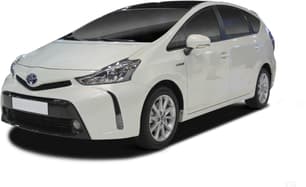
Toyota Prius V vs BYD Sealion 5

What's the difference?

VS
Toyota Prius V
Toyota Prius V

2018 price

BYD Sealion 5
BYD Sealion 5

$33,990 - $37,990

2026 price

Summary

2018 Toyota Prius V
2026 BYD Sealion 5
Safety Rating

Engine Type
Inline 4, 1.8L

Inline 4, 1.5L
Fuel Type
Unleaded Petrol/Electric

Premium Unleaded/Electric
Fuel Efficiency
4.4L/100km (combined)

4.5L/100km (combined)
Seating
7

5
Dislikes
  • No air-vents in the back rows
  • Not fun to drive
  • Showing it's age

  • Steering column needs more adjustment
  • Flat rear seat cushion
  • Engine can be noisy when stretched
2018 Toyota Prius V Summary

I could use three words to describe this car: Toyota, family, hybrid… A fourth word comes to mind, which begins with 'b' and ends in 'oring'…

That might seem harsh, but this isn’t what I’d describe as an aspirational purchase. If you do aspire to a Prius V, though, you’re probably either a hardcore Toyota fan, someone who has a large family, or someone who likes hybrids.

But then again, if you are a potential Toyota Prius V buyer, you could also be one of the smarter examples of our species. While only about 3000 Aussies have chosen a Prius V since it went on sale in 2012, it’s a very, very clever option for family buyers who want to do their bit for the environment, not to mention their own hip pocket.

The Prius V is the most affordable seven-seat hybrid vehicle on the market, and in terms of price, it competes with mainstream models like the Honda CR-V, Mitsubishi Outlander and Nissan X-Trail. But what about space? Practicality? Performance? Let’s take a deeper look, shall we?

View full pricing & specs
2026 BYD Sealion 5 Summary

Following the money comes pretty naturally to carmakers. It’s what happens when the product planning department smells a new direction on the breeze and then handballs that to the design and engineering folks who turn a perceived market trend into a showroom reality. And when everybody gets it right, you have a new default product. And everybody else has to keep up. Some even have to catch up.

We’ve seen it plenty of times before, too. Think about those early 1980s days when the default small car went from a sedan to the five-door hatchback. Didn’t that catch on? You might also remember more recently when a family car had to be a four-wheel drive. And what about the dual-cab ute revolution of the last 15 years?

The other strident market segment right now is the SUV, of course. And within that, most recently has been the march to electrification, starting with conventional hybrid technology and now progressing to the new must-have, a plug-in hybrid platform.

The fact is, if you’re a Chinese carmaker intending to sell on a world stage, you can’t ignore the plug-in SUV in any of its various sizes and marketing segments. There’s a good basis for this, too. Plug-in hybrids just make good sense. They offer the urban running-cost advantages of any hybrid, the option of zero tailpipe emissions, all-electric running over a normal commuting distance and – crucial for a big country like this one – they’ll keep motoring along for as long as the owner puts petrol in them.

Okay, so they can be heavy with all that tech on board, and there’s no denying that two power sources (petrol and electric) make for a more complex machine, but the advantages outweigh the downsides for many buyers.

The other graph you can plot with great certainty is that new tech will get cheaper as the industry moves forward. Which is exactly where BYD finds itself right now by being able to offer a plug-in hybrid variant of its Sealion 5 mid-sized SUV at a price that will have much of the opposition running scared. But how scared should the others be?

View full pricing & specs

Deep dive comparison

2018 Toyota Prius V 2026 BYD Sealion 5

Change vehicle