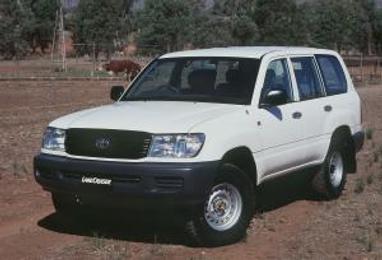
Toyota Land Cruiser 1998 Problems

Are you having problems with your 1998 Toyota Land Cruiser? Let our team of motoring experts keep you up to date with all of the latest 1998 Toyota Land Cruiser issues & faults. We have gathered all of the most frequently asked questions and problems relating to the 1998 Toyota Land Cruiser in one spot to help you decide if it's a smart buy.

Used Toyota Land Cruiser review: 1990-2011
By Ewan Kennedy · 03 Apr 2012
Toyota's LandCruiser is a genuine 4WD, not just a people mover dressed up to look tough, but which is nothing more than a car underneath that supposedly rugged body. Highly capable off-road, the big LandCruiser is a longtime favourite with those on the land, in the mines or wanting a hard working tow vehicle.Cruiser has seating for up to eight people, though it is best if the occupants of the rearmost, fold-down seats aren't over large. With all passenger seats in place luggage room becomes relatively restricted. Toyota LandCruiser is unashamedly a large vehicle and can be a real handful at times in tight suburban running, particularly in undercover carparks. It’s not only the size of the LandCruiser, but also its large turning circle, that can cause hassles. It has been improved over the years.But try one for yourself if you've never experienced the potential parking hassles. Despite this, quite a few are used as family wagons, thanks to the spacious cabin and big luggage area. The LandCruiser has been around for years, but really took off in the sales race with the introduction of the 80-Series in 1990. It was replaced in March 1998 by the 100-Series then the 200-Series arrived in November 2007.LandCruiser 200 is a major evolution of the 100 Series rather than a completely new model. Its styling is slightly softer than that of the 100, but its genuine 4WD capability remains under that smoother skin.The LandCruiser 70-Series workhorse and LandCruiser Prado share little in common with the 80, 100 and 200, so will be the subject of separate articles. The added refinement and comfort of the 80-Series compared with its truck-like ancestors made it easier to live with, but even the 80 is getting on in years now so be sure of its condition before handing over the folding stuff. The LandCruiser is relatively simple for the inexperienced owner to take into the bush. Naturally with all the usual provisos of preparation and driver knowledge that apply to all who drive in off-road conditions. Interestingly, the LandCruiser 100-Series reverted to part-time 4WD in its more basic models. Most engines on used LandCruisers are straight sixes, though V8s became more common in later years. The petrol unit was originally a somewhat ancient 4.0-litre six-cylinder unit that was thirsty and not particularly quick.A 4.5-litre, twin-cam, multi valve engine was installed in the topline models late in 1992 and subsequently spread to the rest of the petrol range. It’s a modern unit with tremendous torque and impressive smoothness. A petrol V8 of 4.7-litre capacity, as used in the Lexus LX470, was offered as an option in the LandCruiser 100-Series from 1998 until 2000. It's quite thirsty, but beautifully smooth and torquey.Later developments of that 4.7-litre V8 engine were used in the LandCruiser 200, with the latest being a 4.6-litre unit introduced early in 2012. A petrol V8 with 5.7 litres is also on offer in the LC200. Diesel sixes are relatively common on older 80-Series and came with displacements of 4.0 and 4.2 litres. From 1990 the 4.2 litre diesel used a single overhead camshaft and two valves per cylinder. In 1995 it received a four-valve cylinder head, though it still had a single camshaft. Much better is the 4.5-litre V8 turbo-diesel used in the LC200 – it's reasonably economical, smooth and provides plenty of grunt. The turbo-diesel V8s are big grunt powerplants, making them particularly suited to heavy-duty towing.Five-speed manual gearboxes are offered in some LandCruisers, but most later models use automatic transmissions, with four speeds in the 80 series. There are five forward speeds in the 100 series, and either five or six ratios in the LC200 depending on the model. The LandCruiser has plenty of underbonnet and under-vehicle space so the knowledgeable home mechanic can do a lot of their own repairs. There are Toyota dealers in all areas of Australia, thanks to the company arguably having the most widespread of all networks.Servicing and spare parts are generally reasonably priced, though some parts cost a lot more than they should. Remember that these are heavy-duty, commercially-oriented vehicles so even things like tyres can cost considerably more than they do for a passenger car. Insurance is unlikely to cause real hassles as the working nature of the vehicle means most companies have favourable experiences with the vehicle, letting them keep prices relatively low.WHAT TO LOOK FORLandCruisers that have had severe off-road use – and plenty have – will probably have underbody, door-sill and bumper corner damage. Even those which have only had gentle use away from sealed roads are likely to have scratches in the paint on the doors.Look for dust in the cabin and boot. This may be caused by windows-down driving, but could also mean leaks around the door seals. Maybe even a twisted chassis due to off-road damage and/or a crash.Be wary of the engine’s condition if it has done harsh off-road driving and/or heavy-duty towing. Engines are generally long lasting but watch for a smoking exhaust when the engine is under load that may indicate it is near the end of its life. An oil light that’s slow to go out when the engine is started is another indication of engine wear. Manual gearboxes on older models are relatively heavy, even when new. The 100 Series and 200 Series are better than the older units. Crunching during downchanges to second and first gears is usually the first sign of problems. Transfer boxes are often stiff in operation even when they are working correctly. Be wary of one that’s too tight as they can be expensive to repair.Check for signs of salty sand as it can cause real rust troubles. Look for rust in the floor, especially if the Cruiser has had a lot of beach use. Have a professional inspector follow up your initial examination as a hard used example could cost big bucks to be put back together again.CAR BUYING TIPWhile we usually think of off-road use being tough on 4WDs, life in the suburbs with a mob of rough kids beating up the back area isn’t all that easy either. 
Read the article
Toyota Land Cruiser 100 Series: Used review (1998-2002)
By Graham Smith · 23 Jul 2020
The LandCruiser has a long and proud history in this country. The big Toyota arrived here in the 1950s when it was put to good use on the Snowy Mountains Hydro-Electric Project.  In some parts of the country there is simply no other vehicle that can compete with it.MODEL WATCHThe LandCruiser's 100 Series is larger overall than earlier models. Weighing in at around 2.5 tonnes, it is perfect for heavy towing but is heavy on fuel unless you purchse a diesel model.  The LandCruiser isn't as roomy as its exterior dimensions suggest it should be.The petrol engine choices consisted of a 4.5-litre double overhead camshaft 24-valve six which boasted 165kW peak power or a 4.6-litre double overhead camshaft 32-valve V8 which delivered 170kW of peak power.  If you chose the diesel route there was a 4.2-litre single overhead camshaft 12-valve six cylinder unit with 96kW, or after 2000 a 4.2-litre double overhead camshaft 24-valve turbocharged six which could belt out 151kW.There was a choice of five-speed manual or four-speed auto transmissions with high and low range four-wheel drive and high range two-wheel drive.  Toyota offered a multitude of model options, including the base wagon RV, GXL, GXV. The entry wagon was a six-seater with split rims, manual front hubs, hard wearing vinyl trim, power steering and basic two-speaker sound.Step up to the eight-seater RV and you drove home with styled wheels, cloth trim, central locking, full-time 4WD, centre diff lock, power mirrors, carpets and better sound.The GXL features included anti-lock brakes, power windows, cruise, CD sound, front airbags and remote central locking. Add the V8 engine, auto trans, velour trim, cut-pile carpet, power seat, auto air, alloy wheels and a CD stacker and you were driving a GXV.IN THE SHOPThe LandCruiser is bought by most people to work hard, so look for wear on the interior trim and general lack of care around the car like dings and dents on the body.  Inspect the underside of the vehicle for damage through offroad use. Look for sandblasting of the underbody from being driven on unsealed roads, if it's severe enough it can lead to rust in exposed steel panels.Also look for bashed and beaten underbody fittings, like brackets, fuel tanks, suspension components, even the underbody itself. Inspect all drive-line joints for broken seals that could have let water into the joints.  Check for a service record and have a specialist check done before purchase.Don't be surprised if fuel consumption is as high as 20L per 100km from the petrol engine models. Many owners convert their LandCruisers to dual-fuel to save money, but be careful as the cost of the more regular valve lash adjustments needed with LPG can rule out any cost saving.CRUNCH TIMEA recent used car survey rated the 100 Series significantly above average in protecting its occupants, but much worse for the impact on the occupants of what it hits.OWNER'S VIEWLes Wilkinson owns a 2000 Landcruiser 100 Series with the turbo diesel six and auto trans which has what appears to be backlash in the drive line.  Brian Montgomery has a low-kilometre 2001 100 Series LandCruiser which has a chassis squeak when driven over slightly uneven roads.TOYOTA LANDCRUISER 100 SERIES 1998-2002Check for signs of off-road abuseCheck drive line joints for broken sealsGood off-road capabilityLarge towing capacityVery thirsty petrol enginesHigh seating positionTough and reliableRating12/20 The big bruiser is still the king of the heavyweight four-wheel drives. It's great for towing, but its size also means regular stops at the petrol pump.
Read the article

The two vehicles you’ve mentioned are, in fact, fundamentally the same vehicle. The only difference in the rear bumpers of each was that the base-model Prado’s bumper was finished in grey plastic, while the upmarket Grande’s was body-coloured for a more integrated look. So, yes, the two bumpers should be physically interchangeable.

The only difference in any of the Prado’s side mouldings was that the entry-level model, the RV, with its skinnier wheels and tyres, didn’t have the wheel-arch flares, so the moulding that joins the rear bumper to the rear part of the wheel arch would be different on the RV compared with the other Prado trim levels.

Toyota LandCruiser: running a 100 Series on gas
Answered by Paul Gover · 29 Jun 2015

I know people who run big Toyotas on gas but the maker has never recommended gas conversions on any of its vehicles. Does that help?

My 1998 Toyota LandCruiser is stalling when shifting into gear
Answered by David Morley · 30 Aug 2024

Torque converters have been known to seize and, if that’s the case, it could stall the engine because there’s no slip to allow the engine to idle while the car is stationary. You need to have this checked by a transmission specialist who may have seen this very thing before. Either way, the vehicle won’t be going anywhere under its own power.

Even if the gearbox itself had frozen solid, the torque converter should still allow enough slip to let the engine idle. So that’s definitely where to start the investigation.

Toyota LandCruiser: replacement for a 100 series
Answered by Paul Gover · 16 Mar 2015

It's the LandCruiser every time if you're heading into the outback. The truck itself is just about bulletproof and gets The Tick from me. Toyota's service and support in the bush is legendary and could make all the difference if you strike trouble.

Toyota LandCruiser: LPG conversion
Answered by Graham Smith · 12 Jan 2012

The 1998 Landcruiser is a popular candidate for the installation of LPG and people who have installed LPG typically save about 50 percent on their running costs. In typical use, and with the government rebate, you could expect to recover your investment within 12 months. The engines operate well on LPG and without premature degradation, however as a precaution it is recommended that you have valve clearances checked every 50,000 km rather than manufacturer's recommendation of every 80,000 km. The worst-case fuel consumption, dependent on whether it's an auto/manual, would be approximately 25 L/100km.

Toyota LandCruiser: LPG refill problem
Answered by Carsguide.com.au · 31 May 2012

Our LPG experts say it's unlikely to be air in the tank because the installation was done some 18 months ago. The most likely cause is a heat source influencing pressure in the tank, so check for modifications to the exhaust system etc.

Toyota Land Cruiser 1998: What is the towing power of this car?
Answered by David Morley · 21 Dec 2019

By 1998, the LandCruiser had gained bigger brakes and a bigger wheel and tyre combination, making these later versions the best for towing. Pre-1995 versions were limited to towing 2500kg, but the upgrade took that limit to 3500kg which is still competitive even today. The transmission makes no difference to this limit.

Toyota Land Cruiser 1998: Any engine problems?
Answered by Graham Smith · 21 Jun 2019

The engine used in the 1998 model was the 1 HD FT, which doesn’t suffer the big-end bearing problems.

Disclaimer: You acknowledge and agree that all answers are provided as a general guide only and should not be relied upon as bespoke advice. Carsguide is not liable for the accuracy of any information provided in the answers.
Have a new question for the CarsGuide team?
More than 9,000 questions asked and answered.
Complete guide to Toyota Land Cruiser 1998
Complete guide to Toyota Land Cruiser 1998 CarsGuide Logo
Reviews, price, specs and more