What's the difference?
Thank the automotive gods cars like the GR Yaris still exist.
Not only are hot hatches the funnest way to drive, but in a world that’s obsessed with electric vehicles, these combustion-powered beasties remind us what we’ve got before it's gone.
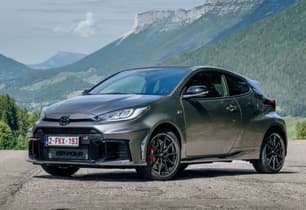
The GR Yaris arrived in 2020 and won praise for its rally-car-for-the-road feel with Toyota’s high-performance division Gazoo Racing heavily modifying the docile Yaris hatch - while adding a bit of Corolla - to create this little monster.
In early 2025 Toyota added more power and torque, along with an automatic transmission for the GR Yaris and now a new variant has been launched - the GTS Aero Performance Package and this is what we are testing.
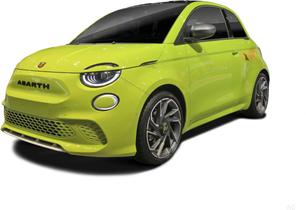
Meet the Abarth 500e, the mad-hatter sibling to the very good and all-electric Fiat 500e, and the Italian brand's first attempt at a bonafide EV hot hatch.
It's tiny, tough and – despite the lack of engine and exhaust – it burbles manically when you fire it up.
So does this mean Italy’s pint-sized, petrol-powered icon has a future in the all-electric era? Let’s go find out.
The GR Yaris GTS with the Aero Performance Package is a so wonderfully special with its brilliant engineering, mind-blowing dynamics and fun-to-drive nature. The new aero package makes an already angry beastie look furious, making it the perfect enhancement that's also functional.
The only lower marks here are for warranty, fuel use and practicality. But if there was a score for fun it'd be a 10/10.
It’s not perfect, but it’s everything a hot hatch should be in the electric era — engaging, exciting, and, above all, fun.
The GR Yaris exists so that Toyota could go racing in the World Rally Championship. As with many racing series it required Toyota to build a road-going version of their Yaris race car, also known as a homologation vehicle. It’s a good deal, they get to race, you get a race car for the road. And so the GR Yaris was born.
Wildly different from a regular five-door garden variety Yaris, the GR Yaris is a hand-built three-door hatch with a wider track, wider and lower body and the use of forged carbon and aluminium for lightweight construction.
The GR Yaris already looks very angry, but the GTS Aero Performance Pack makes it look furious. It adds a huge adjustable rear wing, fender ducts that channel air, a front spoiler lip that aids stability, a giant bonnet scoop to help release air, and rear bumper ducts to reduce drag.
The GR Yaris’s cabin was redesigned for the 2025 update and that saw the dashboard angled more to the driver much like in a race car, but it's more functional than fancy and it’s all very plain.
Still, we’re not complaining. The seats are lovely and the red stitching is a nice touch but this isn’t a Lexus. It’s supposed to favour function over form and so the design is absolutely fitting. And by function I mean dynamics and not practicality.
I’m just going to come right out and say it — I love the look of the Abarth 500e, even if the colour of our test car should be renamed Acid Trip, rather than Acid Green.
I love its perfectly proportioned, hunkered-down hot-hatch styling, the new ABARTH lettering on the body, and the new scorpion logo pasted to the side.
Basically, if you can look at the Abarth and not smile, then you need to find more fun in your life.
Inside, it’s a predictably cramped-feeling space, but it’s all nicely laid out, and the more I use them, the more I like the horizontal drive controllers that don’t eat up the little space you have with a traditional shifter. The materials are a bit hit and miss, though.
The regular Yaris is small, the GR Yaris is smaller at 3995mm end-to-end and with two fewer doors. As a tall person (I’m 1890mm end-to-end) the space on board is adequate up front with just enough knee, head and elbow room.
The GR Yaris is a four seater with the two rear seats accessed through the front doors. There’s not much room in there for adults and not even my lanky 11-year old would be happy in there. Still if you need to carry three other people, technically you can.
Cabin storage is limited to fairly large door pockets and two cupholders between the front seats. There is a little shelf carved into the dashboard which is great and a small glovebox below it.
Boot space is tiny at 174 litres but again this is a small car with other priorities.
While I like the addition of the central screen, it’s surprisingly annoying to use — I found myself jabbing at the buttons again and again before it reacts. You need a Stephen Hawking-level intellect to figure it all out.
I was trying to turn off the Abarth Sound Generator, which I'm reliably informed is possible, but after about five minutes digging through sub-menus, I abandoned all hope.
Normally I’d spend a bit of time exploring the back seat, but frankly, once in there I didn't really feel like spending excess time back there.
The Abarth 500e is only around 3.6m long, 1.7m wide and 1.5m tall, and suffice it to say, the space is tight, and you’ll only be using the two seats in the back in an emergency, or for the smallest of kids.
The boot is pretty tiny, too, starting at 185 litres (VDA) with the rear seats up, but growing to 550L (VDA) with the split-fold rear seat lowered.
So, not much to write home about. But criticising the tiny Abarth for a lack of practicality is like criticising a horse because it can’t swim – it’s not really in its job description.
The GR Yaris GTS Aero Performance Pack sits at the top of the model range with the six-speed manual version listing for $64,990 before on-road costs, while the automatic is $67,490. That’s $4500 more than the standard GTS without the aero pack
The aero pack significantly toughens up the look of the GR Yaris, and also improves its dynamics. So if you plan to use the GR Yaris as a track car and drive it hard and fast, the kit will help.
That's thanks to improved down force from the giant rear wing, air ducts in the fenders to improve steering under braking, a front splitter for stability, underbody cladding to maximise airflow and a bonnet scoop to help release hot air from the engine bay.
The rest of the high-performance equipment comes on the regular GTS including a Torsen limited slip differential, high performance suspension tune and 18-inch forged wheels with Michelin Pilot Sport 4S tyres.
Standard features are the same as the regular GTS and include heated GR sports front seats with suede leather upholstery, a 12.3-inch digital instrument cluster, leather-wrapped steering wheel, aluminium pedals, dual-zone climate control, proximity unlocking and push-button start.
There's also an eight-speaker, eight-inch media screen with Apple CarPlay and Android Auto, and an eight-speaker JBL sound system.
The value is actually great considering all the high-performance engineering around you in the GR Yaris, and it will save you money from being tempted to go down the aftermarket route and buy equipment that hasn't been designed for the car by the people who made the car.
There are some nice comforts, too, like the leather seats, although the media screen is small.
Ok, so bonkers thing number one: This Abarth 500e might look like it could fit in your pocket, but it is priced like a much bigger vehicle, starting at $58,900 plus on-road costs for the Turismo variant, increasing to $60,500 for the limited-edition Scorpionissima.
Outside, either trim gets 18-inch diamond-cut alloys, LED lighting all around, a fixed glass roof, the new e-latch front doors (meaning you can just push a button to open the door) from the 500e, along with some performance-focused add-ons, like a front splitter, greyed-out mirror caps, rear disc brakes and new front and rear bumper treatments.
Inside, there’s a leather-and-Alcantara steering wheel, sports seats, aluminium pedals and climate control, while on the tech front, a central 10.25-inch central screen pairs with a wireless charger and wireless phone mirroring, while a second 7.0-inch Driver Display Screen gives you all your driving data.
Oh, and there’s what the brand calls an Abarth Sound Generator, which is all kinds of crazy, but we’ll touch on that in a moment.
The difference between the Scorpionissima and the Turismo, by the way, is style led, with Abarth decals down the sides, and a certificate of authenticity confirming yours is one of 1949 vehicles sold around the world.
It still boggles my mind how 221kW and 400Nm is extracted from a 1.6-litre three-cylinder petrol engine but here we are. The GR Yaris has this set up with this output, along with all-wheel drive.
Thanks to lightweight materials such as forged carbon and aluminium the GR Yaris weighs nothing in car terms - just 1300kg - so acceleration from 0-100km/h is a rapid 5.1 seconds.
I’ve already detailed the juicy engineering bits the GTS Aero Package is fitted with, from the limited slip diff to the adjustable rear wing, and it’s not an exaggeration to say that not many small hatches are this gifted with this kind of genius.
Our test car has an eight-speed automatic, which is easy to drive in city traffic. However, I'd opt for the six-speed manual because if you've come this far you may as well go the whole way.
There’s a single front-mounted electric motor providing the go here, with a total 113.7kW and 235Nm on offer fed through the single-speed gearbox, which is enough to push the 500e from 0-100km/h in 7.0 seconds.
Happily, the way that power is delivered makes it feel faster, and that Sound Generator does a pretty good impersonation of a petrol-powered hot hatch, rising and falling with your inputs.
The GR Yaris is a hungry beastie that eats through its 50L petrol tank fairly quickly and then wants more. Toyota says you should see 9.1L/100km of 98 RON used in the automatic and 8.2L/100km with the manual over a combination of driving conditions.
Stop-start city driving in traffic saw fuel use increase dramatically to 13.0L/100km in the auto. According to our car's trip computer, my own testing used an average of 14.5L/100km after mainly suburban driving.
Right, there’s one obvious downside to the Abarth experience, and that is that it is fitted with a 42kWh battery that delivers a claimed 253km of driving range.
It’s worth noting that there are three Drive Modes — Turismo, Scorpion Street and Scorpion Track — and that only the first one will deliver the maximum range, because it limits inputs to 100kW and 220Nm.
Engage the other two — I’ve had it locked in Scorpion Track, for example, which gives you all of the power and deactivates one-pedal driving — and you can expect those numbers to drop.
When it comes time to charge, the Abarth 500e is set up for 85kW DC fast charging, which should take you from flat to 80 percent charged in around 35 minutes, as well as a maximum 11kW AC charging, which takes just over four hours to get to fully charged. Or you can plug it into a regular socket, which means more like 15 hours to recharge.
One last caveat: I actually wasn't able to get it to charge, which curtailed my adventures a little bit. I tried three chargers, all of which conjured an error message on the screen, and after a quick call to the folks at Abarth it transpired that a quick software update is required.
There’s been a multitude of electric cars through the test garage over the past six months and the GR Yaris is like a diamond found in a tub of Lego when it comes to driving.
So much sound. The three cylinder snarls on start up sending vibrations into the cockpit and up through the steering wheel, the transmission can be heard engaging gears, the big brakes creak as they’re released. And we’re hardly even moving yet. There’s so much theatre. It’s all real and I love it!
I even love that in the first 10 minutes of driving, a message appears on the instrument cluster asking that excessive acceleration be avoided while the engine is cool. You don’t get that beautiful inconvenience in an electric car.
But when you can excessively accelerate (on a race track of course, right?) it's wonderful and it's loud. Lift off, and the wastegate lets out a little "weeee!" in excitement.
I don't need to tell you that the GR Yaris handles better than just about anything in this price range and while the ride is firm and speed bumps feel like you’ve hit a gutter I still drove the GR Yaris every day, even to do the school run, because it is so much fun. Meanwhile my hybrid long0term test car looked lonely in the driveaway all week...
Being an automatic makes it easy to drive in traffic and the small size makes finding parking spots quick and simple.
Visibility is good, steering is excellent, the seats are big enough to accommodate me but snug enough to offer good lateral support, too.
Remember what I said about how just looking at the Abarth should put a smile on your face? Well, driving it paints on an even bigger grin, and it starts as soon as you fire it up.
While most EVs start silently, leaving you wondering if they're on at all, the Abarth takes a different approach, instead leaning on its sound generator, modelled on the exhaust note of the 695, to give you a throaty rumble when you fire it up. It even revs! And yes, you can turn it off (apparently), but why would you?
On the road, electric drive has actually improved the Abarth experience, I reckon, because all the harshness of the drivetrain has been ironed out, instead just leaving this smooth, potent flow of power every time you plant your right foot, with no gear changes or harsh vibrations to get in the way.
The steering is predictably direct, too, and the whole vehicle feels nimble and quick to react to your inputs.
It’s honestly the kind of car that’s fun driving anywhere, be it suburban streets or twisty backroads, and despite having a couple of options parked at my house, I found myself pulled to the Abarth for all of my trips.
Downsides? The ride is firm but comfortable on most roads, but downright uncomfortable when you clang over bumps or road imperfections. You’ll have to decide if that’s a price to high to pay, but I can live with it for the trade off. And while the cabin tech looks nice, but is fiddly and annoying to use.
Finally, the range relegates the Abarth to a second car, or for those who rarely leave the city. Which is a big ask at the price point.
The GR Yaris has not been crash tested by ANCAP and the score for the regular Yaris can't be applied to the GR version.
Still the GR Yaris comes equipped with an array of advanced safety tech such as auto emergency braking (AEB), lane keeping assistance and a blind spot warning.
There are six airbags, two child seat ISOFIX points and two top tether anchor mounts in the rear row.
The Abarth 500e is fitted with six airbags, and decent suite of active safety stuff, like AEB, Lane Keep Assist, Traffic Sign Recognition, Blind Spot Warning, auto high beam and and an attention monitor. It’s all pretty subtle, though, and it didn't bing or bong at me once, which was wonderful.
It scored four stars when tested by Euro NCAP.
The GR Yaris is covered by Toyota's five-year/unlimited-kilometre warranty which is lacking compared to many other mainstream manufacturers’ seven-year-plus warranties. The good news is that the engine and driveline is covered by an extra two-year warranty.
Servicing is capped at about $300 for the first six visits, although services are six months apart which means that after three years you’ll run out of capped-price servicing.
Still, Toyota’s reputation for reliability does provide some peace of mind.
It’s an interesting ownership proposition, because the car is covered for three years or 150,000km, which is underwhelming and then some compared to the warranty offerings of its competition, but there is capped-price servicing, at $300 per visit, required every 12 months or 15,000km, which lasts 10 years.
The battery is covered for eight years or 160,000km.