What's the difference?
If there’s one brand that can lay claim to be the best in the ‘cheap and cheerful’ category, it’s probably Suzuki. Not only have its cars been consistently affordable and basic, but also broadly loved by owners.
Now, with small SUVs becoming more and more prominent, Suzuki is bringing a new sub-$30K hybrid light SUV to the market - the Fronx.
Weird name aside, the Fronx promises a fair bit on paper. But can it deliver on the road? We jumped in for a quick spin at its Australian launch to find out.
In the distant future, automotive historians will look back at the Honda CR-V as one of the true SUV originals.
Sure, it and the conceptually-identical Subaru Forester, trailed the trendsetting Toyota RAV4 of 1994 by three years, but collectively all three Japanese brands broke and then reset the Australian family-car mould in lightning-quick time. Too much so for the floundering local car industry to ever catch up.
Today, they remain the blue-chip mid-sized SUV contenders.
Six generations in, how does the completely-redesigned CR-V in all-new e:HEV (petrol-electric hybrid) guise stack up? Let's find out!
If you’re considering a small car, particularly if an SUV is the goal, a Suzuki should in most cases be on the shopping list. Back-to-basics motoring is key to the brand’s identity. Its most popular model is a tiny ladder-frame 4X4, for example. Hi Jimny.
The Fronx doesn’t break new ground in any practical sense, but it does come in with a decent price and list of features that should sway plenty of small-car fans in the showroom.
It’s decent to look at, comfortable for the segment, and easy to get used to and drive. The numerical rating on this review betrays just how likeable the car is.
It’s not extremely refined and it starts to lose its dynamic shine on rough roads, but in an urban setting the Fronx should excel.
Note: CarsGuide attended this event as a guest of the manufacturer, with meals provided.
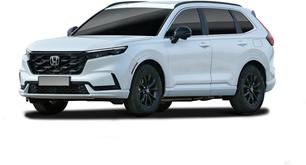
The most-expensive version of the latest Honda CR-V is one of the most convincing family-orientated mid-sized SUVs in Australia, regardless of price and positioning.
For efficiency, economy, driveability, packaging, safety, quality, refinement and value-for-money, it is an outstanding value proposition. Don't buy a RAV4 or Forester hybrid before checking this one out.
We cannot wait for the e:HEV hybrid powertrain to filter down to cheaper grades, to make the best CR-V in decades even more accessible.
‘Fronx’ as a name doesn’t exactly scream ‘cute’, but the little SUV has a pretty classically Suzuki design. This is not a complaint at all.
The Fronx is 3995mm long, 1765mm wide and 1550mm tall, but despite its diminutive dimensions the brand has opted to lean into a ‘coupe’ style with a sloping roofline that creates a relatively sporty look, especially for something with a two-digit power figure.
So while some of Suzuki’s designs have been divisive in Australia (Ignis, anyone?) the Fronx takes a slightly more conservative approach by leaning into more design trends than just the coupe-back SUV shape.
For example, its tail-lights span the width of the tailgate rather than simply flanking the boot as was standard for decades.
The LED daytime running lights at the front are also arranged in a slim, high-up position with a set of headlights below.
Inside is arguably more conservative than out, as the Fronx goes with a fairly standard formula in terms of its layout, with few premium materials (the synthetic leather on the seats feels cheap for example) or adventurous design elements to be found.
But that’s not such a bad thing.
Though considered handsome, the CR-V has never been a style leader. Function over form has always been its calling card, and Number Six is no exception.
Cleanly drawn, with boxy proportions and a blunter, squarer nose providing a contemporary if somewhat bland appearance, the Thai-built Honda lives on the larger end of the mid-sized SUV scale, resulting in lots of space and practicality.
Yet there are interesting and worthwhile details to explore, like narrower-than-usual windscreen pillars for exceptional forward vision.
The same applies to the considered positioning of the exterior mirrors, minimising blind spots, while deep glass areas allow light to flood in.
The stylish, Volvo-esque L-shaped tail-light graphic probably connects most clearly with past CR-Vs, giving the latest version an elegant overall presence.
Compared to the old model, the latest version's wheelbase has been stretched by 40mm to 2700mm, while front and rear tracks are 10mm wider, coming in at 1611mm and 1627mm, respectively.
Note that the front-drive models' ground clearance is 198mm – 10mm less than on the (non-hybrid-only) AWD grades.
Because for all the conservative, even outdated, styling in the cabin, the fact is it’ll be refreshingly familiar to someone who’s getting out of a car from perhaps even before the year 2000.
Suzuki’s place at the budget end of the new-car market means its customers are likely either quite young and buying their first new car, or relatively old and looking for a cheap, rarely used runabout as the ‘last car’.
For the former, a lack of techy distractions is paramount. For the latter, ease of use wins over cutting-edge tech in most cases. Which is why it’s probably okay that the Fronx’s multimedia touchscreen and software wouldn’t feel out of place almost a decade ago.
It can be a tad fiddly to use at speed, but it’s still more straightforward than the ‘iPad-like’ systems Tesla has made popular, and there are physical controls for important functions like climate control.
There’s also a row of ever-present haptic buttons for volume controls and navigation shortcuts.
The ergonomics of the interior are quite basic, but there are no red flags in terms of visibility, reach, or placement.
The head-up display is a bonus, but the physical dials on the dash rather than a digital driver display are clear enough, despite again feeling nabbed from a time before head-up displays even existed.
Space for the front passengers is decent, it’s not cavernous but it’s far from cramped. Elbow rests and seating positions allow for a relaxed ride.
The back seat is a slightly less comfortable place, but at 178cm I can sit behind my own seating position without my knees touching the seat in front, and my head has just enough space above to accommodate the top of a mullet.
Behind that, luggage capacity in the boot is 304 litres, or 605 litres with the rear 60/40 split seats folded.
There’s also no space-saver spare tyre, just a repair kit as standard.
Little wonder the CR-V was the world's third most-bought SUV worldwide in 2023. It's big enough for most families' needs... and then some.
This is immediately apparent the moment the big doors are opened up nice and wide, revealing an airy, spacious and extremely user-friendly interior.
The Japanese brand has striven successfully for greater visual symmetry, harmony and operational simplicity in the dashboard's design and layout.
And, sure, the 9.0-inch touchscreen lacks the wow factor of vast buttonless displays as found in flashy alternatives such as the disappointing Chery Tiggo 7, but it works very effectively.
Hondas have always nailed the driving position bit down pat, and the RS is no exception, with ample seat and steering column adjustment, considered controls placements and unimpeded views of the instrumentation and road ahead due to the aforementioned thin pillars.
The instrumentation cluster is an electronic set-up offering the driver the choice of either super crisp and ultra-clear analogue dials, or somewhat fussier bar graphs, with a digital speedo augmenting both.
There's so much to enjoy and so little to criticise inside Honda's mid-sized SUV. Along with space to stretch, the front seats are notably comfortable and supportive, as several hundred kilometres sat ensconced in them proved. Both sides have electric adjustment at this price point, too.
Ventilation also rates highly, with the honeycomb full-dash-length grille and lovely toggle switches bringing aesthetic and tactile delight, respectively.
And, reflecting the CR-V's US focus, storage is on a large and helpful scale, offering bottle holders in the doors amongst other places to stash things in and on.
Moving to the rear seat area, entry/egress is ridiculously unimpeded, with a decently-shaped bench.
Families are also likely to appreciate series-best legroom, backed up by a handy amount of girth – always a good thing.
You're also met with occupant-facing air vents, overhead grab handles, even more door storage, the obligatory folding centre armrest with cupholders, front-seat-sited map pockets and a pair of USB-C outlets.
However, the standard sunroof does rob some headroom so people taller than about 180cm had better try before they ride, though the 60/40 backrest reclines to 16 positions and that's helpful here.
Being a hybrid, the RS e:HEV misses out on the sliding bench which adjusts by 190mm in other CR-Vs.
Vision out is exemplary back there, enhancing an already spacious and airy ambience. But if the front seat area majors on Japanese quality, the rear is hardly premium, with plenty of dreary cheap plastic trim, betraying the Honda SUV's focus on the price-driven American market. But nothing squeaked, rattled or broke, thankfully.
Further back, the tailgate rises remotely quickly enough, and there's quite a wide and long area to store things, but the electrification elements make for quite a high and uneven floor – though a deep bin area is also provided to hide stuff in.
There's also just a can of goo in lieu of a spare wheel.
Cargo capacity rises compared to the previous CR-V, ranging from 589 litres with the rear seats up, to 1636L, or 1072L if measured only to the window line.
There’s only one variant of the Fronx, and it lands at $28,990 before on-road costs. It’s also relatively stacked when it comes to features, and Suzuki is even working on a sub-$30K drive-away offer for its on-sale date in September this year. We’d expect that means about $29,990 DA, though that’s to be confirmed down the track.
For something at that price point, features aren’t lacking. While things like wireless phone charging and wireless Android Auto and Apple CarPlay have become almost expected for even entry-level cars in Australia, the Fronx also features heated synthetic leather seats and a leather steering wheel.
It’s the first Suzuki in Australia to feature a head-up display, and there’s also a standard surround-view parking display thanks to a set of cameras.
The Fronx’s 9.0-inch multimedia touchscreen is joined by a small 4.2-inch driver display nestled between physical dials for the speedometer and tachometer. Exterior lighting is LED front and rear, with auto headlights and manual levelling.
The only extra-cost option for the Fronx is a choice of ‘premium’ single- or two-tone paint - Arctic White Pearl is the standard no-cost colour. Single-tone paint is $745 extra, while two-tone options are $1345, which is a lot pricier than many premium paint options in the market.
The Fronx comes in at the same price as a mid-to-high spec Hyundai Venue, Kia Stonic or Chery Tiggo 4, but some rivals like the Mazda CX-3 or Toyota Yaris Cross (with its Hybrid drivetrain) are more expensive even in their lower variants.
At the time of writing, choosing the hybrid version over the regular petrol-turbo CR-V means forking out for the top-of-the-line RS. Less expensive (and luxurious) hybrid grades are expected soon.
Starting from $59,900 drive-away, it isn't cheap, especially as its two closest rivals – the RAV4 Cruiser Hybrid and Nissan X-Trail Ti e-Power e4orce – offer all-wheel drive (AWD) for around the same price, while the Honda is front-wheel drive only.
At least the RS e:HEV isn't short on equipment, especially safety, with 11 airbags, Autonomous Emergency Braking (AEB), blind-spot alert, lane-keep assist, rear cross-traffic alert and adaptive cruise control included. Check out our safety section below for more details.
Being the CR-V flagship, you'll also find adaptive LED headlights, a panoramic sunroof, dual-zone climate control, leather upholstery, powered and heated front seats, a 9.0-inch touchscreen, sat-nav, wireless Apple CarPlay/wired Android Auto, Bose premium audio with 12 speakers, digital radio, a wireless charger, privacy glass, hands-free powered tailgate, roof rails, front and rear parking sensors and 19-inch alloys.
Note, however, there is no spare wheel, just a tyre-repair kit. Not good enough. For why, please see the Cost of Ownership/Warranty section.
There's also five years' free subscription to 'Honda Connect', bringing remote-control operation for climate control, lights and locking/unlocking, trip log data, location status, geo-fencing and emergency callout.
What's missing? Along with the aforementioned AWD, some rivals at this price point include larger alloy wheels if that's your thing.
Otherwise, the RS e:HEV brings plenty of features to the table. Sadly, not of the picnic variety, however, unlike in the first two generations of CR-V (1997 and 2001).
The Fronx is powered by a 1.5-litre four-cylinder engine with mild-hybrid assistance, driving the front wheels via a six-speed automatic transmission.
Its outputs are quoted at 76kW and 137Nm, not exactly high-grade stuff and part of the reason the Fronx feels like it takes more than 10 seconds to hit 100km/h.
The CR-V hybrid is powered by a 2.0-litre four-cylinder direct-injection Atkinson Cycle petrol engine.
Married to a pair of electric motors that make a combined power output of 152kW, it delivers a system total of 135kW at between 5000rpm and 8000rpm, as well as an impressive 335Nm of torque from 0-2000rpm.
It sends drive to the front wheels via a single-speed electric continuously variable transmission (e-CVT), featuring deceleration paddles that help redirect regenerative braking energy back into the battery.
Tipping the scales at 1771kg (kerb), the power-to-weight ratio is 76.2kW/tonne. Not great, but the e:HEV's brawn lies in its hefty torque output.
Suzuki claims fuel consumption at 4.9L/100km. With its 37-litre fuel tank, the Fronx should be able to manage more than 600km on a single tank, though theoretically its maximum range given its claimed fuel efficiency is 755km.
Like Toyota's hybrids, Honda's do not need to be plugged in; the small 1.06kWh lithium-ion battery fitted is charged by either the engine or via regenerative braking energy.
Honda says the e:HEV RS on the Urban, Extra Urban and Combined cycles should average 4.9, 5.8 and 5.5 litres per 100km, respectively. The latter figure equates to a carbon dioxide emissions rating average of 125 grams/km.
Fitted with a 57L fuel tank, that means the driver can expect to achieve about 1035km between refills – and on 91 RON regular unleaded petrol at that.
Out in the real world, we managed a still-laudable 6.5L/100km during our time with the RS e:HEV, achieved through a mixture of inner-urban and open-road driving.
How you plan to use the Fronx will make a big difference in whether what you’re about to read is a good thing or not.
The Fronx is a light SUV for a start, so expecting brilliant handling, effortless acceleration and a dead-quiet cabin is going to mean you’re disappointed.
But if you want something easy, engaging and fun, the Fronx might work for you.
Our brief test loop wasn’t entirely indicative of what the Fronx is likely to face day-to-day. With limited time and no preset drive program, the roads within a 20-or-so minute drive of Nagambie, Victoria had to suffice.
The Fronx fared well on the average road, it turned out, with the 1064kg Suzuki managing to feel planted enough to hurl along 100km/h back-roads without complaints. It rides on the same platform used recently by the Suzuki Baleno, something I’ll admit to not having driven.
The rougher roads didn’t faze the light SUV too much, though consistently uneven surfaces made it feel unsettled in some cornering.
Its steering and suspension give enough feedback to make the right inputs easily, though the nature of its light weight and minimal accoutrement in terms of driver assistance make the Fronx feel very rudimentary from the driver’s seat.
At low speeds around the centre of town, the Fronx manages the state’s terrible roads well, though taking off from intersections can be laborious. Much like overtaking, the drivetrain will complain.
And don’t expect its mild hybrid system to do a lot in the way of hard work - or any work at all, really. You could take the hybrid badge off the car, let someone have a drive, and they’d be none the wiser.
From the limited observations on the launch, the Fronx would feel best at home in suburbia or a metropolitan centre more so than on the Hume Highway or the towns dotted alongside it.
Essentially, this is not a refined road trip car for the highway, but its no-fuss approach to getting around means you shouldn’t be surprised if you start seeing them in the car parks at universities or bowls clubs.
If the good-looking e:HEV RS's compelling value and great interior don't convince, then the driving experience might.
Building on five generations of gradual evolution, the latest CR-V uses an updated version of the previous model's all-new architecture – a very solid foundation to build an SUV upon.
Pairing that with Honda's latest hybrid electrification tech is the automotive equivalent of putting together peaches and cream. Even to a vegan.
From the first push of the starter button, the driving experience is seamless, elevating the e:HEV to the premium realm.
As it's in EV mode for much of the time at lower speeds, the SUV powers forward quickly and effortlessly, gliding along with a determined hum.
When the petrol engine eventually engages, it does so smoothly and quietly, yet the electric motor's influence and effects are far from done; the driver can sense all that torque (335Nm, remember) just from the immediacy of the throttle response.
Result? The CR-V's mid-range thrust makes it a deceptively rapid vehicle, accelerating instantly and surging strongly in almost no time at all. Keep an eye on that speedo, too, because the powertrain delivery is silken.
Furthermore, and going against type, the brakes thankfully avoid the wooden feel of many rival hybrids, and instead pull up immediately and with normal and natural pedal pressure.
Additionally, the paddle shifters provide variable off-throttle braking, though not quite down to a full stop.
Honda's chassis engineers have earned their keep when it comes to the CR-V's dynamics, too.
Light and easy around town for painless parking, the steering weights up nicely at higher speeds, allowing the driver to get into a linear rhythm with the machine, and without it feeling nervous or top-heavy when corners get tight – a rarity in an electrified SUV of this size.
And while it lacks the intimate connection of sportier SUVs like the Mazda CX-5 (given the RS badges), most people will appreciate the Honda's calm and controlled handling and road holding.
For the record, suspension in the CR-V consists of MacPherson-style struts up front and a multi-link rear end. However, a bit more suppleness would transform the e:HEV.
Wearing 235/55 R19 tyres, its ride around town is fine over larger bumps, absorbing them smoothly and without fuss, while overall tyre/road noise intrusion is pretty good, too.
Yet smaller-frequency surface irregularities, like joins and rail tracks, are not so easily dealt with, resulting in some sudden harshness.
Driven over exactly the same roads as the ZR-V e:HEV equivalent, it's clear there isn't quite the polish or sophistication that makes the smaller Honda SUV a highly-convincing dynamic and refined alternative to luxury German alternatives.
Other than the occasionally fidgety suspension, the CR-V hybrid makes for a dynamically impressive family SUV.
A big part of many buyers’ decisions about a new car is safety, and the Fronx is pretty basic on this front.
Six airbags cover front and sides for the front passengers, and there are curtains down the sides of the car, but there’s no front centre airbag and no ANCAP rating has been applied to the Fronx as yet.
In terms of active safety, the Fronx has listed among its standard features auto emergency braking (AEB), ABS and brake assist, lane departure warning, hill hold control, weaving alert, blind spot monitoring, traffic sign recognition, rear cross traffic alert and a surround-view parking camera with front and rear sensors.
There are also outboard ISOFIX seat fastenings in the second row.
The only safety system that activated during the test was a lane departure warning, but only when (under normal conditions) it would have been necessary as the car approached the road’s centre line.
Honda has yet to publish ANCAP crash-test results for the latest CR-V. For what it's worth, the previous two generation models achieved a maximum five-star assessment.
Today's CR-V comes with 11 airbags, including two dual front, dual side, dual front knee, front-centre, dual rear side and full-length curtains.
On the active-safety front, there is AEB with pedestrian and cyclist detection, low-speed braking control front and rear, road departure mitigation (RDM), forward-collision warning, blind-spot alert, lane-departure warning/keep, rear cross-traffic alert, adaptive cruise control (with full stop-go), low-speed follow and traffic-jam assist, traffic-sign recognition, driver-fatigue warning, adaptive driving beam and auto high beams.
You'll also find front/rear parking sensors, anti-lock braking with brake assist, 'Electronic Brake-force Distribution', hill-start assist, stability control, traction control, an intelligent speed limiter, trailer stability assist, tyre-pressure monitors and something called 'Straight Driving Steering Assist'.
An ISOFIX child-seat latch is fitted to each outboard rear seat position, while a trio of anchorage points for straps are included either on or behind, as well.
Honda says its AEB system is operational from 5.0km/h, the RDM from 30km/h, the lane support systems from 72km/h and the traffic-jam assist tech works between 0-72km/h. Top speed is 186km/h.
Suzuki has a five-year, unlimited kilometre warranty for its new cars, which is a little behind the curve compared to many budget-friendly brands these days.
Suzuki does have a five-year servicing schedule, with intervals every 12 months or 15,000km, whichever comes first. Total cost is $2005 over the five years, with services averaging $401, which is not particularly cheap.
Honda offers a five-year/unlimited kilometre warranty that also includes roadside assistance.
At the time of publication until the end of March, there is a special offer that extends those to seven years.
Additionally, there is a six-year rust perforation warranty and an eight-year hybrid-battery module warranty.
There's also five years' free subscription to 'Honda Connect', bringing remote-control operation for climate control, lights and locking/unlocking, as well as trip log data, location status, geo-fencing and emergency callout access.
The CR-V's servicing intervals are every 12 months or 10,000km or when the engine oil monitor light illuminates, with capped price servicing pegged at an annual flat fee of $199 for the first five years.
That's under $1000 over that period of time. Nothing extraordinary here unless you remember the old days of how expensive it was to service new Hondas.
Note, however, that the e:HEV's lack of a spare wheel does bring additional costs – namely in the cost of replacing the expensive tyre-repair kit, as well as the substantial time, inconvenience and flow-on issues of a more-severe puncture that can render the CR-V undriveable if the tyre-repair kit is unable to plug the hole.
Honda is not alone in not offering a spare wheel in its hybrid SUV range, but there are real consequences in being stranded with an unfixable flat tyre that needs to be factored in. Family holidays can be made or ruined in such circumstances.